
Muslims Celebrate Eid al-Adha in St. John’s
Eid for the province’s Muslim community is about spending time with loved ones and giving to those less fortunate.
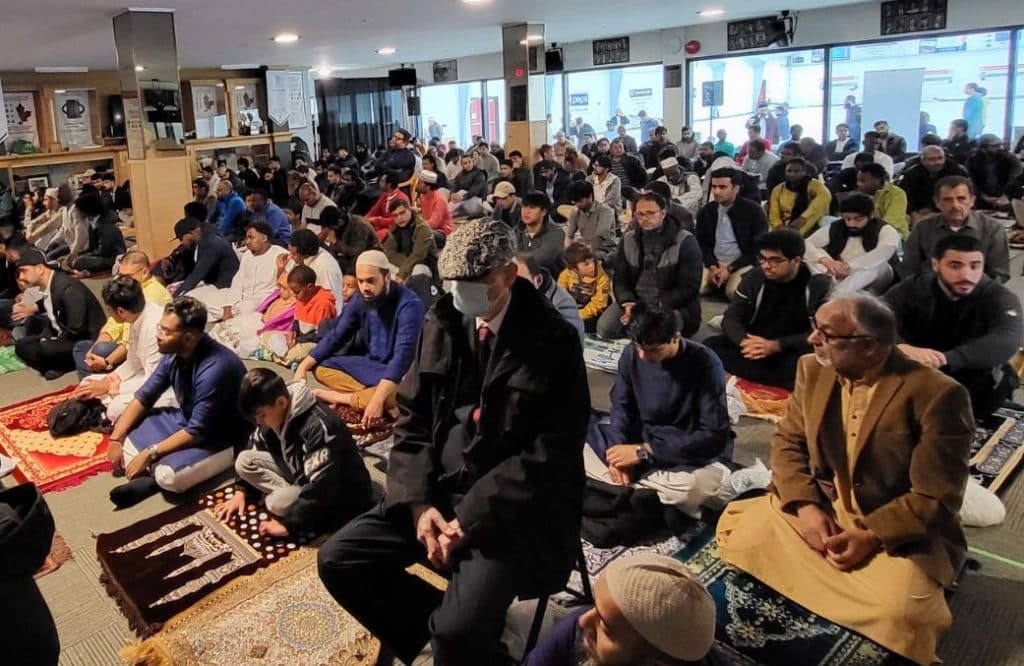
When Muhammad Nazir moved to St. John’s in 1976, the Muslim community wasn’t big enough to warrant a mosque.
Nazir says, at the time, members of the community would find an empty classroom at Memorial University. Now, almost 40 years later, the mosque is no longer able to accommodate the growing population.
On July 28, Muslims around the world celebrate Eid al-Adha, one of two main celebrations in Islam –– along with Eid al Fitr, which marks the end of Ramadan.
Eid al-Adha, or the Feast of Sacrifice, marks the end of the annual pilgrimage to Mecca, known as the Hajj. The celebration also commemorates the Quranic tale of Prophet Ibrahim’s willingness to sacrifice his son for the will of God. Eventually, God spared Ismael and a ram was sacrificed instead.
Will you stand with us?
Your support is essential to making journalism like this possible.
To accommodate the Muslim population, estimated at over 7,500 province-wide, the Muslim Association of Newfoundland and Labrador (MANAL) rented the RE/MAX Centre in St. John’s for Eid prayer services. Even with the larger space, two services were required to accommodate participants.
Prayers were also held in other locations, including the St. John’s Farmer’s Market, by other groups.
Shahbin Hossain moved to Newfoundland from Bangladesh in 2021 to study marine biology at MUNL. She says the university’s chapel isn’t big enough to hold regular Friday prayers and that the province needs more locations to accommodate the growing number of Muslims, but also allow those further away to participate in prayers.
“I feel like there should be other places, especially for women, because not everyone can go to the same location,” Hossain says.
A growing population means a less ‘cohesive’ community
Nazir says the community isn’t as “cohesive” as it was decades ago. “Now there are thousands [of Muslims]. We don’t know many people in the community.”
MANAL built the Masjid-al-Noor mosque in 1990 to accommodate the growing community. At the time, Eid celebrations included potlucks at the mosque or at a member’s home, Nazir recalls. Now, the community is disconnected and divided into smaller groups.
“We would cook and everyone would bring a dish, we would all fit in really well, snuggly in the local mosque,” Sarah Shahab explains. “It is difficult to keep in touch with everyone.”
Shahab moved to St. John’s in 2002 from Dubai, following her sister Amrah, so the family could be together. She says she is a Newfoundlander now and does not want to leave the province. “It’s home.”
Although the mosque is unable to host large Eid dinners, MANAL continues to host events for kids. On July 2, the organization will host a kid’s Eid party at the Techniplex in St. John’s.
What Eid means
Shahab describes Eid as a time for family and togetherness. “It is sad because not everyone is with their loved ones,” she says. “I remember my dad getting dressed for Eid prayers and my mom making Seviyan (Sweet Vermicelli), and there is such a hustle bustle in the kitchen, a whole table is laid out.”
Shahab says it is a reminder to be grateful for the people we have in our lives. “You look beyond family and friends to those who are by themselves as immigrants, or those who don’t have family,” she adds.
Hossain agrees that Eid is about good company. “If you are celebrating with friends despite being far away from home, it is still not that bad.”
Hossain says she also appreciates how the meat of a sacrificed animal is distributed equally into three parts between the donor, their families and friends and those in need. Those who can afford the animal are required to give to the less fortunate, “even if they don’t want to,” Hossain says with a laugh.
Nazir says instead of sacrificing an animal in Newfoundland and Labrador, he instead sends money back home. “I send the money to Pakistan, where an animal is sacrificed and we distribute it to the poor,” he explains.
The growth of the Muslim community in Newfoundland and Labrador has led to greater awareness and acceptance by others in the province, says Shahab. She enjoys inviting her non-Muslim neighbors to Eid celebrations “so that they can see the difference in culture and the diversity.” She says everyone loves being part of the festivities.
In a July 27 statement, Prime Minister Justin Trudeau wished Muslims an “Eid Mubarak” — which translates as “Blessed Eid” in English. “As families and friends across the country come together to pray, share meals, and share food with those in need, we can all be inspired by the values of sacrifice, compassion, and charity demonstrated by Muslim communities in Canada each and every day,” he says in the statement.
Shahab says she has also noticed an increase in visits by Canadian politicians to community events over the years. Last year during Ramadan, federal Minister of Seniors Kamal Khera visited Masjid-al-Noor along with local politicians. Last spring, during the month of Ramadan, MANAL hosted an event inviting non-Muslim attendees to experience Iftari (breaking of the fast). The event was attended by MP Joanne Thompson, among others.
Nazir says it is wise that politicians and political parties are reaching out to the Muslim community because, as potential voters, their numbers have increased significantly since the 1970s.
Despite the various perspectives Muslims hold about Eid, and regardless of the challenges faced by a growing community, Nazir says one thing has remained the same. “As far as the spirit of Eid is concerned, it is the same. Both Eid al-Fitr and Eid al-Adha are happy and solemn.”

Author

Related Articles
Harlow operating within budget before Memorial decided to sell it: former head of U.K. campus
Emails show President Janet Morrison ‘inundated’ with messages over sale of Harlow Campus, while documents suggest former campus head was making progress at reducing costs

Watchdog says it can’t investigate Deloitte over use of AI in $1.6M government report
Internal emails reveal Deloitte helped craft government’s response to The Independent’s investigation
Mother of incarcerated youth calls for dedicated addiction care at new St. John’s prison
Government scant on specifics but health authority says new prison will have two new mental health units and larger clinical space for psychiatry and opioid dependency