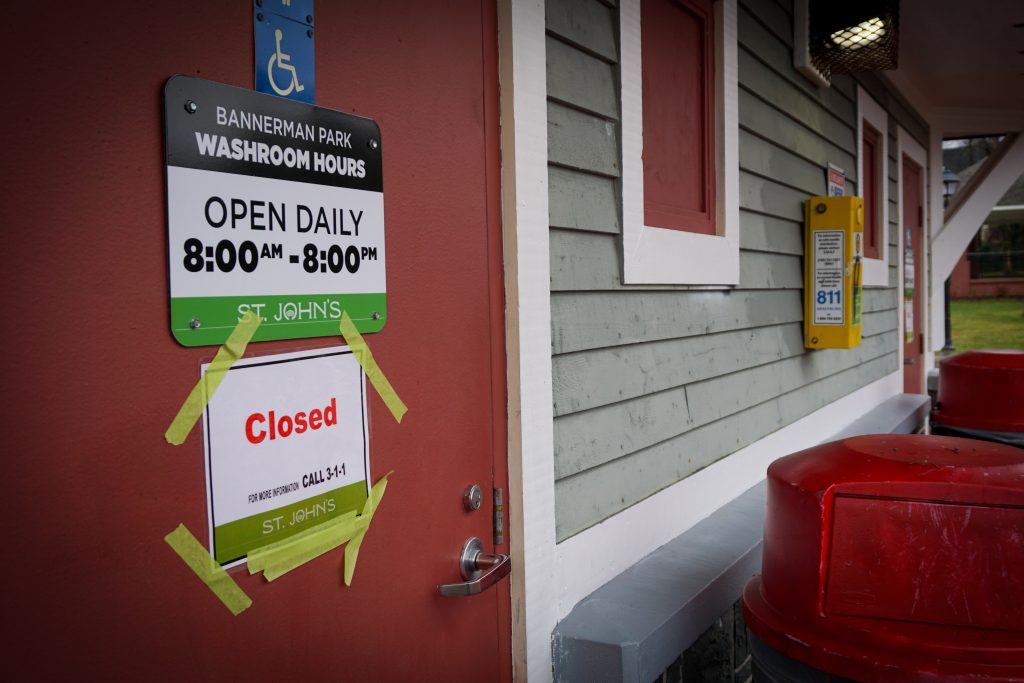
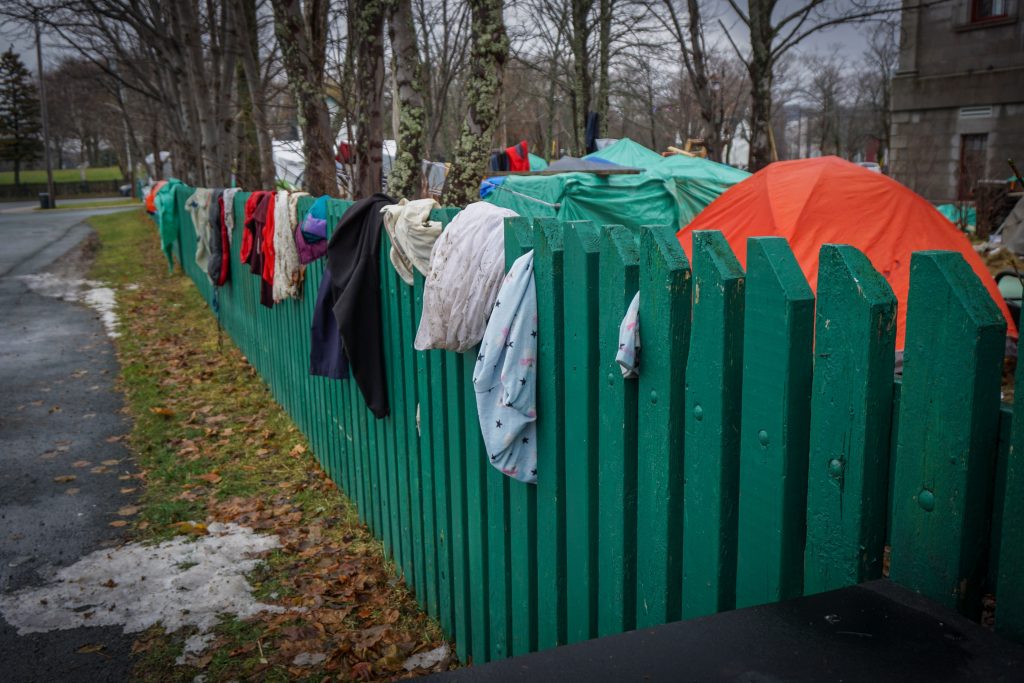
When I spent two nights at Tent City a couple weeks ago, I noticed that one of the City of St. John’s workers looked displeased. When I asked them if the facilities were staying open all winter, they told me someone had clogged the toilet with clothes, so the bathrooms might have to be shut down.
That was November 21, hours before the first snow, which added urgency for Tent City residents to have warmth and safety in the absence of emergency shelter space or other accommodations (where many refuse to go because they say those places are unsafe for them).
But when the City worker told me that the washrooms could be closed due to vandalism, I realized how vulnerable Tent City residents are to the potential deeds of those who might not want them there.
That’s why, when the City of St. John’s announced it was shuttering the bathrooms, it struck me that there were no direct allegations that the unhoused folks themselves had caused the damage.
Instead, St. John’s Mayor Danny Breen told reporters that over the past few weeks there have been “toilets ripped from the floor, there’s been human waste on the floor, clogged toilets and sinks, with needles, and just created a very unhealthy situation and a significant amount of damage.”
Will you stand with us?
Your support is essential to making journalism like this possible.
If Mayor Breen or anybody else wants us to believe the bathroom vandalism was done by Tent City residents, they wouldn’t have to explicitly blame it on Tent City. It is known in public life that the public itself is perfectly adept at making such assumptions.
The human brain is capable of extraordinary feats—ones that we are all prone to—like its ability to manufacture ideas and narratives about others, ourselves, and the world that alleviate our own complicity in—or responsibility for—the pain and suffering of others. This human tendency is weaponized by politicians and other powerful people every day.
When the City announced Wednesday it was closing the Bannerman Park bathrooms, it said its workers refuse to work in such conditions — effectively pitting workers against unhoused people without saying as much.
The City also announced that the provincial government was welcome to put porta-potties on the Colonial Building grounds, where the encampment resides. The province, in turn, said it would do no such thing.
Thankfully, many see through the charade — folks like Laurel Huget, a St. John’s resident who has worked in shelters and now volunteers at the encampment.
On Thursday she told CBC that she used to work in a homeless shelter and has cleaned up rigs (needles), and that the City could easily train workers to do the same. “I wholeheartedly support workers’ right to refuse unsafe work, but it’s not unsafe work if you’re well equipped.”
Huget also pointed out that if the mayor had spent time at Tent City, he would know that volunteers are making regular dump runs to dispose of the garbage that accumulates in the encampment, and that there is a sharps box on site that is routinely emptied.
After the City and the provincial government came under fire for denying Tent City residents access to a bathroom, they swiftly threw together a joint announcement that they were establishing a “task force” on homelessness.
The same task force that could have been created two months ago when the first encampment was established across the road from Confederation Building on Prince Philip Drive. Or at any point in recent years as the housing crisis and the population of unhoused folks burgeoned. Or, the Liberals could have supported the NDP’s request earlier this fall for an all-party committee to address the crisis.
So why now?
“They all met this morning at the call of the premier, given what he called the ‘evolving discourse’ over the past 24 hours,” VOCM reported.
Mutual Aid is Where It’s At
The premier won’t say it, but many watching know it: In the absence of political will, the only thing that will move the needle on helping the most vulnerable among us… is civic engagement. Activism. Advocacy. Solidarity.
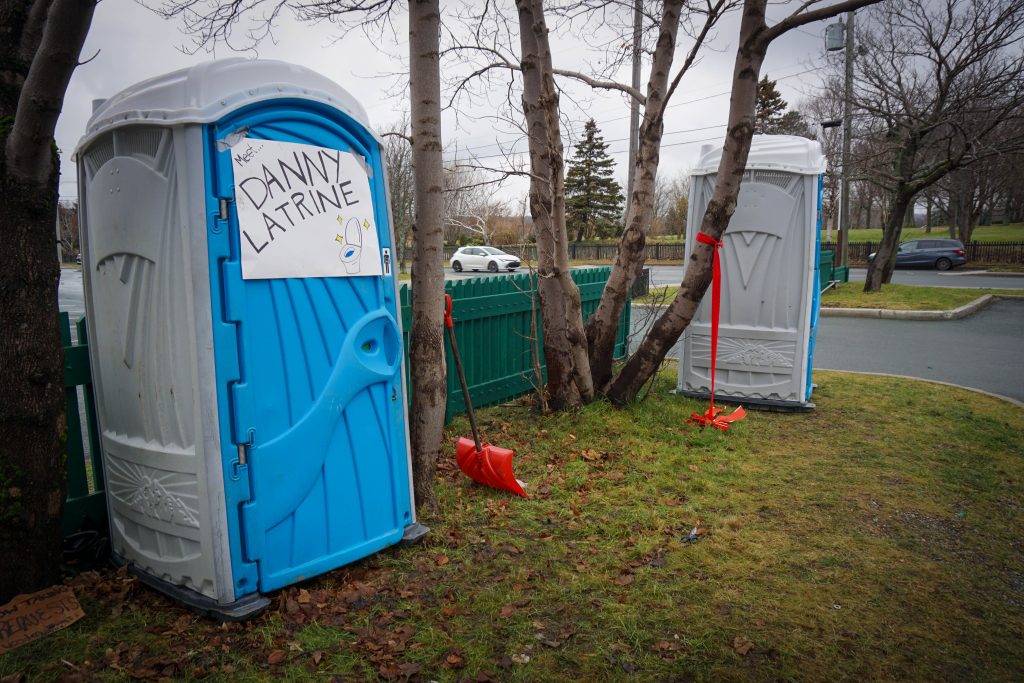
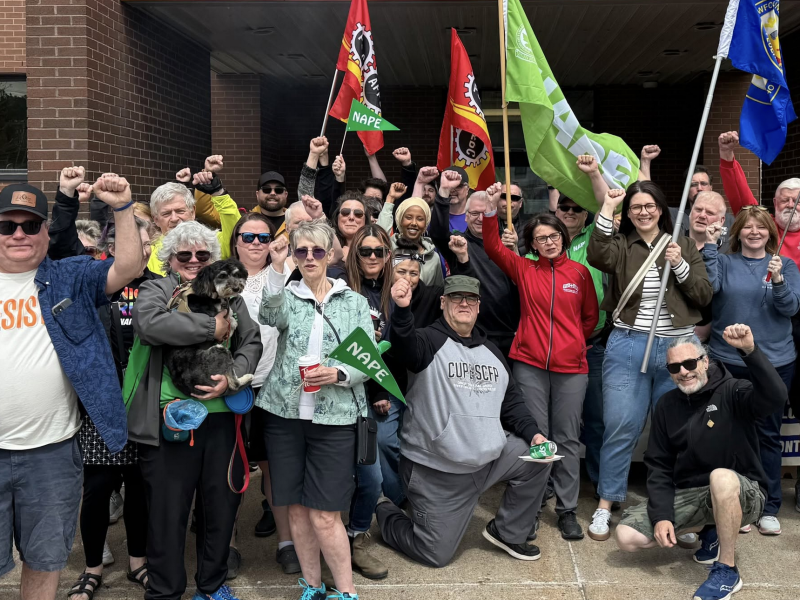
On Friday afternoon, Tent City volunteers announced that “following the failure of Municipal and Provincial officials to provide the means necessary for resident protestors of Tent City for Change to meet basic sanitary needs, community has once again stepped up.” They said a porta-potty had been delivered, and more are on the way. NAPE has confirmed it is behind one of the porta-potties, demonstrating that organized labour has a role to play when it comes to grassroots solidarity with marginalized peoples.
Shortly after that announcement, the City of St. John’s presented the holiday season’s first miracle. It announced that the City and province pooled their resources to not only re-open the Bannerman washrooms, but with “enhanced cleaning and security” to keep them open 24-hours a day.
What can be seen as a small victory in the greater struggle for equality and respect for unhoused people’s human rights, is also a significant victory for those at Tent City for Change who were left with nowhere to meet their basic sanitary needs.
But the City and province’s sudden change of hearts should not overshadow the role of grassroots activism to pressure decision-makers into doing what’s right.
Tent City for Change organizers “are using a mutual aid approach to support resident protestors in meeting their needs while they advocate for permanent housing solutions,” the group’s Friday news release reads. “Solidarity, not charity, informs the on-the-ground work at Tent City for Change.”
Not Buying the ‘Cynical Logic’
What decision-makers may not have expected, is for a rapidly growing number of us to see the reality of the situation: That those in power assume we will accept their rationale and decisions.
But the dehumanization of unhoused people in St. John’s goes beyond just the choices politicians make about which words to use or not use.
“It’s easy to take the bathroom ‘vandalism and misuse’ as the reason we can’t have nice things, as just another ‘tragedy of the commons,’” Sara Swain writes in her latest installment of Let’s Get Municipal. “According to this cynical logic, people will always ruin shared resources because what is owned by all is cared for by none. It’s not true of course, but the simplicity of this story is seductive; it lets us off the hook. If we believe people are the worst, and solely responsible for the circumstances they’re in, then we don’t have to care, or take a modicum of responsibility for how we treat them.”
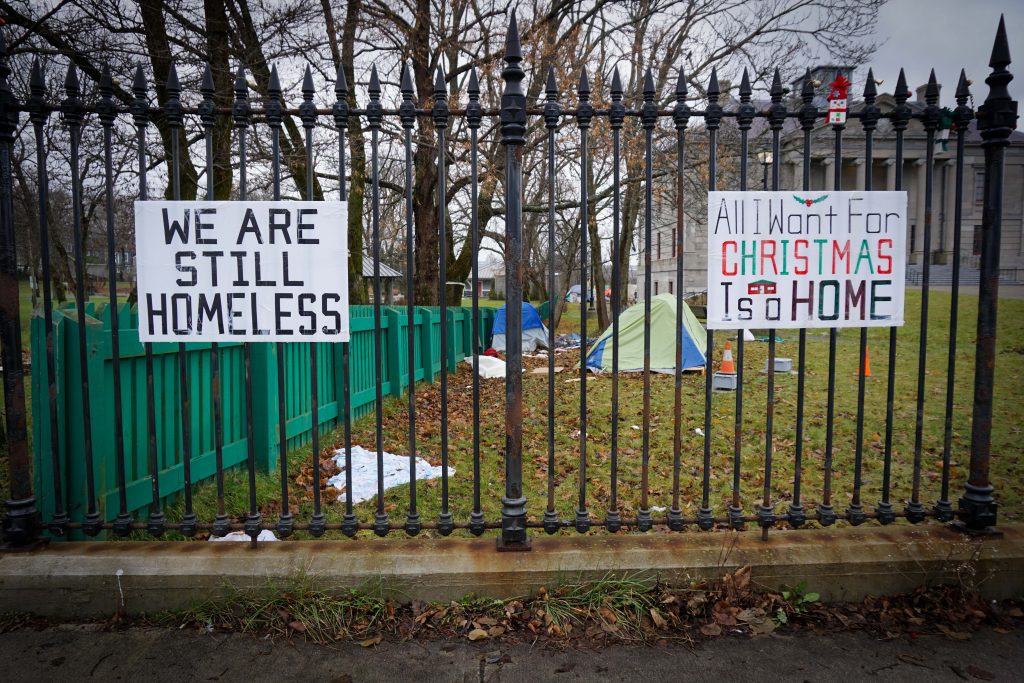
The cries from unhoused folks in Newfoundland and Labrador are finally being heard. And the voices that support them—like those of Memorial University social work professor Julia Janes and her students—are reverberating throughout the upper echelons of power in our province.
Those who depend on our support for re-election are scared because they miscalculated how much we would care about this issue, and about folks who are falling through the cracks and being abandoned when they wind up in the streets. More importantly, politicians have miscalculated the power of civil society — those among us who don’t just want change, but will make change.
“We like to say human life has intrinsic, inherent value–but it’s not true. We have to give it value, and we do this through our attention and care,” Sara Swain writes.
“The only difference between a stranger and someone we love, after all, is the amount of attention and energy we give to them. If we don’t have empathy or compassion–that’s fine, but that’s a limitation of our imagination and our capacity, and it has nothing to do with the limits of the person standing before us.”

Author

Related Articles
Workers deserve allyship, not lip service
On Labour Day 2026, some tips for Labour Minister Lloyd Parrott
The PC’s subtle Throne Speech caveat
Wakeham government quietly places an asterisk next to its promise, ‘For all of us’