
Memorial students escalate protest for Palestine
University says some form of public disclosure on its investments is forthcoming.
Photos by Tania Heath
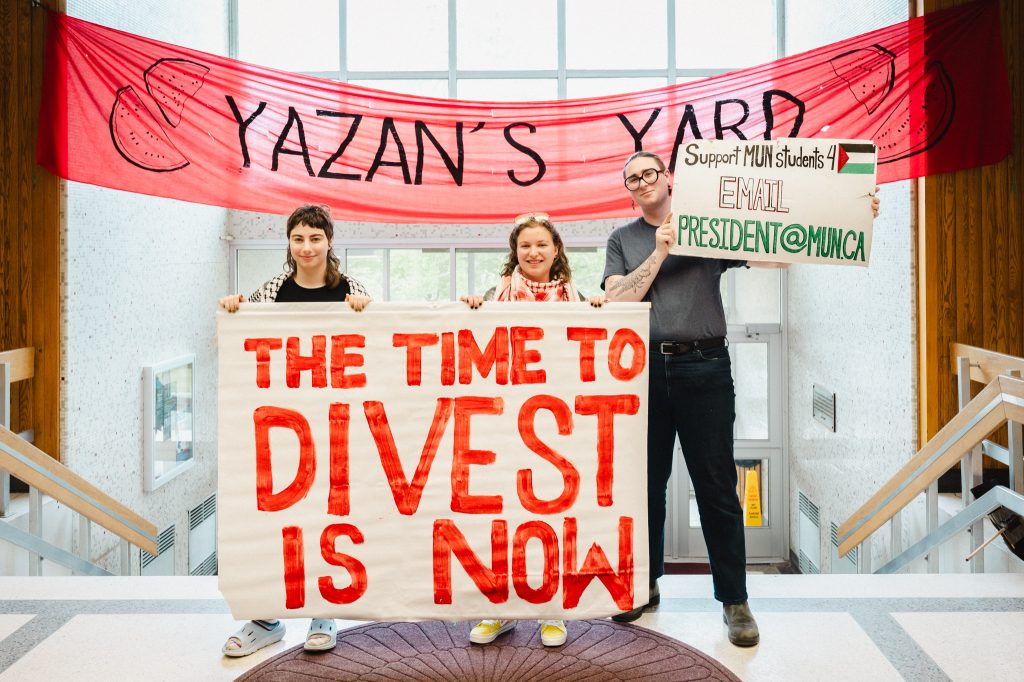
Students at Memorial University (MUNL) have escalated their protest in support of Palestine by occupying the lobby of the school’s Arts & Administration building in St. John’s.
They are calling on Newfoundland and Labrador’s only university to divest from “arms manufacturers and entities complicit in Israeli human rights violations” of Palestinians.
At present, flags festoon Memorial’s hallways, demanding the institution “disclose and divest,” while a red banner emblazoned with “Yazan’s Yard” — the name of the student encampment — hangs in front of the building’s main entrance. Hand-drawn Palestinian flags and posters declare, “Wanted: absent administration,” and “No genocide on our dime.” They offer colourful ambience to the pale wooden walls of the university’s main building. Palestinian music and protest songs play from a speaker in the centre of the space, and in a corner one student hops around keeping time with a traditional Newfoundland ugly stick.
Will you stand with us?
Your support is essential to making journalism like this possible.
On June 7, campus security attempted to evict students from the building, but they relented after students sought legal advice and then refused to leave.
The occupation began in late May as a tent protest on the university’s front lawn.
The MUN Students For Palestine encampment is now in its third week, as students and supporters demand Memorial join other Canadian institutions divesting from investments linked to Israel, and to arms manufacturers.
The encampment is part of a wave of global student protest in support of Palestine. Since the original six tents were erected in the pre-dawn hours of May 21, the encampment has quadrupled in size and relocated to a larger square on campus. There are now coolers, food and storage tents, picnic tables and a porta-potty.
Organizers have also put together a series of weekly educational and recreational events, including ‘teach-ins’ on a variety of topics, workshops on zine-making and documenting social movement history, poster-making, a plant swap, and even embroidery. On June 5, a screen-printing fundraiser was organized in the lobby of the Arts building, with donations going to Palestinian families and Tent City For Change, the grassroots initiative supporting unhoused residents of the city.

During Memorial’s convocation in late May, students distributed Palestinian flags outside the St. John’s Arts and Culture Centre. Several graduating students waved them as they walked across the stage to receive their degree. Nicolas Keough, a representative of the students’ union and a dignitary at the event, held a large banner during university President Neil Bose’s May 30 address. “You have the power to change the world!” Bose proclaimed in his speech, as Keough stood behind him holding up a Palestinian flag. The following day, students’ union representatives say they were denied permission to resume their traditional seat on stage.
On June 5, students staged a theatrical dinner party parody called ‘Dr. Bose’s Dream Dinner Party,’ poking fun at Bose’s convocation address the previous week, during which the president said his dream dinner party guests would include his children, an international student and an Indigenous student. MUN Students For Palestine accused Bose of “tokenizing international and Indigenous students while simultaneously ignoring calls to divest from weapons that are destroying their homes.”
Meanwhile, the weekly marches that have been organized by a city-wide Palestinian Action coalition since October 2023 temporarily moved to campus from downtown in solidarity with the student encampment. About 100 supporters marched on campus June 1 before holding a rally inside the Arts & Administration building. On June 8, another crowd of the same size gathered for a community rally and barbecue, marching along Elizabeth Avenue to rally in Churchill Park before returning to campus.
There have been no further meetings between students and university administration following a May 24 meeting which MUN Students For Palestine described as “patronizing.”
“The unwavering commitment to indifference and the desperate attempts to disguise it as neutrality was disgusting,” the group wrote in a public statement following the meeting. “The incredible capacity for apathy displayed by the leaders in attendance made every student in the room embarrassed to be associated with Memorial University.”
In a May 27 statement, university leadership “commended students on the well-organized and peaceful nature of their protests in the last few weeks.”
The university also said that it is having “conversations internally about our approach to investments, particularly in relation to environmental, social, governance (ESG) and other considerations,” the statement says. “The university remains committed to engaging in meaningful dialogue with our students and addressing their concerns to the best of our ability.”
Campus security sparks occupation
Teach-ins and other events coordinated by MUN Students For Palestine have been held all over campus, at the encampment itself, and even in empty classrooms.
But it wasn’t until June 7 that campus security intervened. That Friday, a teach-in on intersectional feminism was scheduled for 6 p.m. in the lobby of the Arts & Administration Building. According to those present, about 10 minutes before the event was set to begin three Campus Enforcement and Patrol (CEP) officers approached the small group and ordered them to leave the building. According to the university’s website, the building is normally open until 10 p.m.
“They were being pretty intimidating about it and saying, ‘You have to leave now, they’re locking all the doors, you’ve got to go or…’” said Sadie Mees, one of the students present that day. “They were trying to imply there would be consequences.”
Hanaa Mekawy, another student there for the teach-in, said the “vague sort of open-endedness” of the threat of action created a stressful and “very high-intensity moment.”
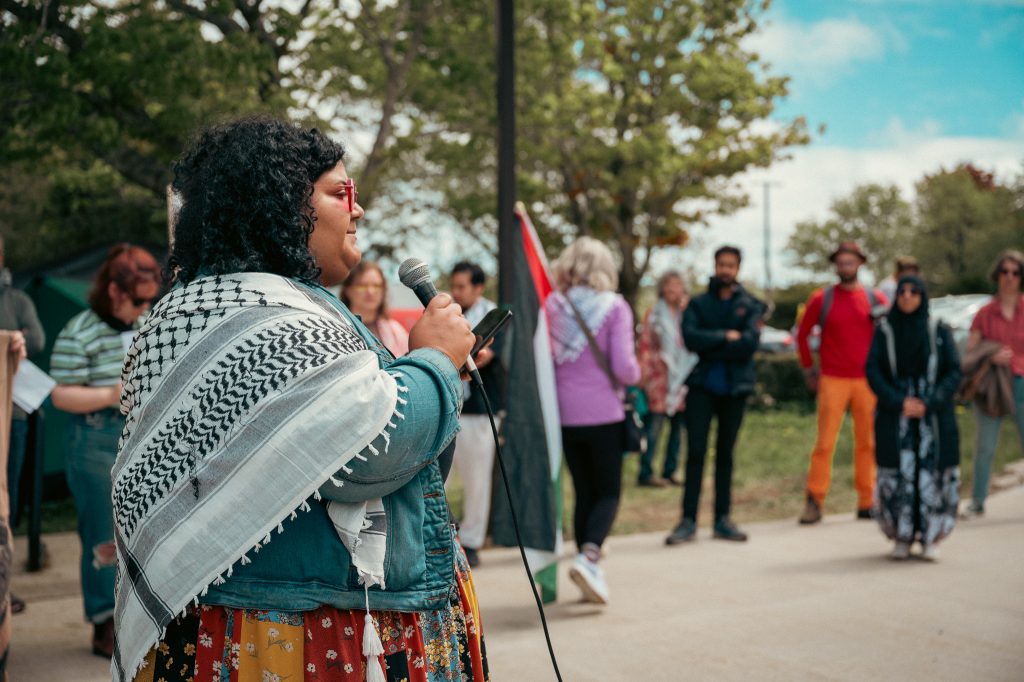
Students say security claimed they had been told to tell the students to leave, but the officers did not give them a reason. The students contacted a lawyer whose number they’d been provided in the event of any problems, and were told that as students doing a peaceful protest and teach-in, it was within their rights to be in the space. Students informed the waiting officers they’d talked to their lawyer and intended to stay.
“Upon hearing that we had checked with a lawyer, [CEP] rolled back a lot and said, ‘You do have a right to be here but we’ve been instructed to tell you to leave,’” said Mees. The students asked for that to be put into writing, or to speak with whoever was instructing security, but the officers said that was not possible because it was 6 p.m. on a Friday.
“We weren’t okay with the university administration just illegitimately trying to revoke our right to be here, so we wanted to show intentionality with our presence and intentionality with our protest and reaffirm the fact that we were not going to be dismissed or ignored by the administration,” said Mees. “And so we ended up staying here.”
The students put out a call for supporters over social media, and over the course of the next two days saw their numbers grow. Students have been occupying and sleeping in the lobby. An information table and shrine for victims of Israel’s attacks on Gaza have been set up in the lobby.
“At the beginning it was quite stressful as we watched to see how they would respond to us,” said Mekawy, who has remained every night since the occupation began. Sadie said that faculty members have also been supportive, emailing the students encouraging messages and dropping off food. And they’re not the only ones.

“Members of the local Palestinian community have approached us to tell us how thankful they are that we are doing something,” she said. “It’s really their support that sustains a lot of us here. They came on that first night and I think that was instrumental in giving us the courage to stand up.”
Encampments and occupations at other universities have sometimes been met with violent repression from police and campus security. On June 6 an occupation at McGill University’s administration building was attacked by riot police using pepper spray and tear gas; 15 people were arrested. An encampment at York University in Toronto was raided by police and dismantled the same day. Memorial University’s administration issued a statement on May 21 stating it respected students’ right to protest and did not intend to take action against student protestors in St. John’s.
“This is the people’s university”
While students’ are calling for MUNL to divest from Israel and arms manufacturing, they’ve also raised questions about public right of access to universities, and universities’ responsibilities to disclose their use of public funds.
“Our university is publicly funded and I think that students are what makes the university,” said Mees, a graduate student in anthropology. “Not just students – it’s also faculty and facilities management contributing – but the institution is nothing without its people and is nothing without the community that’s outside of it keeping it going. I think it belongs to all of us and I think education is a right. And I think we have a right to be educated in a space that has nothing to do with a genocide.”
“This is our university,” said Mekawy, an undergraduate student in political science and sociology. “This is the people’s university. The public deserves the right to know if the money that we put into this institution is responsible in whatever way for the occupation that’s happening to all of these innocent people. This is a place of learning, and for months we have seen professors and students and universities being demolished, and that’s terrible. We should not be connected to that in any way at all.”

Students have been looking to other groups on campus to endorse the call for divestment. The Memorial University Faculty Association (MUNFA) issued a statement on May 16 declaring its support for students’ rights to free expression and peaceful protest on campus.
“Academic freedom,” it writes, citing its collective agreement, “does not require neutrality on the part of the individual, nor does it preclude commitment. Rather it makes commitment possible.”
The association says it “supports non-violent protests, including those that criticize the State of Israel,” and that it stands with the Canadian Association of University Teachers and “defends the right to free expression and assembly on university and college campuses and condemns those institutions that have or are threatening to have police forcibly remove and arrest peaceful protesters.
“Non-violent protests, including those that inhabit physical space on campus, are forms of academic freedom,” the statement continues. “MUNFA defends academic freedom and supports non-violent protests.”
MUNFA also distributed to its members a letter circulated by a group calling itself Memorial Faculty For Palestine. That document endorses the call for divestment and as of June 10 had been signed by 139 faculty members. In an emailed statement to The Independent, MUNFA clarified that circulating the letter is not the same as endorsing its call to action and that MUNFA has not adopted an official position on divestment.

University responds
Memorial President Neil Bose has declined The Independent’s requests for interviews, but Memorial offered an interview with Associate Vice-President Academic and Dean of Students Dennis Peters. Peters said there have been meetings within the university administration and with “various groups” regarding student and faculty demands for disclosure and divestment.
When pressed, Peters was unable to provide specifics of what meetings have happened, and who was involved.

“They’re not hallway chats but they’re not minuted meetings with agendas,” he said. “Some of them are quick meetings and some of them are more formal meetings. I don’t think I can share anything about the nature of those meetings.”
Peters said the university has been trying to gather information on its present investments and will be making some sort of public disclosure about those soon. He said because the pooled investments are handled by a variety of fund managers, it’s taken time to compile a list of what investments they include.
“We’ve been looking for information and we’ll show what information we have. Not everything is available. We can pick a date and time and ask which holdings we have on that date and time. That we can do, and we will be sharing some of that.”
Peters said that information would be shared soon.
“I can promise you there will be communication. I can’t promise what will be in it but I can promise you there will be communication coming forward,” he said.
“I’m party to the conversations but I don’t know when the conversations will conclude exactly or when things will be released. The senior administration of the university is involved in these conversations — the president, the vice presidents, and so on.”
Peters said he couldn’t say whether the university would take action against the student occupation.
“As far as our legal advice tells us, it’s not a legal occupation and I’m not going to say when and how it’s going to end but we’re concerned about the security of our buildings and the safety of everyone in the buildings and our ability to carry on our normal operations.”
He said “protest is perfectly appropriate on campus,” but that the university would “have other things to concern ourselves with” if the protest began “interfering with the safety of the buildings or the security of the buildings.
“That’s a very complicated decision to make about how and if and when we can end it,” he said. “What I would prefer is that the students leave happily, but I’m not sure how we’re going to be able to do that.”
Asked if any incidents have already occurred, Peters cited one on June 1 when protestors in the Arts building “prevented” a security officer from entering. Protest organizers said one of their safety marshalls erroneously stood in the officer’s way for a few seconds until organizers instructed him to move, and that he subsequently apologized to the security officers for getting in their way. Peters also said that on June 1 an officer got in the path of a megaphone (organizers informed The Independent that as of June 7 they have instructed protestors not to use megaphones in the building). Peters also cited the use of extension cords and kettles and a microwave oven as a safety hazard. He also said the university has assigned additional security officers to patrol the building, and that there’s an associated financial cost.

Memorial’s Arts & Administration building has been the site of student occupations in decades past. Students occupied the building for 11 days in 1972 following attempts by the university’s administration to exert control over the student union. The occupation was ultimately successful, with students winning most of their demands.
Students like Mekawy are determined to employ the same dedication in demanding Memorial divest from arms manufacturers and companies complicit in Israel’s ongoing genocide in Palestine.
“You want to be on the right side of history,” she said. “We have for months now been watching one human rights violation after the other, and with the knowledge that our university could be and very likely is involved in this genocide. We have to say something. We have to act on that. That is something that is fundamentally in our power.”
“We don’t get any sleep – it’s uncomfortable, it’s hot, the lights are always on, security guards are there doing laps,” said Mees. “But we feel like we have a right to be there and we want to be heard. So we’ll do what it takes.”

Author
Related Articles
May Day Rally Shows New Face of Today’s Labour Movement
Turnout for May 1 march and rally in St. John’s one of the biggest yet in this province
Recimply the Best: Pitch and Pick Competition Winner Aims to Reduce Paper Waste
Recimply won big at Genesis’ annual Pitch and Pick competition last week. The startup is solving the problem of non-recyclable paper receipts.

Coming Home Queer for the Very First Time
For three days in July, queer Newfoundlanders and Labradorians from all over the world celebrated a rural homecoming 30 years in the making.
As Innu exhibit opens in Labrador, Grand Chief says truth must come before reconciliation
Innu Nation Grand Chief Jodie Ashini says it’s disappointing to open the Innu Pakassiun exhibit without the provincial government’s participation, but Innu know their history and who they are

Liberals’ Bill C-39 a wake-up call for Canadians: Avi Lewis
‘Cracks starting to show in the Carney consensus,’ Lewis tells N.L. NDP convention in St. John’s
As NDP convention gets underway in St. John’s, will N.L.’s third party prioritize growing rural support?
Former party candidates say it’s a steep hill to climb, but there are ways