
Yes, hire a Ukrainian – but hire other newcomers, too
A provincial government advertising campaign encouraging local business owners in Newfoundland and Labrador to hire Ukrainians was well-intentioned, but it also hurt immigrants and refugees from other countries.
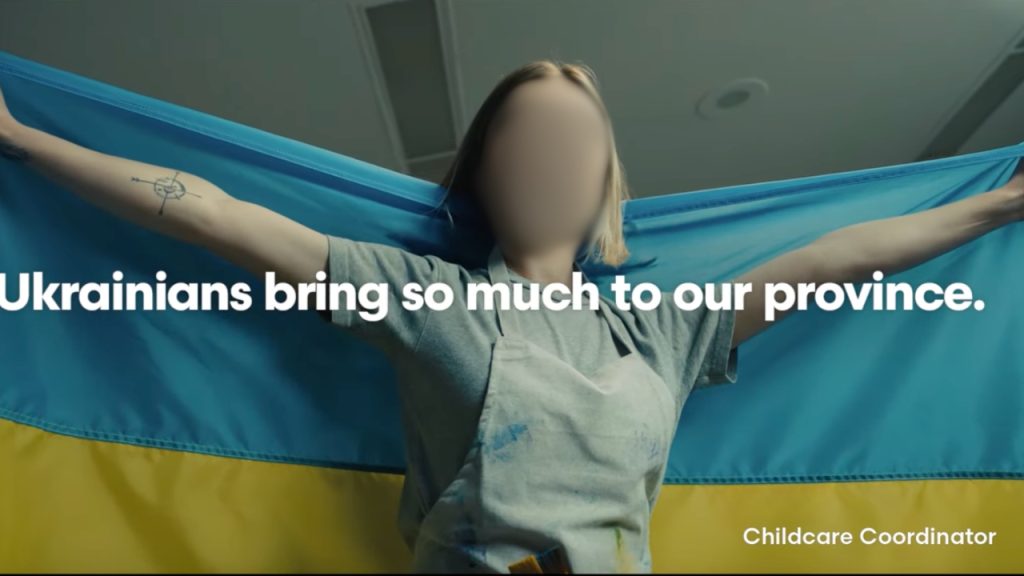
I remember the excitement I felt.
“Amazing! They’re recognizing the valuable contributions of immigrants and refugees to the province!”
It was early spring and the Government of Newfoundland and Labrador had just launched an advertising campaign encouraging local businesses to hire Ukrainian workers. The ads popped up in my social media feeds and I heard them on a local radio station.
They led me to anticipate similar campaigns featuring stories of other refugees, showing business leaders that hiring immigrants and refugees not only boosts our economy – it also enriches our communities.
Will you stand with us?
Your support is essential to making journalism like this possible.
As time passed, however, the follow-up ads never came. There was no acknowledgment by our province of the other foreign and migrant workers who are essential to keeping our communities running. So I wondered: do our elected officials know that other migrants, immigrants, and refugees are facing the same challenges in securing employment as their Ukrainian counterparts?
What initially seemed like a well-intentioned campaign now appeared to be offering preferential treatment, inadvertently undervaluing other marginalized groups.
Did anyone in government not realize how the campaign would make the province’s vast newcomer communities feel? Was I the only one who felt something was off?
Community members speak out
I reached out on social media to members of the community — including racialized people, non-racialized Newfoundlanders, immigrants and those with family members who were refugees — and invited their feedback to the ad campaign. Speaking anonymously due to their vulnerability and fear of repercussions, their responses were overwhelmingly consistent: these ads didn’t sit well with many people. Instead of fostering unity, they were seen as causing division within already marginalized populations as the government’s focus on prioritizing Ukrainian refugees forced other marginalized groups to pander to the government in hopes of being chosen, much like the harmful “model immigrant” narrative.
“I wish they did this for refugees and immigrants of colour,” one community member told me. “My family immigrated here 20 years ago and since childhood I’ve heard that ‘immigrants steal from real hardworking Newfoundlanders.’ In my experience, ‘immigrant’ has always been synonymous with ‘non-white.’ Immigrants from white and English-speaking backgrounds seemed to always be welcomed, or at least flew under the radar much more easily,” they explained. “I have never seen any campaign from the government tackling that xenophobia, which in many cases is intrinsically connected to racism.”
Another person I spoke with said they were “shocked” by the ads, which they said “seemed a little odd to see.”
The exclusion of other immigrant groups from this type of government advertising campaign not only highlights disparities – it also raises concerns about the effectiveness of such campaigns.
“These ads are effective, which is why I want to see the government highlight other hard-working immigrants of other racial and ethnic backgrounds,” one person told me, citing an increase in racism against South Asian immigrants “who are hardworking too.”
Another bluntly stated that the Ukrainian-specific campaign sends the message that “only Ukrainians are important.”

Another community member wondered whether the ads improved resettlement efforts at all. “It’s not enough for immigrants and refugees to find jobs here; we do not just face hiring discrimination, we struggle to find or build community, especially if you’re outside of St. John’s,” they explained. “Children are bullied in school, sometimes physically attacked, and BIPOC [Black, Indigenous, and other people of colour] are harassed while out in public. Why would people stay where they are clearly not welcomed?”
These sentiments were echoed by others who felt that the ads fell short in promoting diversity. As one individual put it, “When the government shows preferential treatment of certain immigrants or refugees above others, how can this effectively promote diversity?”
Others shared their thoughts on what could have been done differently.
“The Newfoundland Government should have included immigrants or refugees of multiple racial and national backgrounds. Xenophobia in hiring discrimination and racism go hand in hand. Refugees fleeing conflict from Sudan, Syria, Palestine, Congo, and Yemen also need the same support with regards to finding jobs. Immigrants from Latin America and South Asia also face horrific hiring discrimination and racism while on the job. The government cannot only prioritize palatable pale faces when attacking discrimination.”
Refugees fleeing conflict from Sudan, Syria, Palestine, Congo, and Yemen also need the same support with regards to finding jobs.
Some community members expressed a desire for transparency in the process. “I want to know who approved this, what the process was, and a full report to see who opposed or brought up issues about the ad and at what point during the process,” one person told me.
Another urged the provincial government to take a more inclusive approach. “We aren’t naive; we can tell you don’t really welcome some of us as much as you do others. There are immigrants and refugees of colour that desperately need your support, and yet you ignore us,” they said. “You want us only as far as you can profit and gain from us, but you won’t support us as much as you do others. Why is there a provincial help desk only for Ukrainian refugees wanting to immigrate to NL, but not one for Palestinian, Congolese, or Sudanese people fleeing genocide or conflict spanning decades? You are cowards that are unwilling to acknowledge and rectify the fact that you have a racist bias.”
Toward a more inclusive approach
The intention behind the “Hire a Ukrainian Refugee” ads was undoubtedly positive—highlighting the skills and contributions of a vulnerable group in our society. But the exclusion of other immigrants and refugees from this narrative has had unintended consequences, causing discomfort and division within marginalized communities.
Newfoundland and Labrador looks different now; we are a more diverse population with residents representing nearly every race and identity. As we work to create opportunities, it is crucial that we do so in a way that is inclusive of all those who are currently marginalized by systemic issues.
Of course, hire a Ukrainian refugee. But also hire an international student, a recent immigrant, a migrant worker—because they all have valuable skills that benefit our province and deserve to find a place in our community.
Our efforts to build an inclusive society must genuinely reflect the rich and varied contributions of every member, ensuring that no one is left behind. A more inclusive approach in future campaigns would be beneficial. This includes featuring diverse groups of newcomers in our ads to reflect the true diversity of our province.
Incorporating stories that highlight various contributions across different sectors can inspire a more welcoming atmosphere and show the multifaceted benefits of immigration.

Author

Related Articles
Throwing shade on solar myths
‘Someday the sun will shine and have-not will be no more,’ Brian Peckford famously said. Solar ‘someday’ can’t come soon enough, writes Angela Antle
No energy justice with Bay du Nord
Newfoundland and Labrador’s Bay du Nord ambitions are out of step with the dire need to phase out global oil production and the province’s benefits agreement with Equinor underscores the need for a new approach to fossil fuels
A housing corporation without a housing mandate
The Liberals and PCs have no right to point fingers at each other in response to the auditor general’s scathing report on social housing