
I smell cucumbers
Billionaire-owned World Energy GH2 is off green hydrogen and floating the idea of energy-hungry data centres
The very first story I covered as a journalist was the Sprung Greenhouse debacle. On a tour of the facility, I had my first—though not my last—introduction to the hallowed Newfoundland tradition of boom-bust mega-projects. Although the Sprung set up was hardly ‘mega’ — just a few leaves, and some greenhouses powered by home heating furnaces — It did however go wildly over budget, attract government largesse to the tune of $22 million dollars and cost several politicians their careers.
I was a young CHMR reporter and I kinda liked the jolly Phillip Sprung. The province was sliding toward the oblivion of the cod moratorium and his idea seemed kind of cool to 20-odd year old me. I hoped he might be onto something. I wanted it to work. I wanted to have a future here.
But the crowd of more seasoned journalists on the tour were not having any of it. Trading sly remarks and asking tough questions, they made the Sprungs sweat through their fake lab coats. I thought the reporters were rude. I wanted them to give it a chance. How could I have known the hard truth back then that mega-projects and billionaires are not going to save us?
At the end, “a Sprung cucumber cost $1.08 to produce, but sold for 63 cents in Atlantic Canada and just 25 cents (US) in Massachusetts.”
Will you stand with us?
Your support is essential to making journalism like this possible.
The Sprungs are still on the go and may actually be billionaires now, selling greenhouses all over the world. It turns out that’s what they were good at — making the actual structures, not growing vegetables that scare cats.
The political fallout of the ‘pickle palace’ cost then-Premier Brian Peckford his career. When Agriculture Minister Charles Power resigned, he told Atlantic Business Magazine he was “embarrassed by allowing myself as minister in 1988 to commit the same kind of process that Joey Smallwood’s ministers must have committed in 1968,” referring to sinking millions of tax payer moola into an operation that clearly had no market. “And it shows that Newfoundland is still susceptible to the quick-fix, fly-by-night boys coming in from outside,” Power said.
The project wound up costing the province $22.2 million ($11.4 million more than in the original contract), while Sprung invested just $4 million.
We haven’t learned a thing
A year after the greenhouses were sold off to Quebec, the province launched a royal commission which concluded the provincial government embraced an expensive venture without fully researching or understanding the technology or the market.
I can’t help but conflate those cukes of yore with hydrogen — both being green and having no market.
Recent news that World Energy GH2 is pivoting from green hydrogen to data centres brought me back to those dank greenhouses. As first reported by AllNewfoundlandLabrador, John Risley, the billionaire-investor behind the project, recently announced he is turning his attention to data centres and artificial intelligence (AI) companies.
“This isn’t a change in direction,” Risley said after an event in Halifax where he made the announcement.
“We’re looking at this as a renewable energy campus and, with the amount of energy available to us, there’s no exclusive option. It’s not like one and done.”
AI data centres may sound fancy, but they’re essentially tin boxes filled with humming hard drives processing the world’s porn, online gambling, and Chat GPTing. They also use an incredible amount of electricity and fresh water for cooling.
Despite Risley’s claims earlier this year that he wants to be remembered for doing good things, for addressing rural unemployment by “creating six-figure jobs,” and is personally driven by the business opportunities presented by climate change — que sera sera.
In the same May 2024 podcast interview with Canadian journalist Edward Greenspon, Risley claimed WEGH2’s wind-to-hydrogen project “will effectively reduce the emissions in Newfoundland and Labrador equivalent to a level greater than all the emissions Newfoundland and Labrador produce,” and that the province “will become a green province overnight.”
As Newfoundlanders and Labradorians, we well know that promises of overnight transformation should be treated with…. a bag of road salt.
Other jurisdictions’ experiences with data centres
Data centres don’t reduce emissions. They are massive gobblers of electricity and fresh water. I would also be pleasantly surprised if the dozen or so cleaners, security guards, and technicians employed at such centres will make the six-figure salaries Risley was referring to in his interview.
In Ireland, residents are fighting back against the construction of more data centres due to their high energy use — 18 per cent of the country’s entire electricity consumption in 2021. In the US, residents in Virginia and Maryland are fighting federal regulations that could lead to ratepayers in the two states financing upgrades to the electrical grid required by the data centres, which are stationed in a part of northern Virginia that has come to be known as “data centre valley”.
In Uruguay, where there have been droughts and shortages of drinking water, Google wanted to use 7.6 million litres of potable water every day to cool its forthcoming data centre there. But protests forced the tech giant to invest in an air-cooling system that requires significantly less water.
Is the west coast of Newfoundland attractive for data centres because of the free land handed over to GH2 and access to fresh water? Will this data-centre dream be the first instance where Newfoundland’s fresh water is monetized? That is something we should all be watching very closely.
Risley mentioned his data centre plan during his May interview with Greenspon, which makes me wonder if data centres have been part of his plan all along. “I will build my data centres out of green steel,” he said, adding, “If I had my druthers […] I’d love our first phase of our project not to be shipping ammonia to Europe, but to be a DRI plant in Stephenville.”
DRI stands for “direct reduced iron” and refers to the production of iron ore pellets, like the stuff extracted from mines in Labrador. DRI can be powered by coal or liquefied gas — or by hydrogen. “We shouldn’t be shipping our steel [pellets] to Sweden to be turned into green steel, we should be doing it here,” Risley said.
Right now there are no hydrogen-fuelled DRI plants in the province, though the Port of Corner Brook has signed an MOU with CWP Global to explore the potential to develop a “green hydrogen hub,” including an iron-processing plant, on the Corner Brook waterfront.
Was this ever really about windmills and hydrogen?
When Greenspon asks Risley about plans to use the Atlantic Loop to export (wind) electricity to the US, Risley replies, “Absolutely.”
It’s a “no-brainer,” he says, adding it’s “too bad Atlantic Canada doesn’t have a more positive kind relationship on the energy file with Quebec.
“If you think about it, the benefit of the Atlantic Loop would be that Quebec’s hydroelectric power would serve as a battery for all the wind in Atlantic Canada and we’d swap back and forth. And what we would do is ship it to New England. We’re talking 20 to 25 years.”
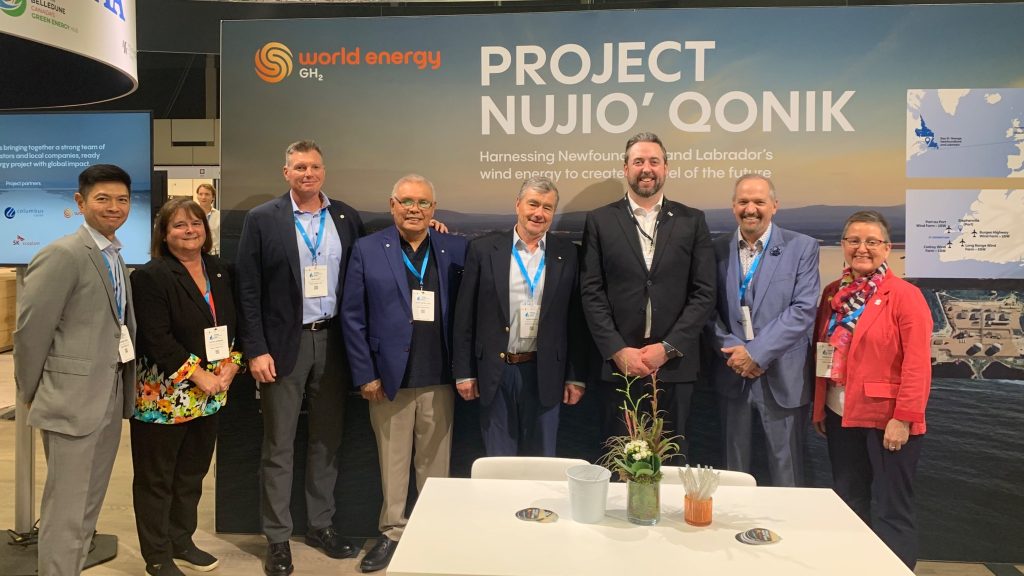
Reviving the Atlantic Loop idea? Green steel? Data centres? Was Risley’s plan ever about using ammonia to export electricity to Europe? Or was it all a roundabout way for the billionaire to get in on the ‘Loop’?
Last July, Canada offered up $300-million in taxpayer money to support green hydrogen projects in Atlantic Canada. What will happen to that money?
How much crown land was World Energy GH2 given? Do they give that back now? Do they deserve free land if they’re only going to build a bunch of tin boxes that use huge amounts of energy and employ very few people?
allNewfoundlandLabrador quoted Risley as saying the data centres will tide World Energy GH2 over as they “wait for the Europeans to get their act together” on the hydrogen file. The company has yet to sign any European agreements for its planned ammonia exports, noting buyers don’t want to commit before terminals and pipelines are constructed, which could take years.
Suppose World Energy GH2 builds the windmills, which it hasn’t yet done, and runs the centres on wind power. Wind-powered data centres would be less polluting, and less of a draw on existing electricity supplies, but they would still use copious amounts of fresh water (unless they adopt the Uruguayan model of air cooling).
Given all the flip-flopping we’re seeing here, I am going to go out on a vine and say, I don’t think World Energy GH2 has any intention of building windmills. Not one. If I’m wrong, I will eat cucumbers everyday for a year.

Author

Related Articles

No energy justice with Bay du Nord
Newfoundland and Labrador’s Bay du Nord ambitions are out of step with the dire need to phase out global oil production and the province’s benefits agreement with Equinor underscores the need for a new approach to fossil fuels

A housing corporation without a housing mandate
The Liberals and PCs have no right to point fingers at each other in response to the auditor general’s scathing report on social housing

Meet two of St. John’s local heroes of transportation
Can community members help make walking safer in winter? Megan Clemens and Myles Russell think so