
Cape Spear voters highlight key election issues
Residents of Mount Pearl, Paradise and St. John’s say the next leader needs to tackle healthcare, quality of life for seniors, and cost-of-living concerns while ‘calmly’ navigating tensions with the U.S.
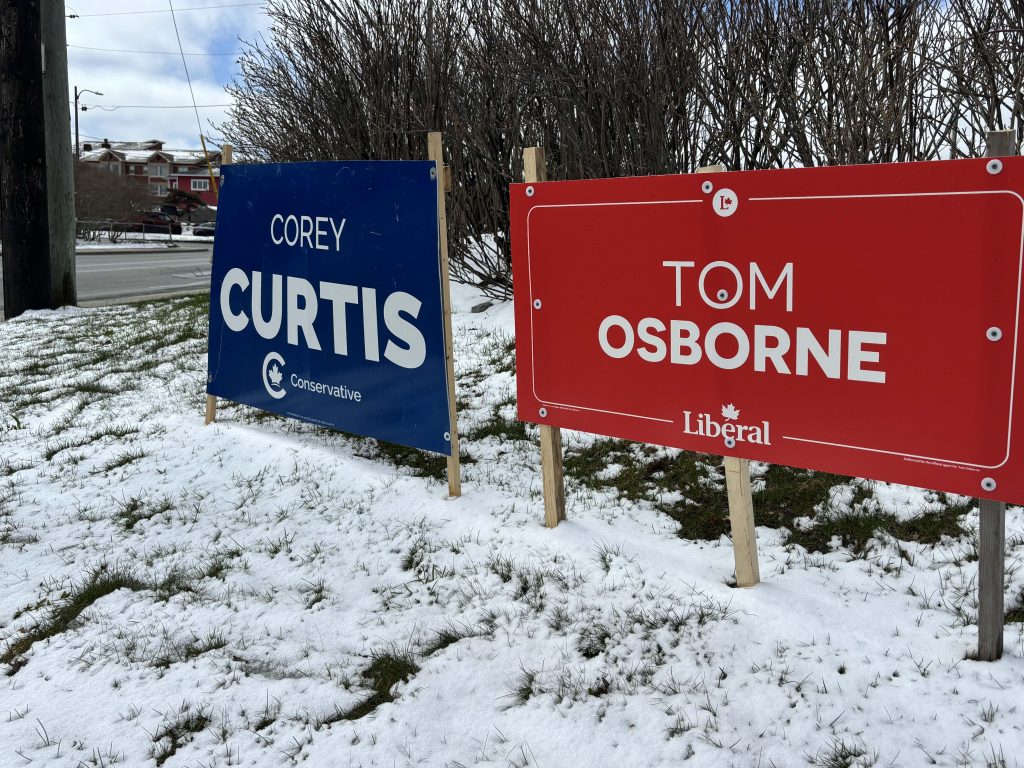
In the new federal riding of Cape Spear—formerly St. John’s South–Mount Pearl—Liberal and Conservative election signs dot the front lawns of homes belonging to the roughly 85,000 residents who live in places like Mount Pearl, Paradise, Petty Harbour–Maddox Cove, and part of St. John’s.
None of the district’s candidates have been in federal politics before, though Liberal candidate Tom Osborne has served in the province’s House of Assembly for years as a member of both the Progressive Conservative and Liberal parties. Osborne is up against Conservative candidate Corey Curtis, NDP candidate Brenda Walsh, Mike Peach of the Animal Protection Party, and Kaelem Tingate from the Green Party.
In the 2021, Liberal MP Seamus O’Regan won the election in St. John’s South–Mount Pearl with 56.2 per cent of the vote, while the NDP and Conservative candidates garnered 23.4 and 18.6 per cent of votes respectively.
The Independent toured the riding to speak with residents about the election. Two residents we spoke with who had Conservative lawn signs said they hadn’t actually decided who they were voting for. The sign on Dave Vance’s St. John’s property was face down on the ground; he said that although he was leaning Liberal, a member of the Conservative campaign approached him about putting a sign on his lawn, and he told them, “go ahead.”
Will you stand with us?
Your support is essential to making journalism like this possible.
It’s the next prime minister who matters most
For Mount Pearl resident Sherry Legge, it’s who leads in Ottawa that matters the most. The 63-year-old said she is voting for Conservative leader Pierre Poilievre, and that she needs a “break” from the Liberals. She said Poilievre’s continued calls to end the carbon tax showed his commitment to voters, even though it was newly minted Prime Minister Mark Carney who officially ended the consumer carbon tax.
During his leadership campaign, Carney pledged to eliminate the consumer carbon tax, calling it “too divisive” to keep in place. The tax was introduced in 2019 by former Prime Minister Justin Trudeau to curb greenhouse gas emissions by adding a tax at the gas pumps. To help offset the costs, the government provided residents with quarterly rebates which have now come to an end.
“We really felt that although Carney did it when he came into office, he was kind of pressured into it, because the Conservatives had already said so [and] in order to appease the public,” said Legge, who supports Pollievre’s continued calls to end the industrial carbon tax. The industrial tax puts a price on excessive carbon emissions and forces industrial heavy polluters to reduce their emissions.
“We feel that with the extra industrial taxes that we’re going to be hurt just as much, because the taxes trickle down to us anyhow, and we’re living on a fixed income,” Legge said. “So people on a fixed income, like it’s not going to affect my income, but everything that I buy is going to be affected.”
According to the Canadian Climate Institute, the industrial tax is not increasing costs for consumers; the industrial carbon pricing systems, the institute says, will “have an average impact of around zero per cent on household consumption in 2025 (with even small net benefits for some consumers) and are projected to reach just a tenth of a per cent in 2030.” Further, the carbon pricing systems “have been designed to keep costs low for industry and largely apply to export products that are purchased by consumers in other countries.”
Mount Pearl resident Scott Bruce said he doesn’t want to see Poilievre as the next prime minister. “I don’t see anything positive from him.” Bruce initially supported Liberal hopeful Victoria Belbin but then continued to support Tom Osborne after he won the nomination.
The 45-year-old added he disagrees with Poilievre’s promise to invoke the notwithstanding clause to ensure consecutive life sentences without any chance of parole for people who commit multiple murders. The notwithstanding clause permits governments to bypass certain Charter rights for a limited time, though the federal government has never used it. Provinces, including Ontario and Quebec, have invoked the controversial clause before.
“Using that notwithstanding clause so casually—like other provinces have done, which I don’t like either—and just overriding citizens’ rights and the ability of the courts to deal with any problems is a huge red flag,” Bruce said.

Bruce said he also doesn’t want to vote for a leader who supported the convoy protests that shut down part of Ottawa’s downtown core in 2022. “He happily aligned himself with a bunch of folks who wanted to, in some ways, overthrow the government,” he said.
Bruce’s wife, Noleen Anthony-Bruce, said she is “afraid” of Conservatives rising to power, also because of Poilievre’s plan to use the notwithstanding clause. “I’m afraid of what the Conservatives’ ideas are,” she said, explaining she sees parallels between the Conservative Party of Canada and the Trump administration in the U.S.
Carol Langthorne, who campaigns for Tom Osborne, said voters need to think about both the Cape Spear candidate they are voting for, and who ends up in Ottawa’s top seat. What the province and the country need is a calm negotiator, she said, and she thinks Mark Carney is the best leader to deal with Trump.
Key issues for residents
Jan Mercer said she is unsure who she is voting for but is leaning toward the Conservatives. Although she added she isn’t sure if it matters who is in power. “It doesn’t seem that any of them are doing much good for us nowadays.”
Mercer said she had a chat with a staff member from the Conservative Party who had asked if they could put a Corey Curtis sign on her lawn. She hasn’t met any of the other candidates or their representatives.
But the key issue for her is seniors’ well-being. She said Newfoundland and Labrador’s younger population is leaving the province, and as those who remain in the province age, they need access to better healthcare programs. While health and senior care are primarily under provincial jurisdiction, the federal government provides funding, including the Canada Health Transfer, as well as national health care programs such as pharmacare and dental care.
Healthcare
The Conservatives have promised to create a new national standard for healthcare workers that would allow doctors and nurses to find work easily across the country. Currently, healthcare workers may need different licenses to work in different provinces.
The Liberals announced $52 million in funding for 16 projects across Canada aimed at helping internationally-trained professionals find jobs in the healthcare system, as part of their efforts to address nationwide staffing shortages. The party is also promising to invest $4 billion in building new community healthcare facilities and upgrading older infrastructure.
The NDP plans to roll out full public pharmacare within four years and end privatization of healthcare. Party leader Jagmeet Singh said the NDP, if elected, would hire 35,000 new nurses by 2030.
The Green Party promises to expand pharmacare and health insurance coverage to include mental health care. Green Party co-leaders Elizabeth May and Jonathan Pedneault plan to increase the number of healthcare workers by streamlining the recognition of credentials for internationally trained professionals.
Seniors
The Green party has promised a guaranteed livable income and expanded paid leave for those taking care of the elderly.
While the other parties aren’t promising as much, they are putting forward other ways they say will help seniors. The Conservative Party has promised to allow working seniors to earn up to $34,000 tax-free—a $10,000 increase from the present level—and to allow seniors to keep their RRSPs growing for an extra two years.
The Liberals have promised to raise the Guaranteed Income Supplement by five per cent for one year, delivering up to $652 in additional, tax-free support to low-income seniors. And allowing seniors to keep more of their retirement savings by reducing the amount they’re required to withdraw from their Registered Retirement Income Fund by 25 per cent for one year.
Finally, the NDP has promised to increase the Guaranteed Income Supplement, double the Canada Disability Benefit, reverse the recent capital gains tax and permanently remove the GST from everyday essentials like grocery store meals, cell phone bills, internet, and heating costs.
For Vance, a heavy equipment operator, the cost of living is the key issue in this election. According to a new poll by Narrative Research, 72 per cent of Canadians say cost of living is the most important issue facing the country.
Cost of living
Political parties have also made cost-of-living solutions a central part of their campaigns.
The Conservatives promise to lower the tax rate from 15 per cent to 12.75 per cent on the lowest income tax bracket, which is currently $55,867. They say they will also increase the annual Tax-Free Savings Account contribution limit by $5,000 per year, and remove GST for Canadian-made vehicles and houses sold under $1.3 million. If elected, they would allow tradespeople who travel for work, including electricians, plumbers and construction workers, to write off the full cost of their meals, transportation, and accommodations.
The Liberals have pledged to reduce the tax rate for the lowest income bracket by one per cent — from 15 per cent to 14 per cent. The party would also eliminate the GST on homes priced up to $1 million for first-time homebuyers and suspend the rule that prevents people from receiving Employment Insurance for six months after receiving a severance package.
The NDP promises to raise non-taxable income from $16,129 to $19,500, extend Employment Insurance to 50 weeks from the current maximum of 45 weeks, and increase the amount of EI a person receives. Currently, Canadians receive up to 55 per cent of their previous income. The NDP wants to adjust the program so that recipients would get two-thirds of their prior income. New Democrats also want to expand pharmacare, dental care, and mental health support, while banning private clinics.
The Green Party is pledging to increase non-taxable income to $40,000 for people earning less than $100,000 a year. They also want to expand paid leave for Canadians who need time off work to care for elderly family members, people recovering from a miscarriage, and other family needs.
Other parties need to get their messages out
Everyone we spoke with agreed that Canadians need more diverse political representation and access to information on political parties other than the Liberals and the Conservatives. Bruce said he wants Canadians to vote for the parties whose policies they support, rather than “having to vote strategically all the time.”
He added that climate change is a big issue for him and was disappointed to hear that the Green Party was removed from last week’s leaders debates for not having enough candidates. “As far as I’m concerned, they should have had an equal voice.”
The Cape Spear residents we spoke with weren’t aware of all of the candidates in their riding, which Bruce said is a problem. “I haven’t even heard of who my NDP candidate is here, locally, so I don’t even know who I would be dealing with,” he said.
According to Elections Canada, the country saw a record turnout for early voting, with 7.3 million Canadians having already cast a vote. That’s a significant jump from the 5.8 million early voters in the 2021 election. Remaining eligible voters will cast their ballots on April 28.
The Independent’s federal election coverage is supported by the Covering Canada: Election 2025 Fund.

Author

Related Articles
Proposed Canada-N.L. impact assessment agreement ‘something we should be worried about’, says MUNL prof.
A Memorial University professor says the draft ‘Co-operation Agreement between N.L. and Canada’ risks diminishing community involvement and environmental protection with resource development projects

Provincial government sitting on upward of 5,000 unpublished access-to-information requests
Just 71 per cent of all completed and eligible requests are publicly available, says ATIPP Office

Access to information: N.L. failed to make public over 1,000 responses in a single year
Province says it’s dealing with an increase in requests, but NDP leader is concerned the mounting problems may be intentional