
‘No one is representing us’: Port au Port residents protest outside EnergyNL conference
As industry leaders gathered to promote Newfoundland and Labrador’s role in the global green energy race, protestors stood outside to demand transparency and environmental protection

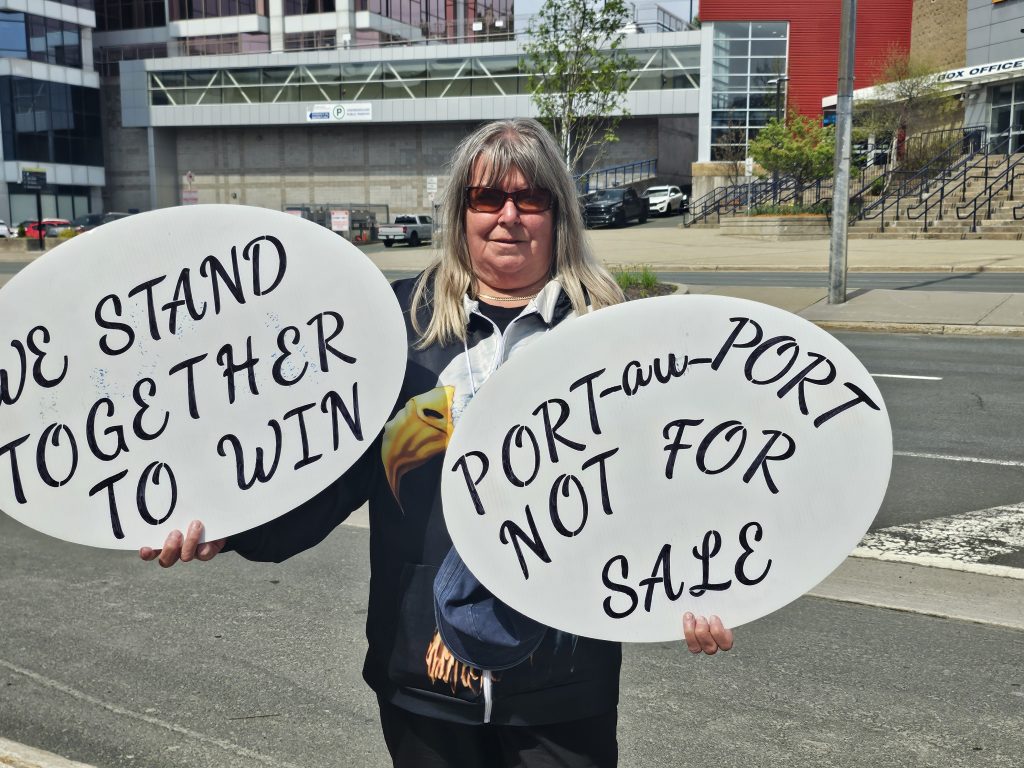
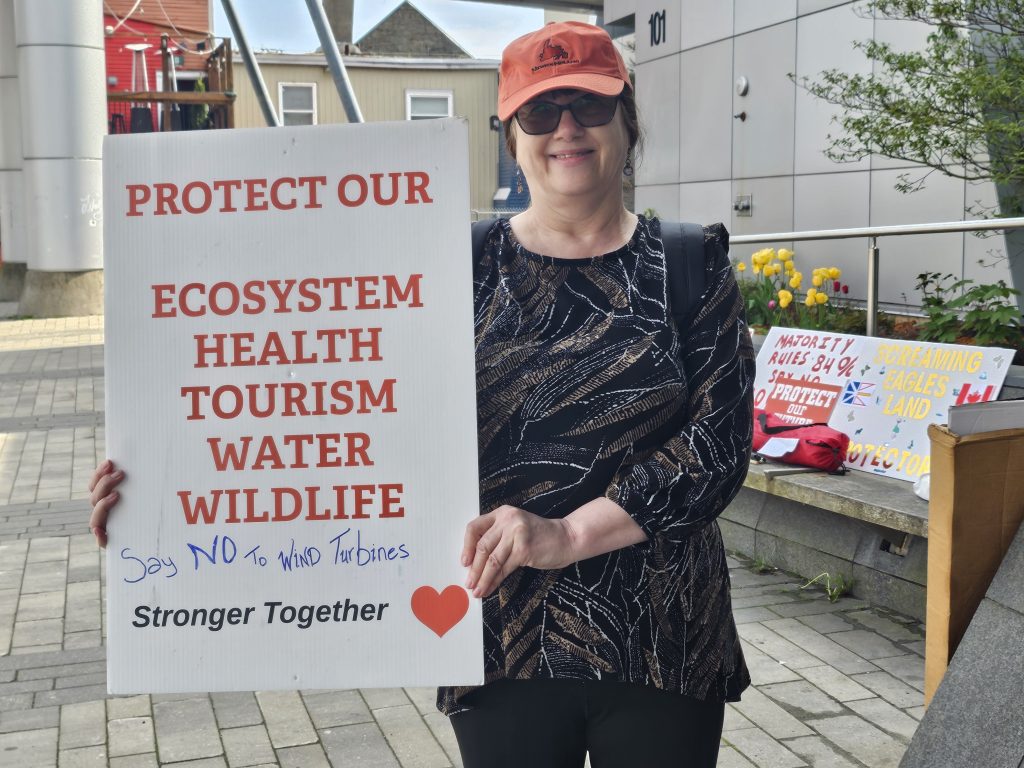
Residents from communities on the Port au Port Peninsula, joined by other protesters, gathered outside the St. John’s Convention Centre last week to oppose a proposed wind farm and mega wind-to-hydrogen project planned for Newfoundland’s west coast.
The peaceful protesters hoped to attract a response from industry experts, policymakers, and business leaders who attended the annual energy conference that ran June 3-5.
The mega hydrogen and ammonia plant planned for Stephenville and the two planned wind farms that will power it—titled Project Nujio’qonik—requires the installation of 164 wind turbines on the peninsula, which are projected to create up to one gigawatt of power to feed the plant in Stephenville. Each wind turbine would stand up to 200 metres tall and cross an area roughly the size of the City of St. John’s. Many of them would be nearby and within view of small communities.
Owned by World Energy GH2, the project was first announced in 2022 under the pretense it would be used to generate electricity for a hydrogen and ammonia project in Stephenville. It has been hailed as Canada’s first commercial green hydrogen and ammonia initiative.
Will you stand with us?
Your support is essential to making journalism like this possible.
Coreen Tourout, 62, a member of the grassroots group Screaming Eagles and resident of Piccadilly, said protesting outside the convention doesn’t feel good — but it serves as a stark reminder, she adds, that “no one is representing us.” Not the MPs, and not the provincial government, she said.
Screaming Eagles was formed in 2024 by eight women from the peninsula who identify as Indigenous, but Tourout said the members of the group have been advocating for transparency about the wind farm for the past three years. This is the fifth time Tourout has visited St. John’s to try to get a response from the provincial government and industry leaders. “We’re just fighting for our land.”
So far, she said, the government has made little effort to address the concerns of Port au Port residents and has ignored calls for a written commitment to protect the region’s environment, its communities, and way of life. Although Minister Crocker and World Energy GH2 representatives are at the convention for the conference, neither approached the protesters, Tourout said.
Harm to way of life
Sandra Woolridge said many residents on the peninsula rely on the land for their way of life, and she’s concerned about how construction and the eventual presence of turbines will impact hunting, farming, animal and plant life, and access to fresh water. “What are we gonna do when all that equipment gets on the roads?” she asks.
Tourout said the peninsula is too small to accommodate the project while still allowing residents the serenity and normalcy they are used to. Apart from the 164 turbines, World Energy GH2 also plans to construct transmission lines, supporting infrastructure and access roads to connect the wind farm to the Stephenville plant. World Energy GH2 said the turbines will be located at least one kilometre away from homes on the peninsula. But Tourout said that isn’t far enough.
For her part, Woolridge said she wants the government to provide a concrete emergency response plan for residents during and after the construction of the wind farm. For example, evacuation procedures in the event of wildfires and assurances that roads will remain accessible during medical emergencies. The closest hospital to residents in the peninsula is in Stephenville, more than half an hour from Piccadilly and over an hour from the community of Mainland.
“We got elderly. We got students on our peninsula. We only got one way of getting off of there. If all this construction starts and we got someone out there that has a heart attack,” Woolridge said, worried.
Tourout added that communities on the peninsula must be given a clear plan for decommissioning and cleanup once the turbines reach the end of their typical 20-to 30-year lifespan. But the group is most concerned about the project’s potential impact on the freshwater supply that the communities depend on.
The communities on the peninsula primarily rely on ponds, and rivers for their water supply. In 2023, the local service district of Mainland had to shut off its water system due to contamination concerns involving its secondary water source, LeCointre’s Brook. At the time, the community had blamed World Energy GH2’s construction of a meteorological evaluation tower to collect data and help determine the viability of the wind project.
At the time, the provincial environment minister and a spokesperson for World Energy GH2 told CBC that they were testing the water regularly and considered it safe for drinking.
The Screaming Eagles said they know what they are losing—land, ecosystem, water—but also question if there is any long-term benefit to the communities. The energy generated from the project is intended for export to Europe. Woolridge said the communities should at least receive free electricity in exchange for the disruption to their environment and way of life.
Global hydrogen environment
On Wednesday, the EnergyNL conference focused on renewable energy but lacked the urgency and enthusiasm that marked conversations about oil and gas exploration the previous day. Six representatives from companies investing in green-hydrogen projects highlighted the high costs, existing technological challenges, and waning international momentum for green hydrogen. The group included World Energy GH2 Chief Executive Officer Richard Hugh.
But they stressed the importance of green hydrogen in a net-zero world, noting the demand for renewable energy is expected to increase dramatically.
Karlis Povisils, partner at Copenhagen Infrastructure Partners—which holds a majority stake in Toqlukuti’k Wind & Hydrogen, a major onshore wind and hydrogen project near the Avalon isthmus—said that “global market activity expected for green energy has not materialized, and in fact, has likely been set back somewhat by a series of dramatic developments.”
Povisils attributes the scaling back of green energy production to American President Donald Trump’s decision to roll back his country’s clean-hydrogen tax credit.
Speakers also stressed that the province, and Canada as a whole, will play a bigger role because of the rollback of incentives for US companies and showed appreciate for Prime Minister Mark Carney’s call to make Canada an “energy superpower.”
Hugh said that World Energy GH2 is a strong believer in hydrogen and the role it will play in the clean energy future, “but it [the project] remains a very complex ballet of solving challenges, whether it’s technical, engineering, off-take.”
Hugh said that over the next few years, there will continue to be job opportunities for engineers through the project and “communities are going to benefit.” There was no mention of the protest outside the convention centre by Port au Port residents, or any reference to their concerns over the past three years.
In an email to The Independent, a World Energy GH2 spokesperson said because global green hydrogen markets are taking longer to develop than expected, the company is looking at other opportunities that “can be developed in parallel to the maturation of the industry.”
The company added that this includes opportunities with various industries that require clean energy for their operations, such as ongoing discussions with data centre developers, but noted that “there are no developments of this type on the near horizon.”
The Screaming Eagles said they are looking for confirmation that their way of life will be protected. They aren’t against renewable energy projects, they said. Instead, they want a sit-down meeting and legislation from the provincial government promising it will preserve the land, water and the peninsula’s residents, said Tourout. “We just want to be heard. We want to know. And we want stuff in writing.”

Author

Related Articles

Access to information: N.L. failed to make public over 1,000 responses in a single year
Province says it’s dealing with an increase in requests, but NDP leader is concerned the mounting problems may be intentional
Memorial University student union walks back plan to close radio station amid backlash
‘I wish CHMR the best,’ Memorial University Students’ Union executive says ahead of vote to defund the campus radio station

INTERVIEW: Avi Lewis says N.L. is ‘ground zero’ for the biggest challenges facing Canadians
The federal NDP candidate says socialism and economic populism are the antidote to unfettered capitalism and the ‘epic market failures’ it has brought