
Let’s make housing and mental health an election issue
It’s time to ask all municipal and provincial candidates what they would do to address the intersecting crises

On my early-morning walks with my dog I feel like I fall in love with St. John’s again every day. Signal Hill and the ocean, the hills and houses, my downtown neighbourhood and community, and access to ponds, trails and other outdoor public spaces.
Lately, the walks include a different scene as well: tents in the woods, sleeping bags and blankets on benches, people huddled in bus shelters. I see people struggling, asking for money, actively using — with no privacy or modesty.
What’s going on? Why do we live in a place with enough wealth and resources to include everyone, yet fail to do so?
The illusion of separateness between us is dangerous and divisive. We all share a common humanity, and therefore a common worth and value, regardless of our social status or whether we’re housed or not, or whether we struggle with mental health and addictions or not.
Will you stand with us?
Your support is essential to making journalism like this possible.
Affordable housing is scarce with rents at a record high and vacancy rates so low. Buying a modest starter home in Newfoundland and Labrador is not as attainable as it used to be. We can’t blame people for not having a place to live. We can’t blame them for living with addiction or mental health conditions in public spaces when they don’t have private spaces of their own. No doors to lock, no walls to hide behind, so the crisis happens in the public eye. No one is better than anyone else or immune to being on a path that can lead to being unhoused. Any of us could be just one crisis away.
Housing and health are inseparable
As a nurse practitioner, it’s challenging to care for someone’s health if they are unhoused or living in dire poverty. They have bigger obstacles than their physical health issues which prevent them from being able to access care. I take care of people who can’t afford their medications, or who don’t have phones to make or receive calls about crucial follow-ups. I see people every day who have no stable place to live, or who stay in unsafe places where sleep is hard to come by. I see people with no safe place to use the toilet or shower. I care for people with no kitchen to cook in, no option for healthy food, or whose only food comes from the dollar store. I care for people whose medications get stolen in the temporary shelters our government pays for, where many folks share a room and can’t sleep at night because they witness mental health crises, active drug use, and threats to their and others’ safety.
Given all we know, how is the current state of affairs acceptable? We’ve made great strides in medicine and health, yet still can’t feed and house our own community members — the most basic of human needs.
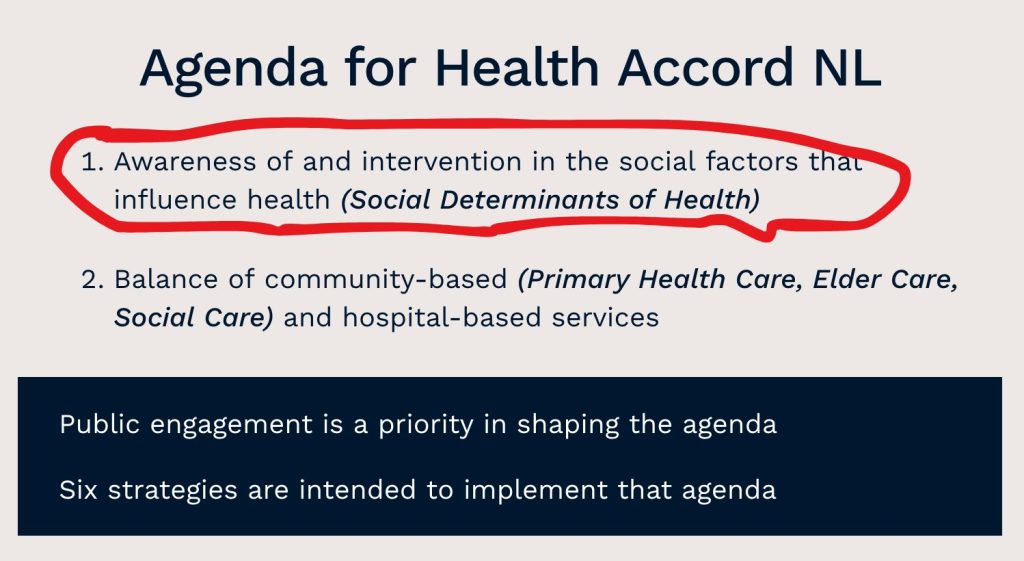
The province’s Health Accord, a 10-year plan released in 2022, recognizes social determinants of health, some of the many external things which affect a person’s health, like housing, income, education, social status, employment and discrimination. In fact, the accord’s first agenda items is “[a]wareness of and intervention in the social factors that influence health (Social Determinants of Health).”
The report also acknowledges that “stable, safe, adequate housing is critical to mental and physical health. A healthy person who ends up in poor housing or homeless will become unhealthy. Stable housing facilitates the provision of services that help address issues commonly experienced by individuals experiencing homelessness, including mental health and addictions.”
Likewise, the province’s Five-Point Plan to Improve Availability of Housing That is Affordable—launched in October 2023 in response to growing public support for a tent encampment in St. John’s where dozens of unhoused people were living—was accompanied by an acknowledgement from then-Housing Minister John Abbott that “having a safe, affordable place to call home is critical for mental and physical health.”
In every case, the province does not recognize housing as a basic human right and has invested tens of millions of dollars in to, in the government’s own words, “[help] stimulate private sector development and stabilize or reduce housing prices,” as if the market, driven by profit motives, is a suitable antidote for the convergent health and housing crises.
For-profit housing isn’t the answer
Similarly, private, for-profit shelters aren’t the answer. They kick unwell people out on the streets during the days instead of helping them, and arguably perpetuate homelessness and wreak havoc on our neighborhoods. There are better ways, like public community shelters that provide housing, education upgrading, and mental health support.
How can any less be acceptable when we have community groups losing funding while private, for-profit shelters are part of a growing industry?
St. John’s has seen affordable rentals diminish as Airbnb and other marketplace services for short-term rentals—often owned by people who not only don’t live in the neighborhood, but aren’t even residents of our province—dominate the market.
Since the advances of neuroimaging several decades ago, we now know that addiction is not the result of weakness or lack of self control; it’s a chronic relapsing brain disease. People need help managing their addictions. Countries which respond most successfully to addiction are those that treat it as a health issue, not a criminal issue. Her Majesty’s Penitentiary is overcrowded, dirty, and provides little access to programming, offering little hope for change to those who end up there. We can do better.
Countries with the lowest rates of homelessness have made big investments in social and public housing. Yet in Newfoundland and Labrador, and Canada, housing has become an industry—part of landlords’ investment portfolios—which has turned a basic human need into a commodity whose value is determined by the market.
Time for action
We are fortunate enough to live in a democracy, and to have elections for two levels of government on the horizon: municipal and provincial.
Ask the candidates in your community and riding where they stand on housing, Airbnbs, and private shelters. Ask them what they will do to address health inequities. Ask why it’s so hard for residents to access mental health and addiction services, and what they will do to improve this.
Let’s put restrictions on Airbnb and abolish private shelters. Let’s fund community-based shelters like Emmanual House, Marguerite’s Place and the Tommy Sexton Centre, whose mandates are to help people, not turn a profit, by offering housing alongside supports. We need rent controls and tax breaks for people who offer affordable housing.
And let’s remember our common humanity. People don’t choose addiction any more than they choose diabetes. Let’s offer compassionate support. We are at a crossroads in St.John’s and across the province. We need to create decent, compassionate spaces for everyone. St. John’s deserves it. Newfoundland and Labrador deserve it. And we deserve it too!

Author

Related Articles
It’s time to fix MCP and strengthen public healthcare
Instead of looking to the private sector for answers, the provincial government should be investing in our public healthcare system

On healthcare, you don’t know what you got ‘til it’s gone
What’s at stake in the federal election? And why are nurses and other healthcare professionals sounding the alarm?

Eliminating Hepatitis C
From an unknown virus to an incurable one, Hepatitis C has now become a very treatable infection, inspiring optimism about the future.