
Revolving Door: The problematic relationship between politics and business in N.L.
The merchants are very much still here, and they’re making terrible decisions for the rest of us

Former Premier Andrew Furey joins the board of directors of New Found Gold, a mining company with interests in central Newfoundland, at a time when the mining sector is receiving increasing attention because of the role minerals are expected to play in the move away from fossil fuels, towards renewable energy.
It was only May 9 of this year that Premier John Hogan was sworn in as Furey’s replacement as premier of Newfoundland and Labrador.
Retired politicians advising corporate actors on how to influence policies is highly problematic. Furey was recently paid by taxpayers to make policy. He brings with him his insider knowledge and easy access to decision-makers as a Liberal insider.
At the federal level, there is increasing attention on this issue as the Commissioner of Lobbying recently issued new guidelines which state that board members may now be considered employees for the purposes of lobbyist registration, if they are paid for such activities. The commissioner also considerably widened the definition of who is to be considered a lobbyist.
Will you stand with us?
Your support is essential to making journalism like this possible.
The federal government has a longstanding five-year prohibition on lobbying for public-office holders under the Lobbying Act. This helps to avoid a situation in which a lobbyist has insider knowledge gained while collecting a paycheque from taxpayers.
Furey sat on the boards of mining companies prior to becoming premier, including Canada Flurospar and Alderon Iron Ore, and owned both stock options and shares in the former company. He received compensation from Alderon of $93,417 in 2017 and $78,465 for 2018. Alderon went out of business in 2020 after failing to pay a $14-million loan, mere months after Furey left the board, so we have no idea how much compensation he received from them in 2019. No annual report was delivered for that year.
It is noteworthy that these are corporations which lobbied government and Canada Fluospar received loans from the public purse. Furthermore, Furey reneged on his promise for transparency around his corporate dealings while he was running for the Liberal party leadership in 2020.
Hogan now leads the charge to develop hydro and mining resources in Labrador
As news broke that Furey was being appointed to the board of New Found Gold, Hogan was in Labrador West announcing he would work with industry and NL Hydro to bring more electricity to Labrador West. He is campaigning on the idea that this would enable further mining projects in the area.
Hogan claimed that the Memorandum of Understanding on Churchill Falls with Hydro-Quebec could enable an expansion in mining by the Iron Ore Company of Canada (IOC) and Tecora, including the Kami project and development of iron-ore deposits at Julienne Lake. Alderon had acquired the rights to the Kami iron-ore project in 2010, before their implosion. The company supported the Muskrat Falls project, and former Premier Danny Williams also sat on its board after he left office.
It has been argued in many quarters that the MOU is highly problematic. Accounting executive and local businessperson Michael Wilson walked away from the Independent Churchill River Negotiations Oversight Panel on the basis that it wasn’t independent and the MOU is deeply flawed.
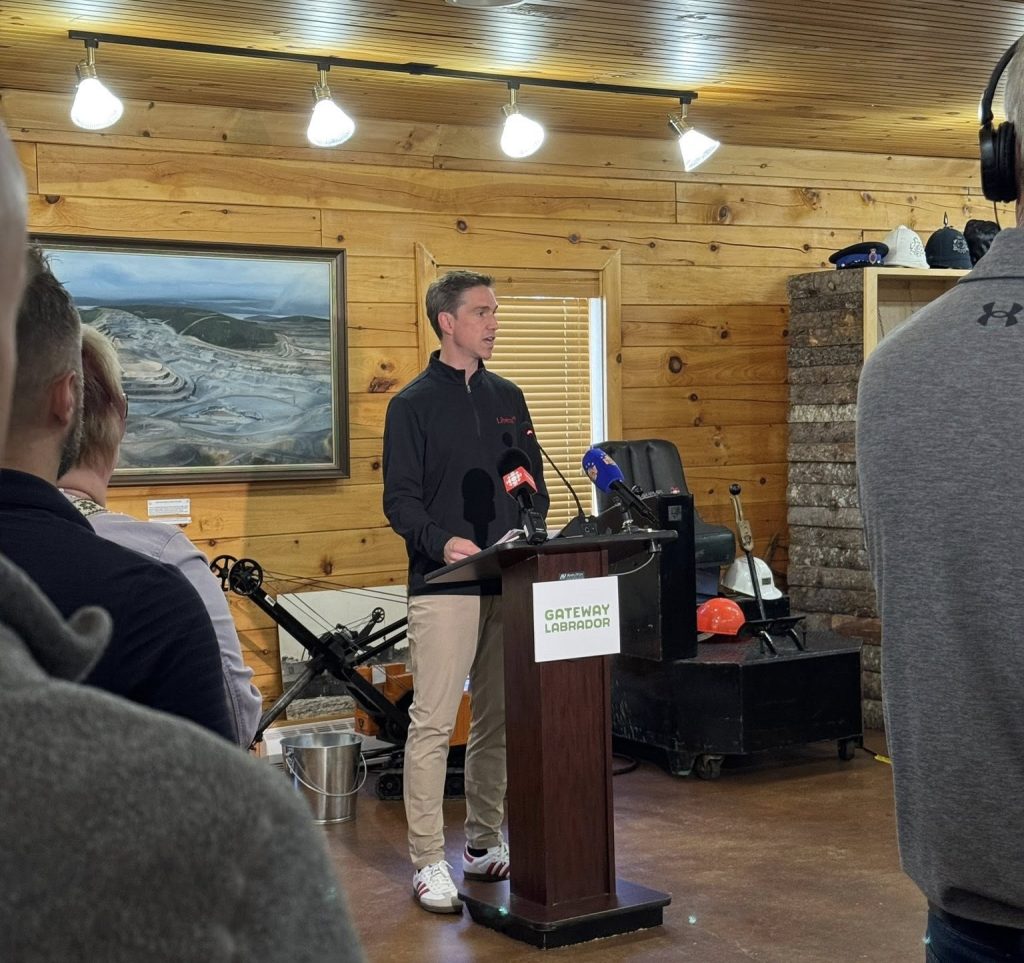
It is interesting that Furey, who has long ties to the mining industry, also led the negotiation of the MOU, which Hogan says will increase NL Hydro’s hydroelectric capacity four-fold.
It’s also noteworthy that former St. John’s South–Mount Pearl MP Seamus O’Regan has made a leap to the private sector. After leaving the federal cabinet in July 2024, O’Regan joined law firm Stewart McKelvey in March of 2025 as a senior business advisor to, “provide strategic advice to clients on natural resources, Indigenous relations, and public policy.”
During his time in the federal cabinet, O’Regan served as both Minister of Natural Resources and Minister of Indigenous Services. In June of this year he visited Labrador selling the MOU. Meanwhile, Prime Minister Mark Carney has identified the proposed Gull Island hydroelectric project, which is part of the MOU negotiations, as a “nation building project”. The Strange Lake rare earth mine is also on that list. Carney has also appointed former Hydro-Quebec CEO Michael Sabia as his Clerk of the Privy Council. Sabia has his own conflict of interest with Gull Island as he was with Hydro-Quebec when the MOU was announced last December.
There is no limit on corporate donations in this province. Notably, in 2024 the provincial Liberals received corporate donations from Fortis Inc. ($18,650), Pennecon ($40,300), Coastal Shipping Ltd. ($35,000), and World Energy GH2 ($6,750). The Marco Group contributed $38,900. Recently, in the midst of the provincial election campaign, the New Democratic Party pledged to ban corporate and union donations in Newfoundland and Labrador politics.
Some of these companies have also received public funding from the Liberal government or were awarded major government contracts. Pennecon Hydraulic Systems Ltd. received $149,200 through the Green Transition Fund. The Marco Group has been awarded a number of lucrative government contracts, including building the new penitentiary, the new mental health facility, and the expanded emergency room at the Health Science.
Further demonstrating strong Liberal ties to the private sector, former Minister of Industry, Energy and Technology Andrew Parsons joined the Sussex Strategy Group earlier this year in the same month he resigned after nearly 15 years in office. Former Premier Dwight Ball also moved on to the Century Global Commodities Corporation after his retirement.
A history of extraction
Mining is an extractive industry in that companies extract minerals but scholars are increasingly recognizing that the extraction goes deeper than taking a resource from the ground. As described in the important text Extraction/Exclusion, there are social and environmental impacts of these projects beyond the taking of the resource. Megadams like Muskrat Falls are also considered extractive because of their implications beyond the damming of the water, such as impacts on food and water sources. Indigenous communities are particularly hard hit because these projects often occur on their lands.
Labour is also extracted and, as such, so are our very bodies. The hardest labour on these projects is done by locals. We do the mining and the building while the management jobs often go to outsiders who come here for a few years. After the resource is gone, they leave again. These projects also create professional positions in major centres where corporate headquarters and large contractors are located. The hard labour jobs are the ones politicians love to brag about, while most of the benefits and best jobs will go to people, jurisdictions, and corporations far away from our province.
Newfoundland and Labrador has long been one big extraction project, starting with our foundation as a fishing station that supplied populations around the globe with fish. In the words of Dean Bavington, this culminated with the cod fish resource off our shores being managed into annihilation by 1992.
This occurred after centuries of rural Newfoundlanders and Labradorians living in extreme poverty and in places that lacked government services. Meanwhile, the merchant class of St. John’s and other jurisdictions reaped most of the economic benefits of fish harvesters’ hard labour. After the collapse of the fishery, rural parts of the province experienced a loss of population that was “unprecedented in a developed country in modern times,” as those in the fishery were left with nothing but a small amount of temporary government funding.
Mining and forestry also have long histories in our province. Railroads were constructed to open up the interior and enable that extraction. We paid dearly for those railroads, leading into the financial collapse and loss of our democracy in 1934. Again, it was contractors on the outside who benefited.
This economic dualism between urban and rural parts of the province is still a part of our culture and the merchants are very much still with us. Newfoundland and Labrador was established as a mercantile economy and we’ve never really been able to break that pattern, largely because our government and corporate leaders in the St. John’s region benefit so much from it.
Furey, O’Regan, Williams, Hogan, Parsons, and Ball should be seen as part of the contemporary merchant class. Their loyalties are not to the working-class voters of this province, but to their own business interests and those of the merchant class. The other members of their class are often located in Toronto, Ottawa, and Montreal, as our provincial interests are sold out to these spaces.
Merchants are also the urban contractors who advocate for building Muskrat Falls and now Gull Island for the same reason. They don’t care about whether the province becomes financially viable; they merely care that the contracts keep coming.
They do things like set up so-called independent oversight panels that aren’t independent at all. They create the illusion of oversight while appointing other friendly merchants to move the project through the approval processes. It’s a club, and for the most part we’re not in it. If you take issue with their lack of due diligence, you’re likely to be referred to as a naysayer.
Fear not, we’re told. This next big megaproject will finally get us there. We’ll have the revenue we need to pay for services and get out of debt. It will be different this time.
It will not be long, of course, before we see once again that things weren’t quite as lucrative as we were told they would be, and our tax dollars will have to pay for our latest mistake. This is the story of the Newfoundland Railroad, Churchill Falls, Sprung Greenhouse, and Muskrat Falls.
We have been suitably warned of the problems with the Churchill Falls MOU by Michael Willson. The Gull Island project is very important to mining interests, so we should not be surprised that Furey is joining the board of another mining company. Rare earth minerals are the next big thing as the world moves away from fossil fuels, but the merchant class also needs hydroelectricity to develop them.
This is a plan to save the merchant class. It’s not a plan to save the planet and it’s not a plan to save us. If they were seriously interested in addressing climate change they would be considering public policy options around degrowth, which would reduce consumption and the cost of living. They would not be pursuing new oil projects, something that is also driven by the St. John’s merchant class.
Education. Healthcare. High quality social services. These are the paths towards moving Newfoundland and Labrador into the global knowledge economy, as our leaders destroy the university and send our healthcare money to travel-nursing firms outside the province. Another extraction. But if we build our economy by elevating our own people, as many countries have done, who would the province’s merchant class extract from?
Poor conflict-of-interest laws, lack of accountability, endless political donations from corporations, and a revolving door between politics and business. These are the protection mechanisms of the merchant class. If you wonder why nothing ever seems to work in this province, these are some of the reasons. Nothing will ever work if we continue to let them get away with it.

Author

Related Articles

May Day Rally Shows New Face of Today’s Labour Movement
Turnout for May 1 march and rally in St. John’s one of the biggest yet in this province

Recimply the Best: Pitch and Pick Competition Winner Aims to Reduce Paper Waste
Recimply won big at Genesis’ annual Pitch and Pick competition last week. The startup is solving the problem of non-recyclable paper receipts.

Coming Home Queer for the Very First Time
For three days in July, queer Newfoundlanders and Labradorians from all over the world celebrated a rural homecoming 30 years in the making.

What Québec’s provincial election could mean for the Churchill Falls deal
With the separatist Parti Québécois leading in the polls and 29 per cent of Quebecers undecided on who to vote for, anything could happen on Oct. 5, and beyond
Hydrogen Hype?
It seems the wind has been taken out of the sails of Newfoundland and Labrador’s wind-to-hydrogen hype. So what does this mean for the province’s renewable energy transition?
Canada must reverse refugee healthcare funding cuts
The cuts are likely to reduce medication adherence, increase hospitalizations, and download healthcare costs to the province