
Ignoring climate change in the provincial election will have ‘devastating consequences’, say youth and labour leaders
Who in this election is talking about climate change and a just transition? Community and youth groups are, but not the candidates in any meaningful way

Newfoundland and Labrador’s never had it easy, economically or with the climate. But now climate change and extreme weather events are poised to add to the province’s woes: more than 3,500 households were evacuated in 2025 due to wildfires, affecting more than 7,500 people. Hundreds of homes and other structures were destroyed, and the Kingston fire alone resulted in more than $70 million in insured damages.
While party leaders addressed the fires in Wednesday’s leaders’ debate, none of them offered the kind of bold solutions we need to meet climate targets and mitigate the impacts of climate change.
Keeping the climate crisis on the agenda
At the outset of the provincial election, the Newfoundland and Labrador Federation of Labour, which represents the more than 70,000 unionized workers in the province, identified 10 priority issues for the election, including climate change and a just transition to a green economy. This comes at a time when the United States has been aggressively backtracking on climate change commitments, some provincial governments have signaled a willingness to deprioritize the fight against climate change, and the federal government won’t say if it’s still committed to achieving Canada’s 2030 climate goals. McCormick says the province’s experience with devastating wildfires this summer shows how short-sighted and dangerous this backtracking is.
Will you stand with us?
Your support is essential to making journalism like this possible.
“We’ve seen record temperatures over the past year, more heat warnings over the past summer than ever in the past, and wildfires burning out of control for the entire summer,” she says. “You’d think our three political parties would be really prioritizing not just a direct response to the wildfires that happened this year, but more holistically what our plan is to tackle climate change.”
NAPE represents wildland firefighters (conservation officers) who serve on the front lines of wildfires. In 2016 the province introduced presumptive cancer coverage for volunteer and career firefighters but excluded the wildland firefighters represented by NAPE. The initial Liberal platform announcement around wildfire support—which includes $100,000 for firefighting uniforms, $500 honouraria for volunteer firefighters, a $10,000 honouraria for volunteer firefighting departments, along with procurement of two bird-dog aircraft and a heavy lift helicopter—maintained their exclusion from presumptive cancer care. But after NAPE castigated the Liberals’ announcement as “nothing short of a disgrace,” the premier’s office backtracked the very same day and agreed to extend coverage.
But climate change is impacting provincial workers and workplaces in myriad ways. Last summer the NLFL undertook a workplace heat stress project, collecting data on workers’ experiences with heat stress in the province and surveying what measures are being taken—and not taken—by employers to address the growing problem. They’re still analyzing the data but McCormick says there’s a growing awareness among workers across all sectors of the impact heat stress is having on their work and how unprepared employers are to address the issue.
Despite the American about-turn on climate change, McCormick says global momentum is still building toward transitioning to a green economy, and the province needs to prioritize that work. The federation’s heat stress project helped open up conversations about climate change across the province, she says.
“People are connecting the dots between heat stress and climate, and these have been really rich conversations. It’s given us an opportunity to talk to people who have worked in the oil and gas industry and left, reflecting their desire to work in green jobs,” McCormick explains. “There’s a lot of support for doing that work in Newfoundland and Labrador which is maybe contrary to the themes we sometimes hear when people talk about oil and gas and our dependence on it.”
McCormick says a big part of that work has involved educating workers about their right to refuse unsafe work. Heat stress and climate change, and the lack of provincial occupational health and safety standards addressing them, is creating unsafe working conditions across the province. She says young workers and migrant workers are feeling particularly vulnerable and often feel they don’t have a choice but to work in unsafe conditions, even though the law states otherwise.

McCormick is concerned about the way North American governments are deprioritizing the fight against climate change. “It’s misguided,” she says. “It’s going to have devastating consequences for workers in the short term. We’re going to see more wildfires. We’re going to have a need for more water bombers. And the very skilled workers who fly them, the wildland firefighters, the volunteer firefighters, they should all be compensated fairly for the work they’re doing to protect and save our communities. We’re going to need a lot more of that. To move away from that transition, I don’t think it’s fiscally responsible for governments, but it’s also putting our population at risk when we don’t take steps to provide people with green opportunities. We’re going to see more extreme weather, warmer temperatures, more wildfires.”
The federal government is prioritizing so-called nation-building projects mostly centred around energy developments, and McCormick says that sends an implicit message to provincial and territorial governments about priorities. “Nation building can mean a lot of things but part of that should be investing in public services and public infrastructure and renewable energy,” she says. “So hopefully we move farther in that direction instead of where it seems like we’re headed. We’ve got to keep doing that work to push back.”
Other community organizations are concerned as well. On Sept. 30 the NL Environment Network submitted a series of questions to the three parties on behalf of three of its member organizations: the Essential Transit Association, Grand RiverKeeper Labrador, and NatureNL. Those questions address climate change and extreme weather, green jobs and funding support for environmental organizations, regional public transit commitments, and the impact of the MOU and potential future energy developments on Labrador. The group says it will be sharing the responses with the public.
‘Young people are concerned‘
Mixed Coast Collective is a BIPOC-led provincial environmental organization that’s been working with provincial youth organizations around the provincial and municipal elections. The collective issued a survey to candidates at both levels, and while they received good uptake from municipal candidates they have yet to receive responses from provincial candidates. They’ve extended the deadline for provincial candidates to Oct. 10.
“We are all very concerned that none of the provincial candidates have filled out the survey,” says Jude Benoit, co-founder and organizer with the collective. “Young people are concerned that the provincial candidates don’t really care enough to answer the voices of youth across the city and across the province,” Benoit says. “Even if candidates don’t get perfect grades, hearing from them that they’re going to work with youth to try to do better is better than hearing nothing at all.”
Collective co-founder and Director of Programs Kassie Drodge agrees. “Climate and environmental issues have been mostly sidelined so far, which is concerning given how deeply they connect to housing, jobs, and community safety. Climate action should be an election issue because it shapes every other policy area, especially here in NL where coastal impacts, energy transition, and affordability are all interconnected.”
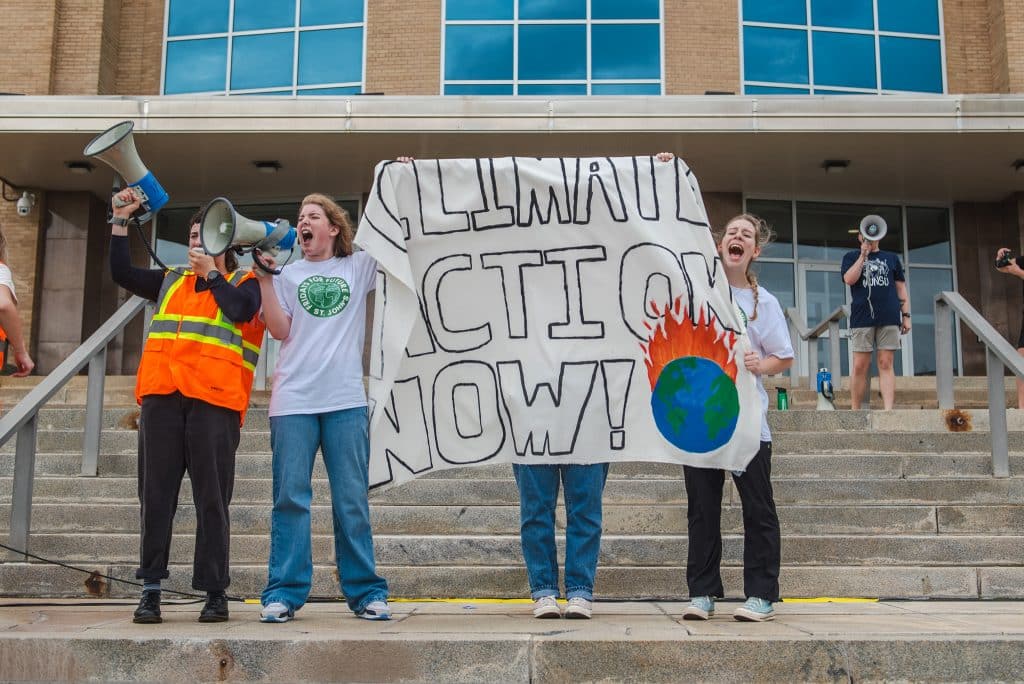
Climate change, labour, and the very survival of the province are all deeply interwoven, they say. “We really worry about the lack of conversations we’ve seen around things like emergency preparedness and climate change,” says Benoit. “Things like making sure that all of the towns in Newfoundland and Labrador have clean drinking water; that’s something that we still don’t have complete access to in this province. We still don’t have emergency preparedness plans in a lot of municipalities and a lot of towns and we are afraid of what’s happening with climate change, what we’ve seen with Hurricane Fiona, what we’ve seen around the world. As young people looking up to our leaders and not hearing them talk about what’s making us afraid, it doesn’t provide a lot of confidence, and it can make it extremely difficult to decide who to vote for when we know that if we don’t have the earth, we don’t have anything.
“As a youth, I would like to see our leaders come out and talk about their ideas for emergency preparedness, for climate change, because we know it’s coming,” Benoit continues. “We saw the wildfires over the summer; we saw whole towns lose homes, lose properties that have been in their families for generations. We know that it’s already here, so what are we going to do about this? What are we going to do to prevent them in the future? How are we moving away from the oil and gas industry? How are we moving away from things that we know are contributing to climate change? How are we moving toward green jobs?
“A lot of youth want to know about our future. We know Newfoundland is an industry-based province; are we going to be moving to industries that are better to the Earth and industries that are more sustainable? Because we know that oil and gas jobs are not going to last forever. I think these are a lot of the concerns right now of the youth vote. We want the candidates to engage with us in having these conversations.”
Mixed Coast Collective intends to keep the pressure on political parties regardless of the candidates’ response to their survey. They are holding a provincial just transition town hall on Friday, Oct. 10 from 12-5 p.m. at The Lantern in St. John’s. “Our goal is to make environmental policy more transparent and accessible to voters, especially younger folks and rural communities who are often left out of the conversation,” says Drodge.

Author

Related Articles

May Day Rally Shows New Face of Today’s Labour Movement
Turnout for May 1 march and rally in St. John’s one of the biggest yet in this province

Recimply the Best: Pitch and Pick Competition Winner Aims to Reduce Paper Waste
Recimply won big at Genesis’ annual Pitch and Pick competition last week. The startup is solving the problem of non-recyclable paper receipts.

Coming Home Queer for the Very First Time
For three days in July, queer Newfoundlanders and Labradorians from all over the world celebrated a rural homecoming 30 years in the making.
N.L. faces ‘serious liability questions’ over Ithaca Energy’s entry into province’s oil sector, legal expert warns
Premier Tony Wakeham won’t comment on Ithaca’s ‘political things’ but law professor says Newfoundland and Labrador could face legal risks based on company’s ties to Israel’s illegal occupation of Palestine

N.L.’s offshore oil could help bankroll a company linked to Israel’s illegal occupation of Palestine
Ithaca Energy’s impending takeover of Suncor’s stakes in three oil projects comes after PM’s promise to ban trade with Israel’s illegal settlements, while Ithaca’s majority owner is named on a UN blacklist for its alleged activities supporting settlements in the occupied Palestinian territories
Gander didn’t protest U.S. ambassador during 9/11 visit, but still sent a clear message to Trump
There were no boos when Pete Hoekstra appeared at the 25th anniversary commemoration. Instead, Newfoundlanders kept their focus on the nearly 3,000 lives lost — and reminded America that Canada will not bow to anyone