
Labrador priorities in the 2025 N.L. election
Labrador candidates talk Indigenous rights, food insecurity, climate change, and establishing a Search and Rescue station in the region
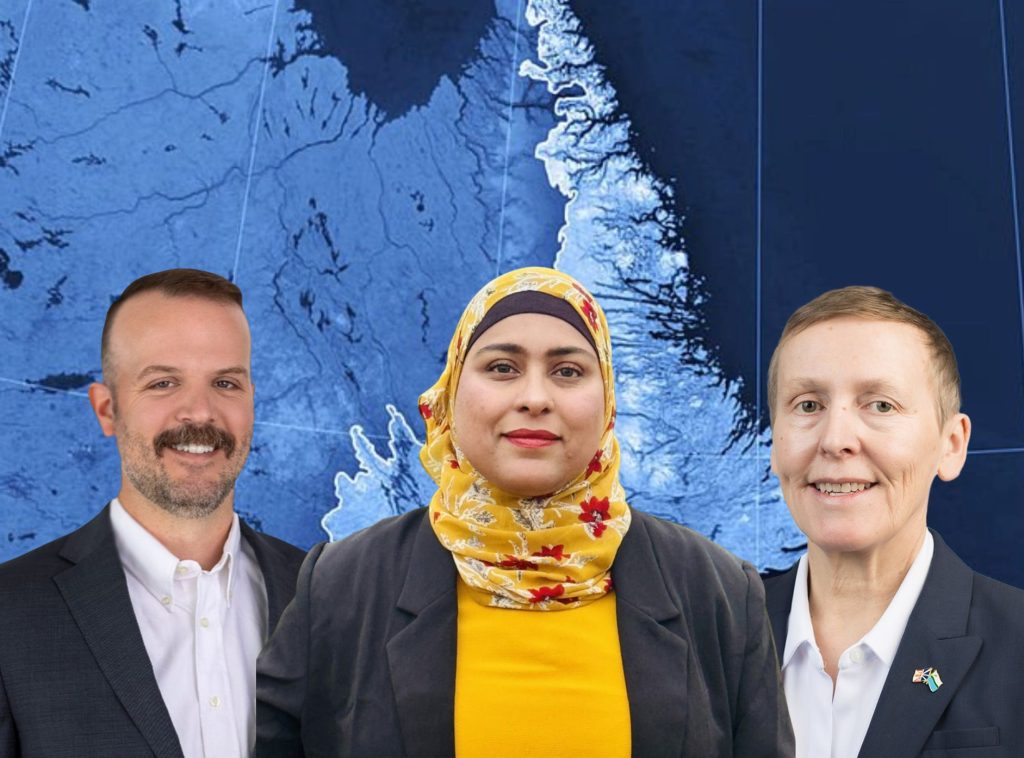
Labrador has four seats in the House of Assembly, representing 10 per cent of the legislature. While the mainland part of the province has just six per cent of the province’s population, it also accounts for around 72 per cent of Newfoundland and Labrador’s total land mass, much of which is Innu or Inuit territory and home to natural resources the province wants to develop, like minerals and hydroelectric power.
As Labradorians head to the polls on Tuesday, here’s what the parties and some of their Labrador candidates are saying on issues impacting communities across Labrador.
Indigenous Rights
When the Truth and Reconciliation Commission (TRC) released its final report 10 years ago, the federal and most provincial and territorial governments committed to implementing the commission’s 94 calls to action, around 30 of which fall under or relate to provincial jurisdiction.
Will you stand with us?
Your support is essential to making journalism like this possible.
Call to action 43 calls for all levels of government to “fully adopt and implement the United Nations Declaration on the Rights of Indigenous Peoples (UNDRIP) as the framework for reconciliation.”
Only the provincial NDP has committed to implementing UNDRIP in provincial law. “We will be introducing legislation to adopt [UNDRIP] with the clear, achievable benchmarks and timelines for implementation,” Shazia Razi, NDP candidate for Labrador West, told The Independent.
The NDP platform doesn’t explicitly mention the TRC or the National Inquiry into Missing and Murdered Indigenous Women and Girls (MMIWG) final reports, but Razi says the party is “committed to implementing all of those calls to action, and we will also work with the Indigenous governments and organizations as partners in determining those benchmarks and timelines based on what those governments identify as their most pressing needs.” Razi says an NDP government would not announce any policies “without first engaging and working with Indigenous partners.”
PC candidate for Torngat Mountains and incumbent MHA Lela Evans, who was first elected to the House of Assembly in 2019, says Indigenous people are “being failed at the basic level,” and that in order to begin solving the multiple crises facing people in Labrador, “we got to ensure that they have the basic needs looked after.”
Evans says “all levels of government” are failing Indigenous communities, particularly on the north coast, whether it’s access to nutritious foods, adequate healthcare, housing, or adequate education.
She says the issues identified in the TRC’s final report, the MMIWG final report—which was released in 2019—and climate change mitigation, food insecurity, and other issues are all related. “I tell people that you can’t talk about one thing without talking about the big picture.”
Evans points to the TRC’s calls to action that deal with Indigenous children in state care. “Well, how can you get your children back from CSSD, from in care, if you can’t afford nutritious foods?”
She also points to the cost of heating homes in northern communities, the cost of airfare, and barriers to accessing healthcare for medical patients who have to travel from the north coast to Happy Valley-Goose Bay or elsewhere in the province. “Our patients can’t get out to their appointments or they can’t get back,” Evans says. “It means that sometimes people choose whether or not they are gonna try to go to their doctor appointment.”
The PC Party devotes a section of its platform to reconciliation, saying “truth and reconciliation means being honest about the issues facing Indigenous Newfoundlanders and Labradorians and being proactive in making meaningful changes to deal with the wrongs of the past that are still impacting people today,” it says. “This can only be accomplished by listening and working together as partners. Imposing solutions without true consultation does more harm than good.”
If the party forms government, it promises to “continue implementing the recommendations of the Truth and Reconciliation Commission and the Inquiry Respecting the Treatment, Experiences and Outcomes of Innu in the Child Protection System […] in true partnership with Indigenous communities.”
The Inquiry Respecting the Treatment, Experiences and Outcomes of Innu in the Child Protection System is ongoing but expected to conclude in the coming year.

The PC platform also makes a vague commitment to UNDRIP, saying the party would “[m]ake progress on the implementation of the United Nations Declaration on the Rights of Indigenous Peoples.”
Liberal Party candidate for Lake Melville Shaun MacLean says the province has a “responsibility to address these wrongs,” and that “it’s important to work with Indigenous governments to address the calls to action.”
MacLean says the “provincial government has a responsibility to address violence prevention,” and that the Liberals would sustain funding to community groups addressing intimate partner violence and violence against women.
The Liberal Party has been in power since the TRC report was released a decade ago and doesn’t appear to be tracking its progress on implementing specific calls to action. The party’s platform doesn’t mention the TRC calls to action or the United Nations Declaration on the Rights of Indigenous Peoples.
A government spokesperson told The Independent in an email that the provincial government “is in the process of implementing the Truth and Reconciliation Commission Calls to Action and the Missing and Murdered Indigenous Women and Girls Calls for Justice that are within provincial jurisdiction,” and that “provincial actions are being undertaken in collaboration with Indigenous Governments and Organizations.”
When asked specifically which calls to action and calls for justice have been implemented, and whether the government is tracking its progress, the Office of Indigenous Affairs and Reconciliation did not respond to our requests.
Food insecurity
Evans wants greater transparency around the price of food in Labrador’s Northern stores, which receive federal funding through the Nutrition North Subsidy Program. She says that program is failing north coast residents.
The PC platform says the party would “push Ottawa for a fair food fishery that gives Newfoundlanders and Labradorians the same access to codfish as the rest of Atlantic Canada,” which it says would “increase food sustainability and safety on the water.”
The PCs also say they will “increase the availability and affordability of food in Labrador, giving special attention to fresh products and produce.”
Razi says food insecurity is a priority for her too, and that the NDP “recognizes that the food prices are extremely high […] especially for these remote regions on the north coast of Labrador.
“We will make sure the government would sit down with the Nunatsiavut Government and Innu Nation to work together to identify alternative means of transportation [to get] basic goods to these communities. We will also re-examine the current contract with the Woodwards to determine whether the province and the people of the north coast [are] getting good food value for money, for the services offered. We will also examine the ability of bringing back a freight boat to supplement shipping services to the north coast.”
Razi says it’s “extremely important to help communities maintain and regain autonomy when it comes to food supply.”
The Liberals’ platform notes that through the Agriculture Sector Work Plan, the Liberal government “worked with farmers and fish harvesters to increase food security to 20 percent since 2015,” and that if re-elected, the Liberals would “establish a cross-sectoral working group with industry and other community partners with the goal to further increase food security.”
MacLean says the Liberals would advocate for more funding for the Nutrition North Subsidy program to help offset the high prices of nutritious foods in stores on the north coast.
“We will also look into more grants and funding for more community gardens,” he adds. “We know that community gardens may help community members to have more access to nutritious foods.”
Climate change
The “Taking Action Against Climate Change” portion of the Liberals’ platform is four sentences and reiterates the party’s plan to “reduce greenhouse gas emissions by 30% by 2030 and 60% by 2040, with a long-term goal of achieving net-zero emissions by 2050.” It plans to do this while expanding the province’s oil and gas sector, which the International Energy Agency and leading climate scientists worldwide have said cannot happen if we want to limit global warming to 2 degrees.
MacLean says “there are a lot of different layers” to addressing the climate crisis, and that the Liberals “will look into different renewable resources projects that may potentially help community members of Innu and Inuit communities on the north coast of Labrador.”
The PCs say in their platform that a Progressive Conservative government would “create a more attainable Climate Change Action Plan with clear and achievable emission reduction targets, by sector, and report on them regularly.” At the same time, the party says, it would “continue to promote Newfoundland and Labrador oil on the world stage due to its low carbon footprint and the efficiency of our industry.”
Evans says if the province “properly transitions away from fossil fuels—or the reliance on fossil fuels in our infrastructure, like our services—not only would it be helping the environment, [but] we’re ensuring economic prosperity and growth for future generations.”
She says if Newfoundland and Labrador doesn’t begin transitioning to renewable energy “as the demand goes down, it’s really going to impact us as a province.”

Razi says Labradorians are “living through the effects” of climate change, pointing to the 2023 Cain’s Quest snowmobile race that was called off partway through due to warm weather conditions.
“We recognize that the north coast of Labrador is predicted to warm rapidly in the coming years, which will have great impacts on the way of life of the people in that region,” she continues. “It will be disrupting the traditional transportation patterns and food supplies.
She says an NDP government would take a “proactive approach” and begin preparing immediately to help people on the north coast. “One of the first things that we will do as an NDP government is set up new funds for climate resilient infrastructure that municipalities could apply for,” she says. “We will also have projects to improve transportation routes [and] continue to support the investment of feasibility studies and other works to examine the viability of the roads to the north coast, and discuss ways to support the construction of a new air strip in Nain with Nunatsiavut Government.”
The NDP is also promising to phase out oil and gas industry subsidies. Razi says the party will develop more “climate-focused jobs” and strengthen wildfire prevention and responses.
Search and Rescue
Evans also addresses the need for search and rescue stations in Labrador. “I don’t think there should be just one,” she says. “When you look at the Labrador coastline, it’s too large to cover with just one.” Search and rescue is about a “timely response,” more than anything, she continues. “If you have to travel vast distances to get to where an incident is occurring, and look at the conditions that the people are in […] it is not only about drowning, but the risk is also hypothermia.”
Razi wants to see a primary search and rescue station in Labrador. “We as New Democrats are frustrated, frustrated by and cannot understand the logic behind the refusal of the federal government to place a SARS station in Labrador. It just boggles my mind to see why this hasn’t happened yet.”

While search and rescue stations fall under federal jurisdiction, and NDP government “would lead the charge on lobbying the federal government” to have one established. “We would unite the voices calling for a SAR station […] until the government sits down with us to commit to setting one up and to a timeline for doing so. We will be advocating for immediate provincial measures to strengthen ground and seasonal SARS where possible […] and we will also be pressing the federal government for a permanent primary Marine Air SARS station for Labrador.”
Liberal party candidate for Lake Melville MacLean says, “we cannot have another story, we cannot have someone else pass away,” recalling the stories of Labradorians who have been lost and in need of a faster response time from search and rescue in the province.
“Our party is committed to advocating to the federal government for at least one SAR station in Labrador,” MacLean says. “The Liberal Party will work on addressing this for the safety of everyone in Labrador.”

Author

Related Articles
PCs have no plan to meet ambitious housing targets
Finance minister pins housing hopes on federal funding, says his own portfolio of rental properties doesn’t put him in a conflict of interest
Photos returned to Innu ahead of Labrador exhibit showcasing history, culture
Cultural Guardian Jodie Ashini hopes the archival photographs will help strengthen youth’s connection to Innu culture, and ultimately improve mental health

Can N.L. have oil and gas, and climate targets too?
Finance minister says yes, but ATI requests show there’s no plan for how to do both — and reveal significant unpublished emissions estimates