
A housing corporation without a housing mandate
The Liberals and PCs have no right to point fingers at each other in response to the auditor general’s scathing report on social housing
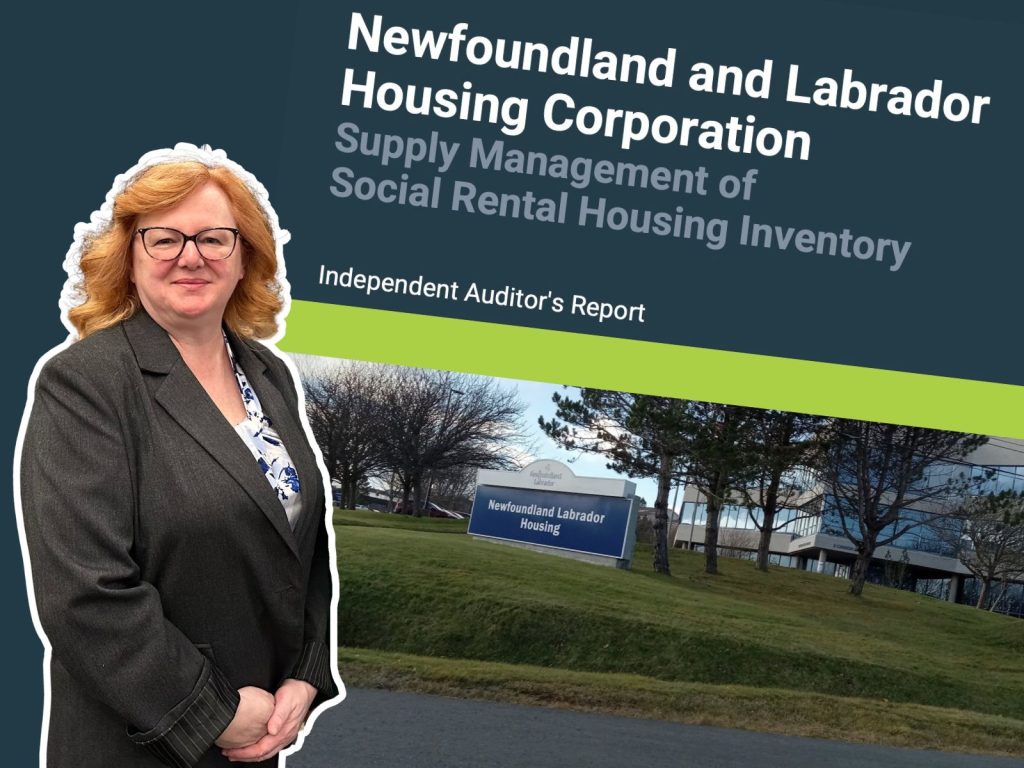
Newfoundland and Labrador’s auditor general thinks the provincial housing corporation should be making active efforts to provide an adequate supply of affordable housing to residents. But that conflicts with the crown corporation’s present role of maintaining institutional inertia while the housing crisis rages on.
Last month Auditor General Denise Hanrahan released a report detailing a host of issues at Newfoundland and Labrador Housing Corporation, with a laundry list of unmet expectations and examples of the corporation failing to follow its own policies. “I have deep concerns about the Newfoundland and Labrador Housing Corporation’s ability to effectively carry out its mandate with respect to social rental housing,” she said.
There are, no doubt, organizational culture issues at play within the corporation, but most of all this is a failure of instruction rather than a failure of execution. The provincial government needs to decide that housing will be a priority and direct the NLHC to act accordingly, rather than continue to sit on its hands while the situation becomes increasingly dire.
The report’s core thesis is this: NLHC “did not effectively manage the supply of social rental housing inventory to meet the needs of Newfoundland and Labrador during the audit period.” And the basis for this is mainly a lack of demand forecasting, poor asset management, failure to follow policies with respect to tenancy, and delays in moving on announced funding for new housing construction.
Will you stand with us?
Your support is essential to making journalism like this possible.
The auditor general found that new social housing construction happens “on an ad hoc basis,” an accurate reflection of the current practice in the absence of any sort of cohesive strategy or planning around housing and homelessness at the provincial level. She also highlights governance issues and failures to apply the corporation’s own policies in practice.
What is the housing corporation for?
Hanrahan’s report is predicated on the assumption that NLHC exists to meet housing needs and should expand its supply through proactive pre-planning when residents’ housing needs increase. The trouble with this assumption is that it does not reflect the reality of the role given to NLHC by the province.
Newfoundland and Labrador’s social housing supply has remained relatively static over the past five years despite the worsening housing crisis. Expansions both in the corporation’s own portfolio – as well as funding for community housing providers and the private sector to construct affordable housing – have been sporadic, time-limited, and all presently have no known plans for renewal or expansion. Hanrahan repeatedly emphasizes that NLHC does not do any sort of demand forecasting, which makes perfect sense in context: if the corporation has not been given direction or resources to respond to ballooning rates of housing insecurity, there is no reason to collect such data.
Beyond the corporation’s failure to grow its portfolio in tandem with growth in housing insecurity, Hanrahan points out that with social housing units being sold into the private sector or being otherwise removed from NLHC’s inventory, the social housing stock saw a net decrease of 57 units. In the same period, the waitlist for housing grew 71 per cent. This doesn’t take into account the 5.3 per cent of NLHC units that sit vacant or are otherwise “unavailable for use” – a vacancy rate two and a half times that of private rental housing. That’s despite the infusion of tens of millions of dollars intended for the construction of 104 new units, just four of which were under construction 16 months after budget approval.
Taken together, these metrics paint a damning picture of the extent to which the province has failed to provide an adequate supply of affordable housing to its residents. This is not a system under strain – it’s one shrinking in the face of rising need.
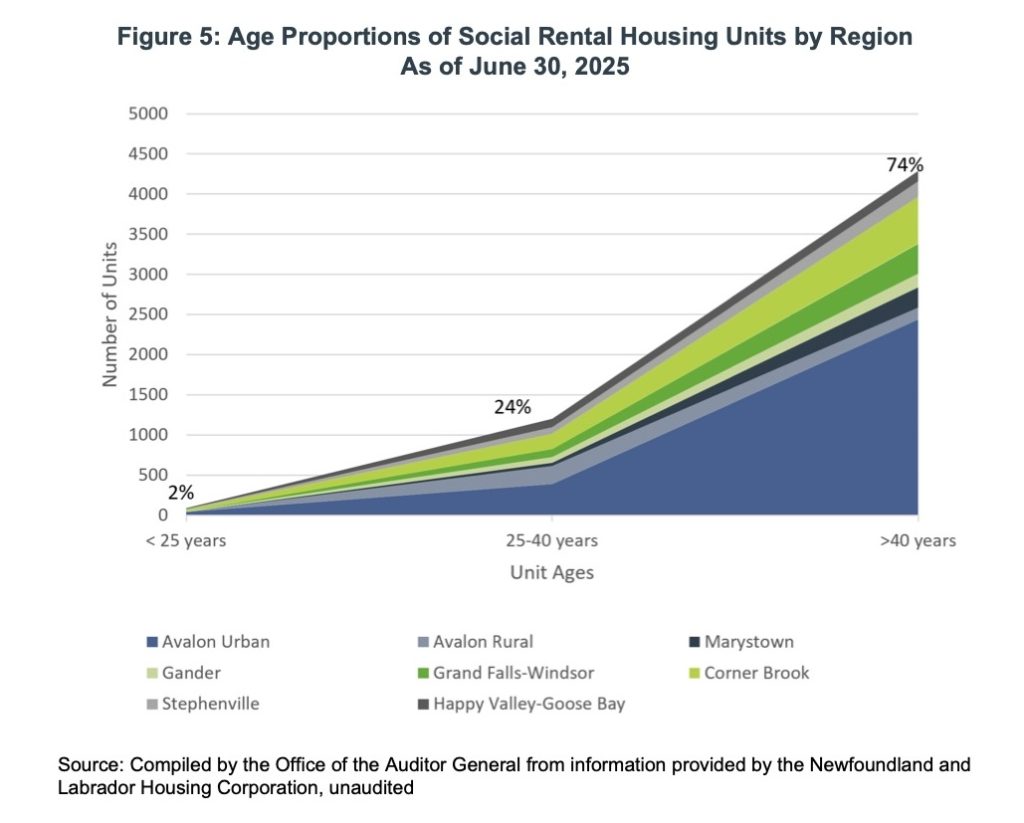
The report identifies insufficient role clarity, too. Does the corporation’s CEO take direction from the NLHC board, or from the housing minister? In both cases, no one is giving the direction to meaningfully respond to the housing needs of Newfoundlanders and Labradorians. The best efforts of the recent past have been marginal, evidenced by this graph showing the age of NLHC’s portfolio and revealing a paltry two per cent of units constructed in the last 25 years.
Mandate misalignment
The housing corporation’s website describes a vision “where everyone has a safe and affordable place to call home.” This language differs strikingly from the mandate described on the same page: “to develop and administer housing assistance policy and programs for the benefit of low to moderate income households throughout the province.” The corporation is, strictly speaking, doing the latter: providing some housing for some low-income households. Nothing in its mandate speaks to the vision statement’s “everyone,” which is evident in both the auditor general’s report and in the housing corporation’s practice. Without any direction or resources aimed at actually aligning NLHC’s actions with the housing needs of Newfoundlanders and Labradorians, Hanrahan’s findings are predictable.
Her report recalls a 2008 audit which found many of the same issues, after which the PC government of the day said all recommendations had been implemented. A report I wrote in 2024 identifies many of the same issues from 2008, including misalignment of units with demand, extended vacancies in areas with large waitlists, and sales of units in areas of high-housing need. The auditor general points out that, in one case, 19 units were sold at a rate of a little over $13,000 per door. In another case, in Burin, five units were sold because “they were vacant for an extended period, had been permitted to fall into disrepair, and local developers expressed interest in purchasing them,” despite 86 households waitlisted for social housing in the area.
Hanrahan’s considerations of the NLHC’s applications of policies relating to “over-housing” – tenants living in units with more bedrooms per person than the National Occupancy Standard – is an interesting case. While the NLHC may not be removing tenants from units where this is the case, the established lack of a sufficient supply of smaller units, paired with the overwhelming waitlist for those units units, means there are two potential paths of action if the corporation wishes to promptly address the matter: evict tenants from social housing altogether which, with low vacancies and high costs in the private market, likely means evicting them into homelessness or housing insecurity; or, move tenants into smaller units as they become available – which happens at an exceedingly slow rate – and extend the already lengthy wait time for the thousands of households on the list.
While the auditor general’s role is not to evaluate the policies themselves, it’s impossible to apply this one in a way that’s not ethically dubious and – given what we know about the costs of homelessness when compared to social housing – financially irresponsible.
Likewise, Hanrahan finds the housing corporation’s lease renewals were not performed consistently, including verifying residents’ income to confirm their eligibility for social housing. The income cut-off for social housing eligibility is $32,500, which sits well below most conventional measures of poverty. For example, the market basket measure – a metric which indicates the cost of a modest standard of living – was just under $53,000 for a four-person St. John’s household in 2024.
It’s not the auditor general’s job to discuss the quality or relevance of policies, but her comments on income testing – including reporting a single instance of a household’s earnings orders of magnitude greater than the cut-off – fall flat in this context. The desire to align social housing resources where the greatest need exists is understandable, but highlighting a single instance of the 40 sampled cases contributes to stigmatizing views of those who access social services. A more systems-level view of these policies and practices might highlight that many households experiencing housing insecurity aren’t eligible for public housing; it also might consider better alignment between the income required to actually afford private market housing and the eligibility thresholds for social housing.
Not a new crisis, but still no crisis response
Housing Minister Joedy Wall has blamed past administrations for the housing corporation’s failures, but in their first five months as government the Progressive Conservatives have done little to address the matter. In the case of social housing, responsibility can be assigned to both parties. The auditor general’s 2008 report found that many of the same issues existed during the PC’s long reign from 2003 to 2015. Neither the Liberals nor the Conservatives have the right to point any fingers here; the inaction and absence of leadership is decades deep and the blame rests on all shoulders.

Particularly galling in Minister Wall’s response to the report is his suggestion that “the onset” of Newfoundland and Labrador’s housing crisis happened in the recent past, when 2016 Statistics Canada data indicate that, a decade ago, 39.5 per cent of tenant households and 10.6 per cent of owner households were living in unaffordable housing. While it’s clear a long history of inaction will take time to undo, using Hanrahan’s damning report as fodder to throw rocks at the opposition while Newfoundlanders and Labradorians continue to experience incredible hardship instead of taking action — well, that hardly inspires confidence.
Last week the government hosted a “special debate” on the report in the House of Assembly, but that too offered little beyond a game of political hot potato and an empty motion encouraging government to take further action without substantive specifics on which actions ought to be taken. Given how long the current government has been in office, and that few details on its plans to address the housing crisis have been offered beyond a policy review (which is a direct response to the report), it’s hard to feel this has been, or will be, a priority.
I have long said that governments need to earn the right to use the phrase “housing crisis” with a corresponding crisis response. After five months in office, and with precious little action to point to, the PCs haven’t earned that right.
One can only hope the auditor general’s incisive remarks will serve as a catalyst for strategic and co-ordinated action to address the depth of need for affordable housing in Newfoundland and Labrador. The province must give the NLHC a real mandate for change and a clear directive to meaningfully answer to the housing needs of Newfoundlanders and Labradorians.

Author

Related Articles
Budget 2026 does not meaningfully address housing insecurity
A provincial budget delivered in the midst of a housing crisis should have something consequential to say on the subject of housing
National housing report misses the mark on real human impacts in N.L.
Newfoundland and Labrador’s B+ on its progress to increase housing supply doesn’t paint an accurate picture of residents’ lived realities in the province
The case for affordable housing
Whether you’re concerned with human rights or simply with dollars, investing in affordable housing makes sense