
Throwing shade on solar myths
‘Someday the sun will shine and have-not will be no more,’ Brian Peckford famously said. Solar ‘someday’ can’t come soon enough, writes Angela Antle
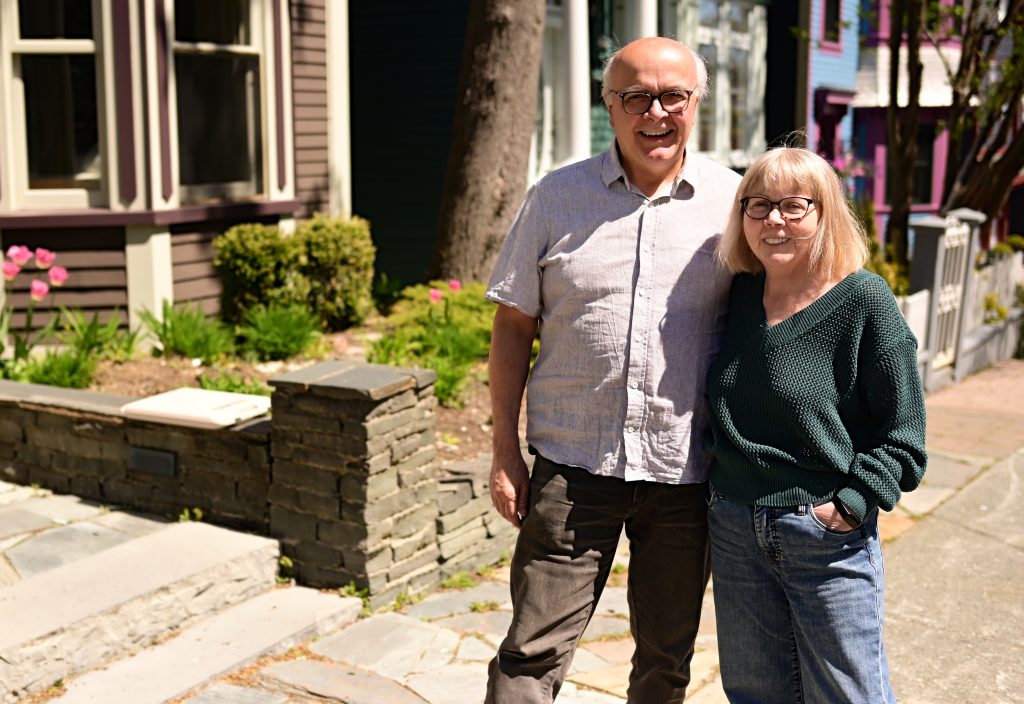
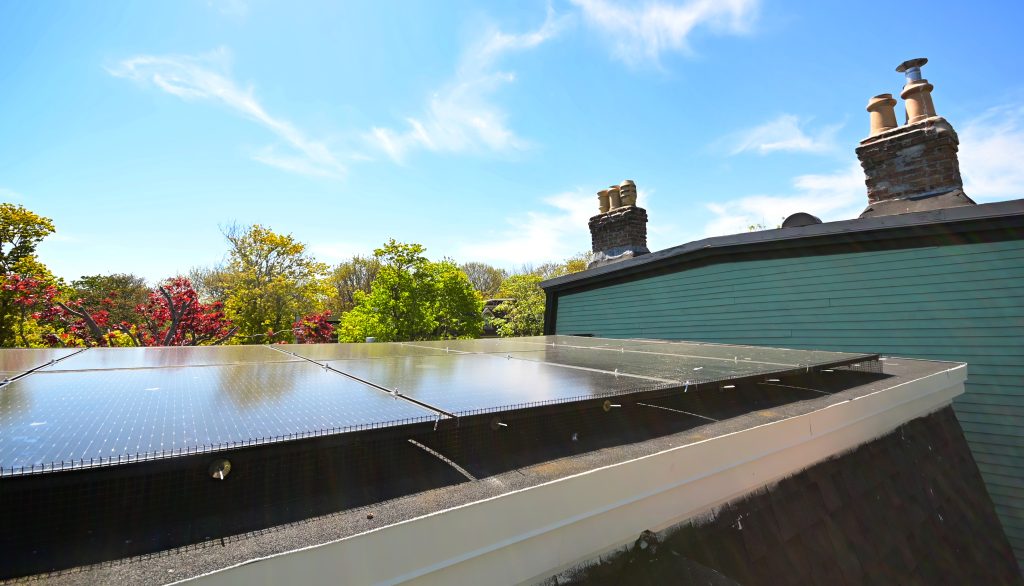
Renee Keough and Sean Penney live in a 19th century home in downtown St. John’s. The sun is often blocked by neighbours’ houses or the large oak in their front yard. Their roof is also flat, making it “not ideal” for solar panels. In fact, “you probably can’t get much worse,” says Keough.
Despite their impeded access to direct sunlight, almost a quarter of the couple’s energy needs are met by the solar array on their roof. They also sell excess power back to the grid via the province’s net-metering program.
Penney and Keough are among this province’s early solar adopters. With fewer than 100 solar projects currently connected to our grid, it’s not like the technology is taking off here. But Keough and Penney are passionate about renewable energy (they also drive an electric vehicle) and, convinced that solar power was possible here, they dove in.
Myth #1 — N.L. does not have enough sun
Will you stand with us?
Your support is essential to making journalism like this possible.
Ashley Smith, a St. John’s-based climate change consultant with Fundamental Inc., slays the myth that Newfoundland and Labrador doesn’t get enough sunshine for solar power.
“Solar panels need ‘light’, not ‘sunshine’ to produce electricity. They need the type of radiation that our eyes and brains interpret as ‘the visible spectrum’ to make electrons jump their orbits and create the ‘flow’ of electricity,” she explains. In fact, she says, the province’s cooler temperatures make solar panels more efficient here.
“Solar panel power production decreases as the panels themselves heat up – so the sunny cool days, or bright overcast days, or sunny days with wind, will all maintain a higher production overall than a hot summer sun.”
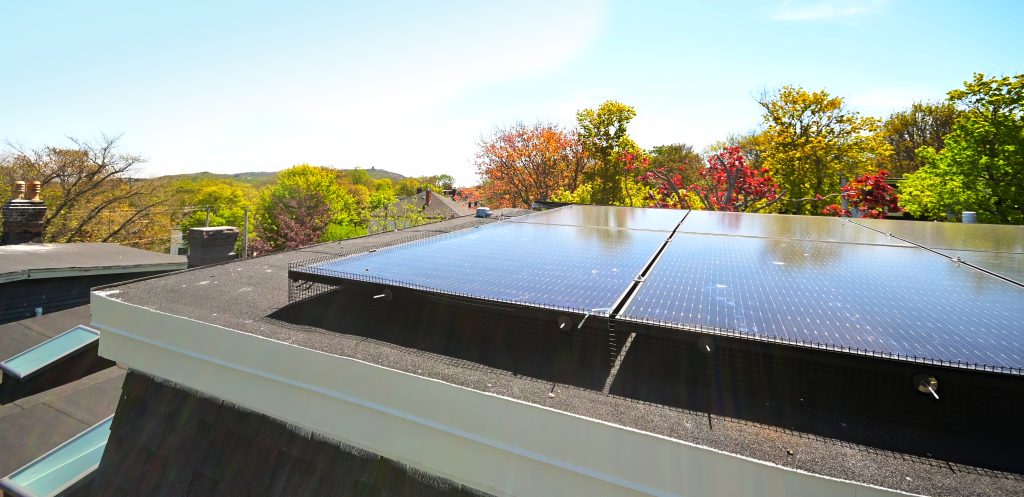
The Keoughs’ experience affirms Smith’s claims about daylight versus sunlight. “We have enough sun,” says Keough. “When there is daylight, electricity is being produced by our solar panels. That means foggy days, rainy days, snowy days.” Keough says the couple had just one day in the 16 months since their solar panels were installed when no energy was produced. “It was the day after a snowstorm and the panels were still covered in snow,” she says. “The next day we were back to production.”
Keough and Penney used the (now-dormant) Canada Greener Homes interest-free loan program to purchase and install their solar panels. They’ve been solar-curious for decades, ever since Penney bought a solar cell home in the ’80s just to see what it was all about. “At that time what it could produce in terms of energy was enough to power [a radio], and only in bright sunlight. The music would fade as a cloud passed over,” Keough recalls. “We also used it once to trickle charge a car battery.”
Last year, Keough and Penney produced more than 7,000 kWh with their solar panels. “Our house and car required 31,995 kWh, so we bought 24,923 kWh [from NL Power],” Penney explains. “Some [41 per cent] of what we produced by solar was sold back to NL Power, and 59 per cent was used directly for our EV and house.”
Myth #2 — N.L. is too far north for solar power
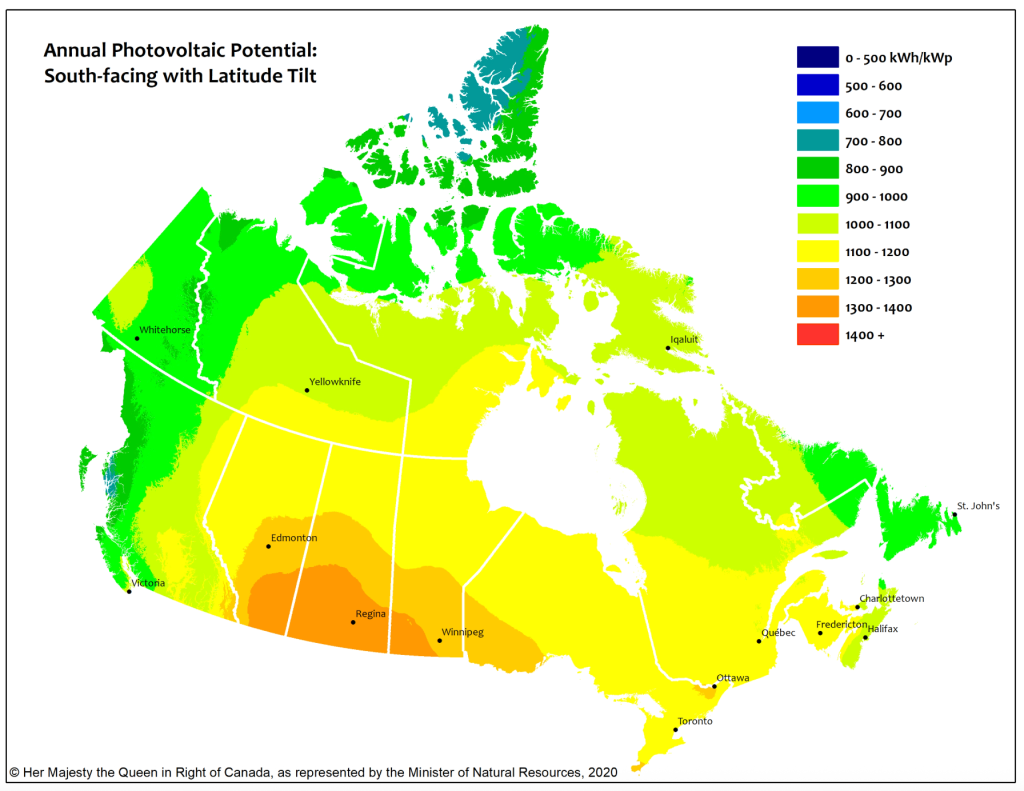
Measuring the sun’s ability to produce energy in a particular location is described as ‘solar production value’ (SPV). Ashley Smith says the federal government measures the island’s SPV at around 950, and most of Labrador at around 1050, pointing out that Newfoundland and Labrador’s solar values are higher than Berlin and Tokyo’s SPV of 700.
Myth #3 — Solar power is unreliable
Bill McKibben of 350.org and author of Here Comes the Sun, calls solar the “Costco of energy,” arguing it’s “cheap, in bulk, and available off the shelf” at a time when we “can’t depend on fossil energy.” The renowned climate advocate points to research showing that the cost of solar has now fallen below oil and gas — a point further reinforced by global geopolitical instability that has resulted in even less predictable availability and pricing of oil.
McKibben’s book details how since 2024, the world’s fifth-largest economy California has been generating 100 per cent of its electricity from solar most days (with the help of batteries). The Cali solar revolution represents a 25% drop in natural gas use in that state from 2023 to 2024. While the illegal US war in Iran may be temporarily boosting oil and gas companies’ bottom lines, McKibben is betting on a longer term sea change in the acceptance of renewable energy. Facetiously, he says, “without meaning to, President Trump is speeding up the world’s conversion to renewable energy.”

Plug-in PV
Also called ‘balcony solar’, plug-in Photovoltaic (PV) refers to solar panels with either a built-in inverter or an accompanying one that you plug directly into an electrical outlet. The solar energy flows from the panel into your electrical outlet and is then used by your appliances. How does that work? The solar inverter overrides the power coming into your home from the grid so that your appliances and lights run on solar first, before drawing on more costly grid electricity.
Mckibben says this form of solar power is transforming countries such as Pakistan, where balcony solar now generates half of the country’s electricity. The Pakistan government, he points out, recently turned back 24 boatloads of LNG from Qatar, preferring to pay a penalty because they no longer needed the gas to make electricity.
Plug-in PV is not yet CSA-approved for use in Canada, though the technology is being used in the US. CSA communications specialist Claire Brassard says the plug-in configuration falls outside the scope of the Canadian Electrical Code (CEC) and the National Electrical Code (NEC). But she indicated that CSA could soon approve the technology noting that in December 2025, they began an “outline of investigation’ through UL 3700,” to establish safety and performance requirements for plug‑in photovoltaic systems. However, Brassard says once CSA approval is achieved, access to plug-in for Canadians will ultimately rest with provincial and territorial governments, and utilities.
Community Solar Projects
Where a balcony solar system typically benefits a single household, community solar projects benefits more than one individual, family, or business. The start-up costs and benefits are shared with energy shared by neighbours, a town, or for example amongst co-op members. Sometimes the projects are on closed-loop microgrids, meaning the power created stays within the community, powering homes and businesses without excess energy flowing back to the grid.
In Nunatsiavut, there are five solar microgrid projects in Makkovik, Nain, Hopedale, Postville, and Rigolet. The Nunatsiavut Government website says the combined projects will produce over 70 megawatts of clean electricity annually and reduce GHG emissions by more than 60 tonnes, “which is equivalent to over 20,000 liters of diesel fuel per year.”
Nunatsiavut Regional Energy Manager Jamie Hewlett says the projects represent energy independence and are a, “significant step forward in how we generate and manage energy in northern and remote communities.” He says the projects “strengthen energy security” by diversifying Nunatsiavut’s energy mix and reducing reliance on fuel shipments, which he points out are “vulnerable to weather and logistical challenges.”
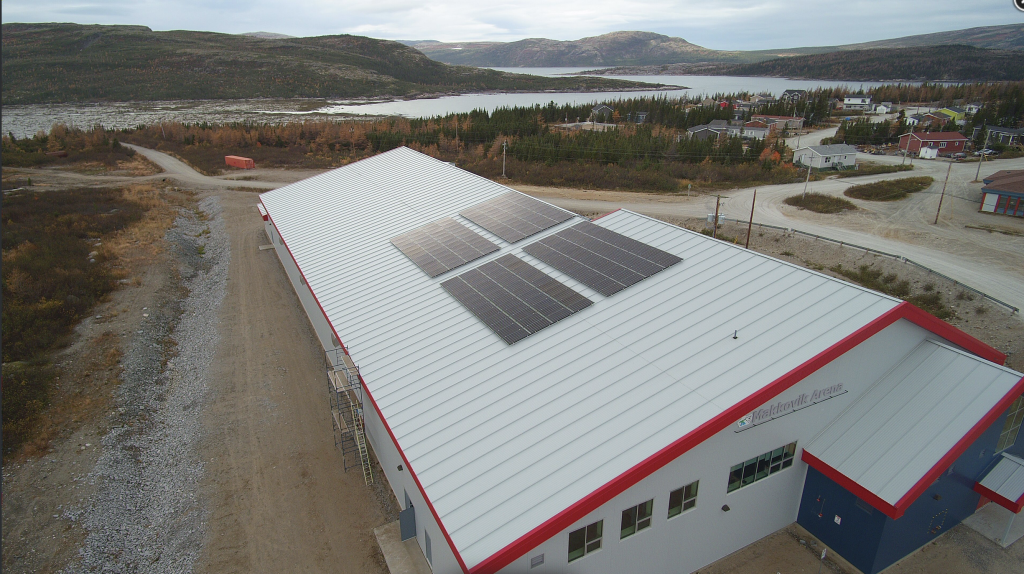
“By building, owning, and operating these systems locally, Nunatsiavut is developing the capacity to generate its own clean energy and retain the economic benefits within its communities,” Hewlett continues, explaining the projects operate under power-purchase agreements or net-metering arrangements, meaning the direct financial benefits — through reduced energy costs — “flow to the building owner, which in this case is the Inuit Community Government in each community.”
In Nunatsiavut, the biggest challenges encountered so far relate to logistics and the environment, such as “transporting materials to remote communities, short construction seasons, and designing systems that can perform reliably in harsh northern conditions,” Hewlett says. Coordinating projects across Nunatsiavut’s coastal communities also requires “strong partnerships and careful planning.”
Over time, Hewlett says, the community solar regime will not only reduce emissions, but also “create opportunities for revenue generation and reinvestment in the region in a way that aligns with [Nunatsiavut’s] sustainability goals.
“Solar is not only viable in Nunatsiavut,” he adds, “but an important part of our energy future.”
Domestic Rooftop Solar
Most people will be familiar with rooftop solar panels. Unlike balcony solar panels, rooftop solar arrays are made up of heftier, longer lasting (tier-1) panels that are professionally mounted on your rooftop and wired into your electrical panel like the solar panels on Penney and Keough’s roof. “In the summer there are days we produce more than 100 per cent of what we use,” says Penney. “And every day of the year we produce some solar electricity and thus offset the cost paid to NL Power by that amount. So the benefit translates into less paid to NL Power or we sell to them and they credit our account.”
A 6-step how-to for domestic rooftop solar in NL
Eamon Minty, a Stardust Solar rep in Newfoundland and Labrador, lays out the roadmap for going solar.
- Size up your bills: An installer will assess your average electricity consumption and determine how many panels you will need and what impact they can have on lowering your bills.
- Size up your roof: Minty says they will use satellite imagery of your roof to determine size and solar capacity. A southern-facing roof, for example, will create more energy than a northern-, eastern-, or western-facing roof.
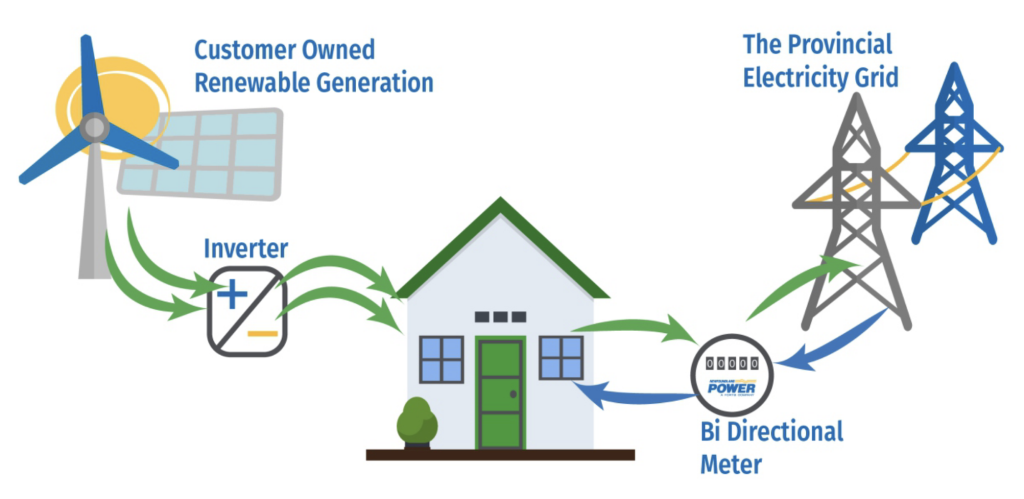
- Change your electrical meter: When you install solar, you sign a Net-Metering Agreement with NL Power. Minty says once the system design has been agreed upon, the installer puts in the request, the client signs the agreement and pays for a $450 bi-directional smart meter. That meter logs what you pull from the grid and what you send back to the grid from your solar array. If you use more regular electricity than you generate with solar, you pay the difference. If you generate more solar electricity than you use, you are given credits for the difference. This means you can ‘bank’ energy credits in the summer months, then use them to offset costs in the winter months. This is all tracked on your monthly utility bill. NL Power zeros-out the account annually, so credits earned by the homeowner don’t accumulate as a liability for the utility.
- What about your electricity panel? Any panel size from 100amp all the way up to 800amp will be able to accept solar. In most cases, houses with smaller panel sizes have a smaller roof area, thus still allowing for the inclusion of solar. “Every now and then we’ll run into someone who has maxed their panel; in this case, an upgrade will be required. This upgrade can be a full service upgrade or the inclusion of a pony panel to take the solar load.”
- A battery is not necessary: A battery to store captured energy is an additional expense (upward of $20,000), that can be added later if you wish to store your solar energy instead of simply capturing real-time solar energy for your immediate use and selling excess back to the grid.
- The upfront cost: Stardust uses both Longi 500w modules and JA Solar 500w modules. Minty costs them at approximately $1,100 per panel which includes the solar module and other necessary components, like inverters, racking, rails and labour. He says the Longi panels are under warranty for 25 years to generate “80 per cent of their original capacity meaning after 25 years, your 500w modules will have degraded to 400w.” Using my 1200 sq foot home as an example, it’s estimated that I will need over 20 panels, which is a sizable upfront cost.
So why doesn’t N.L. have a thriving solar economy?
Barrier #1 — Upfront costs
Minty admits the high upfront cost of investing in solar is a barrier for many, explaining he has seen financing rates in the industry, “as high as 29.99 per cent of the value of your system for the longest loan period.” He says this barrier could be addressed with provincial government policies that incentivize solar. Currently Take Charge NL offers rebates of approximately $20,000 to transition homes from oil to electric heat or heat pumps, but they do not support the installation of solar panels. Some municipalities such as Mount Pearl offer small solar grants of $5000 to businesses.
Keough and Penney say solar was a good investment for them because once they paid the upfront costs, their access to solar energy remains constant, and their costs won’t increase. As an added bonus, Penney says, “the cost of buying from NL Power will continue to increase, [so too] will the cost per kWh they pay to us.”
High start-up costs aren’t the only barrier to building a solar economy in Newfoundland and Labrador, there are also a number of policy roadblocks.
Barrier #2 — The 5 MW aggregate solar cap
In 2015 the province released its net-metering policy framework, which put a five-megawatt limit on how much solar energy could be produced in the province. Under this cap, only early adopters able to afford the current high cost of (unsubsidized) solar will be able to access this renewable energy source. Once the 5 MW cap is met, NL Power will not permit any additional solar projects. Early adopters already account for “approximately 19.8% of the 5.0 MW aggregate capacity limit for net metering generation within the province,” the Public Utilities Board said last year. This represents a barrier because it introduces uncertainty.
Barrier #3 — The 100 kW cap on each installed solar system
Let’s talk kilowatts. Whereas a kW is a measurement of power, a kWh is a measurement of the use of energy over an hour. Here’s an example from Alberta’s Direct Energy “If you are running a 2 kW appliance, such as a clothes dryer, you only need to power it for 30 minutes to reach 1 kWh.”
N.L. Power’s 100 kW cap on solar systems favours smaller domestic users like Penney and Keough whose array, for example, is rated at a maximum output of 8.1 kW.
The 100 kW cap discourages larger community and commercial solar installations. In a 2024 submission for the provincial government’s Climate Change Action Plans consultations, Municipalities NL, which represents the many communities on the front line of the climate crisis, called on the provincial government to either increase or do away with the 100 kW cap. “As in other jurisdictions, there are significant opportunities here for municipalities to offset their energy use,” the organization says. “Town halls, community centres, hockey rinks – operating costs for all of these public facilities could conceivably be reduced as our renewable energy sector diversifies.”
Barrier #4 — A lack of solar incentives
On a recent bus ride in Halifax, I lost count of the rooftop solar arrays and wondered why we don’t see the same thing here in N.L. Dave Brushett of Solar Nova Scotia says that province’s Solar Homes Rebate (a PACE program – more on that to come) kickstarted residential solar installation uptake in Nova Scotia. “Then, when the [now dormant] Canada Greener Homes Grant and Loan Program came along, we had an existing industry that could continue to drive uptake. And it worked. Nova Scotia now has over 13,000 net metering installations (domestic and business) compared to just 83 in Newfoundland.”
Nova Scotia has what Bruschett calls a ‘right to solar’ law, whereby residents aren’t required to sign a net-metering contract with the utility — “and importantly, the utility cannot create fee structures or system access charges that discourage customers from developing, installing, and using their own renewable generation or energy storage,” he explains. “That’s an important consumer protection. It means rooftop solar isn’t just a utility program. In Nova Scotia, the right to generate your own clean electricity is protected in law.”
Nova Scotia has a thriving solar economy in part because the province amended its Municipal Government Act in 2010 to allow municipalities to enact what are called ‘property assessed clean energy’ — or PACE — programs. PACE programs provide “upfront capital for eligible projects and use municipal property assessments as the repayment vehicle over a set period (typically 10 to 20 years),” according to the Green Municipal Fund.
In Nova Scotia and other PACE provinces, municipalities can create bylaws to allow the financing and installation of renewable energy equipment for homes and businesses. The PACE incentives can take the form of rebates or low-interest loans, all managed by the municipality.
As of 2024, PACE-enabling legislation existed in Prince Edward Island, Nova Scotia, Ontario, Saskatchewan, Alberta, Northwest Territories and Yukon, but not in N.L.
I contacted Newfoundland and Labrador’s Department of Municipal and Community Affairs for an explanation as to why this federal money to encourage renewable energy is being left on the table. The department said it was aware of PACE, but it is not actively developing PACE-enabling legislation because, “ [it] would require careful review of several pieces of legislation, including municipal and assessment-related statutes, as well as consideration of potential impacts for municipalities, property owners, lenders, and taxpayers.”
How PACE supports clean energy: comparing N.L. to Alberta
Under PACE, Alberta offers incentives up to $500,000 to retrofit or build solar projects, combined with renewable heat and electricity generation systems on municipal buildings or land. Communities like Airdrie, Banff, and Medicine Hat also offer Clean Energy Improvement Program (CEIP) initiatives to support domestic solar by residents with up to $50,000 for residential properties, $1 million for non-residential properties, and $300,000 for farms. Participants’ annual CEIP repayments cannot exceed the annual municipal property tax amount over the lifetime of the measure.
Without PACE programs, solar in Newfoundland and Labrador is only accessible to those who can afford the high upfront costs. Why isn’t the province making the changes necessary to enable more citizens to access affordable and secure renewable energy?
While a solar revolution in Newfoundland and Labrador is technically possible, the caps, no access to PACE programs and the high upfront costs are all major barriers. A just solar transition would enable more affordable and more secure energy for all residents and communities. Solar installations could guarantee energy affordability, and dependable energy during emergencies as well as help rural communities transition from expensive, loud, inefficient, and polluting diesel. Not only would communities save money on energy costs, selling excess solar energy back to the grid could be a revenue stream.
To learn more about the possibilities of solar energy, Bruschett says he “would love to see representation from Newfoundland and Labrador at the December 2026 Atlantic Canada Solar Summit.”

Author

Related Articles
Why taxpayer subsidies for Big Oil won’t create more jobs
As Equinor delays Bay du Nord decision, report finds less than 1% of Canada’s jobs now in fossil fuels

Dear Mr. Wakeham: Climate changes aren’t coming — they’re here
Not only are wildfires caused by climate change, new research links the heatwaves that cause them to oil companies active in Newfoundland and Labrador

‘Close to panic level’: Survey respondents chime in on climate crisis
More than 100 readers responded to The Indy’s first climate survey, and almost all share deep concerns