
Billions for bombs, scraps for N.L.
The Carney Government’s planned military and defence spending will have impacts here at home
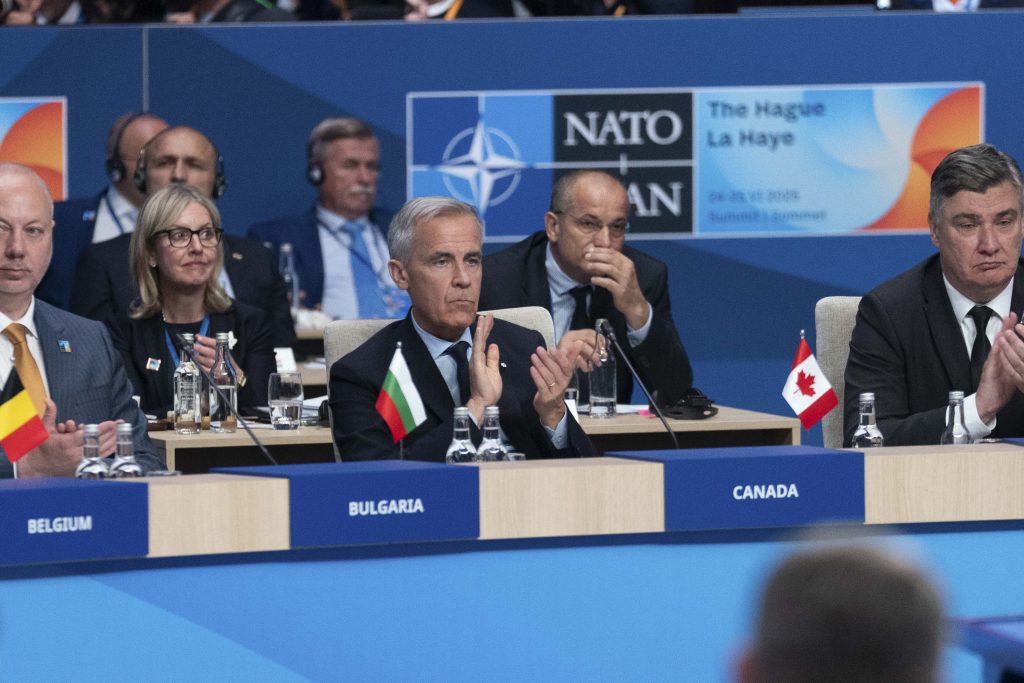
With emergency rooms overflowing and public services crumbling under the weight of austerity, the federal government has unveiled a $150-billion plan — not for hospitals, but for military arms.
On June 25, Prime Minister Mark Carney announced Canada will contribute a staggering five per cent of its GDP towards military spending by 2035 — which equates to about $150 billion yearly — bringing us in line with the North American Treaty Organization’s (NATO) new target. Carney also committed to reviewing Canada’s progress toward this goal in 2029, “to ensure [the country’s] expenditures align with the global security landscape.”
The Carney government has justified this ludicrous hike in military spending by framing it as an investment in our sovereignty. But at the same time the Liberals are selling that sovereignty down the river to Washington. Unfortunately, this is a pattern that seems to be repeating itself all over the globe. With most NATO members committing to spending 5 per cent of GDP on military, many countries are turning to American arms manufacturers to bolster their armies. There is, however, a notable exception to the 5 per cent commitment. Donald Trump has rejected the new target for his own country, while continuing to pressure Canada and others to pick up the tab by purchasing American-made weapons.
Canada’s protect-our-sovereignty justification comes amid growing instability in geopolitics. With escalating conflicts spanning from Eastern Europe to the Middle East, the Canadian government and its NATO allies are choosing to send lethal aid to friendly states in the region. In response to situations like Russia’s invasion of Ukraine, Canada has already committed $6.5 billion in military assistance since 2022.
Will you stand with us?
Your support is essential to making journalism like this possible.
Canada has also been criticized for dodging the Israeli arms embargo by sending Tel Aviv-bound artillery propellants through the United States. A full list of military shipments to Israel can be found online, much of which was sent after the so-called embargo of early 2024. With the growing tensions around the world, nations such as China, North Korea, and Russia have been meeting to discuss possible next steps.
The pros and cons of Canada’s so-called ‘investment in sovereignty’
With Ottawa throwing around this kind of money, some will surely wash up on the shores of Newfoundland and Labrador. Few realise there’s already a military industry here in the province. Paradise-based company Score recently landed a $89-million contract to produce components for the first three of 15 destroyer vessels for the Royal Canadian Navy’s new fleet of ships. This has created 10 jobs, with the “potential” for more as the project progresses.
Another company projected to benefit from Canada’s increased military spending is Newdock in the St. John’s harbour. While there have been no confirmed contracts signed, the company has refitted and maintained military vessels in the past. During a visit to the company on her campaign trail last March, and amid growing tensions with the United States, federal cabinet minister and St. John’s East MP Joanne Thompson told reporters that “crisis is creating work and opportunity in this city,” adding that the province will play a role in servicing ships operating in Canada’s north. “Who would ever have imagined that we would talk about our democracy being under threat or that we would talk about a need to have protection for our sovereignty for the north?”
Some tech companies, like Kraken Robotics of Mount Pearl and Virtual Marine in Paradise, are also optimistic about more defence spending landing on their doorstep.

In July, Atlantic Canadian companies in the defence sector converged in St. John’s for the annual Maritime and Arctic Security & Safety Conference. Atlantic Canada Aerospace Defence Association CEO Victoria Belbin told reporters Labrador will have a growing role in the realm of global defence and security, CBC reported, including with the existing 5 Wing Air Force base in Goose Bay. Gary Best, CEO of the Nunatsiavut Group of Companies, said he sees opportunity in developing the infrastructure required to facilitate Canada’s military expansion. “Helping the communities perhaps upgrade their airstrips, upgrade the existing ports, provide employment opportunities and […] build and maintain multi-use infrastructure,” he said. “That’s why we’re here talking to the defence industry and government people.”
Meanwhile, Indigenous leaders have been stressing the importance of respecting First Nations, Inuit and Métis Peoples’ rights and consulting with communities amid Canada’s military buildup in Inuit Nunangat, the homeland of Inuit in Canada. Madeline Redfern, COO of CanArtic Inuit Networks, told conference attendees in July that if Inuit “are not meaningfully consulted and we’re not involved, then we actually have a legal challenge in a legal case to demonstrate that Canada and the proponents haven’t fulfilled their obligation.”
The Carney government plans to reduce government expenditures by 15 per cent by 2029. The Prime minister recently admitted that Canadians should expect austerity in the coming years, with the public service sector forecasted to be impacted the most and layoffs on the horizon.
In July, CBC reported that internal emails from top bureaucrats at Indigenous Services Canada (ISC) told employees the budget cuts “will involve difficult decisions that will impact our programs and activities, as well as our workforce.” Funding for ISC, which was created in 2017 to “improve access to high quality services for First Nations, Inuit and Métis,” has already been set to decrease approximately 20 per cent by 2028. This is in addition to the Liberals’ 15 per cent cut over the next three years. As University of Ottawa law professor Anne Levesque recently wrote, Carney’s across-the-board cuts “will have disproportionate and unlawful impacts on First Nations peoples, in violation of the Canadian Charter of Rights and Freedoms and the Canadian Human Rights Act.” Levesque called the cuts “morally indefensible in a country that professes a commitment to reconciliation,” adding they “expose the government to significant legal liabilities that will cost taxpayers far more than any short-term savings.”
So much for reconciliation.
The costs of military spending
Former Parliamentary Budget Officer Yves Giroux was wary of Carney’s promise to even meet NATO’s previous military spending target of 2 per cent of GDP. Giroux, whose seven-year term ended earlier this month, told Bloomberg News in June the increased military spending “would require a major shift of government priorities, away from social spending.” Giroux also said new military spending could be financed by tax increases or a higher deficit, which translates to longer wait times at the DMV, fewer resources for our universities, and reduced funding for our healthcare system, which is already under tremendous stress.
In July, the Public Service Alliance of Canada (PSAC) said the Liberals’ sweeping 15 per cent budget cuts “look and feel like austerity and will hurt everyone in Canada who depends on vital public services.” PSAC National President Sharon DeSousa said “[c]utting jobs means cutting services. Full stop. It means longer wait times for passports, parental benefits and EI cheques, shuttered programs, and a government that can’t deliver for people in Canada.”
According to PSAC, more than 10,000 federal public service jobs have been eliminated in the last year alone, more than 2,000 workers have been given their notice, and thousands more job cuts are on the way. This means far fewer good-paying union jobs, even right here at home — jobs that are increasingly in short supply as we ship them off to the United States.
The same shipbuilding project that Score has been contracted to contribute to recently came under fire. Initially, the command management system on each of the ships — the infrastructure that controls the weapons, radar, and other intelligence equipment — was to be made in Canada by Canadian workers. Lockheed Martin Canada stated that it would use the locally-designed CMS-330 system as part of a focus on local industry. But after winning the contract Lockheed chose to use the American Aegis system that its parent company produces. Soon after, the U.S. State Department announced it would be selling the radars and additional software to outfit the new Canadian vessels as well.
This all means that the Americans will have full control over the supply of repair parts, upgrades, and future modifications for these new ships. For years to come, Canadian tax dollars will flow south of the border into the pockets of the American defence industry. The former procurement chief at the Canadian Department of National Defence responded to the situation by stating: “This is what happens when you exclude Canadian companies: You find yourself potentially being held hostage,” adding “[w]e don’t control the [combat management] system; the Americans do. Who knows what they are going to demand from us?”
Not too late to say no
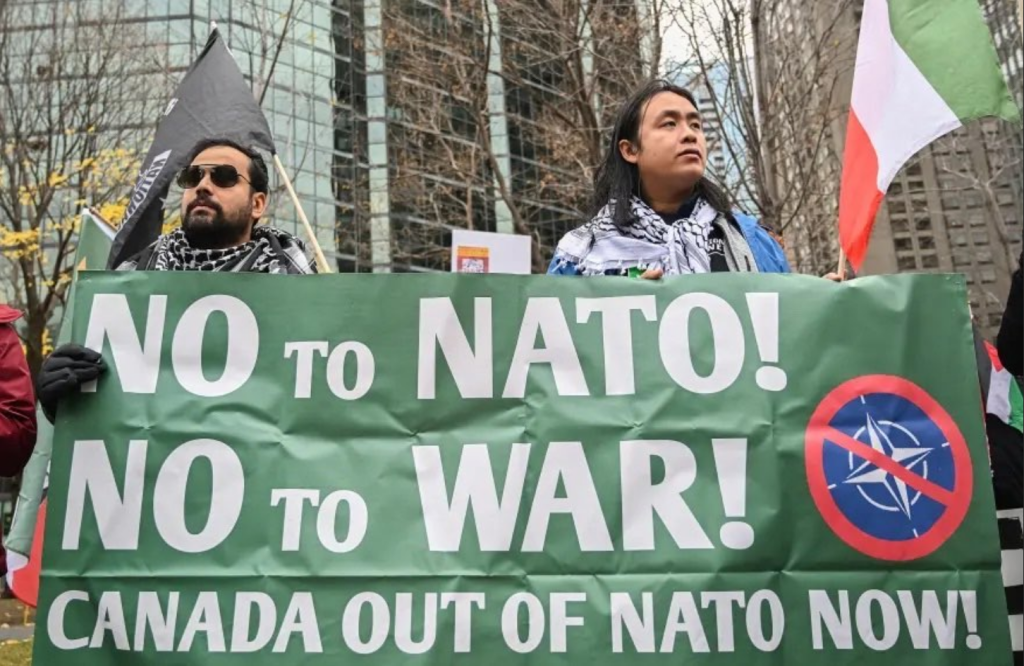
With little public debate, Canada is being pulled deeper into NATO’s orbit and military confrontations, from the Arctic to the Middle East. As of yet, the United States has refused to commit to the very target it is strong-arming NATO “allies” to adopt.
Canada can create its own path — away from economic subservience to the United States, from NATO, and from being dragged into foreign conflicts, toward caring for residents, Indigenous Peoples and others living within its borders.
Carney’s promised $150-billion yearly expenditure could be better served in so many ways, as People’s Voice argues, suggesting that investment could instead create 430,000 publicly-owned social housing units annually, solving the country’s housing crisis. It could also be used to construct more than 3,500 schools or 60 new hospitals every year, helping to relieve the overburdened healthcare system and ensuring our children have a bright future. Or 1.7 million full-time jobs that pay $40 an hour, raising the standard of living for Canadians from coast to coast to coast. Or it can line the pockets of arms manufacturers, while we send our best and brightest off to die in foreign wars.
At a time when schools are underfunded, hospitals are overburdened and thousands of public servants are being laid off, Canadians are being told to accept one of the largest military build-ups in our history, all in the name of protecting our sovereignty. But whose sovereignty are we really securing when the ships are fitted with American systems, the contracts go south of the border, and Indigenous communities are left out of the conversation? Newfoundland and Labrador may see scraps of this spending, but the costs could be far greater. As billions pour into bombs and battleships, we’re left wondering: who will defend us from our government’s own priorities?
We don’t need to accept this. Working people across this province and Canada are being told to scrimp and save while the government shells out your tax dollars to war profiteers. Dollars that aren’t building schools, staffing hospitals, or housing families. It means delayed Indigenous reconciliation, slashed union jobs, and the gutting of the public services we rely on. All for what? To grovel at the feet of American hegemony?
We must organize, mobilize, and demand that enough is enough. It is our future the federal government is selling off. Our children’s future. It’s time we demand a budget that serves people, not weapons dealers. The labour movement must lead the charge. Let’s build a Canada that invests in care, not killing. Let’s fight for peace, for dignity, and for each other.

Author

Related Articles

An LNG future for Fermeuse?
Proposal for massive liquefied natural gas hub exhumed on Newfoundland’s Southern Shore
Thinking beyond the crisis in journalism
There are many legitimate reasons for concern, but news media have an unprecedented opportunity to innovate and create a new era of journalism

N.L. long-term care needs more nurses, who need more time with residents
Only the NDP and PCs are committed to improving nurse-to-patient ratios