
Manufacturing an uber problem for gig workers
The provincial government and City of St. John’s recently welcomed ride-hailing giant Uber, apparently without concern for workers and riders alike.

After years of customers’ growing frustration with the taxi companies in St. John’s, Uber has finally arrived in Newfoundland and Labrador.
Those pushing for the ride-hailing company to be legalized have argued taxi wait times became unacceptably long (especially George Street pick-ups), or that they’d become too expensive.
But will Uber actually deliver real solutions?
The process that got us here demands we ask whether the government actually cares – because there’s plenty of reason to believe it didn’t.
Will you stand with us?
Your support is essential to making journalism like this possible.
Reporting by CBC NL last fall showed that Uber officials were basically telling provincial and municipal governments which laws the company wanted changed to begin offering its service in the province; and governments were very open to those requests. In October 2023, St. John’s Mayor Danny Breen told the public broadcaster that the city’s legal team was “asking ride-booking companies what they need written into a municipal bylaw to operate in St. John’s.”
Among Uber’s demands was that the company would be primarily regulated at the provincial level, instead of having to deal with the municipal rules that currently govern taxi services. It’s a tactic Uber has been using for years — starting with California in 2013 — to ensure it’s subject to more lenient regulations than taxi companies, and to make it harder for cities to rein the company in when the drawbacks of its operating model start to become more obvious. But in St. John’s, Breen was all too happy to relinquish that authority to the province.
CBC has already tested Uber against Jiffy and City Wide on a few routes in St. John’s and found the cost differences negligible. This is striking for a couple of reasons. If Uber is operating in St. John’s like it has in other markets, it tends to offer lower prices at first to get people hooked, then raises them over time. It also has much lighter regulations to follow than a taxi company, including fewer obligations to its drivers, which would theoretically lower its operating and labour costs.
I’ve been following Uber for the better part of a decade, and even wrote a book that dug into its business model. The data we have on the company shows that how Uber really works differs a lot from how it markets itself to consumers — which is a lot of what we heard in the lead-up to the provincial government’s decision to legalize it.
The assertion that Uber is so much cheaper than taxis and arrives so much faster was true during its heyday in the mid-2010s, when it was losing billions of dollars a year in its effort to capture market share from taxis and other ride-hailing services globally. The company burned more than $33 billion USD between 2014 and 2023, and only briefly turned a profit at the end of last year before going into the red again in the first quarter of 2024. But as it’s been forced by investors to show it can turn a profit in recent years, the service has quite significantly changed.
Uber has pushed up prices while further cutting driver pay to increase its profits. Since 2019, the percentage of the fare it takes for itself has increased from 22 to 28-29 per cent, which transport analyst Hubert Horan estimates was the equivalent of $1 billion USD a quarter taken out of the pockets of drivers and given to shareholders. Even one of the drivers CBC NL spoke with told them the pay was terrible: about $10 an hour after gas and insurance. That’s because of an even more shameful decision by the provincial and municipal governments to deny drivers for ride-hailing services any semblance of the rights that traditional employees can expect.
Taxi services actually have pretty strict regulations. On top of rules meant to keep passengers safe, municipalities regulate the number of taxis that can be on the road and the price they can charge to customers. That ensures consumers know what they’ll pay, but also that fares are set at a level where the driver can also expect fair compensation. If the roads are flooded with taxis, that means there will be too many drivers for too few fares, and they won’t earn enough for it to be worthwhile. But the Uber model, which the provincial government has affirmed, works much differently.
On Uber, there’s no regulation on the number of vehicles, little transparency into how the fare is calculated, and no wage protections for drivers. In short, there’s no obligation for drivers to even get paid a minimum wage — including in places like Toronto where drivers reportedly make as little as $6.37 an hour. The government effectively chose to make workers shoulder the burden of trying to fix the transportation havoc they caused.
Middle-class residents will get their Uber service, the city and province can go back to ignoring the problem regardless of whether it’s truly fixed, but workers who need extra cash to pay the bills as the cost of everything keeps escalating will have to accept the poor terms on offer. Meanwhile, allowing Uber to treat drivers as contractors means they won’t have to pay payroll taxes or workers’ compensation premiums.
When Uber was introduced in Newfoundland and Labrador last month, Premier Andrew Furey defended his government’s decision by arguing that “Uber exists in 10,000 cities.” What Furey didn’t mention is that many of those cities have acknowledged they made a mistake giving Uber the lenient regulations the company demanded. Now they’re trying to limit the number of Uber vehicles on their roads or force the company to do better by their workers, if not treat them as full employees.
Being late to the game with Uber meant Newfoundland and Labrador had the opportunity to learn from other jurisdictions’ mistakes. But Labour Minister Bernard Davis has basically said the province can learn those lessons later. Why be proactive and do right by the workers providing an essential transportation service?
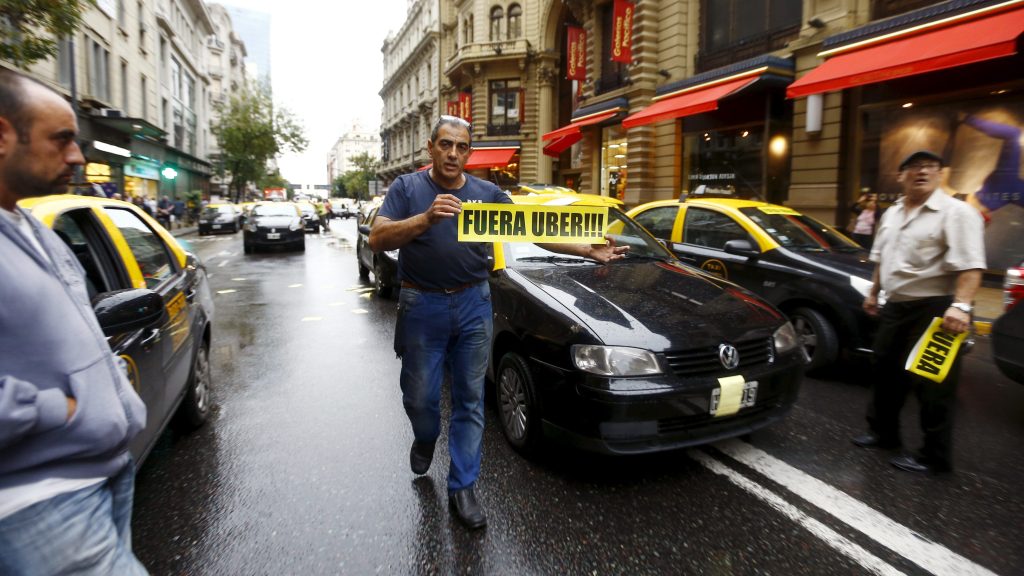
The reality is that the transport problem on the streets of St. John’s, the metro area, and many other parts of the province are the result of poor government decisions — and introducing Uber isn’t going to fix them. The taxi problem was a regulation problem, not a lack-of-Uber problem. Municipalities did not do the work to update taxi rules to address the changing needs of their residents, even as the taxi industry was allowed to significantly consolidate over the past decade, reducing the options for residents and the competitive pressure on taxi companies.
On top of that, governments designed our communities in ways that make it difficult to navigate without a car. It’s often hard to walk, bike, or take a bus — so if you can’t drive, a taxi is the one of the only other options. The province hasn’t been making a concerted effort to fix that problem either, for example by subsidizing the operating costs of transit services like Metrobus so they can expand their service.
Instead of doing the hard work of addressing the root of the taxi problem — not to mention the deeper issue of poor transportation across Newfoundland and Labrador — the provincial and municipal governments have created a two-tier system where a multinational company is getting favourable treatment compared to transport services that are actually embedded in local communities.
To top it all off, they shafted workers just as Uber lobbyists asked. Now they’ll leave the problems to fester for another few years until they inevitably come to a head again.
Paris Marx hosts the Tech Won’t Save Us podcast and is the author of ‘Road to Nowhere: What Silicon Valley Gets Wrong about the Future of Transportation’. He grew up in Newfoundland and currently resides in Montreal.

Author

Related Articles

N.L. long-term care needs more nurses, who need more time with residents
Only the NDP and PCs are committed to improving nurse-to-patient ratios

How N.L. became the life (and death) of the party
We’re cutting through the undergrowth to find out why our political parties feel dead — and what might liven them up
Safer Communities: election promises and a bleak Liberal track record
Will the Liberals’ plan to address crime actually make communities safer?