
Thinking beyond the crisis in journalism
There are many legitimate reasons for concern, but news media have an unprecedented opportunity to innovate and create a new era of journalism

Decline, loss, closures, crisis. These are some of the words often used when describing the current state of local journalism.
The pessimistic, if accurate, rhetoric often perpetuates the state of hopelessness among journalists and others lamenting the decline of local news media.
It’s been almost two and a half years since Meta blocked Canadian news content on Facebook and Instagram. According to a report released a year after the ban, nearly half of news media engagement has disappeared, and Canadian news outlets have lost 85 per cent of their reader engagement on Meta’s platforms.
On top of that, 212—or approximately 30 per cent—of local news outlets in Canada previously active on social media are now inactive. Canadians are consuming less news, partly because they are seeing less of it online. There has been an estimated loss of 11 million views per day due to the Meta ban.
Will you stand with us?
Your support is essential to making journalism like this possible.
The Media Ecosystem Observatory report mentioned above says that while Canadians are continuing to learn about politics and current events through Facebook and Instagram, they’re doing so through a more biased and less factual lens.
In an ideal world, the digital sphere would foster an open and inclusive environment where more voices could be heard and local news could thrive. But digitalization comes with its own set of barriers: algorithms, shadowbanning, and the spread of misinformation and disinformation.
The Meta news ban has worsened an already unstable local news industry. For years, local news outlets across the country have felt the pressure to adapt to a changing industry and world.
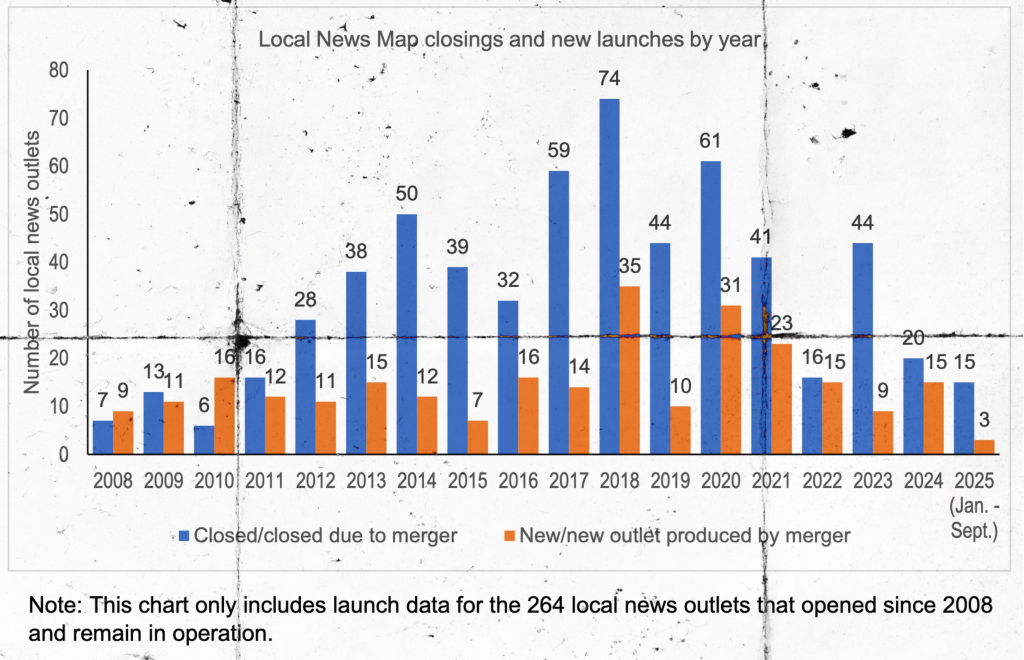
According to The Local News Map—a crowd-sourced resource tracking what is happening to local newspapers, broadcast outlets, and online/digital news sources in communities across Canada—603 local news outlets closed in 388 communities between 2008 and Oct. 1, 2025. Seventy-three per cent of those were community newspapers.
The map also reports that, since 2008, 419 news outlets have launched, with 264 still open today. The Independent is one of those. While the future of print news is unclear, many journalists and editors are working tirelessly behind the scenes and counting their small victories. News outlets are opening their doors, such as Montreal’s The Rover, founded in 2020, and some longstanding papers are standing their ground, namely The Walrus, which was founded in 2003.
It’s in this climate that The Independent and other news outlets across the country are struggling to overcome barriers and ultimately reach the publics they exist to serve.
Cutting to the chase
Communities need local news. One or two outlets covering an entire province is not enough to report what’s happening in every community. Important stories are slipping through the cracks.
Journalists in local newsrooms report on community events, hold government to account, and investigate corruption and abuses of power. But they have fewer resources at their disposal than ever. On top of that, the internet and communications technologies are evolving so quickly that news outlets find themselves in a never-ending cycle of adaptation.
“There is no question that newsrooms should be evolving and adapting to a shifting media ecosystem by innovating in what they do and how they do it,” digital media scholar Alfred Hermida and professor and journalist Mary Lynn Young have said. “The issue is how these decisions are made and implemented.”
Local newsrooms’ limited resources make investing in digital innovations—like the development, training and production of interactive and immersive technologies—challenging, if not completely out of reach.
Nevertheless, finding ways to embrace and innovate with new technologies while also prioritizing intergenerational sustainability is essential to the survival of local news.
Could community involvement be the key?
One of the trends emerging from widespread internet access has been the rise of citizen journalism. Smartphones and social media enable members of the public to report and share news without any involvement from traditional media.
According to a recent study conducted by journalism researcher at the School of Literature and Journalism in China, Songcheng Zhou, “citizen journalism has been one of the major factors facilitating the increasing news coverage by instantly providing grassroots views, giving the silenced a voice, and sowing the seeds of community involvement.”
Through research data collected from a survey, Zhou found that citizen reporting yields speedy, unpretentious, and public-influencing news, however, it struggles with a major trustworthiness issue due to misinformation and bias.
The results emphasized the need to equip people with media literacy skills, conduct verification practices, and adhere to moral standards so that trust in citizen journalism can be maintained.
What’s clear is that members of the public are already getting involved in documenting, reporting, and sharing the happenings in their communities. So why not build trust in community reporting by fostering collaboration between journalists and members of the public?
Encouraging the involvement of community members through programs like Documenters could prove beneficial. The idea behind this US-based project is to pay residents to attend local government meetings, take notes, and pose questions that journalists and other citizens could help develop.
It’s meant to be a way of ensuring that all municipal governments get adequate attention. Documenters Canada, inspired by a program in the U.S., launched a pilot project in September 2024 with The Green Line in Toronto.
More recently, Concordia University’s department of journalism helped launch the program in Montreal in October 2025. Journalism students, associate professor Magda Konieczna, and collaborators helped train community members to document public meetings in Montreal municipalities and boroughs.
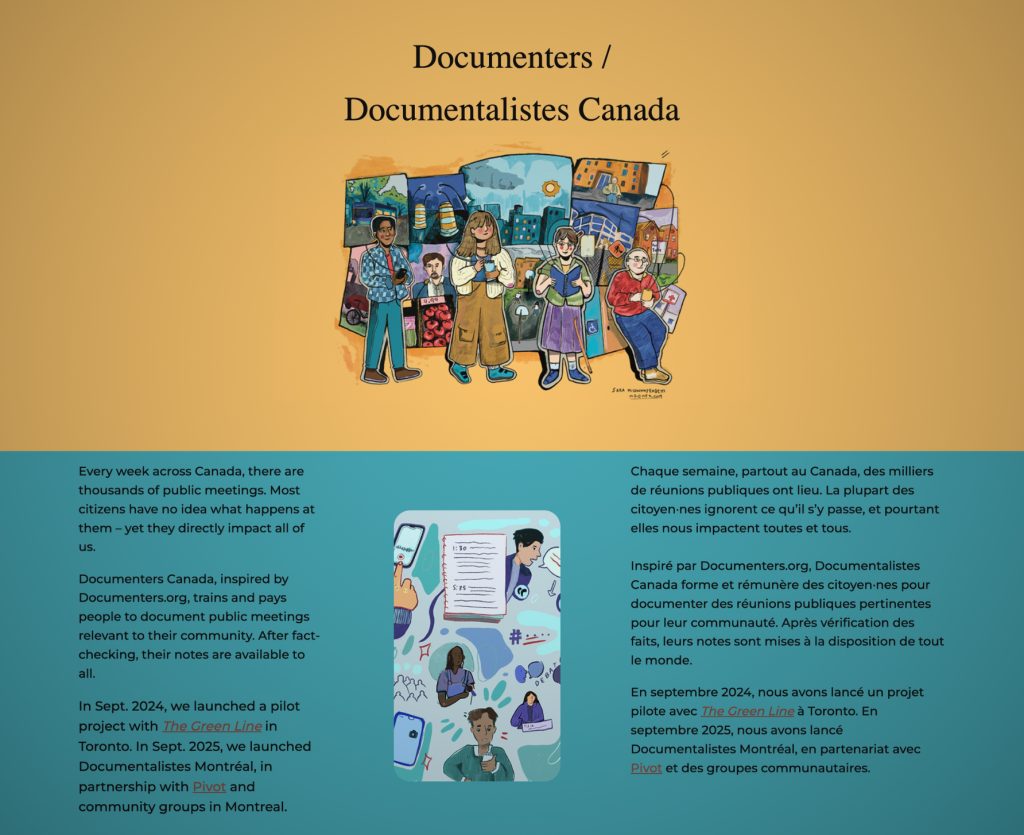
There are now six local documenters trained, four of whom are youth.
Another notable advancement in community reporting is the National Observer’s recently-launched Civic Searchlight, an innovative research tool that provides digital access to public meeting transcripts from 550 municipalities across Canada. This database can help journalists and the public keep tabs on municipal governments that may otherwise be overlooked.
‘Intergenerational solidarity’
Building up youth in a community to feel confident in their knowledge of municipal politics can also reap sustainability.
The Boyle Heights Beat in Los Angeles was founded in 2010 as a high school journalism project in which students are trained by professional journalists to report on their own community.
Over 300 students have gone through the program, some moving on to careers in journalism. In 2024, the Boyle Heights Beat integrated into the Los Angeles Local News Initiative, a nonprofit news organization whose goal is to ensure all L.A. communities have access to local news by building community newsrooms.
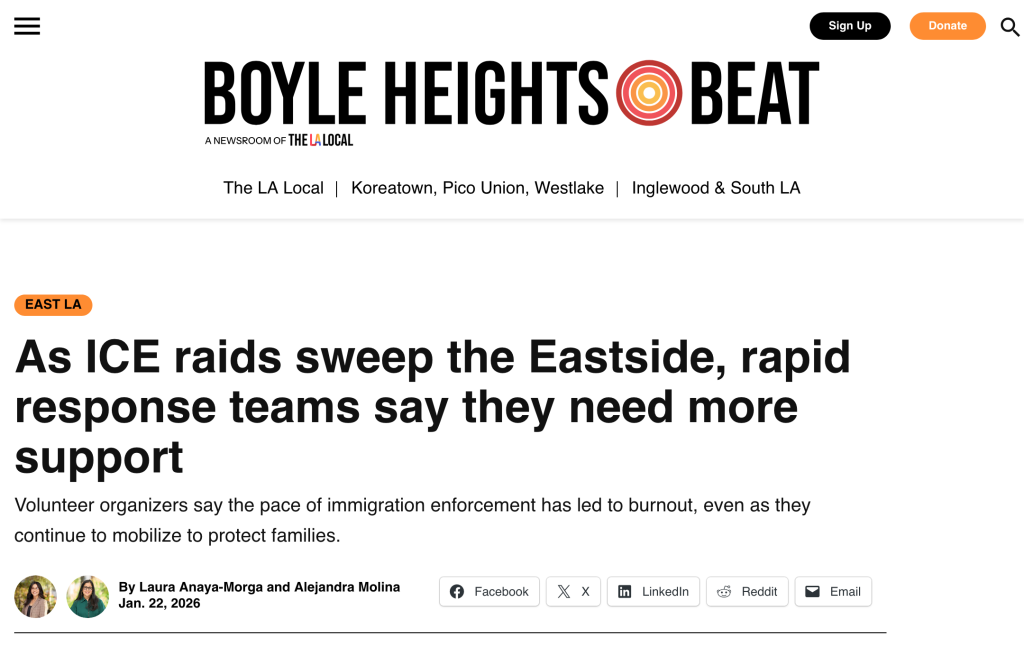
The newsroom continues to train high school students and collaborate with the L.A. branch of Documenters to involve even more community members. It has also challenged negative stereotypes and narratives often attributed to the marginalized community of Boyle Heights in mainstream media.
Kevin Martinez went through the Boyle Heights Beat program himself and later returned to become the Los Angeles Local News Initiative’s community engagement director.
In a recent article for the American Press Institute, Martinez describes “intergenerational solidarity” as the importance of creating spaces for mutual learning where knowledge and lived experiences can be communally exchanged across generations. The Boyle Heights Beat mentorship program builds bonds between generations, strengthening the local news environment.
What can we build to last?
Being a young, aspiring journalist wanting to work in local journalism can feel disheartening. Watching outlets close and veteran reporters lose their jobs can make you want to walk away.
But it’s the young, excited and eager journalists who need encouragement to know all is not lost. The rebuilding is happening, there are those with the gumption to continue the fight for local journalism, and the younger generation is part of the solution.
Host volunteer programs and workshops at local high schools, colleges and universities. Young people need to know there’s still a place for them to tell others what’s going on in their communities.
Let’s find a balance between focusing on what we can build to last and all that we stand to lose.

Author

Related Articles

An LNG future for Fermeuse?
Proposal for massive liquefied natural gas hub exhumed on Newfoundland’s Southern Shore

N.L. long-term care needs more nurses, who need more time with residents
Only the NDP and PCs are committed to improving nurse-to-patient ratios

How N.L. became the life (and death) of the party
We’re cutting through the undergrowth to find out why our political parties feel dead — and what might liven them up