
Where the federal parties stand on housing
The Liberal and Conservative platforms rely on the same market-driven approach to housing that created the crisis, while the NDP’s more progressive approach lacks details

It’s a familiar refrain: there is, indisputably, a housing crisis in this country. Vacancy rates have fallen precipitously, rents are increasing as renter household income is falling, home prices are climbing exponentially. The availability and affordability of housing in Canada is far from a new issue. Since the onset of the pandemic, however, the magnitude of the crisis has become unignorable, politically speaking. All three major federal parties have a lot to say about housing in their platforms, historically a relatively novel occurrence in Canadian elections.
The Conservative housing platform has two principal levers it proposes to pull: tax incentives and effectively withholding infrastructure funding from municipalities who fail to bootstrap themselves into increasing the pace of development. Interestingly, this is in tandem with a promise to cancel the Housing Accelerator Fund, a program intended to help municipalities reduce barriers to development. The Conservatives plan to offer a 50 per cent reimbursement for reduced development charges, which they erroneously refer to as “building taxes,” leaving municipalities responsible for dealing with the loss of the remaining 50 per cent. They likewise promise to “reward cities that permit over 15% more homebuilding,” while punishing those who miss this target, as well as requiring certain kinds of development regulation changes, particularly around public transit. Pierre Poilivre’s party also vows to sell off thousands of buildings and pieces of land currently owned by the federal government. Notably, the transactional language differs from current programs which offer land for affordable housing projects at no cost.
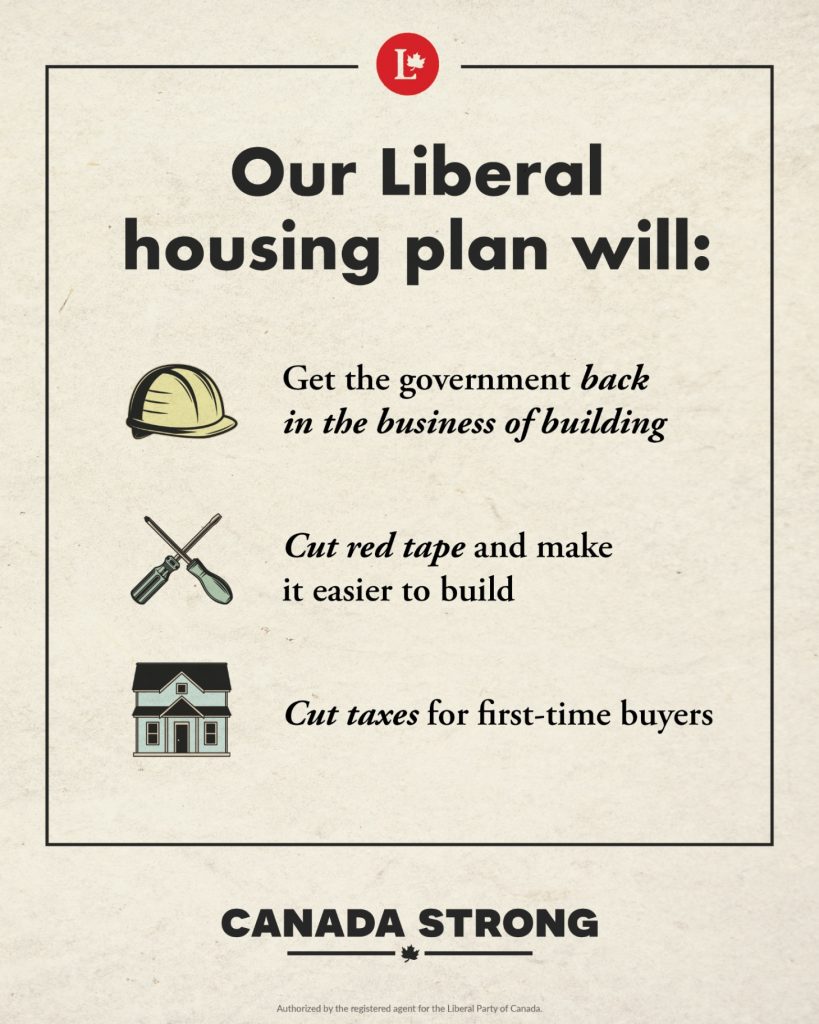
The Liberal housing platform makes much ado about a proposed new crown corporation referred to as “Build Canada Homes,” which they say will act as a developer, particularly of modular homes. It seems Prime Minister Mark Carney’s proposal would separate CMHC’s current affordable housing programs into this new entity, which replaces one bureaucracy with another. The Liberals also propose to offer loans and grants to increase modular building capacity, as well as “issue bulk orders of units from manufacturers to create sustained demand.”
Build Canada Homes clearly intends to rely on modular construction to solve the housing crisis, and this section makes up about half of the Liberal Party’s housing platform. The platform also contains a number of tax incentives, mirroring the Conservative vision, and discusses many interventions into municipal jurisdiction, including a promise to “cut municipal development charges in half,” with a promise to make up the lost revenues for a period of five years. There is no mention of what happens after that period. Indeed, many promises in this plan are about municipal activities, with no mention of how they intend to reconcile the jurisdictional overstep that this represents, or of how municipalities are expected to resource the promises the Liberals are making on their behalf.
Will you stand with us?
Your support is essential to making journalism like this possible.
Like the Conservatives, the New Democratic Party also discusses making public lands available for development, but with significant differences in the implementation: their plan involves earmarking 100 per cent of “suitable” public lands for “rent-controlled homes,” with a target of 100,000 units by 2035. They likewise propose a new crown corporation, the Community Housing Bank, “to partner with non-profit developers, co-ops, and Indigenous communities.” The details of this proposal aren’t elaborated in the party’s release.
Mirroring the other party’s platforms, NDP Leader Jagmeet Singh’s housing plans include intervention in municipal responsibilities, including, “[f]reezing development charges and working with cities to cut them in half,” and requiring more multi-unit housing and housing near transit routes, and “committing to 20 per cent non-market housing in every neighbourhood.” For context, non-market housing, including social housing owned by NL Housing and the City of St. John’s, currently accounts for around 3 per cent of housing stock in Newfoundland and Labrador. Under current regulations, this would not be possible for municipalities in the province to implement without changes to provincial legislation. The NDP also promises to “speed up permits and approvals,” which is in the municipal purview; their platform does not discuss how this would be achieved. The platform also includes national rent control and other renter protections aimed at curbing profiteering by landlords.
The Conservative and Liberal platforms share the striking similarity of continuing to lean heavily on the kind of market-driven logic that enjoyed total dominance in the Canadian housing policy landscape since the mid-1990s. This logic follows simple supply-demand dynamics; in this world, creating more housing will suffice to bring prices down. While supply shortages have dominated the conversation, as shaped by CMHC—the federal crown corporation which funds the vast majority of housing-related initiatives—it’s unlikely that simple supply will solve the housing crisis. Financialization—the view of housing as an asset which should generate profit—means that in the absence of other measures, such as capital gains taxes and rent control, an increase in supply may not curb unaffordability, though it may increase access for some.

In essence, what we see in both these platforms is a doubling-down on a way of seeing housing which has produced a very clear divide in this country. That divide sits between those who reap the benefits of asset-based welfare—which 90 per cent of private mortgage holders do through publicly-funded CMHC mortgage insurance—and those who do not own a home and thus contribute to the wealth of the homeowning classes by paying them rent and subsidizing the government programs that facilitate property ownership.
In 2024 in St. John’s, the average home price—based on the CREA Home Price Index—increased an amount nearly equivalent to the median gross income of a renter household. Consider, too, that the average homeowner household income is almost three times that of a renter household, and you have an idea of the impacts of 30 years of these kinds of policies. The message from both the Liberals and Conservatives is that this will continue unabated.
Poilievre’s policies around housing lean further into this market-based approach, cancelling funding programs in favour of tax incentives with an austerity flavour. Indeed, Poilievre proposes to extend the tax incentives which already contribute to the financialization of housing, namely the exemption of the capital gains tax. Under the current regime, gains on the “investment” in a primary residence are untaxed, meaning you can make unlimited money without paying any taxes whatsoever. The change would see this extended to all asset sales, meaning these transactions will take place in the total absence of any public benefit whatsoever.
Carney’s policies put more lipstick on the neoliberal pig, but have the same basic premise at play: housing is and should be a means to make money. While Poilievre does not mention funding for affordable housing—indeed, no mention of purpose-build affordable housing appears in the Conservative platform at all—Carney offers the same loans-framed-as-funding for which the Parliamentary Budget Officer has criticized past Liberal governments.
In essence, the messaging is about the government paying for housing, while in fact these are loans which are repaid, with interest, that produce revenue for the feds. The Liberal platform also includes a promise to “reduce tax liability” for sales of properties from private owners to community housing organizations, “so long as the proceeds are reinvested in building new purpose-built rental housing.” In this version, the tax abatement still permits unlimited profiteering, this time on the backs of community organizations, but at least it contributes explicitly to increased housing supply.
The NDP’s platform is not immune from the supply discourse, in particular with reference to permitting processes and municipal development regulations. The key difference is that their platform addresses renter’s interests in a way that’s missing from the other party’s platforms. National rent control runs counter to the market-driven stance of the other parties and is a rare proposal which addresses the impacts of financialization directly.

New research from the U.S. shows that rent control does exert moderate downward pressure on new housing supply for the wealthy, but increases the supply of housing affordable to low-income households; it inverts the present priority system of wealth over housing as a human right which is at play in the Canadian policy landscape.
While the Liberals emphasize modular building to a great extent in their platform, the NDP offer more generic language suggesting they will “support building pre-fabricated homes to help meet tight timelines,” continuing the discourse within government that treats modular as a silver bullet. While there are significant benefits to adopting these construction methods, industry publications put current modular outputs at about 6 per cent of all building starts. Like many of the points in the NDP housing platform, the feasibility of relying on these measures would require support that isn’t articulated or accounted for in the party’s publications.
All three parties propose stepping into municipal jurisdiction, implying to some extent that municipalities are to blame for the housing crisis. While there are many issues at the municipal level which need addressing, including many of those mentioned in the platforms, laying this responsibility at the feet of the level of government with the fewest resources and least power denies the culpability of the federal government for underfunding critical infrastructure, including housing, for several decades. Further, all three parties will be making municipalities, many of whom are already cash-strapped, responsible both financially and logistically for delivering their election promises.
While Poilievre directly threatens to withhold funding, Carney offers time-limited support without mention of what happens after that period, or of what consequences will follow if targets are not met. The NDP simply does not discuss how it intends to achieve the municipal outcomes it proposes, including how the party would mitigate the impacts on municipalities.
While the mixture of carrots and sticks varies by party, it’s clear all three intend to exert considerable pressure on municipalities in a way that feels unfair. The parties might be better served to develop an approach to intergovernmental cooperation that addresses inequalities between regions and levels of government. Rather than making election promises on municipalities’ backs, all parties could choose to work with them in collaboration to assure that regulatory bottlenecks are minimized while municipalities get the resources they need to deliver services for their residents.
Platforms fall short
All the platforms fall short on solutions that offer the potential to meaningfully address the housing crisis. The Liberals and Conservatives both double down, and in some cases expand, on a framework which has produced massive inequalities in access to housing. The market-driven approach concentrates wealth upwards. It must be emphasized here that these programs are still government subsidies — tax breaks and mortgage insurance both use public money to subsidize private profit. They are simply government subsidies which, in our current housing landscape, actively harm those who are not homeowners for the benefit of the already wealthy. The crisis we are living in is the product of these kinds of policies.
The NDP is brave enough to swim against this tide, but the party’s platform feels unrealistic without some attention paid to how they intend to achieve these goals, such as 20 per cent community housing in every neighbourhood when the national average is four to eight per cent, and about three per cent in NL. Even where rent control is concerned, the details matter greatly; some rent control policies, such as vacancy decontrol, can actively harm renters, while others can benefit them without significantly harming landlords.
An approach that might bring about change would address supply through funding, not repayable financing, for permanently-affordable community housing, which has been demonstrated to cost less public money than other responses to homelessness such as emergency shelter and policing. Incentives for private development play a role, too, in addressing the supply deficit, but both of these must be deployed in tandem to produce real results.
The parties are right to work with other levels of government on reducing barriers, but this has to be done in a collaborative way that provides resources where they’re most needed. None of the platforms discuss regional inequalities, which is an essential part of the discussion when it comes to the distribution of these interventions. Regulatory measures such as capping the capital gains tax exemption, collecting taxes from real estate investment trusts—and yes, a balanced and well-considered suite of rent control measures—can help address financialization.
No one of these measures will work alone. This crisis requires holistic attention and political courage to reverse the course we’ve been on for all these years.
The Independent’s federal election coverage is supported by the Covering Canada: Election 2025 Fund.

Author

Related Articles

An LNG future for Fermeuse?
Proposal for massive liquefied natural gas hub exhumed on Newfoundland’s Southern Shore
Thinking beyond the crisis in journalism
There are many legitimate reasons for concern, but news media have an unprecedented opportunity to innovate and create a new era of journalism

N.L. long-term care needs more nurses, who need more time with residents
Only the NDP and PCs are committed to improving nurse-to-patient ratios