
At the top of Mt. Cabox, I sat down and wept
In the rush towards a new wind energy frontier, we ought to slow down and account for what might be lost.

We shall not cease from exploration
And the end of all our exploring
Will be to arrive where we started
And know the place for the first time.

- T.S. Eliot, “Little Gidding” (1943)
I was planning something geographical. An expedition to Mt. Cabox, Newfoundland’s highest peak. At 2,671 feet, it’s not much by global standards, but hey, we’re a ‘have not’ province again. High mountains we have not. The jewel of the Lewis Hills, Mt. Cabox is located about 30 km southwest of Corner Brook and 20 km north of Stephenville. It’s one of the highlights of the Long Range Mountains, the undulating heights and hollows that stretch clear across the island’s west coast, almost 400 km from Cape Ray to the Strait of Belle Isle.
I had assembled a crack team of scientists. A wildlife biologist. Late 30s, tall, rangy, and clothed exclusively in Fjallraven, the biologist hikes through brush like a bull moose. Nothing slows him down. Growing up within sight of the mountain, he had many rambles across the Big Plateau, hunting with his father. Then there was the exploration geologist. Quick to smile and quick to laugh, the geologist’s graying hair and beard do nothing to curb the mischievous, boyish glint in his clear, blue eyes. His experience and knowledge would come in handy while scrambling across the most southerly Bay of Islands Ophiolite Massif. And then there was me, the poet-philosopher of the group. Like Walt Whitman, “I lean and loafe at my ease observing a spear of summer grass.” It’s hard work, but someone has to do it. (We are currently accepting applications for a botanist.)
The idea was to spend three days up there in late August 2023, poking around and pottering about. The forecast was calling for rain on Monday morning and Wednesday evening, but a nice stretch of clear, warm weather in between. We were going to hike in, set up camp high in the hills, and spend Tuesday – glorious, sunny Tuesday – exploring . The astrological forecast was even better. We would be up there for the Super Blue Moon in Pisces, the second full moon of the month. An auspicious portent.
Will you stand with us?
Your support is essential to making journalism like this possible.
The expedition had a certain urgency to it. We planned it after learning the area had been proposed for development as part of World Energy GH2’s wind-to-hydrogen mega-project, Project Nujio’qonik. The biologist and I were still coasting on the high from our first ascent of Mt. Cabox when we found out that Prime Minister Justin Trudeau and German Chancellor Olaf Scholz would be meeting in Stephenville. The news reached us on our descent, as soon as we returned to the world of cell service: they were going to sign a memorandum of understanding to provide hydrogen energy to Europe’s leading industrial nation.
We were crestfallen. Just moments prior, we had believed there was a lifetime to keep coming back to the mountain, without ever approaching all that it had to offer. We started hatching our multi-day return expedition before we even got back to paved roads.
Thankfully, just a few months later in November 2022, the provincial government excluded the Lewis Hills from the bidding process. We kept our commitment to hike The Cabox anyway. The area might be safe for now, but who knows for how long. There are plans in the works to develop several pristine, unique, and spectacular landscapes for wind-energy production on the southwest coast and other parts of the island.
It’s a challenging dilemma. I recognize the necessity for decarbonization (although it should be noted that hydrogen’s role in a decarbonized world is far from clear or assured). Yet, as a historian of Newfoundland’s resource development projects, I can’t help but be uneasy. I have a certain amount of PTRDD (post-traumatic resource development disorder). I’m surprised more politicians and entrepreneurs don’t suffer from this. How many times do we need to learn the same lesson? “First as tragedy, then as farce,” Karl Marx famously quipped. But home on the island, this farce has been repeated so many times, it’s become an anti-comedy.
Perseverating on the climate emergency, the effects of development on stunning ecosystems, and the place of hiking and privilege in all this, can leave one deflated and spiritually adrift. But I subscribe to G.M. Trevelyan’s school of psychotherapy: “I have two doctors, my left leg and my right. When body and mind are out of gear (and those twin parts of me live at such close quarters that the one always catches melancholy from the other) I know that I have only to call in my doctors and I shall be well again.”
So, off we went to Mt. Cabox again, for a therapeutic constitutional under the full moon in August.
***
We set out on a Monday afternoon, after a cappuccino and a truly spectacular breakfast sandwich at the Wild Strawberry Créperie and Café in Stephenville. A fresh, flaky biscuit, a billowy square of egg, fried ham, sharp cheddar, topped off with some local greens, all for $7.50. I didn’t dare tell them that godless townies would gladly pay twice that for their divine creation.
We began to question seriously the sanity of leaving the comforts and breakfast sandwiches of society to sleep on a pile of rocks for two nights. It didn’t help that it had been raining all morning. “It’s tailing off,” we foolishly told ourselves, as we headed for the trailhead.
The two-hour, 26-km trip up dirt road was a bit rowdy. We waved enviously at the quads zooming past us. We waited for the rain to finish “tailing off.” When we finally decided to get geared up and go, the skies opened up. We hid in the car with our packs on. “Surely, this is the worst of it,” we lied to ourselves. It did let up, and then we hit the trail.

The hike began as many others do on the island, with a narrow path through boreal and bog. But then it turned into something else. The first time (of many) that my jaw hit the floor was cresting the head of the valley overlooking Fox Island River. The tree-line faded away as it meandered down the valley. A rust-colored, Mars-like gorge rose across the river. The Lewis Hills.
The most southerly of the four Bay of Islands Ophiolite Massifs, the Lewis Hills are like its more famous cousin, the Tablelands. These massifs lay bare Earth’s red mantle, forced to the surface by the process of obduction. Composed of magnesium-and-iron laced mafic rocks, they are actually more of a snakeskin, serpentine green, but when they are exposed to air they oxidize and turn red and rusty.
These geological wonders were a mystery to geologists for decades. They are usually deposited by volcanic eruptions, but the area did not exhibit any evidence of volcanic activity. There was simply no way to account for the existence of the Bay of Islands Ophiolite Massifs.
It wasn’t until the 1960s that plate tectonics theory offered a convincing explanation. Newly developed within certain fringes of geology, this revolutionary theory saw Earth’s landscape as a process. It envisioned continents, oceans, mountain ranges, earthquakes and volcanoes arising from the collisions and drifting apart of large plates of crust and mantle. Ophiolites are the physical record of this process, documenting the movement of plates through their stratigraphic sequence of siliceous oozes, basaltic pillow lavas, sheeted dikes, gabbro, and peridotite.
Rather than being pushed down deeper into Earth’s molten iron core, the rusty, craggily gorge I was hiking up – such a stark contrast to the hike’s boreal beginning – was pushed up and over Earth’s crust. This is quite unique geologically, with Newfoundland providing some of the most well-preserved and easily accessible examples for the geologically-inclined rambler.
In 1967, Memorial University geologist Robert Stevens was the first to document and detail the timing of this process, known as the Taconic orogeny, “i.e., Early to Middle Ordovician subduction of the eastern continental margin of North America beneath a fringing magmatic arc system” in the marble-mouthed language of geology. According to Stevens, the rock I was hiking on was the remnant of the Iapetus Ocean floor, a sort of proto-Atlantic Ocean that disappeared at the end of the Silurian period, roughly 420 million years ago.
It made for spectacular hiking.
We followed a winding path through the red scree, with the loose stones crunching under our boots. The path mirrored the clear, crystal blue curve of a tributary to the Fox Island River. We hopped across rivulets and dried-out streams, which pointed to how much water must flow in the spring. At the walking scale, the area was not as barren as it seemed from a distance. Flat juniper shrubs fanned out across the rock. I skipped over them like puddles. Small, delicate lavender-coloured flowers sprung up from the rocky slope. Sadly, we had no botanist to identify them, but they looked like tiny daisies. Pitcher plants popped out of the rocks, my first time noticing one at that elevation and outside of a bog. Newfoundlanders are a lot like pitcher plants, I thought as I walked by: often found in bogs, imbued with surprisingly ‘murderous propensities,’ filled with gastric juices.

The rain continued on, spitting, driving, misting, drizzling. The mountains were temperamental and imposing. Dark rain clouds hung ominously over the plateau, like there was a distant battle raging just over the escarpment. Normally, that’s not ideal hiking weather, but I liked seeing the mountain’s many moods and timbres. My Tilley hat and rain shell were working, and we were buoyed by the promise of good weather on the following day.
“Just wait for Tuesday, boys. It’s all about Tuesday.” A few nips of the good stuff from my sealskin flask helped. It offered an inner warmth and dryness. I understood deeply why the Scots, shivering in their wet kilts on the moors, called it uisge beatha, the water of life.
From the river, we began to climb the 640 metres across the ancient ocean floor up to a huge plateau. It’s not easy, but it’s well within the margins of any reasonably fit walker. It’s a low-grade incline most of the way, until you get to a defile at the end of the gorge. A narrow, rocky path rose out of the gorge to the plateau above, dropping off precipitously to ravines on both sides, the smooth, glassy rock intimating powerful spring deluges. We rested on some large boulders at the base of the climb, and ate lunch in the pouring rain.
Soaking wet, and dead tired, we were staring up at the biggest climb of the trip. This was our lowest point on the whole three-day endeavour, spiritually and dimensionally. A nip offers inner strength too, or as George Mallory called it, after a particularly harrowing day on Mt. Everest, “medical comfort.” I passed the flask around and we trudged on.
***
There’s a saying in the rock climbing world: Geology is now. It was a reminder that despite the seemingly-stolid permanence of rock, it is always shifting, changing, morphing. Climbers know this intimately. Holds crumble, flakes detach. A rock face can change while you’re inching your way up it. Geological time is remorseless. It halts for no climber. That evening at basecamp, with the wind howling high up on the plateau, I learned this intimately, too.
The rain let off as we made our way up the defile and out of the peridotite gorge. The sky was clear by the time we were setting up our basecamp. We set up camp and ate dinner in a fairly active scree field. It wasn’t ideal, but it was protected from the wind, and we were all gassed from the climb. I enjoyed Newfoundland’s finest culinary delight: a side of Butt’s Esso smoked salmon. There is simply no describing the feeling of all that fat and protein hitting your nutrient-depleted bloodstream. Hiker’s heroin. I washed it down with some ramen and a lukewarm Miller Lite.
The only wood within sight was one gnarled, stunted fir, which was about an inch around and probably 300 years old. No campfire tonight. All we had to do was watch the sun set and the full moon rise. We found the best seat in the house: a bench-like rock large enough for the three of us. At our feet, a thin, vertical piece extended out, acting as an ergonomic footrest.
From there we watched the first feature presentation: the sunset. The desert-like peridotite gorge framed the boreal landscape like an impressionist painting. Thin, wispy clouds meandered across the pink and orange sky. The quality of light and the sky’s hues shifted and changed as the sun set, bringing the scene to ever-new combinations of beauty and mystery.
As the moon rose, it cut its arc across the sky, illuminating the lakes that we had hiked around earlier in the day. But as the angle of the moonlight changed, it started lighting up little patches and pockets of water all over the gorge. The geometry of light and water was so precise that we all saw different reflections. I moved my head to the left and the reflected light compressed to pinpoint: a landlocked star.
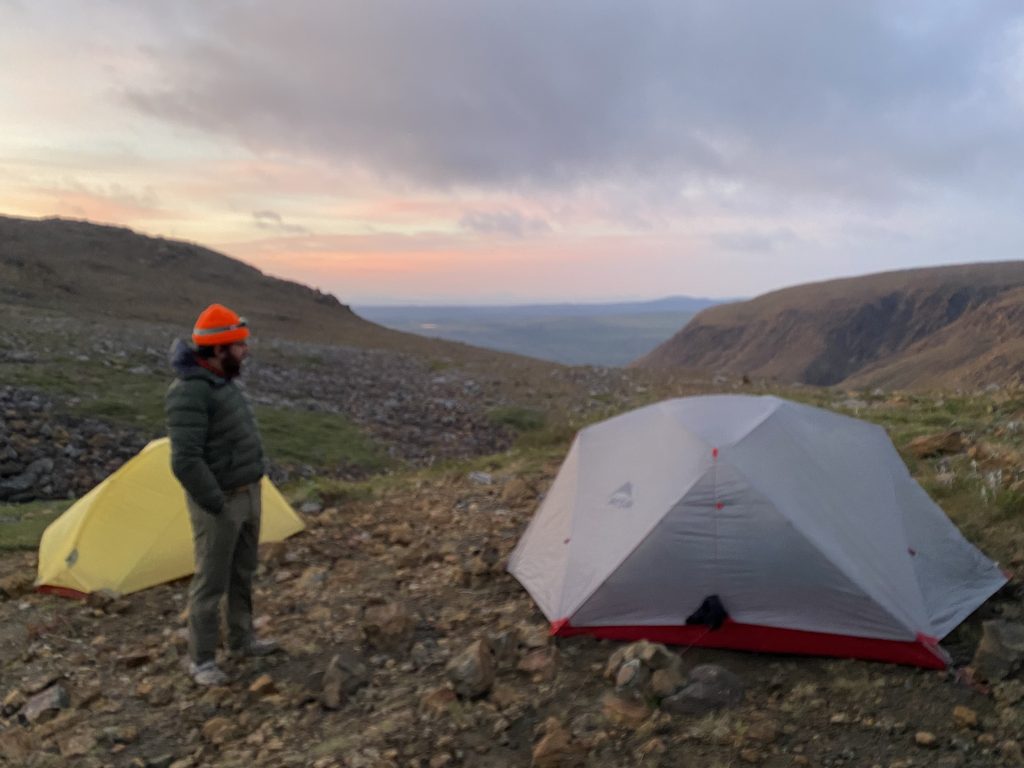
From this rock, blinded by the super blue moon and land-stars, we chatted about geology and astronomy and the human experience. Casting long moon-shadows on an ancient ocean floor, looking lovingly back at the forested world, our everyday concerns, stresses, and aspirations melted into air. We couldn’t help but appreciate the mysteries of the universe. Our experience was quite clearly not the center of it.
As we chatted, the geologist cast a spell over us with the story of deep, geological time. Oceans are born and they die. There was a time before the Atlantic Ocean, and there’ll be a time after the Atlantic Ocean. There are marine fossils on the top of Chomolungma (Mt. Everest) because it was once at the bottom of an ancient ocean. It is still growing. Tectonic plates shift at about a rate of 1.5 cm per year, which is about the same rate that human toenails grow. John McPhee puts it this way: “Stretch out your arm sideways, and imagine that the 4.55 billion-year timeline of earth’s history runs from the tip of your nose to the tip of your middle fingernail. A quick swipe of a nail file would wipe out human history.” At that scale, how can you worry about your taxes?
As I thought about life and death on that scale, I was reminded of a story by a fourth-century Daoist philosopher, Chuang-Tzu. A very old chestnut, indeed. I break it out whenever anyone mentions life, death, love, grief, change, or pounding on a tub. A friend came to offer condolences to Chuang-Tzu after the passing of his wife. When he opened the door to Chuang-Tzu’s hut, he found The Sage pounding on a tub and singing.
“It’s bad enough you’re not weeping, Chuang-Tzu,” the friend said. “But pounding on a tub and singing? That’s going too far.”
“You’re wrong,” Chuang-Tzu replied. “When she first died, do you think I didn’t grieve like anyone else? But I looked back to her beginning and the time before she was born. Not only the time before she was born, but the time before she had a body. Not only the time before she had a body, but the time before she had a spirit. In the midst of the jumble of wonder and mystery a change took place and she had a spirit. Another change and she had a body. Another change and she was born. Now there’s been another change and she’s dead. It’s just like the progression of the four seasons, spring, summer, fall, winter.
“If I sat here bawling,” Chuang-Tzu continued, as he picked up his tub, “it would only show that I understand nothing about fate. So I stopped.”
We heard a clean ‘plunk’ and the footrest popped off our mineral bench. Another change took place. Geology really is now, I thought. We stood up, and turned our seat into the ultimate animal-proof food container. We used our former footrest as one of the walls. We filled in the gaps with smaller rocks, creating an impenetrable larder.
“Nice work, fellas,” the biologist said. “We’ve achieved the technological development of late Neanderthal.”
We puffed out our chests and slept proudly.
***
We woke the next morning after 8 a.m., when the sun crept over the eastern flank of the gorge and started baking us in our tents. Sleeping on an ancient ocean floor had never been so restful. Waiting for the water to boil for our morning coffee, we laughed about my first camping trip, when I asked, drowsy in my tent, “Is it supposed to be comfortable?”
Tuesday didn’t disappoint. It was a Tuesday for the ages. Sunny, warm, and lustrously clear. Fueled by some coffee and oatmeal, we set off for a day exploring the big plateau around the summit. One final steep climb, and we left the red peridotite gorge behind, with the landscape opening up, wide and vast.
The plateau is divided into a Tolkienesque series of discrete landscapes that rise and fall gently, each with a unique feel and ecology. First we crossed an area that looked like arctic tundra, all spectacular ponds and rocky granite outcrops. Then we entered into wide open alpine meadows, acres of delicate lavender flowers and small cattails, swaying gently in the wind. Each area had a different smell that put the best overpriced yuppie candle or perfume to shame. Even the boggy areas smelled delectable. A smell so pure, so ideal, so Hegelian, that it can only be described in German: moorgestank (bog-stink).
We walked over bogs, over fields, over shrubby bushes and stunted trees. We passed the odd pool or stream. The Bonsai-like tuckamore trees looked like they were pruned by master Zen gardeners. Each zone had all the essential qualities of delightful walking: springy, uninhibited, unbridled. There was no bushwhacking on the plateau, only bushfrolicking and bushgliding.
We slowly gained the last 170 metres until we reached the summit, marked by a pile of rocks, a survey marker, and a broken granite headstone, stating: “LEWIS HILLS: Newfoundland’s Highest Point.”
At the top, literally a few metres from the cairn, a family of caribou was grazing lazily in the sun. They were not disturbed by us. They met us with calm indifference. When geologist James Howley traversed the area in 1874 he found the same attitude amongst our cloven-hoofed compatriots: “I have seldom seen deer [caribou] so tame as those met with in this section of country. It looked as though they had never seen a human being before.” If it was remarkable in 1874, then it bordered on the inconceivable in 2023. The caribou ambled a little further on.
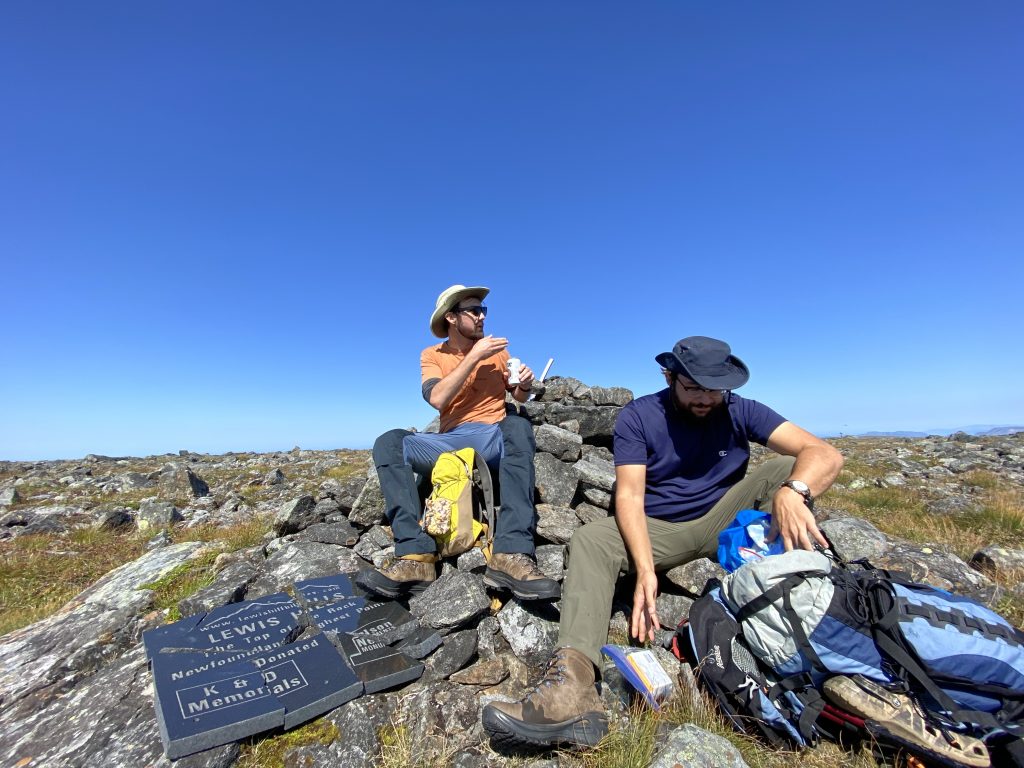
We sat down to eat lunch. I ate a can of smoked herring, some aged cheddar, and a few handfuls of good ol’ almonds and dates, my Middle Eastern take on the hiking classic GORP. After a lunchtime puff, we were a little higher still. Lying in the sun at the top of the visible world, we were tired, sore, but ecstatic.
We explored the plateau for a few hours, eventually remembering that with each step we grew farther and farther from our basecamp. With nothing to do but cook supper and wait for the moon to rise, we retraced our steps toward basecamp for our second night on the mountain. We crossed a vast stretch of green shrubby lumps and bumps that looked like a mogul run in summer. The biologist’s father dubbed the area the Potato Patch. We stopped for a dip in a clear, cold alpine lake.
After dinner, we returned to our rock for the full moon. We felt like a family rushing to the couch to catch the latest episode of our favourite series. We took bets over where the moon would rise in the evening sky. It poked its head over the peridotite, and rose full in the sky. It was subtle, but it was noticeably fuller than the night before. That night we didn’t need our headlamps. We needed sunglasses — nay, moonglasses!
We were moon-struck, literal lunatics, unfastened from everyday moorings and worries, in loving communion with the geological time. Tears rose up in my eyes. I felt deeply connected to the landscape, a part of the mountain, but at the same time deeply unburdened by my attachment to it, gliding away like a stream. I understood both my own and the rock’s fleeting place in the flow of deep time. Eventually I pulled myself away and retired to bed.

We arose early the next morning, with the full moon hanging plump like a ripe damson in the dawn sky. We had to push to make it out before the rain. Down the defile, across the red gorge. I bid adieu to the pitcher plants. I kissed the shrubs and flowers goodbye. We forded the river, walked up the steep ridge, across the bog and through the boreal forest back to our car, our lives, and the “real” world, which, it should go without saying, after three days basking in the glory of Mt. Cabox, is quite obviously the fake world.
My two Trevelyanian therapists, my left leg and my right, had worked. I was recharged and rekindled by the resplendence of nature. I turned my phone back on to tell my partner that I was alive and ecstatic.
This time I found out that the provincial government had just announced that four companies, including World Energy GH2, were granted Wind Application Recommendation Letters.
***
I’m not here to tilt at windmills. I don’t want to argue about the merits of green hydrogen development or the wisdom of energy mega-projects in general. I’m not here to offer a counter-proposal, or to deliberate between conservation and development, ecology and economy. I’ll leave that to the technocrats and the activists, to the entrepreneurs and the charlatans. There is a need for a serious, sober debate that asks hard questions about what the future of energy looks like. But this isn’t the place for it.
I am writing this because I feel compelled to account for what might be lost in the rush of a new resource frontier. Chilling with unconcerned caribou. Traipsing over alpine meadows filled with flowers swaying in the breeze. Things like sleeping on rocks that were once deep underneath an ancient sea, waltzing through Japanese gardens of tuckamore-bonzai trees, smelling the unparalleled moorgerstank, and the small enchantment of landlocked stars.
All of this is located on a globally rare and unique geology and topography. It is literally the only place on Planet Earth where you can experience that particular combination of biogeography and geology. Call me a lunatic (guilty as charged), but it would be nice to share that with future generations.
While Mt. Cabox is safe, many other fragile and precious ecosystems, including those of the Codroy Valley and the Port au Port Peninsula, are at risk as we rush headlong into the wind energy boom, wilfully or unwittingly forgetting the inevitable bust part of the boom-bust cycle in resource industries. Ecological anxiety and grief are sensible reactions for land defenders and conservationists in the face of all this. Environmental philosophers have a term for it: solastalgia.
But I felt something different up in the Lewis Hills. There was a time before the Atlantic Ocean and there’ll be a time after it. There was a change, and then Mt. Cabox was born. I am lucky I got to experience it for a brief, infinitesimal flash of geological time. I got to witness a small enchantment. At some future point, there’ll be another change, and it will be gone.
How can I be sad? I won’t weep for Mt. Cabox or the Codroy Valley or the Port au Port Peninsula, or any of the dazzling ecosystems that have been or will be destroyed or changed by settlers in the pursuit of profit and control. I may weep staring at the full moon, but I won’t weep because of the changes. I’m simply going to spend as much time up there as possible. I hope you can as well. If you make the trek during the full moon in August, you’ll find me somewhere up in those hills, singing and pounding on my tub.

Author

Related Articles
Meet two of St. John’s local heroes of transportation
Can community members help make walking safer in winter? Megan Clemens and Myles Russell think so
International Women’s Day is not a celebration
How do we build a fighting feminist movement?
The PC’s subtle Throne Speech caveat
Wakeham government quietly places an asterisk next to its promise, ‘For all of us’