
Be there with balaclavas on
Safe workplaces. Clean streets. Rising bakeries. A promising new apartment building. Development regulations relax. New meets old on Monkstown Road.

When the tent encampment at the Colonial Building was dismantled last Friday, the contractors the province hired showed up to Bannerman Park donning hazmat suits, reflective vests and…balaclavas. In the pictures I saw, they looked like a gang of thieves executing a heist.
I was in Halifax while this was going on. Wandering through the downtown, I came upon some of the sites of their former tent encampments: one at Grande Parade, another at Victoria Park. These common spaces are empty now. They look pretty desolate with the temporary steel fencing lining their perimeters. The city of Halifax dismantled the encampments mid-March. People have since erected tents elsewhere, like a grassy median in the middle of University Ave.
Cabinet Minister John Abbott assured the public that the face coverings were a necessary measure. The identities of the workers had to be hidden, he said, so they wouldn’t become social media targets. Abbott framed it as a workplace health and safety issue, but nothing he said could dispel the unease created by those bad optics.
The blaclavas spoke loud and clear: this is a dirty job, no one is proud of it, and no one wants to be seen doing it.
Will you stand with us?
Your support is essential to making journalism like this possible.

We’ve normalized doing things we don’t want to do for the money that we need, and making others do things they don’t want to do for the money they need. When it comes to paid work, we consent, commit, and concede to things we don’t always intend or mean to. The choices aren’t always obvious, and it’s hard to know how, where, and when to draw the line. This is how values and priorities get slowly eroded at work; this is how people get hurt.
It was the National Day of Mourning recently. The day is meant to commemorate all those who have died, been injured, or suffered illnesses in their workplaces. Deputy Mayor Sheilagh O’Leary represented the city at the wreath-laying ceremony at Confederation Building on April 28. “This falls firmly within occupational health and safety,” she said at the end of last week’s council meeting, “something we take very seriously.”
I made my own trip to the Confederation Hill this week, once I returned to St. John’s. I walked across the lawn towards the red pines in the secluded corner of the building’s east block to visit the Ocean Ranger monument, designed by painter and sculptor Stewart Montgomerie (1941-2017). It’s been there since 1985 yet somehow I’ve never seen it. The sinking of the Ocean Ranger and the loss of all 84 of the men onboard is one of the worst disasters in our provincial history. It was also a preventable workplace tragedy.
Today, the sea remains one of the most dangerous places to work for Newfoundlanders and Labradorians. A couple of weeks ago, two men died when their fishing boat capsized in Lark Harbour. Two years ago, Terry Roberts drowned while working on a pilot boat operated by Canship Ugland. His family continues to seek accountability–and change.
We know the ocean is dangerous: it’s not made for us. But our workplaces are. We must expect more from them and the people and promises that lure us there. At work we give our life’s time and energy, our most precious, finite resources. Sure, we get something in return for what we give, but we shouldn’t wait for tragedy to reveal the truth to us: that what was offered was never enough.
Municipal awareness goes a long way
O’Leary presided over a skeleton crew at the council meeting on April 30, while Mayor Danny Breen, Councs. Sandy Hickman, Jen Bruce, and Maggie Burton were in Charlottetown, PEI for the East Coast Music Awards. Next year, council members won’t have to travel; the awards will be held in St. John’s. The city was slated to host them in 2020 but they were canceled due to the pandemic.
O’Leary made a couple of proclamations, including Municipal Awareness Week, which runs from May 5-11 on the tails of the Municipal Symposium held in Gander May 1-3. The proclamation recognizes the vital role municipal governments play in providing services that enhance the quality of life of its citizens.
A little municipal awareness can, of course, go a long way. City council’s recent rejection of an application for a 17-unit townhouse cluster in Kilbride is a case in point. The development had already received conditional approval from the province under the Affordable Rental Housing Program. However, had the city been consulted earlier on, the proponent and the province would have learned that the land in question is not viable for development at this juncture.
Municipal awareness could also go too far: in Alberta, a recent bill proposed by the provincial government would give it new powers over municipalities—an unprecedented move in Canada we should all be concerned about.
A final verse for National Poetry Month
“I’m very sad to say that this is our grand finale for National Poetry Month,” O’Leary said. “It’s been a real treat to have our Poet Laureate Mark Callanan here.”
Callanan graciously thanked O’Leary and the city for allowing him to share some of the finest work by local writers.
To close National Poetry Month, Callanan invited Agnes Walsh to present some of her work, a fitting choice as Walsh was the first ever poet laureate of St. John’s. She read Wind in the Old Town, a wistful poem that harkens back to the time when St. John’s was an international port.
The wind, a force that originates from somewhere else, moves in with dynamic energy and unsettles everything: “We couldn’t talk / the wind stoled our words / whipped them at the wrong ears / So people became delirious with information that had nothing to do with them.” That’s a great line that pretty much sums up what happens on the Internet.
She also read a poem from her new collection The Wind has Robbed the Legs Off a Madwoman. It’s based on the painting Launching the Currach by Paul Henry, which depicts an old man and four younger ones trying to get the old Irish-style boat into the water.
The poem gives words to what the painting cannot — the intangible transfer of cultural knowledge among these men, how it moves and lives through their actions: “it’s what’s in the old man’s head that the men need / the right time to launch / the tides, the look of the sky / then he is the old man on the strand / the cold blue-black sea to look into / time moving out of him and into them.”

Bakeries are great if you knead dough
Council approved a discretionary use application for a Ukrainian bakery at a home occupation in the Residential Zone at 36 Liverpool Ave. There will be no storefront; the goods will be delivered, or picked-up by a third party delivery service. The hours will be 8 a.m. to 11 p.m., which seems a little late for a bakery, but 11 p.m. just happens to be the time the city’s noise by-laws take effect.
The city received mostly supportive feedback from residents. One concerned resident however, wrote in on behalf of several neighbors, stating that the presence of the bakery would likely prevent them from enjoying their outdoor space due to “Noise level from fans, 15 hrs. per day, odors, traffic congestion and noise.”
But, you know what they say about people who don’t like the smell of baking bread: they’ll never be happy anyway.
Council also approved a change to the hours of operation at 85 Bond St. to accommodate Casablanca Bakery and Catering. The site, which is a non-conforming use, was previously the home of Postmaster’s Bakery, now at Rawlin’s Cross, and Volcano Bakery, which relocated to Conception Bay South.
“It’s interesting to see the number of bakeries we’ve been receiving applications for,” O’Leary remarked. “Obviously people like their baked goods,” she laughed, “myself included!”
‘Harmful to the streetscape and neighbourhood’
Council approved the proposed design for a single residence at 34 Monkstown Rd., but not without a very lengthy discussion, which began the week prior at the Committee of the Whole meeting. The approval came with only one condition, rather than the three that were originally proposed: that the proponent consider using wooden cladding for the exterior instead of vinyl siding.
Council could only recommend the proponent consider using wooden cladding, however, because according to the design standards, vinyl siding is technically allowed. The material was chosen because of its durability and its continuity. According to the proponent, 18 houses on Monkstown Rd. currently have vinyl siding on them already.
The area in question — a vacant lot between two large heritage homes — is designated Heritage 2. As it turns out, this area has much more relaxed design standards than the ones required for Heritage 1. Rennie’s Mill Road, for example, which runs just behind this stretch of Monkstown Road, is subject to more stringent standards because it’s Heritage 1.
The proponents, Elmo and Cathy Russell from ERCO Developments, originally requested an exemption from the city’s heritage by-laws, but it wasn’t granted. They eventually consulted with the requirements, and came back to the city with the current proposal, which was then circulated for public consultation.
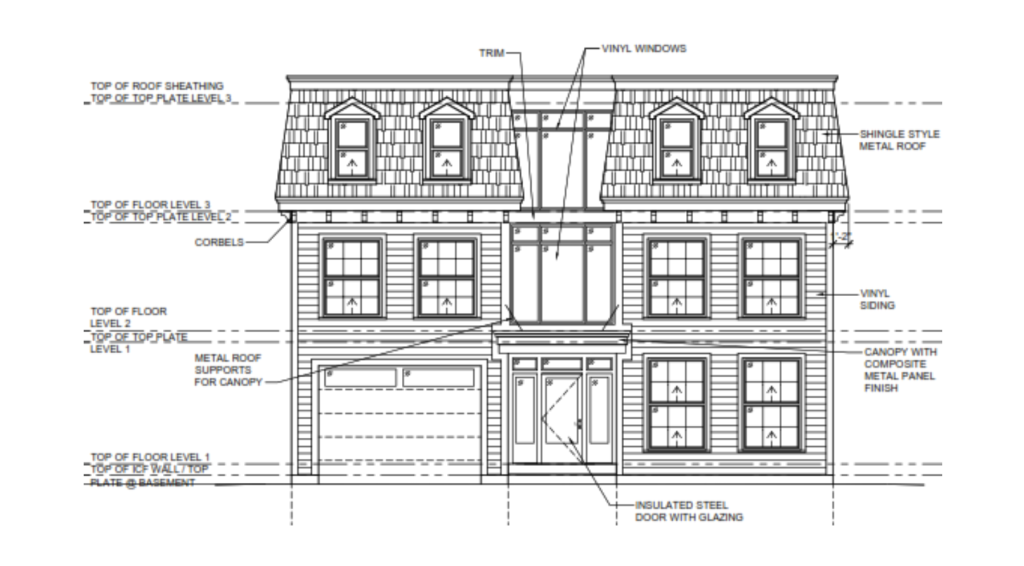
The city received lots of feedback from residents; most of it was not positive. Many residents just did not like the look of it, and viewed it as a disruption in the aesthetic continuity of the streetscape. One resident wrote that the proposed house was not “sympathetic” to its surroundings, as if it were a person. Another worried that its presence would diminish the heritage value of the entire area, both its aesthetic value and the property values of the nearby homes. The George Street Association went so far as to describe the house as “harmful to the streetscape and neighbourhood in which it sits.” That’s an awful lot of power to give one house on the only vacant lot on an already pretty eclectic 50-house street.
To discuss conserving or restoring an old building is one thing, because there are real historical artifacts that can ground the discussion. In this case, the discussion is about the proposed new building’s anticipated immaterial effects on nearby heritage structures. It’s easy to see how it could go off the rails. Aside from potential damage to old trees, the harms being referenced here are symbolic and largely subjective.
The design standards are supposed to be a helpful guide, but it’s clear from the feedback that there is confusion about the differences in design standards between the different heritage areas, and what the design standards for Heritage 2 should be. This confusion carried over into the council’s deliberations at the Committee of the Whole.
Design standards vs. personal taste
No one on council was outright against the proposed design, just certain elements of it. The aforementioned use of vinyl siding was a sticking point. So too was the size and placement of the garage, as well as the lack of bay windows. Multiple motions were put forth to address these different design elements, but in the end, they were lost after being put to votes.
A garage is permitted in a Heritage 2 area as long as it is not a “prominent” feature. The one the Russells have proposed is subtle enough: it’s for a single car, and comprises only a small portion of the facade. It also sits flush with the flat facade of the house so it integrates more seamlessly into the design. What’s more, there are already a few properties on the street that have garages–some of them heritage properties–one just a couple of houses down even has a large accessory building with a very prominent double-car garage.
As for the bay windows, it was noted they are a common feature of many of the beloved Southcott Second Empire-style homes in the area. However, most of the houses on Monkstown Road (31 out of 49, in fact) do not have this fancy fenestration.
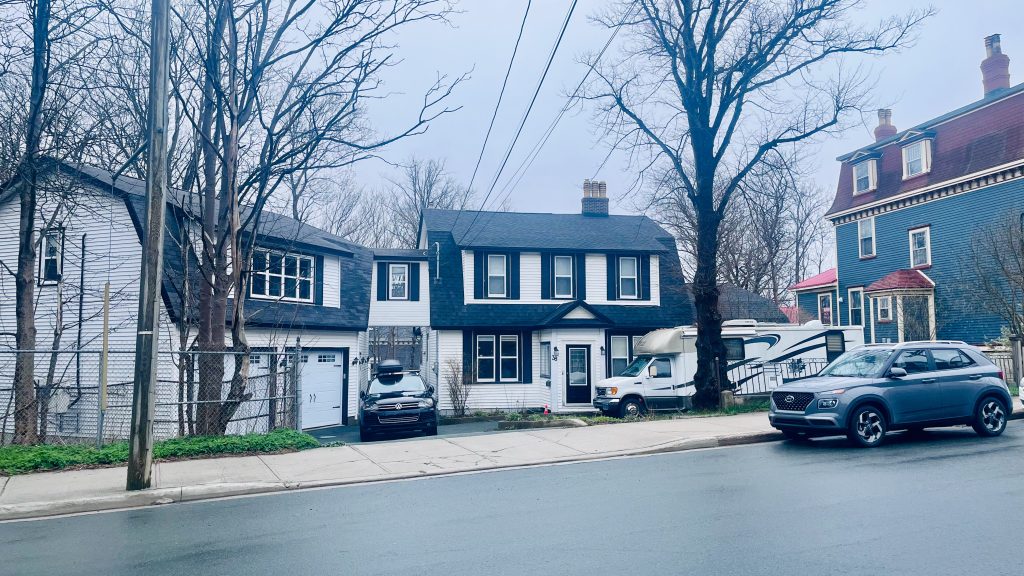
Bay windows are aesthetically pleasing, to be sure. They’re also a crafty way to introduce more natural light into the otherwise dark living rooms of sunless St. John’s homes. They require extra glass and materials, so they do cost more. This also is part of their appeal. No doubt, they were an ostentatious flex for members of the merchant class trying to show off their acquired wealth.
When Counc. Burton originally introduced this item at the Committee of the Whole a couple of weeks ago, she encouraged council to take its decision-making out of the realm of personal taste, and respond to the heritage design standards as they are — not as they wish they were.
However, if there is one thing clear from the discussions that took place, it’s that heritage design standards as they are still have enough ambiguity in them to let personal taste gain a foothold in the outcome of an application.
Finally, an apartment building on Blackmarsh Road
Council agreed to consider redesignating 113 Blackmarsh Rd. from the Commercial (C) District to the Residential (R) District, and consider rezoning it from the Industrial Commercial (IC) Zone to the Apartment 2 (A2) Zone to accommodate a development application for an apartment building.
It also approved the draft terms of reference for a Land Use Report (LUR). Once a satisfactory LUR is received, the application will be referred to the public for notification. The proposed building would have four levels and would contain 24 units.
This is big news, as it’s been four years since an apartment building was built in St. John’s. The area has also been a vacant lot for some time. Counc. Ron Ellsworth commended the proponent for the creative use of the space. The lot itself is triangular in shape, which creates some complex challenges for things like snow storage. The development shows ingenuity.
O’Leary also pointed out that the development presents a good opportunity to consider how trees might also be included in the design plans.

Cul-de-Sac on Bay Bulls Road
Council agreed to consider rezoning 121-125 Bay Bulls Rd. from the Open Space (O) Zone to the Residential 1 (R1) Zone. The applicant is proposing to demolish the building at 123 Bay Bulls Rd. and reconfigure the lots to develop the land at the rear as a cul-de-sac, which if you didn’t know, is French for “end of the bag.”
The area will accommodate the development of 10 single detached dwellings.
A whole new world of housing possibilities (and trees)
Council agreed to consider a text amendment to the Envision St. John’s Development Regulations that will enable a greater variety of housing types in residential zones. The move comes in light of the $10.4 million in federal funding St. John’s is receiving through the Housing Accelerator Fund to stimulate housing growth.
Given the increase in demand for dwellings that are generally smaller than average single-family suburban homes, Counc. Ophelia Ravencroft said, “this is one of the most exciting notes I’ve seen come in at any point in my two and a half years on council.
“It does exactly the kind of work that I think that we as a council should be doing […] to ensure that we’re respecting and actively supporting and enabling everyone to be able to access and realize their human right to housing.” She added: “I’m genuinely hopeful that this will ensure that we are addressing our housing crisis in a real way.”
There will be public engagement opportunities coming forward, and residents can visit the Engage St. John’s website to participate. Public comments can be submitted throughout the month, or in person May 22-23.
‘Densification is going to make our city more sustainable’
“This isn’t just about developers. Let’s be clear,” O’Leary said, noting it will open up opportunities for many people, including families who want to keep their children nearby, or parents and grandparents.
She noted she’s also requested a meeting with the city manager to discuss the Urban Forest Master plan.
“As a tree lover and somebody who’s an advocate, and [as] a council who supports climate action, it is extremely important that we keep an eye on how trees are integrated into this,” she explained, especially when it comes to higher apartment buildings and backlots.
“Densification is going to make the city more sustainable and increase the tax revenue per linear foot,” Counc. Tom Davis added. “So really, it’s all positive. And I hope that anybody who participates in the consultations will take that into account.
“I know sometimes you’re thinking about your neighborhood,” Davis continued, but in the bigger scheme of things, it provides solutions that can help a lot of people. “People who are finding it difficult to afford their homes will now have an option of being able to or easily subdivide and get that extra revenue to help cover their costs,” he explained.
“We’re in a housing crisis,” Counc. Jamie Korab stated. “We’re altering our regulations—some might say drastically—but you know, to address the times we need some drastic measures.” Three levels of government can work together to support these changes, he said, but they won’t actually be building these homes. It will be developers, and some homeowners. These new changes will cut down on the amount of obstacles, granting builders more flexibility.
Sidewalks an ‘unnecessary inconvenience’
Council was notified of a couple of petitions that were received from residents. Davis presented a petition on behalf of residents from Kenmount Terrace in support of the rezoning of 175 Ladysmith Dr. It is currently a vacant lot. They are supporting the move from Commercial Neighborhood to Residential Reduced Lot to accommodate more residential development. The petition included 21 signatures.
Korab presented a petition from some residents from Coventry Terrace. “Coventry” means banished, which might explain why I had to look it up on the map. It’s located near Team Gushue Highway. The petitioners requested that the city reconsider its plan to install sidewalks on Willenhall Place at Daimler Street.
The lack of sidewalks on the cul-de-sac has not contributed to increased injuries, they said, claiming that the addition of sidewalks will reduce parking, increase the need for maintenance, and present an unnecessary inconvenience for residents. There was no mention of the convenience it might provide for pedestrians, or non-residents, however.
There were 15 signatures received, but Korab noted there are 50 homes on the street.
Spring grieving and cleaning
Counc. Carl Ridgely took a moment at the end of the meeting to extend his condolences to the family of Bob Cole, on behalf of the city of St. John’s. Cole was a legend in the hockey world, “up there with the greatest of them all,” he said. Cole died on April 24 at the age of 91.
Davis wanted to thank the residents of Kenmount Terrace and members of the St John’s Gospel Hall for coming together the weekend before to clean up the neighborhood. “We picked up a big load of garbage which I’m going to bring to the dump myself tomorrow,” he said.
Korab reminded everyone that yard waste collection has started up again. Since they’ve begun the initiative, it has resulted in 6,000 tonnes of waste being redirected from landfills, which makes for an average reduction of 180 tonnes of greenhouse gasses per year.
Ravencroft announced that street cleaning is on the horizon and encouraged everyone to check when their streets are scheduled to avoid hefty fines.
Community cleanups, O’Leary said, are not just about the task at hand — they’re also a good way to connect with your neighbours. The city will support anyone who wants to have their own neighbourhood litter cleanup; visit Clean St. John’s to register.

Author

Related Articles

Meet two of St. John’s local heroes of transportation
Can community members help make walking safer in winter? Megan Clemens and Myles Russell think so

International Women’s Day is not a celebration
How do we build a fighting feminist movement?

The PC’s subtle Throne Speech caveat
Wakeham government quietly places an asterisk next to its promise, ‘For all of us’