
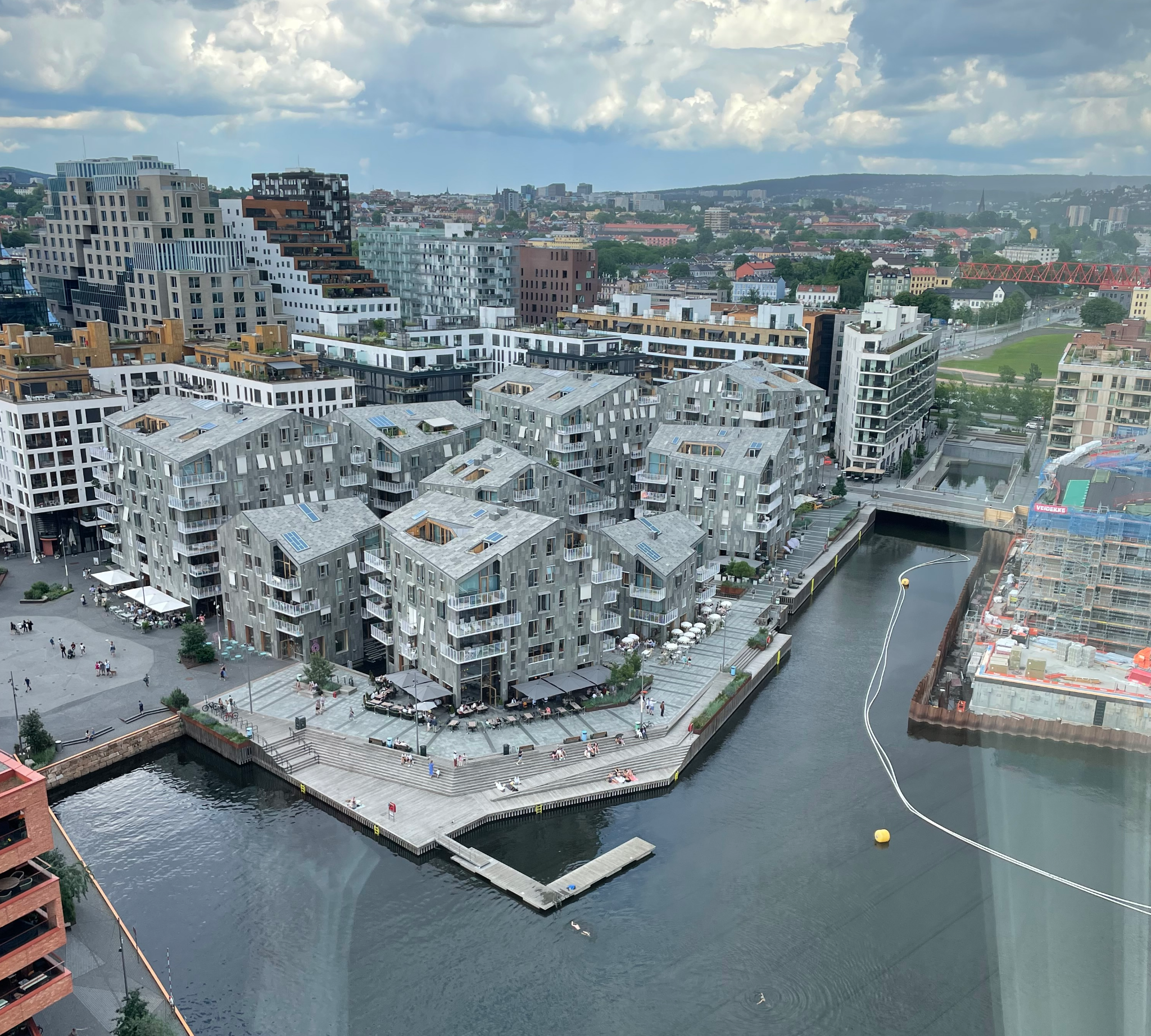
I was biking through Bjorvika, Oslo’s posh ‘Fjord City,’ in early June when news of Premier Furey’s Energy NL speech buzzed in my pocket.
I should’ve ignored it and kept pedalling, admiring the swimmers, floating saunas, the opera house, and kayakers. Instead, I stopped and squinted at my screen. As I read the speech, Oslo’s sustainable ‘future’ evaporated into fumes.
How could a surgeon, who supposedly believes in science and is guided by the Hippocratic oath, deliver a speech that sounds like it was written by Exxon’s public relations department? That kind of thing happens in Canada, after all. Surely, Dr. Furey is aware that the United Nations’ World Health Organization (WHO) considers climate change the “single biggest health threat facing humanity”?

Will you stand with us?
Your support is essential to making journalism like this possible.
The WHO estimates that the impacts of climate change “are already harming health through air pollution, disease, extreme weather events, forced displacement, food insecurity and pressures on mental health,” and that each year, “environmental factors take the lives of around 13 million people.”
Never mind all that. “We will be all in on oil and gas for decades and decades to come,” Furey exclaimed to the Energy NL delegation, “because the world needs us to be.”
I realise Oslo can afford to build sustainable places like the Fjord City, because of Norway’s oil royalties. The Norwegian Pension Fund reported assets of approximately $380,000 CAD for every Norwegian.
The eighth largest producer of oil and third largest producer of gas worldwide, Norwegian companies are still drilling, while municipalities like Oslo and Bergen are trying to move society away from oil’s slimy grip. Stine Osleand, the director of Bergen’s climate office, calls this one-foot-in-oil, one-foot-in-the-future stance the Norwegian ‘split.’
Bergen’s climate budget
I met Oseland in Bergen on an Empowered Futures research trip to learn about sustainable urban transitions. Smaller than Oslo, Bergen, on the country’s west coast, is comparable to St. John’s. It too was founded on salt fish, with colourful wooden houses built densely around a harbour crammed with fishing boats, cruise ships, and oil service vessels, and Bergen’s population is approximately 292,000. It holds the record for the most annual rainfall in Europe, and like St. John’s will have to combat sea-level rise with climate change.
In 2016, Bergen City Council boldly committed to creating a fossil-free port, fossil-free heating, transport, and fossil-free waste management. The primary policy tool Bergen used to achieve this is called a ‘climate budget.’

A climate budget “incorporates climate action into the overarching budget of the municipality,” Oseland explains. “Climate measures are quantified both in terms of financial costs and in estimated reductions in CO2 equivalents. Hence, it is a way of formally accounting for CO2 in the same way as money, and we revise annually to make sure we are on track for the local climate transformation.”
Bergen calls itself “a 1.5-degree city” and is making these dramatic changes to adhere to the Paris Agreement goal of keeping the planet habitable by holding global warming to well below 2 C. Exceeding 1.5 C warming, the United Nations warns, could “trigger multiple climate tipping points — such as breakdowns of major ocean circulation systems, abrupt thawing of boreal permafrost, and collapse of tropical coral reef systems — with abrupt, irreversible, and dangerous impacts for humanity.”
In Bergen, the City’s spending decisions are made against the climate budget. “More importantly, there is transparency about what the city is doing and regular reporting on progress,” says Oseland. “The municipal toolbox is limited and more policy tools are needed, but the biggest lesson I’ve learned is to start with city-controlled emissions in parallel with the private sector.”
Bergen first eliminated gas-burning vehicles (including buses) in the city fleet, expanded their light rail system — an electric tram that brings suburban workers to and from the city centre — improved bike trails, and in 2026 will convert to electric ferries.
When it looked at the private sector, it found that the construction sector had extremely high emissions due to its diesel-run machinery, construction waste, and the emissions of dump trucks going back and forth to the landfill with construction waste. The City developed a rigorous construction materials recycling program and told contractors that, by 2025, all construction sites on city-led projects had to be fossil-free.
Fossil-free contractors score higher in competitions for the City of Bergen projects. Oseland says change wasn’t immediate, but eventually, a good-natured competition developed between the contractors to see who could source the most powerful electric excavators, cranes and tools.
In addition, the city aims to protect all green spaces for biodiversity, recreation, carbon sequestration, and stormwater run-off. New builds can only go ahead on former industrial sites and all new buildings, public and private, are built to passive house standards, which have thicker walls, triple-glazed windows, and maintain heat or cool air — depending on the season — requiring far less energy.
“I am particularly proud of how all-encompassing [the climate strategy] is — how we have managed to show the interconnectedness in local climate transformations in a comprehensive way,” Oseland says. “And that we have managed to bridge adaptation and mitigation.”
Council threatens progress
Many of Bergen’s sustainable adaptations are funded by toll roads into the city. Recently, a more conservative city council was elected on a platform to eliminate those tolls. That council recently announced job cuts at the Bergen climate office, and proposed to cut the City’s entire climate budget, prompting protests and jeopardising Bergen’s climate budget.
Montreal, Saskatoon and Edmonton are all using climate budgets and I was surprised to learn St. John’s piloted the concept in 2022-23. “We had heard about it from Oslo and Edmonton, so we scoped a pilot,” City of St. John’s Manager of Sustainability Edmundo Fausto tells The Independent. “We were warned about how onerous the process can be.”
The onerous part is accurately accounting for scope 3 GHG emissions that are not created by City-owned vehicles or buildings. The City of Edmonton echoes this in a review of the implementations of its 2023-2026 Climate Budget, which calls for “standardized processes for GHG assessments and the need for specific methods for calculation of project emissions will need to be reviewed, refined, updated and new methods may need to be developed.”
The St. John’s pilot focused on capital projects that impacted energy used directly by City operations. “Year to year, a carbon budget basically mirrors the city budget process. We found that for it to be effective at accelerating our climate action, beyond the great work the council has enabled us to do, scope 3 emissions would need to be accounted for — that is, the GHG emissions that residents, contractors, air travel, and freight, marine transportation and others make.”
Fausto admits the data-heavy work of accounting for scope 3 emissions is impractical for a staff of two at this time. “The juice wasn’t worth the squeeze at this point in our process. We will revisit it as we go further,” he said. “A climate budget can be a great tool.”
St. John’s and the climate emergency
St. John’s declared a climate emergency in 2019 and committed to a target of net-zero GHG emissions by 2050. Fausto says there will be an update to the City’s sustainability plan presented to the council later this year.
I recently joined the City of St. John’s Environment and Sustainability Expert Panel which contributes expertise to the City around sustainability initiatives. Until joining, I was unaware of the projects our capital city has in the works.
“We’re putting a new geothermal system in the new Mews Centre, removing the oil furnaces in Buckmaster’s Centre, the Brookfield fire station, the Animal Care facility, and the former Metrobus building still used by the City operations,” Fausto explains. “Our City Works Depot is also going hybrid and the Goulds fire station [request for proposals] incorporated passive house standards.”
Transportation, however, remains the single largest source of greenhouse gases, accounting for 52 per cent of St. John’s emissions. To really put a dent in our GHG emissions and meet climate targets, commercial and personal vehicles need to convert to electric.
In Norway, the government stepped in to make this choice much more affordable by eliminating taxes on the purchase of electric vehicles and electric vehicle owners enjoy a 50 per cent discount on ferries, insurance, tolls, and parking.
“No other country in the world has gone as far as Norway in decarbonization of its transport sector: two-thirds of new passenger vehicles sold in 2021 were fully electric,” according to the Organisation for Economic Co-operation and Development (OECD), an international public policy coalition of which Canada is a part. “Norway also electrified a third of its domestic ferries and is a pioneer in electric aviation.”

The OECD notes that transport emissions in Norway are projected to decrease by nearly one-third by 2030. It’s progress, but the report also notes Norway needs to “further accelerate electrification of the transport sector to halve transport GHG emissions by 2030.”
So far, only two of the City of St. John’s 431 vehicles are electric, and just eight of the 60 Metrobuses are hybrid. Fausto says the next 14 Metrobuses will be electric, once the older diesel buses break down. It would take bold and intentional collaboration, from all three levels of government across Canada to achieve similar GHG reductions here.
If there’s one thing we can take from the premier’s Energy NL speech, there won’t be a lot of help from the province.
That ambivalence — or is it denial? — is echoed in the province’s most recent Climate Change Action Plan update, which concludes with a lukewarm projection, that “in the absence of additional actions in the coming years, the 2030 target may not be achieved and our ability to achieve net zero GHG emissions by 2050 will be challenged.”
Remember how Bergen’s Stine Oseland called the Norwegian stance between oil drilling and sustainability measures ‘the split’?
What then should we call Newfoundland and Labrador’s stance to keep drilling oil while not meeting our climate goals — the face palm?
Correction: A previous version of this article said the City of Bergen had already protected green spaces, however it is still the City’s goal to protect green spaces for biodiversity, recreation, carbon sequestration, and stormwater run-off. The article has been updated to reflect this correction.

Author

Related Articles
An LNG future for Fermeuse?
Proposal for massive liquefied natural gas hub exhumed on Newfoundland’s Southern Shore

Thinking beyond the crisis in journalism
There are many legitimate reasons for concern, but news media have an unprecedented opportunity to innovate and create a new era of journalism
Why taxpayer subsidies for Big Oil won’t create more jobs
As Equinor delays Bay du Nord decision, report finds less than 1% of Canada’s jobs now in fossil fuels