
Broken promises and lost faith
Student life at Memorial has been deeply impacted by the university’s failed commitments to peace, justice and equity
As I complete my sixth year and my second degree at Memorial University, I wish I could say that this institution hasn’t decimated my trust in higher education.
It wasn’t always this way. Throughout my undergraduate degree I felt a deep love and respect for my school, in particular the Anthropology department where I took most of my classes. I genuinely believed in the power of the university to usher in change, justice, and share knowledge. I thought all the revolutionary potential in the world was contained in my reading lists.
I am grateful to my professors for the knowledge and skills they have taught me. But I now struggle to reconcile those experiences with the ones I had once I started engaging with people in real life, not just in the lecture hall.
Like many universities across North America, Memorial University’s stated vision and the image it projects are at odds with its actions. The MUNL Inscription, a 1934 poem written for the founding of Memorial University College, employs a myth of rebuilding the province in the wake of a devastating world war, of providing education for generations to come, and of promoting peace and justice. Likewise, Memorial’s current strategic plan speaks to the university’s commitment to enacting positive change in the community, province and world. A host of other official statements and documents from Memorial echo the same themes.
Will you stand with us?
Your support is essential to making journalism like this possible.
I know these documents better than I ever would have cared to, thanks to hours of dedicated review during our Palestine solidarity encampment. Over the course of nearly two months I and my fellow protesters exhausted every avenue we could think of to convince university administrators to act with integrity and dignity. We scoured MUNL policies and would feel a brief moment of hope when we would uncover another commitment the university had claimed, another angle we might use to lobby for just policies. We wanted MUNL’s commitments to be genuine, but they never were — and it never worked.
MUNL knowingly retains millions of dollars of investments in weapons manufacturers and other companies complicit in the ongoing genocide of the Palestinian people. In July 2024, Memorial’s board of regents voted to maintain those investments, despite the miniscule financial impact of moving them. That, despite Memorial’s strategic plan explicitly stating:
“We recognize that we are entrenched in systems that dominate and continue to uphold colonial values, policies and practices. We commit to dismantling and redressing these historical and current violations.”
The sheer number of documents committing Memorial to equity, inclusion, and redressing systemic harms is overwhelming. Here are a few:
- Transforming Our Horizons (Memorial University’s Strategic Plan, 2021-2026);
- The University of Toronto Scarborough Charter (aimed at combating anti-Black racism, signed by MUNL in 2021);
- Memorial University Equity, Diversity, Inclusion, and Anti-Racism Strategic Planning Report (February 2024);
- The Dimensions Charter (as of 2022);
- MUN Strategic Framework for Indigenization (2021–2026);
- GovNL public post-secondary review, “All Hands On Deck” (April 2021);
- Universities Canada Principles on Equity, Diversity and Inclusion (October 2017)
Tracking Memorial’s broken promises
Keeping tabs is necessary because trying to negotiate with MUNL has taught me the university will lie in public. So the only way to hold the university’s decision-makers accountable is to document every encounter and share every source. Don’t just take my word for it, have a look at the documents above for yourself. They espouse moral platitudes, but these empty promises quickly crumble when faced with the reality of taking positive action.
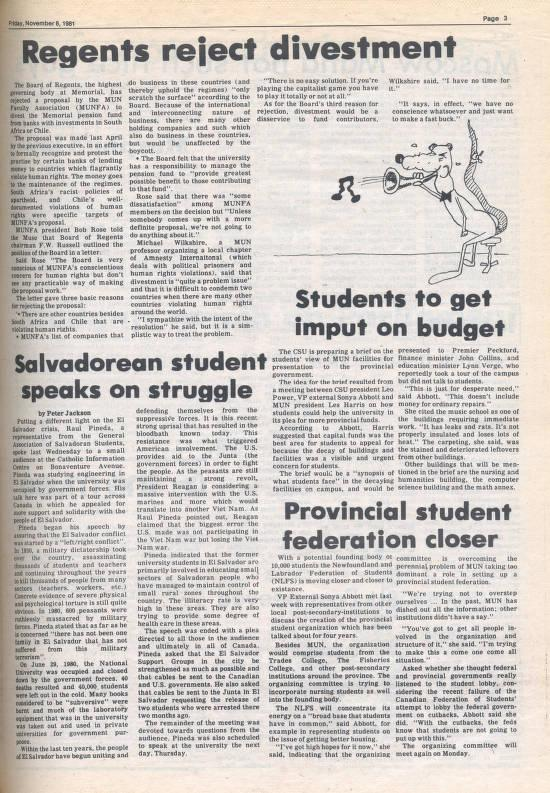
Over the decades, Memorial has demonstrated a clear history of upholding the status quo. It refused to divest from apartheid South Africa in the 1980s. It charges exorbitant prices for international student tuition, continuing the trend of colonial extraction. It deliberately invests in weapons manufacturers with connections to Israel’s genocide in Palestine today.
In its current strategic plan, Transforming our Horizons, Memorial says: “we commit to dismantling and redressing…historical and current [colonial] violations.” It is not possible for them to mean that while knowingly enabling a genocide. It just isn’t.
It makes you wonder: what other policies and commitments are being ignored for the sake of convenience?
I was so hopeful when the MUN Palestine solidarity encampment had its first meeting with the university administration in May 2024 to discuss divestment; I thought it would be a breeze. MUNL has such a unique connection to its students and community, and it has made all these commitments to justice. Certainly, it would be keen to divest. Instead, then-President Neil Bose said the university has a duty to remain neutral.
When my friend fell behind on tuition payments due to the genocide taking place in his home country, I naively believed then-Vice-President Jennifer Lokash, who promised to work collaboratively with faculty and students to develop additional paths for financial aid. Instead, out of necessity, community members fundraised to ensure my Palestinian friend was able to pay his remaining tuition and graduate. I know several other students who had to turn to the community for financial support after the university failed them.
Turning betrayal into action
I just can’t help but feel betrayed. My experience—and those of many other students I know—is incongruent with the image Memorial presents of itself and with the experience students reasonably expect.
But this contradiction is just one of many exposed at Memorial University in recent years. The university has produced a seemingly never-ending series of scandals, which are followed by consultations and think tanks, then new policies and initiatives, vowing to do better. Those are promptly neglected, and the cycle continues.
We don’t need more policies and promises. We need the university to uphold the ones it has already made. And we need the public to hold it accountable.
Show that you care about Memorial University. Think critically, pay attention, and demand better. Reach out to the new president and show your concern. A provincial election is coming up; call your local representatives, tell them you want accountability and justice at MUNL. Use your voice, be heard, make a difference.
Author

Related Articles
Slowly killing research at Memorial University
A university is not its buildings, and it doesn’t exist to serve private-sector interests. It is about the pursuit of knowledge.

Hope, grief, and value: a reflection on the Humanities
‘I saw the magic that happened in our seminars as the seed of something that could only benefit society by spreading.’
Memorial University students can’t afford silence
Why we’re taking action on Oct. 1