
Doing the heart work: My time with Memorial’s Office of Public Engagement
Love is something we don’t talk about much in university spaces, but for those I got to know during my time at OPE, love is the driving force behind their professional trajectory
One day in April, 2019, I found myself in a glassy office building on the west end of Sherbrooke Street in Montreal. I was being interviewed for a prestigious doctoral scholarship; I’d come in on the early flight from St. John’s and I was travel-weary, disoriented, and stressed. I only remember one question from the interview, posed by a professor of political science: “You write a lot about community in your application, and about how important community is to you… so why have you chosen to go into academia?”
The question was phrased as though “community” and “academia” were two incompatible concepts, but this hadn’t been my experience of university at all. I managed to mutter something to the tune of, “oh, I’m at Memorial. We’re not really separate from the community in that way.”
This felt true to me. I grew up at a time when arts community kids like me could take weekend theatre classes through MUN Extension, which meant that arts community professionals could pay a few bills teaching those classes. In high school, I spent nights at the CHMR studio while teenagers with radio shows spun actual vinyl and tried not to say too many curse words on air. I went to MUN Anime Society screenings with fellow nerds, and to MUN Cinema Series screenings with sophisticated grown-up cinephiles.
My first kiss was by the pay phones at the Thomson Student Centre in 1992 (I was in Grade 9, he was in Grade 10, and we’d skipped school to hang out at the QEII library). Many years later, I worked as a coordinator for the 2006 Magnetic North Theatre Festival, which meant hours in the then-operational Reid Theatre. I tended merch tables at SPARKS Literary Festival, and sat through Suzuki violin lessons at the School of Music with an inattentive kindergartener.
Will you stand with us?
Your support is essential to making journalism like this possible.
All this was years before I ever enrolled as a Memorial student. I was just a member of the public, kicking around campus like it belonged to me.
My answer to the interviewer’s query must have been good enough, because I got the scholarship. But the question attuned me to the relationship between universities and communities — a relationship I’d always taken as a given but which was, apparently, not universal.
In 2022 I found myself in another glassy office building, this time on Signal Hill. I’d started working with Memorial’s Office of Public Engagement (OPE) in a part-time grad student position; the next summer, I moved into a full-time role as OPE’s Framework Coordinator. I had two primary focuses: drafting an updated version of the university’s Public Engagement Framework, which had expired in 2020, and coordinating programming to support the Framework across Memorial’s five provincial campuses (St. John’s, Signal Hill, Grenfell, Labrador, and the Marine Institute).
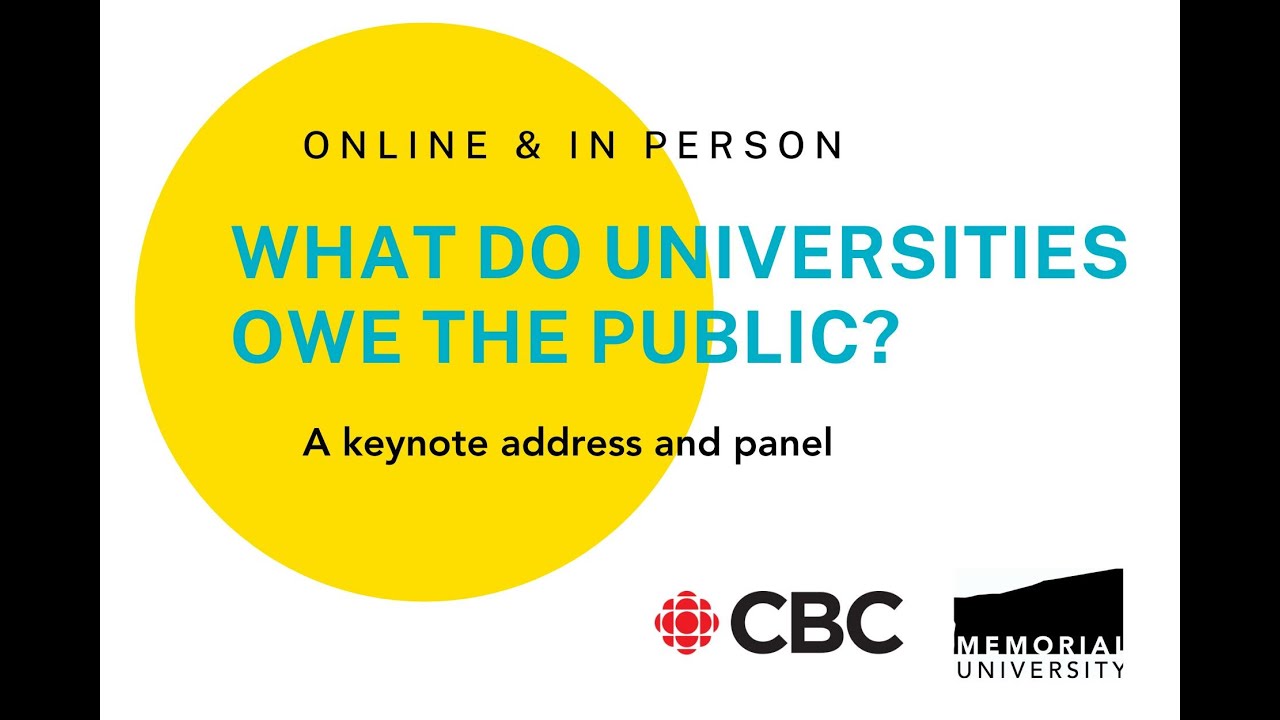
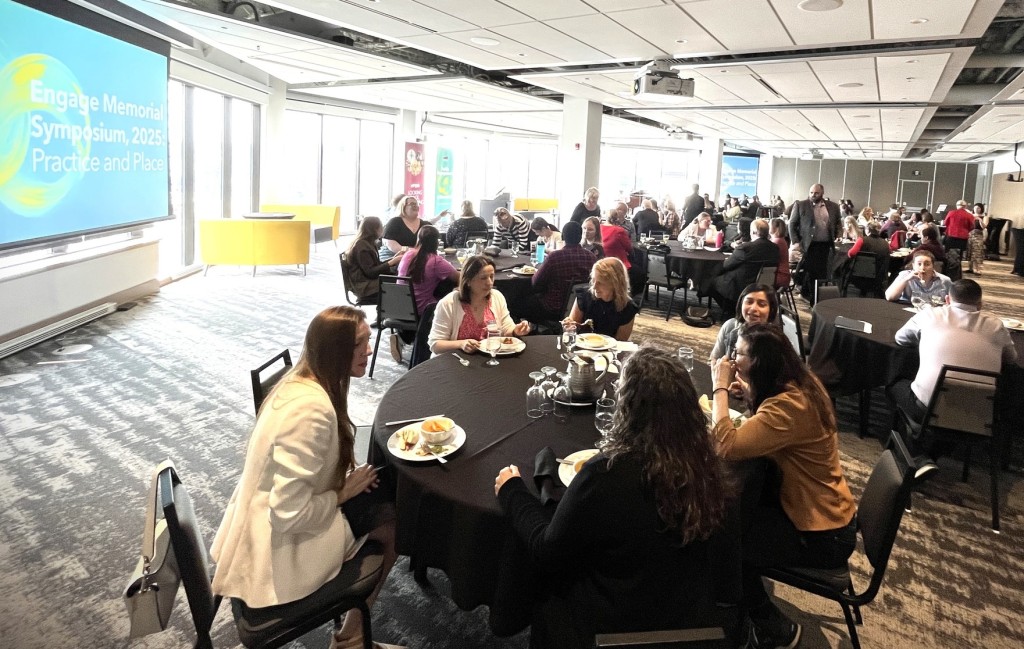
The first (and, sadly, only) instalment of this pan-institutional programming was the Engage Memorial Symposium, a two-day event held last May that brought together enthusiastic researchers, instructors, administrators, and students from all five NL campuses (and where the excellent keynote discussion, What do Universities Owe the Public?, was recorded).
Public engagement is identified in Memorial’s academic mission as an area of priority, alongside research and teaching and learning. Research at Memorial is guided and overseen by the Research Office; teaching and learning falls under the aegis of the Office of the Provost and VP Academic. The Office of Public Engagement was established to serve a similar function as these other offices; the argument then was that excellent research and pedagogy don’t just happen on their own without structures and supports, so why should excellent public engagement be expected to?
The Public Engagement at Memorial website (recently updated to remove the “Office of” part), explains that, at Memorial, “public engagement” means:
Collaboration between people and groups inside Memorial and people and groups outside the University that furthers both Memorial’s academic mission and the priorities of our public and community partners. Drawing on the knowledge and resources brought by all involved, public engagement is based on mutual respect, mutual contributions, and mutual benefits for all participants.
In order for something to be considered public engagement, there has to be meaningful, egalitarian involvement from partners outside Memorial: community organizations, governance groups, businesses, individual collaborators. Community involvement has to be there at every step of a project. This emphasis on deep collaboration serves many functions; one of these is that it creates a safeguard against the extractive research practices that dominated scholarly work for so long, and which have done such damage to communities – especially to Indigenous, racialized, disabled, minority-gender, rural, and other communities whose intellectual property and spiritual and creative practices have been (and, unfortunately, continue to be) appropriated and exploited. It’s also a way to honour, support, and be enriched by the many different knowledges and ways of being in the world that are so seldom given their due in formal spaces of learning.
It’s worth pointing out what public engagement is not: it’s not the public simply using Memorial’s facilities (although that’s a pretty good thing, most of the time), it’s not Memorial folks doing volunteer work in the community (although that’s probably good stuff too), and it’s not what most of my teenage Memorial memories were made of (but I wouldn’t trade them for the world). And it’s definitely not public relations. Public engagement isn’t about making the university look good. It’s about making sure the university meets its obligation as a public good.
One of the ways OPE supported this work was through our funding programs. These were relatively small amounts of funding—$2,500 for the Quick Start fund, $10,000 for Accelerator—which Memorial faculty, staff, and grad students could apply for in collaboration with a public partner. These funds helped build generative partnerships between Memorial and the community; they also helped Memorial researchers build their careers.
In 2024, OPE student staff conducted research on public engagement as a tool for academic career growth; one of their findings was that over half of respondents—all of whom had received OPE funding since 2019—had leveraged funds from our office to attract further funding from provincial and national sources. (This report has been removed from the website, but can be downloaded below.)
The report’s removal from the university’s website erases the labour of then-students Simone Cominelli, Katherine Rorke, and Victor Borba, who deserve acknowledgement for their excellent work.
I can’t speak for what went on before I joined the office, but during the years I was there we poured our hearts and brains and souls and guts into what we were doing. We worked with a committee of brilliant folks from across (and outside) the province—Memorial faculty, staff, students, and alumni, plus community partners from St. John’s, Clarenville, Corner Brook, and Happy Valley-Goose Bay—to rewrite the framework in a way that was accessible, consistent with the university’s (purported) values, and a pleasure to read. We had the draft ready to submit for approval a year ago and had planned to launch it in October 2024. The publication date was pushed back to January 2025, then to May 2025, then to sometime—maybe soon, maybe never. One of the last things I did at OPE was draft a Gazette article to have on hand when we were finally able to celebrate. (I don’t know who has access to those files now, but if the framework is ever approved and the article ever goes up, I’ll know it’s mine.)
I finished my contract with OPE in mid-July, six days before the closure of the office was announced. It was clear that changes were coming, but we had no idea what they would be. We’d been working through cuts for a year already: administrative support vanishing, no more student placements, staff positions made redundant. Not that long ago, we’d had more staff than we had desks for; by the time I left, we were three raccoons in a trench coat performing the tasks of a pan-university academic mission area unit. Still, we were coming up with plans every day for what we could do to make the most of our skeleton crew and shoestring budget. Most of these involved building community inside the university to support those working with communities outside it. In spite of it all, things felt like they were maybe going to be okay. That’s the real kicker: we were doing good work, and we were doing it well, and it mattered to people.
In the weeks since the closure of the Office of Public Engagement, I’ve received messages of support, of concern, and of outrage. I’ve also received messages of love — how much people loved working with us, and how much they appreciated our support for the work they love to do. Love is something we don’t talk about much in university spaces, but for so many of the researchers, instructors, administrators, students, and public partners I got to know during my time at OPE, love is the driving force behind their professional trajectory. OPE supported the heart work of academia, the work that comes from a sense of personal and collective moral obligation to make this place—the university, the province, the world—more equitable, more humane, more liveable, and more joyful.
And so, I’m thinking back on that interview question. “You talk a lot about how important community is to you… so why have you chosen to go into academia?” Up until recently, I didn’t think I had to choose one or the other. But this round of cuts changes that, and it makes me wonder if Memorial is still a place where I—where we—can have both.

Author

Related Articles
Slowly killing research at Memorial University
A university is not its buildings, and it doesn’t exist to serve private-sector interests. It is about the pursuit of knowledge.

Hope, grief, and value: a reflection on the Humanities
‘I saw the magic that happened in our seminars as the seed of something that could only benefit society by spreading.’
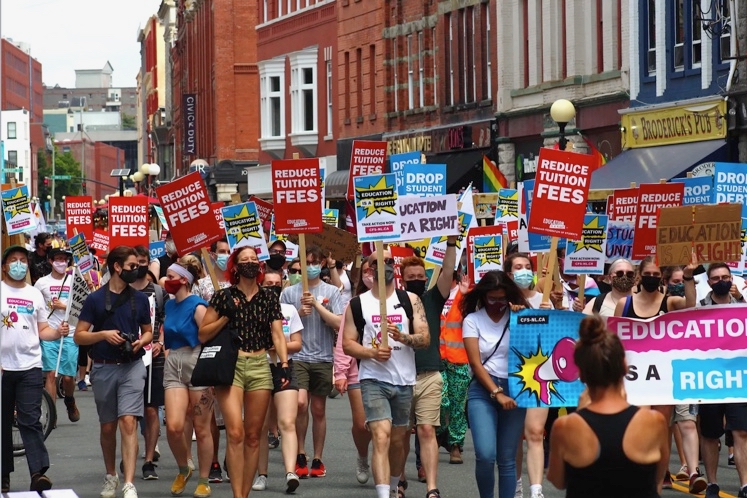
Memorial University students can’t afford silence
Why we’re taking action on Oct. 1