
Hope, grief, and value: a reflection on the Humanities
‘I saw the magic that happened in our seminars as the seed of something that could only benefit society by spreading.’

On Oct. 16 I convocated from Memorial University’s interdisciplinary Master’s program, an M.Phil in the humanities, just months after I was informed the program will be closed this semester. I can only presume it’s due to the program’s perceived quantitative and abstract value for the university. It’s not a big money maker.
But this small, relatively unknown program was carefully curated and designed to create a value-laden and cohesive experience. Students came from all disciplinary backgrounds, my own being molecular biology, a professional degree in health sciences, and a Master’s in Theology. I had classmates who came from environmental anthropology, political science and English literature.
We had six core courses, each examining a different theme: utopia, the anthropocene, identity — and each week we would have a guest lecturer from a different discipline to help us examine and integrate themes from a different disciplinary perspective. The discussion was so rich—unusually so because of the diversity of backgrounds—both culturally and disciplinarily. I was still marinating in the discussion for hours afterward. Classes were in the late afternoon to accommodate work schedules.
We had one project to focus on for each core course — a longer-length final paper, where we could write about anything related to the theme of the course using any methodology; we had a huge amount of scholarly freedom with which to explore and engage our interests. And we had to orally defend our paper to a panel at the end of term, which deepened our integration of the material, and is solid practice for both doctoral comprehensives and professional interviews. We were matched with a ‘tutor’ from any discipline to guide us in whatever way served us: professional development, writing support, scholarly development, a soft spot to land when life was hard or someone to push us to the next level. It was a unique program that not every institution could lay claim to.
Will you stand with us?
Your support is essential to making journalism like this possible.
My training in the humanities is ostensibly irrelevant. I spent 12 years working as a front-line healthcare worker and now work in residential mental health and addictions. But I draw on my background in humanities every day; it allows me to look at problems in a different way than those with solely professional degrees that the university increasingly relies on for income at the expense of the liberal arts. Don’t get me wrong — I needed my professional degree to develop certain technical and transferable skills. But my education—not just in the liberal arts, but in the humanities specifically—allows me to bring something different to the table. It taught me how to go deeper, to approach problems in an unconventional way, to engage with people who have vastly different values and perspectives, and come out on the other side with insights. I didn’t just grow academically, I grew personally too.
From abstract to practical application
How has a graduate education in humanities affected my professional work in an unrelated field? Well, there is currently a heated debate in residential mental health and addictions. With new initiatives like harm reduction, there are two nebulous camps: those who prize accountability in the name of growth and change, and those who are focused on compassion for mistakes that often occur in a vulnerable and marginalized population. You might already believe which camp you fall in, but it becomes far more complicated in the real world – especially when you need to make decisions as an organization with staff divided in different camps. If there are rules around substance use, and people violate them (in various contexts, I might add), how do we choose a course of action?
It’s a philosophical question. It’s a question for the humanities, but often we become mired in judgement, opinions, and surface-level debates entrenched in our own perspectives.
I suspect I was hired at my current workplace precisely because I had a different educational background. I sent my manager an email suggesting how we might discuss this issue. Whenever someone tells me, “I just think there needs to be some accountability,” I reflect on this when I go home at night. I think accountability has various shapes, forms and routes, and I think there are various degrees to which we hold people accountable. I wanted to go beyond the superficial opinions and debates, so I told my manager that I want to ask the room: “If you think there needs to be accountability, what does accountability mean to you? What does it look like? How do you prioritize accountability in relation to other values? Does this prioritization change with context-specific variables? What is the difference between accountability and justice, and what are the implications of both?
This is a vastly different conversation than those which often occur during conventional staff meetings, but changing the conversation this way allows us to go beyond surface-level debates and creates space for more open and effective discussions. Not all workplaces are able to engage in these kinds of conversations, but mine can – and it’s the perfect setting for someone in the humanities when those around them usually have specific professional credentials like social work or child and youth care diplomas. We need social workers, nurses, engineers and other professionals, but we also need professionals with breadth and depth. We need professionals with backgrounds in literature, history, philosophy and gender studies. Not just professionals who begrudgingly took a course in ethics, but who follow their non-professional interest in the humanities, then integrate and apply it.
In another case, when I look at trauma I don’t read qualitative or quantitative evidence-based articles — I read affect theory like Eve Kosofsky Sedgewick and contemplate how it relates to stuffed animals or squishmallows as a coping tool.
There is also a large volume of scholarly debate about strained physician-patient relations that is often rooted in the social sciences, but my humanities background makes me think of this in terms of subjective experience of time, how this differs between clinicians and patients, and how it creates conflict between the two. I think about the problems I faced in healthcare in terms of phenomenology rather than socialization or communication; my capstone project or “mini-thesis” was on this topic.
Grieving the loss of potential
The humanities are arguably the most vulnerable sector of academia. I’m sad for the final cohort behind me who are left in a sort of purgatory, to finish their degree by taking electives before the program is disposed of. I’m sad for my program director, who empowered me, understood my personality quirks and social faux-pas, withheld judgement – and is now out of work. But most of all I’m sad for the loss of potential. I grieve the loss of potential discussions, potential enrichment – for the people who might have reaped rewards from a unique program and the effects this could have had on those around them.
I made a jestful comment in one of our utopia-themed classes that our classroom was a utopia. I was only partially kidding though; I saw the magic that happened in our seminars as the seed of something that could only benefit society by spreading. What happens to our world when we can only think in a defined and limited set of ways? I shudder.
I engage in activism in a localized way: in the philosophical approach to my work, the choices I make, and the way I engage with the people I encounter. I’m not the person who organizes rallies or letter-writing campaigns, but I hope this story supports those efforts. I hope it opens a mind or two. The world we live in has become frightening and disorienting. We need people who can change conversations if we are ever going to mount an effective challenge to greed and polarization. The world in which we live needs the humanities.

Author

Related Articles
Slowly killing research at Memorial University
A university is not its buildings, and it doesn’t exist to serve private-sector interests. It is about the pursuit of knowledge.
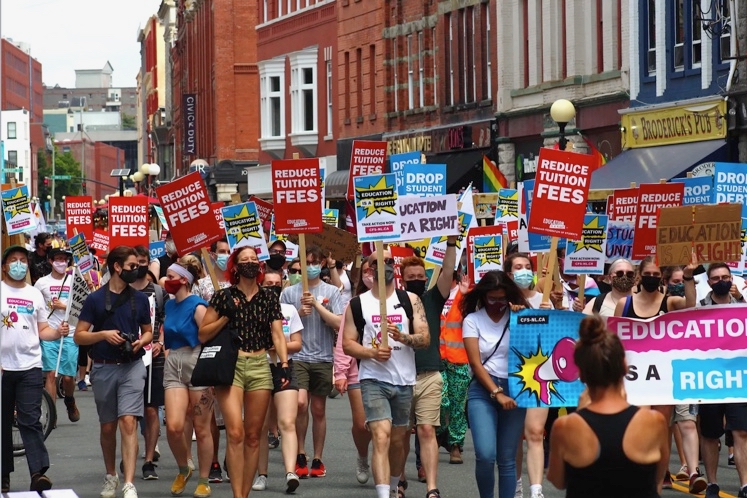
Memorial University students can’t afford silence
Why we’re taking action on Oct. 1
From Black Excellence to Black Flourishing at Memorial University
Excellence on its own will never keep us safe