
Budget 2026 does not meaningfully address housing insecurity
A provincial budget delivered in the midst of a housing crisis should have something consequential to say on the subject of housing
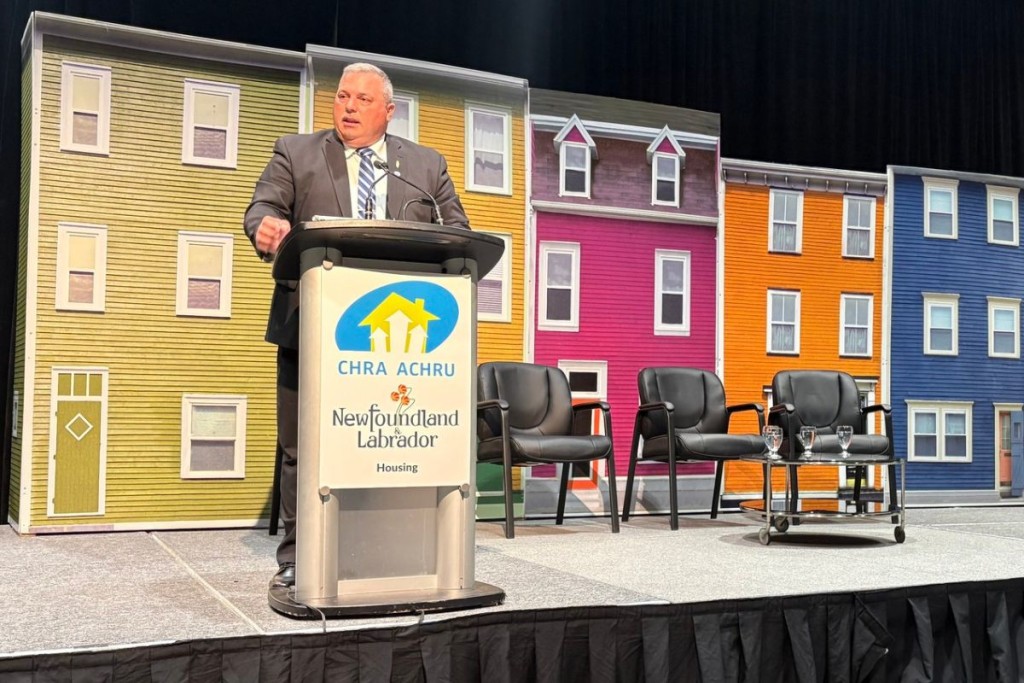
“With costs increasing and a shortage of attainable housing, our province needs to get building and we need to get building fast.” In last week’s budget speech, provincial Housing Minister Craig Pardy delivered the words so many wanted to hear, adding the Progressive Conservatives have “set the ambitious goal of thousands of new homes over five years.
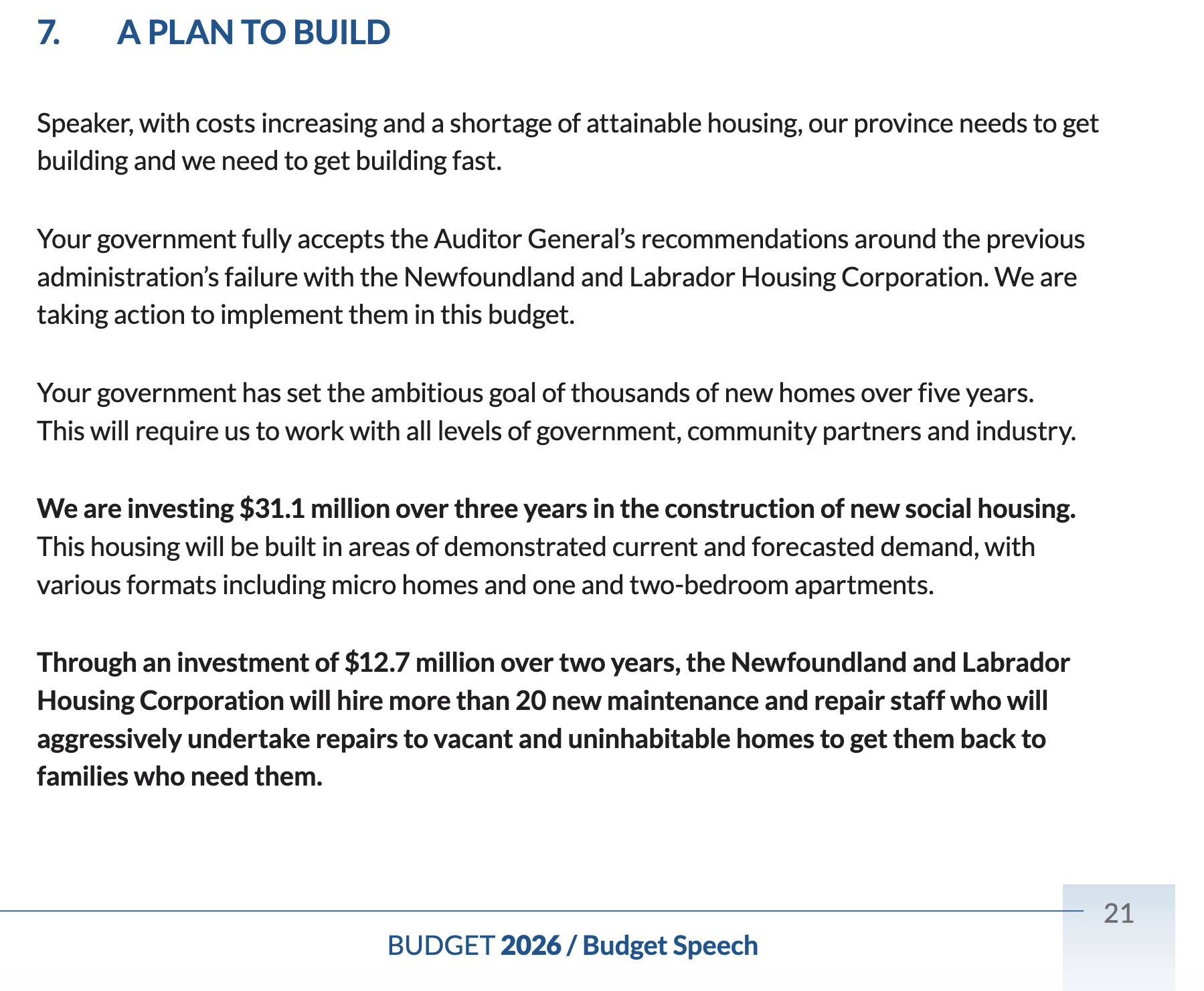
Pardy said the PCs “fully accept” the auditor general’s recent recommendations to improve social housing, and that the government is “taking action to implement them in this budget.” All that being said, the budget falls far short of taking meaningful action on housing, leaving substantial shortfalls in its promise of “Opportunity for All of Us.”
What’s in the budget?
The Wakeham government allocated $31.1 million over three years to construct new public housing units, “in high-priority areas based on current and forecasted demand.” Auditor General Denise Hanrahan noted in a recent report that NL Housing has failed to forecast future demand, so it’s unclear how that demand will now be calculated.
Will you stand with us?
Your support is essential to making journalism like this possible.
With current construction costs above $350,000 per door, $31.1 million amounts to fewer than 90 units. If accounting for the net decrease pointed out in that same AG report, it means that NL Housing’s portfolio will expand by about 30 units if we benchmark per-door costs optimistically. That amounts to about a 0.6 per cent increase in the total number of public housing units, and would address 1.2 per cent of 2025 waitlist demand, which sat at 2,603 households.
I’m loath to criticize expanding social housing, but this is a drop in the ocean of what’s needed to meaningfully improve housing conditions for low-income people in this province.
The budget also includes $12.7 million for repairs to public housing units, which is critical to making better use of existing assets. The auditor general reported that 222 units are vacant and 72 are “unavailable for use” because they require major repairs. With the promise to hire “more than 20 maintenance staff,” and an allocation of about $43,200 per vacant unit, it remains to be seen whether this investment will sufficiently address the deep maintenance deficit in the province’s social housing, but it seems possible.
Another $10.5 million was announced “to support Labrador West in its application to federal crown corporation Build Canada Homes for the construction of new seniors’ housing.”
Build Canada Homes recently replaced the Canada Mortgage and Housing Corporation’s National Housing Strategy programs as the new vehicle for delivering funding for affordable housing construction. The new corporation stresses the need for “shovel-ready” projects, which means land must be secured, designs and municipal approvals must be in place, and a host of other criteria and activities which all take time and cost money.
The trouble is, Newfoundland and Labrador has no funding programs in place to finance those activities, presenting a major challenge for organizations to develop viable applications. This investment will no doubt increase the likelihood of success for Labrador West’s application to Build Canada Homes, but this one-off allocation leaves housing providers without a clear, consistent, and transparent process to build into their development plans.
Investing in a single project is good, but it fails to address the structural problems caused by a lack of consistent pre-development funding and provincial government non-participation in systematically funding community housing development in general.
In a similar vein, the budget included funding announcements for a couple of specific transitional housing programs, as well as funding for the shelter system. These are positive developments for the organizations in question, and for their clients, but they too don’t solve the structural problem in the non-profit housing sector of stagnant operating funds which fail to account for the increased demand for services and the increased costs associated with providing those services.
Funding temporary initiatives without increasing the availability of permanent affordable housing is extremely costly and creates a bottleneck in the system – and in human lives.
Another $4 million was allocated for “approximately 500 additional Canada-Newfoundland and Labrador Housing Benefits.” These are subsidies provided to tenants to bridge the gap between what they can afford and the actual cost of housing. These subsidies, in the face of structural underinvestment in non-market housing and insufficient housing supply in general, bridge a gap in the housing system. They simultaneously funnel money through low-income people to increase profits for the private sector. In a province without rent control, this is poor economic planning. While this may serve as a means to an end to improve resident quality of life while making necessary additions to the non-market sector, if it’s the main strategy for addressing housing insecurity, it is both not an effective solution, and not cost-effective.

For context, to bridge the gap between the social assistance amount for rent for a single individual at $522 and the average rent for a one-bedroom apartment in the province at $1,119 — which is likely an underestimate — a tenant would require an additional $597. By contrast, the monthly per-unit net cost of operating an NL Housing Corporation unit in 2024-2025 was $660. The latter provides a long-term solution that facilitates actual housing security and predictable public cost, while the former relies on the whims of a poorly-regulated private market and effectively transfers money from the public to the private sector without long-term benefits. The province says it expects these new funds to substantially reduce NL Housing’s waitlist, but that presumes the availability of private market rental units. With vacancy rates as low as one per cent in some areas, this is far from a safe assumption.
What cannot be left unsaid here is that providing people what is well-known to be a substandard amount of money to account for the cost of living is an intentional policy choice. The budget increases the amount of personal income, which goes untaxed to $15,000, an untargeted benefit which will accrue to low-income households and high-income ones alike. It also includes a 20 per cent increase to the NL Senior’s Benefit, a tax credit for seniors earning less than $30,078 per year. Of this change, Pardy said in the budget speech, “[Seniors have] earned it. They deserve it.” Looking at this valorizing statement, as well as what’s missing from the budget — increases to social assistance and sufficient investment in new non-market housing — might inform some conclusions about who is viewed as deserving by this government, and who is not.
The budget lacks action to bring social assistance rates anywhere within shouting distance of the cost of living, all while mentioning (without clear funding commitments) a 10-year poverty reduction strategy through which, Pardy says, “we intend to bring Newfoundland and Labrador’s poverty rates to the lowest in the entire country.” In 2024, based on the market basket measure, Newfoundland and Labrador was seventh in poverty rates among Canadian provinces. The provincial government could rapidly accelerate its progress toward this goal by simply increasing social assistance rates in line with the market based measure, rather than announcing a strategy without dedicated funding to action it.
Action on housing means intentional, systemic changes which allow for more non-market housing development and which alleviate the reasons why people are housing insecure in the first place. In its first budget, the Wakeham’s PCs had a choice to break away from the institutional inertia that has characterized government responses to housing issues spanning decades. Instead, they chose one-off political measures which leave the foundational issues untouched.
Newfoundland and Labrador is currently the only province in Atlantic Canada without a dedicated housing strategy, and that is evident in the approach to housing we see in Budget 2026. When discussions about cost of living don’t take into account the largest line item in most household budgets, something is missing from the accounting. Until housing enters into the conversation in a meaningful way, any efforts to improve quality of life for Newfoundlanders and Labradorians are bound to fall short.

Author

Related Articles
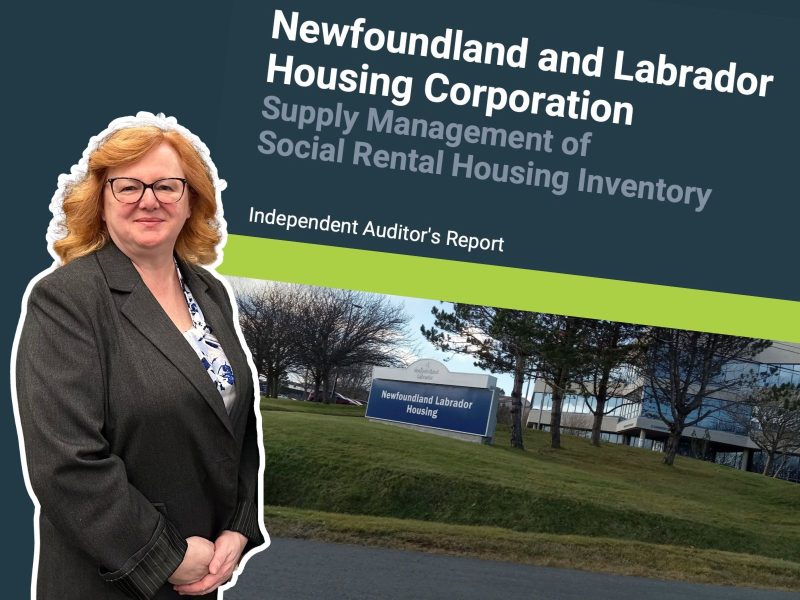
A housing corporation without a housing mandate
The Liberals and PCs have no right to point fingers at each other in response to the auditor general’s scathing report on social housing
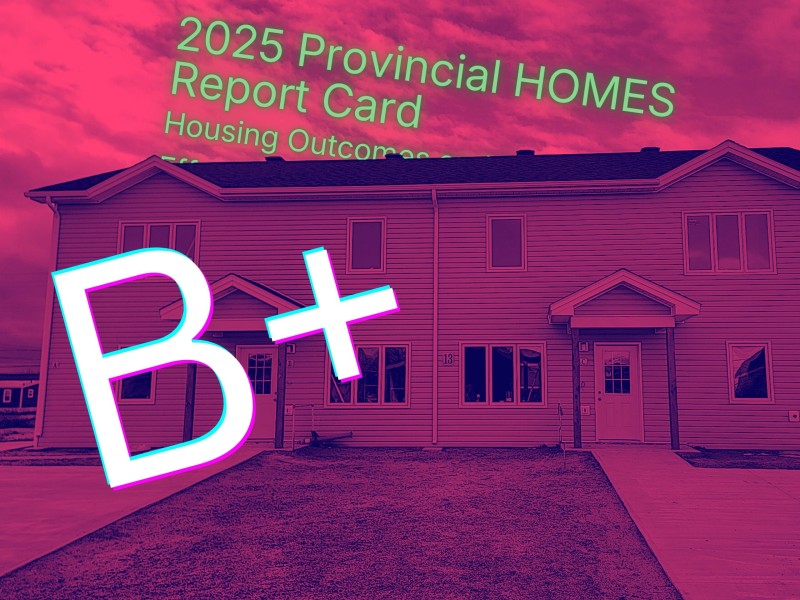
National housing report misses the mark on real human impacts in N.L.
Newfoundland and Labrador’s B+ on its progress to increase housing supply doesn’t paint an accurate picture of residents’ lived realities in the province
The case for affordable housing
Whether you’re concerned with human rights or simply with dollars, investing in affordable housing makes sense