
National housing report misses the mark on real human impacts in N.L.
Newfoundland and Labrador’s B+ on its progress to increase housing supply doesn’t paint an accurate picture of residents’ lived realities in the province
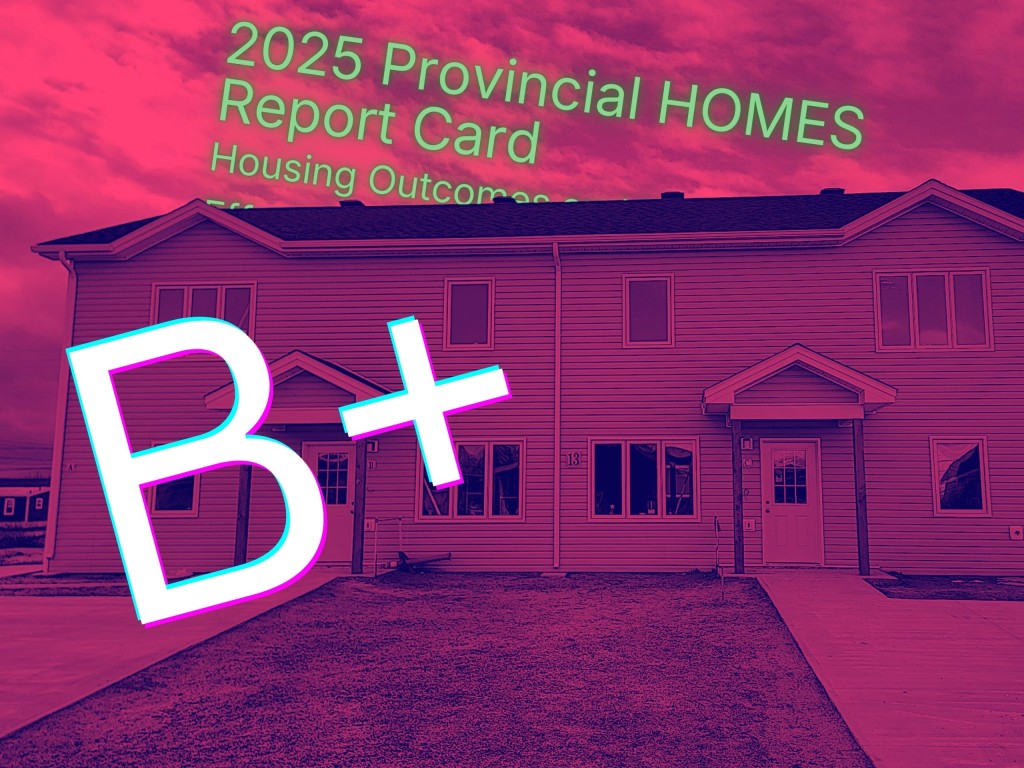
Last month Ottawa-based not-for-profit Missing Middle Initiative released its first annual Housing Outcomes and Management Effectiveness Score (HOMES) report card, which grades Canadian provinces on their progress to increase housing supply.
Perhaps to the surprise of anyone who’s tried to find housing in recent years, Newfoundland and Labrador received an overall grade of B+, potentially leading those who have somehow managed to avoid being touched by the housing crisis to believe that our governments’ responses to the housing crisis are working well, or that all the news stories about the dire straits folks are in are overblown.
While it would be a relief to learn the circumstances around our province’s housing crisis are improving, regrettably this isn’t the case. Many of the metrics used to evaluate housing system health by the Missing Middle Initiative in its new report fail to examine the bearing of policy choices on human lives and on the ability of residents of this province to realize their human right to housing.
Faulty logic and ‘filtering’
Will you stand with us?
Your support is essential to making journalism like this possible.
The HOMES report card uses the same foundational logic of the dominant line from government policymakers in recent years: a supply shortage is at the heart of the housing crisis, and resolving that supply deficit will resolve the problem.
This approach has been critiqued for several good reasons, not the least of which is that supply infusions with no attention to affordability levels are unlikely to make a meaningful difference for those experiencing housing insecurity. This is especially poignant in our present climate of stagnanting or dropping incomes—in particular for renter households—and insufficient access to necessary support services that enable residents to sustain their housing, like access to mental health, education, and employment services. If we were to ignore these latter two elements—and we can ill afford to do so—we would nonetheless be left with a set of faulty assumptions about what untargeted supply infusions could achieve.
The Canada Mortgage and Housing Corporation (CMHC) applies the concept of “filtering” to its supply focus: the notion that building new housing means wealthy people move into new homes, leaving their previously-occupied dwellings for lower-income households at lower prices. However, studies show that rates of filtering are glacial in their pace and even slower in markets where prices are rising quickly, as is the case in Newfoundland and Labrador since the onset of the COVID-19 pandemic. The notion of filtering also ignores gentrification and the ability of wealthy speculators to outbid low-income residents for less expensive properties. In a world where housing is deemed an “investment” and speculative housing markets drive home prices ever upward, the concept of filtering appears untethered to reality.
Rewarding the absence of action
The HOMES report evaluates the policy environment based on its use of—as the Missing Middle Initiative deems them—“pro-supply policies” and “anti-harmful policies.”
In the “pro-supply policies” section, the report’s authors consider six factors mainly associated with streamlining the development process, including the speed of approvals and the availability of zoning and Geographic Information Systems (GIS) data. The report appears not to distinguish between St. John’s and the province broadly, which ignores the enormous differences in the municipal realities outside the metro region and the particularities of rural housing needs.
Nevertheless, St. John’s is noted to underperform in this area, “even with comparatively simple applications.” This aligns with findings from a report I co-authored with the Community Foundation of NL last summer on community housing development, in which all interviewees cited the municipal process as a challenge in development. The report also rightly points out the extension of permitted uses—staff-level approvals that can be done relatively quickly without public meetings or votes of council—for multi-unit development is relatively limited at present, even after the City of St. John’s passed a housing amendment in June 2024.
In the “anti-harmful policies” section, the report’s authors reward the absence of policies which introduce regulation on existing housing supply—ostensibly to address supply shortages through better use of existing dwellings—and make new supply more affordable. The report lauds jurisdictions avoiding the use of tools like inclusionary zoning and restrictions on short-term rentals, the intents of which are to target supply at lower-income households in the former case and increase the availability of existing units in the latter.
The HOMES report authors cite a correlation between the use of such policies and poor housing outcomes. While they acknowledge “it may be because poor housing outcomes cause governments to consider these reforms, rather than the reforms causing poor housing outcomes,” this does not alter their evaluation. Ironically, the absence of these policies in a Newfoundland and Labrador context is at least partially attributable to the fact that municipalities don’t have the legislative authority to implement them due to the proscriptive nature of the powers given to them by the provincial government.
The neoliberal approach of minimizing regulations follows the market-driven supply-first logic at play in this analysis, but it runs counter to targeted, human-rights-focused affordability targets. There is value in lowering barriers to development, especially in the context of affordable and community housing. There is equally an imperative to use measures to target new developments where they meet community needs, not just where private profits can be maximized, which is what this report seems to endorse.
Local realities
The HOMES report card rates rental affordability based on average rents compared to the national average. The average rent on a national scale, however, has very little bearing on the financial reality of renter households in Newfoundland and Labrador, where average renter household income sits at 22 per cent below the national average, and where average rent is higher than the 30-per-cent-of-income benchmark for such a household at $1,119 per month, per newly-released data from CMHC. In other words, the average rental unit is unaffordable to the average renter household. None of this is captured by looking at the national picture. Ignoring the impact of income on rental affordability is an enormous gap in the HOMES analysis.
In contrast to their rental affordability analysis, the report uses a composite home price-to-income ratio to determine the affordability of purchasing a home, which is useful because it considers the tangible impacts of housing prices on homeowner households. However, the Missing Middle Initiative’s estimate of income is based on two full-time, year-round working adults with no seasonal variation in income, which as of the 2021 Statistics Canada census was the case for just 27.5 per cent of workers in Newfoundland and Labrador. Data is available for household income overall, and for homeowner households specifically; these come in at $38,746 lower and $26,946 lower than the benchmark used in the HOMES report, respectively. In short, the Missing Middle Initiative’s conclusions are drawn from numbers which are substantially higher than the actual incomes of households in our province.
The report also considers the number of “surplus” housing units in St. John’s and the province, citing a correlation between volume of units in a housing system and affordability. In the report’s estimation, Newfoundland and Labrador has an excess of more than 5,000 owner-occupied homes and rental units, a surplus of over 400 condo units, but a deficit of close to 17,000 apartments. Each of these gets equal weight, so the cumulative total of what amounts to a massive shortfall—borne out by the CMHC rental market data which identified multiple zero-percent vacancy rates for various unit types across larger communities in the province—doesn’t seem to bear as significantly as it ought. The story here is of a housing supply which has long been out of pace with the needs of the population, and one which has not been managed in a way that positions it to meet those needs.
Supply won’t save us
It can’t be denied that building an abundance of new housing is an essential part of solving the housing crisis. It is useful to understand what factors influence housing supply and how well implementation measures to increase supply are being put into place across our country. If such an analysis is to be useful though, it has to be grounded in meaningful data that takes into account the realities of human experience and local context.
The outdated logic of market-driven neoliberal housing policy has to be retired in favour of a way of thinking that foregrounds the human right to housing and targets resources where they stand to advance those human rights, not merely increase private profits.
We cannot assume that lower housing costs will magically follow in this financialized housing system, and we will not de-regulate our way to affordability. This crisis demands a response that is thoughtful, targeted, and grounded in human dignity and human experience, a plan that we will not get from metrics untethered to grounded reality.
Download the full report:

Author

Related Articles

The case for affordable housing
Whether you’re concerned with human rights or simply with dollars, investing in affordable housing makes sense