

The Liberals did it. They held to Premier Andrew Furey and Justice Minister John Hogan’s promise to deliver the 2024 budget “as soon as it is safe to do so.”
Amid ongoing fish harvester “violence,” Finance Minister and Deputy Premier Siobhan Coady spent the night inside Confederation Building to avoid having to cross the protest line in the morning.
Sporting her controversial new shoes, Coady stood on the floor of the provincial legislature and delivered an 83-minute budget speech in the same fashion as last year.
Will you stand with us?
Your support is essential to making journalism like this possible.
Outside that Liberal cocoon in the House of Assembly, though, everything had changed.
Opposite the Liberals sat 16 empty legislature seats. The PCs and NDP boycotted the event in solidarity with the fish harvesters. The public gallery was closed to the public. And the press gallery was empty, as reporters remained outside, where dozens of riot police — some in military fatigue — protected the fortress from those militant fish harvesters.
As Coady concluded her speech, her face conveyed a pride in the Liberals’ work.
“Four years ago we set out on a course to tackle difficult problems together: our provincial finances, health care, infrastructure, transportation, economic growth. The work continues and expands: housing, poverty reduction, education,” she said.
“Transformation is happening; progress is being made. There is positive momentum and we must not waver. We must keep our compass true. Our determination resolute. We must not be distracted or deterred by head winds, noise, negativity or by those who say it cannot be done. For we know it can, it will, and it has. It is the beginning of a great future with incredible opportunity. Let us continue the momentum toward a stronger, smarter, self-sufficient and sustainable Newfoundland and Labrador.”
Just like last year, Coady’s colleagues gave her a standing ovation.
There’s just one thing. Despite the province’s record spending on health care and its decision not to raise taxes, Budget 2024 will not be remembered for those things.
It will be remembered as one of the surest signs that the province’s political elite are completely detached from reality — from everything happening in our province outside that shrinking Liberal bubble.
Because at the very same time labour leaders were calling for de-escalation of tensions outside Confederation Building, the Liberals chose a different path. They went to the provincial Supreme Court to get an injunction so that the police could be brought in to deal with the protest.
Premier Furey might benefit from reflecting on his own words from April 2021: “As politicians and as leaders, if we keep to our heart the simple question when answering what we should do, how we approach a policy or decision, with this fundamental principle in mind: ‘Is the decision that you’re about to make the right one for Newfoundland and Labrador?’ I think we’ll all be in good stead moving forward.”
Actions louder than words
But those words alone aren’t enough to contextualize the present. To begin measuring the state of democracy under nearly a decade of Liberal government and almost four years under Furey’s leadership, we need to revisit Furey’s first swearing-in ceremony in August 2020.
That’s when the incoming premier made perhaps his most important promise of all: that things will be different on his watch.
“I know there are skeptics out there. I know that there are those whose faith in our political institutions has been rocked,” he said. “I can’t change the past. I can only stand up now and tell you how this government will move forward: transparency.
“You will know exactly what the hard decisions are, and how they will impact our province, and why we are making them. When asked a question, expect a straight-up back-based answer; no rhetoric, just reality. We will stand and be accountable for our mistakes, and we will together strive to learn from them. And we will of course be judged by future generations on the difference we make today.”
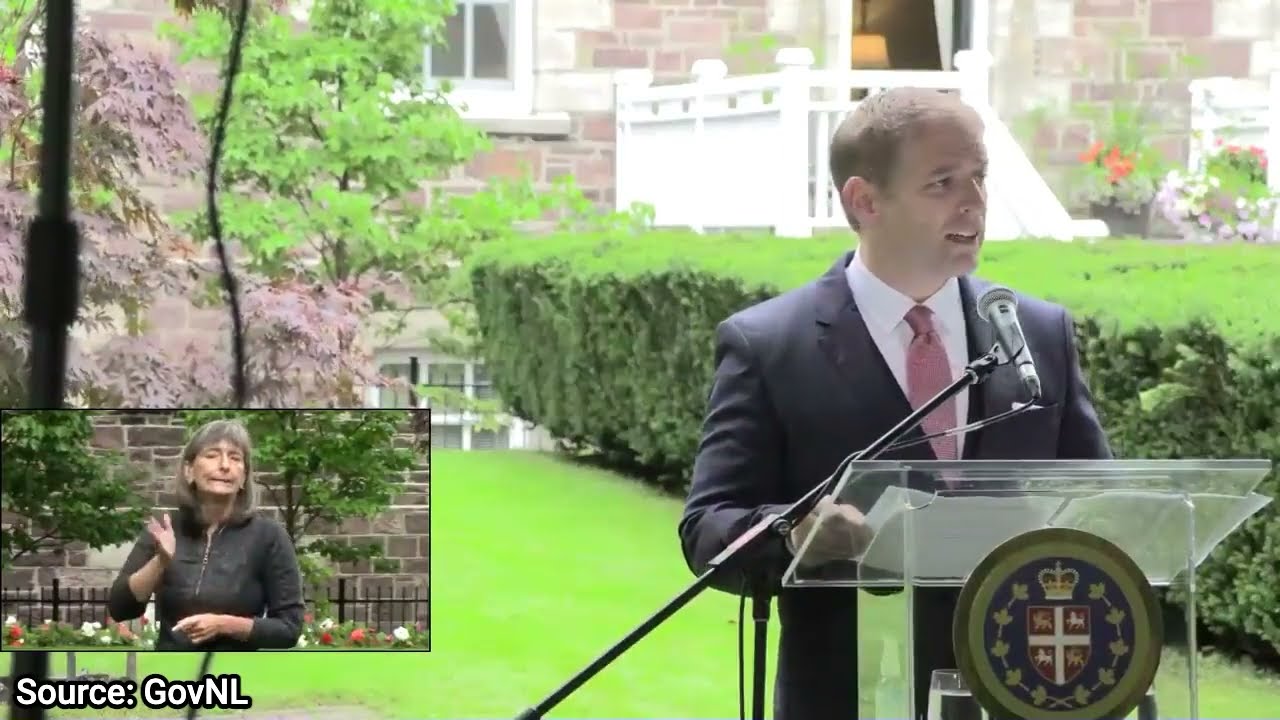
But under Furey’s leadership, the Liberals have been anything but transparent on key issues and policies.
Days after his swearing-in ceremony, Furey announced he had appointed Moya Greene — a rich businesswoman and staunch neoliberal — to chair a team to review the province’s finances and make fiscal recommendations. Green was known for her role in privatizing the Canadian National Railway, deregulating Canada’s airline industry, and for privatizing Britain’s public mail service — the latter prompting the Financial Times to remark that “[e]ven prime minister Margaret Thatcher balked at the political risk of selling off a public service that carried the Queen’s head on its stamps.”
The following month Furey announced the full roster of his Premier’s Economic Recovery Team (PERT), which included then-Newfoundland and Labrador Federation of Labour President Mary Shortall.
“What was missing were statements explaining how they would accomplish this task, whether or not the [PERT] report would be made public, and most importantly, how the public and organizations, like unions, would be able to participate in the process in a way where all concerns would be taken into account,” Shortall wrote for The Independent in 2021, several months after she resigned from the PERT.
The long time labour leader and activist, who now serves as president of the federal NDP, called the PERT’s work “window dressing,” explaining “the lack of transparency, top-down approach, rushed timeline, lack of real collaboration and an overall feeling that not all perspectives were being considered, or appreciated,” influenced her decision.
“Concerning for unions was the fact Dame Greene had a long history leading in deregulation, centralization and privatization schemes with Crown Corporations and public services – everything from rail to mail,” Shortall wrote in her Independent op-ed. “Her anti-worker, anti-union attitude was well known within the global labour movement. When you invite someone carrying an axe to the table you should expect cuts.”
If the Liberal government under Andrew Furey was going to restore the public’s faith in our province’s democratic institutions, it would not be during his top-down review of the province’s finances and assets, which represents the most explicit effort to reshape — or “reset” in Moya Greene’s words — our province’s economy in recent decades.
The Furey government’s broken promise of transparency didn’t end there.
Following the PERT report’s release in May 2021, Furey released a “state of the province” video address at 6 p.m. on a Thursday, the same time many are tuned into local news programs.
The move angered opposition parties and irked journalists, who were not given access to the premier until the following day to ask questions. “I think the government needs to start engaging a little more directly with citizens and maybe with members of the media as well,” Memorial University political science professor Russell Williams told CBC.
“Government should be making itself more available to discuss both the recommendations of the Greene report but their own plans for what they’re going to do about the situation the province is in,” he said.
Then, in 2023, the Liberals came under fire from Michael Harvey, the province’s privacy commissioner, after announcing they would no longer be providing Harvey’s office with draft legislation to review for potential access and privacy breaches.
In a special report released last November, Harvey said that “the nature of consultation […] has been fundamentally diminished” due to the new Liberal policy. In turn, all Harvey could do was advise MHAs to “undertake their own careful and in-depth analysis, to the best of their ability, of the access and privacy implications of bills.”
Waning public consultations
In 2021, The Independent requested data on the Liberals’ pre-budget consultation process. According to the Department of Finance, the Liberals had 639 participants (in-person, online, and by email) in the 2017-18 pre-budget consultations. Then 428 in 2018-19. Then 329 in 2019-20. And 210 in 2020-21, when the pandemic prevented the ability to hold in-person community sessions.
Before the pandemic though, the public engagement numbers were already in steep decline. The point of public engagement, of course, is for the government to gather as many perspectives and recommendations as possible in order to make decisions informed by those who will be most impacted.

In 2021, Siobhan Coady’s office told The Independent that “consultation and engagement with the people of the province is vitally important and we will certainly examine methods to increase such engagement in the future.”
The Independent has followed up with the Department of Finance several times since June 2021. But for almost three years Coady’s Director of Communications Diana Quinton has not responded to a single email, leaving The Independent to conclude that it has been blacklisted by the department.
On March 6, The Independent asked Coady during a scrum at Confederation Building what the government has done to increase pre-budget public consultation since 2021.
Coady said they have opened up public engagement “earlier in the process, so we give people adequate time. We started this back, gosh, in November,” she said, “trying to get people to be engaged.
“We make the opportunity available to them and make sure that they’re aware of it.”
Opening pre-budget submissions earlier, however, doesn’t mean residents have had more time. In 2022, the government gave the public 17 days to complete the pre-budget questionnaire on its EngageNL website, which garnered 247 responses. In 2023, the window was opened for just 17 days again, generating 374 questionnaire submissions. In 2024, residents had 18 days and it’s unclear how many submissions were received.
Since the pandemic, the Liberals have not reinstated the in-person consultation sessions previously held in communities across the province. Yet they have continued to meet with corporate lobbyists and industry stakeholders.
Gradually limiting media access to politicians?
Following question period on March 4 this year, The Independent requested that newly-elected MHA and newly-appointed Housing Minister Fred Hutton be included in the press gallery scrums that day.
Each day following question period, one member of the press gallery submits a request on behalf of all press gallery reporters to Furey’s communications director. For the past few years, the Liberals have asked that press gallery members submit that request by text. That’s what happened on March 4.
During the scrum with Hutton, The Independent pressed the minister on the fundamental question of housing as a human right. Hutton refused to say whether his views align with those of international and federal laws, which consider housing a human right.
Outrage ensued — from the NDP, the PCs and residents of the province.
The following day, Furey’s Director of Communications Meghan McCabe informed reporters that the policy about how the press gallery requests Liberal MHAs and ministers for scrums had changed. Instead of a text, she told reporters she wanted to meet them in person to take their requests — a process that would reveal to her which journalists were requesting which MHAs and ministers.
This was the backdrop for Budget 2024. Outside the legislature, the presence of heavily-armed riot police represented the Liberal government’s calculated response to those reacting with desperation to the Liberals’ own policy failures.
And inside the House of Assembly, the Liberals appear to be working to control journalists’ access to our elected officials.
The Department of Finance has not responded to The Independent’s request for a breakdown of the public consultation numbers for 2024.
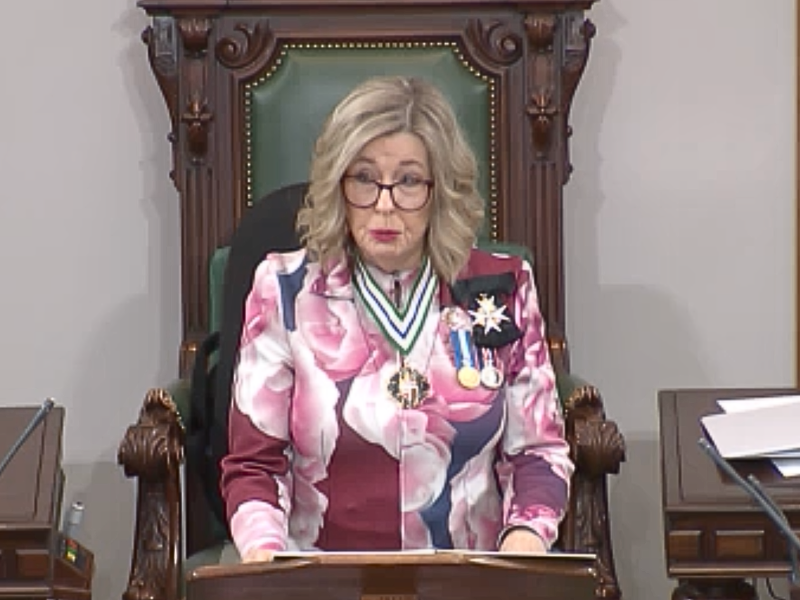
Take a good look at this photo.
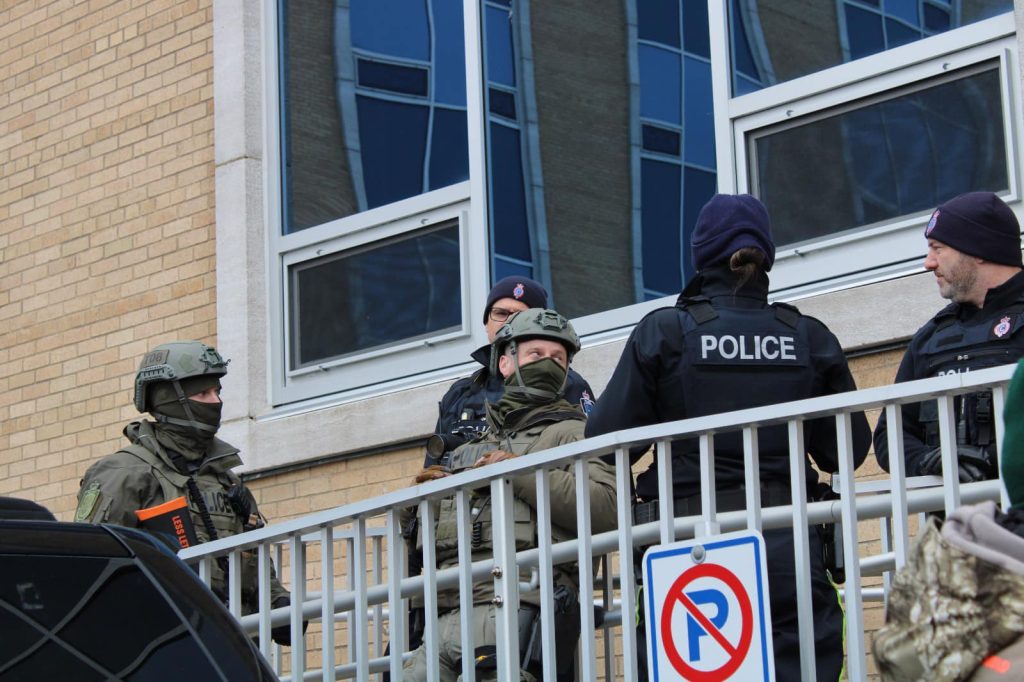
This may not be how the Furey government wants us to remember Budget 2024. But this is how Budget 2024 will be remembered.
Author

Related Articles
The PC’s subtle Throne Speech caveat
Wakeham government quietly places an asterisk next to its promise, ‘For all of us’
Thank you Air Canada flight attendants
Why the CUPE-led flight attendants’ strike and labour victory is a win for us all