
Thank you Air Canada flight attendants
Why the CUPE-led flight attendants’ strike and labour victory is a win for us all
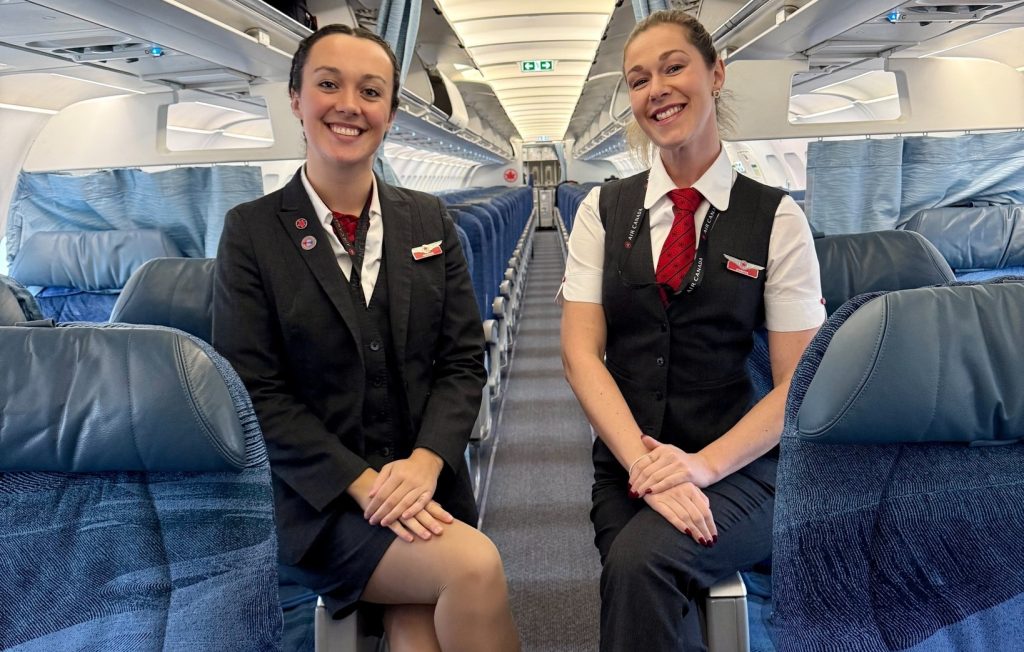
I have a theory about flight attendants’ labour victory over Air Canada (and the Carney government) this week.
But first: do you remember the last time you traveled by air?
The second you stepped onto the plane, a flight attendant likely greeted you with a smile. Maybe they handed you a sanitary wipe, a set of earbuds, or a bottle of water. Another flight attendant was probably in the aisle, helping passengers stow their carry-on bags in a compartment overhead. Once everyone was seated, they most likely instructed passengers on what to do in the unlikely event of an emergency. They probably made sure your seat-belt was properly buckled, and they may have tended to those with accessibility or other needs. In my experience, flight attendants have even offered up a joke or two over the intercom in an effort to help quell the apprehension many feel while flying.
It’s all part of the job, right?
Will you stand with us?
Your support is essential to making journalism like this possible.
In news coverage of the strike, Canadians learned that Air Canada flight attendants don’t get paid for the work they do while planes are on the ground (all of the things I just highlighted, and more). This unpaid labour was a focus of the negotiations between CUPE, the union representing 10,000 flight attendants, and Air Canada.
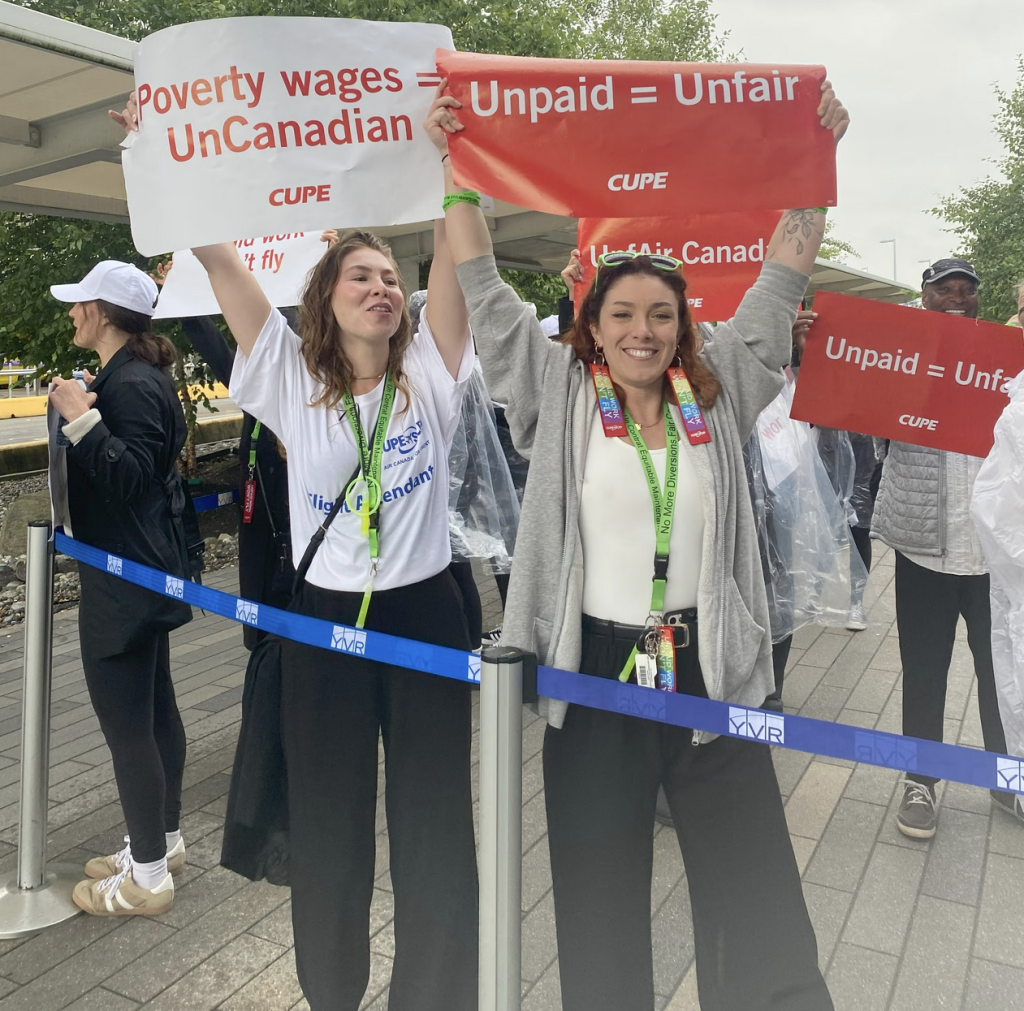
“There was something about these flight attendants, the particular issue that they were fighting about related to unpaid work, [that] resonated so strongly with so many,” Larry Savage, a professor of labour studies at Brock University, told CBC.
The strike and the Carney government’s response
Eight months of negotiations had failed to bring workers and their employer to an agreement, so on Aug. 13, CUPE announced flight attendants would exercise their constitutionally-protected right to strike if a deal was not made within 72 hours.
On Aug. 15, a day before the strike began, Abacus data reported that an overwhelming 88 per cent of Canadians believed flight attendants should be paid for all the work they do, not just when planes are in the air.
With the strike looming, Air Canada responded to CUPE’s proposals “for a fair cost-of-living wage increase and an end to forced unpaid labour,” the union said in an Aug. 16 release, “by sandbagging the negotiations.”
The airline, CUPE claims, refused to negotiate in good faith knowing the Liberal government was likely to invoke Section 107 of the Canada Labour Code, which gives the feds the power to make a strike illegal and force workers back to work. This, despite the fact withdrawing labour is often the only mechanism workers have to even the balance of power between them and their employers when negotiations break down.
Section 107 of the Code, in effect since 1984, has rarely been used by federal governments, but the Liberals—first under Justin Trudeau and most recently under Mark Carney—have invoked Section 107 several times over the past couple years to force workers back to work. That trend continued with the flight attendants’ strike, when just seven hours into the collective action federal Minister of Jobs and Families Patty Hajdu announced that “Air Canada and CUPE flight attendants are at an impasse and remain unable to resolve their dispute.”

Hajdu invoked Section 107, which directs the Canada Industrial Relations Board (CIRB) to arbitrate the dispute. “I am exercising this authority because it is critical to maintaining and securing industrial peace, protecting Canadians and promoting conditions to resolve the dispute,” Hajdu said on Aug. 16. “Despite the parties’ resolution of several key differences, the CIRB is best positioned to help them find a solution on the outstanding items.”
But CUPE and organized labour across the country were having none of it, even though a refusal to return to work could result in charges and jail time for union leaders. “We will not be returning to the skies this afternoon,” CUPE National President Mark Hancock said at a news conference on Monday. “If it means folks like me going to jail, then so be it. If it means our union being fined, then so be it.”
Labour fights back
Fed up with the Liberal government’s abuse of its power to end labour disputes, Canadian Labour Congress (CLC) and unions across Canada took a firm stand in support of CUPE and the flight attendants. On Aug. 17 Canada’s labour leaders held an emergency meeting and formed a united front. “We came out stronger and united, with a clear message to push back against the government’s attacks on workers’ rights: an attack on one is an attack on all,” CLC President Bea Bruske said in a statement later that same night. “The labour movement is united and standing firm, and we will not allow these Charter-protected rights to be trampled upon.”
The CLC, which represents more than three million Canadian workers, voted unanimously to demand the federal government “immediately withdraw” its order to end the strike, to commit to ceasing use of Section 107, and, once Parliament resumes, to amend the Canada Labour Code to remove the section altogether.
If the demands weren’t met, the CLC said, Canada’s unions would coordinate a “fight-back campaign [to remind] politicians and Canadians more broadly what these workers are fighting for” and raise money to fight the matter in court. No doubt, under the current climate and with such strong support from Canadians, charging CUPE leaders for encouraging flight attendants to stand their ground likely would have backfired on Air Canada and the government.
So, with a strong united front in support of the flight attendants and a clear indication that a back-to-work order wouldn’t bode well for the airline, Air Canada swiftly returned to the table and acceded to CUPE’s demands for fair pay and at least 60 minutes of pay for the work flight attendants do while on the ground.
Victory for workers
The following day, this past Tuesday, the CLC declared victory for the labour movement, saying in a statement that CUPE and the flight attendants “delivered a decisive blow to employers who think they can sidestep fair bargaining by hiding behind Section 107 of the Canada Labour Code.
“With the backing of the entire labour movement, CUPE stood its ground, defied the order, and forced the company back to the bargaining table—where a fair deal was reached. The outcome makes one thing clear: Section 107 is no longer a reliable weapon for employers.”
The CLC continued: “By refusing to bow to government interference, CUPE flight attendants exposed Section 107 for what it is: an unconstitutional violation of workers’ Charter-protected right to free and fair collective bargaining. Any employer thinking of leaning on Section 107 in the future should think twice—it’s a crutch that just snapped.
“The lesson from this strike is undeniable: workers win when they fight, and collective agreements are made through negotiation, not government-imposed edicts. Section 107 has been dealt a blow it shouldn’t recover from—and that’s good news for every worker in Canada.”
Victory for all of us
So, what’s my big theory about why the flight attendants were so successful in their labour action?
It’s not rocket science, but it is brain science.
In the first quarter of 2025 alone, Canada’s 24 largest air carriers transported almost 22 million passengers. Flying is an experience many of us know, hence our familiarity with the work flight attendants do to keep us safe and help us get from point A to point B. When we learned they were doing much of that work on their own dime, we related to the sense of injustice they feel for not being paid for that work. (The injustice is even greater in light of Air Canada’s record operating revenues of more than $22 billion in 2024, alongside its payout of millions in bonuses to CEO Michael Rousseau and other top executives.)
Going beyond our innate ability to empathize with others, support for workers appears to be trending upward in Canada, particularly in the wake of the COVID-19 pandemic, when the poor working conditions and other injustices facing so many was exposed for all to see amid lockdowns and the need to continue providing care for vulnerable populations and operating other essential services like grocery stores. (Recall the Dominion workers’ strike in 2020, which lasted 12 weeks and won workers pay increases among other things.)
As the cost-of-living and affordability crisis continues amid soaring inequality, our collective sense of injustice appears to be expanding in response to a growing recognition that the system is rigged against workers, and in response to the realization that middle-class Canadians are frequently pitted against workers, low-income earners, and those living in poverty — all while the rich get richer.
Organized labour is to be commended for fighting back against the federal government’s abuse of Section 107 at the expense of workers and the one thing workers have to fight the injustices of their employers: the strike.
The next time you board an Air Canada flight, thank your flight attendant for standing up for the rights of all workers and their families and communities.
Author

Related Articles

Why Furey must not call a snap election
Trump’s chaos and confusion demand solid daily leadership from the Liberal Party of N.L.
