The Wakeham government doesn’t care about Indigenous Peoples
11 years later, the province is still not publicly sharing details on its alleged efforts to implement the Truth and Reconciliation Commission’s calls to action
The most important thing for settlers — non-Indigenous Canadians — to know about Truth and Reconciliation is that the residential school system was explicitly developed to destroy the strong connections First Nations, Inuit and Metis communities had to their lands for the explicit purpose of expropriating those lands and building the country, its provinces, and their economies.
It’s settler colonialism 101.
Indigenous people fought long and hard to shine a light on the atrocities of Canada’s residential school system and the impacts they had on their nations, from British Columbia, to the Arctic, to Labrador. The result was a lawsuit against Canada that forced the federal government to acknowledge those harms, apologise for them, and establish a Truth and Reconciliation Commission, which spent years interviewing thousands of residential school survivors and their families before publishing its final report — and the accompanying 94 calls to action — in late 2015.
It’s been 11 years since then, and the parties that once emphatically committed to implementing those recommendations have largely fallen silent on the matter except on days like today, the annual National Day for Truth and Reconciliation, when they release statements that make it sound like they care about Indigenous Peoples and are doing the hard work reconciliation requires.
Will you stand with us?
Your support is essential to making journalism like this possible.
Since 2015, it has become abundantly clear that Canadian leaders are far more interested in the appearance of reconciliation than actually confronting the much more damning part of what is being asked of them: to understand the truth of the role residential schools played, and still play through their legacy of intergenerational trauma, in facilitating the ongoing colonisation of Indigenous lands.
In recent years, Indigenous-led organisations like the Yellowhead Institute and Indigenous Watchdog have worked hard to track governments’ progress on implementing the TRC’s calls to action. As they often note, however, progress has been slow, stalled, and even absent.
Governments prioritise what matters to those who elect them, including the corporate interests eager to profit from the extraction of resources on Indigenous lands. Corporations perceive Indigenous land rights as an obstacle to development and profit, which means it’s up to the rest of us to pressure our governments into the policy and legislative changes necessary to recognise and respect the rights of First Nations, Inuit and Metis nations and communities. Only then can they be liberated from Canada’s and its provinces’ colonialist policies which continue oppress Indigenous Peoples and dispossess them from their lands.
It’s all about the land, as late Secwepemc leader Arthur Manual, Kahnawà:ke Mohawk activist and scholar Taiaiake Alfred, and many others have illuminated for us in great detail.
Without truth, no reconciliation
Leading the Government of Newfoundland and Labrador, Tony Wakeham is showing us precisely what lip service to reconciliation looks like while actively and overtly ignoring First Nations’ communities rights in Labrador. In fact, this year the provincial government didn’t even bother to put out a news release to mark the National Day for Truth and Reconciliation — one of the most basic things a province can do to at least communicate to the media and the public that truth and reconciliation are priorities. This makes Newfoundland and Labrador the only province in Atlantic Canada not to publish an official news release on Sept. 30.
Instead, the PCs put out a vague, meaningless statement on its Facebook page: “Today we honour Survivors, remember the children who never came home, and acknowledge the lasting impacts of residential schools on Indigenous Peoples, families, and communities. We remain committed to reconciliation through learning, respect, and meaningful action.”
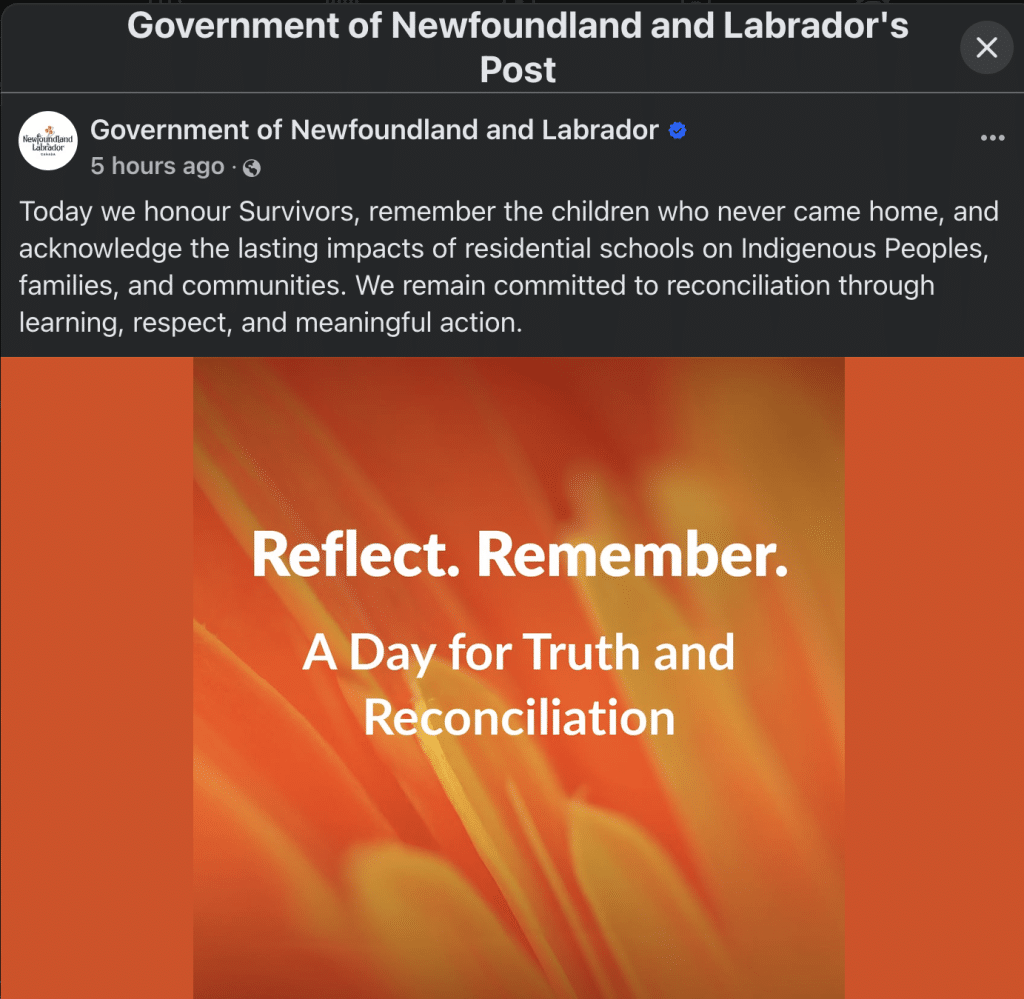
No acknowledgement of its own culpability for those harms, its promises to end structural and systemic violence against Innu, Inuit and Mi’kmaq in this province, and no mention of its promise during last fall’s election campaign to “continue implementing the recommendations of the Truth and Reconciliation Commission,” including making “progress on the implementation of the United Nations Declaration on the Rights of Indigenous Peoples.”
Reconciliation doesn’t happen overnight — or apparently over a decade — but this province’s PC government is not even showing the courage to acknowledge the truth of Newfoundland and Labrador’s past and present, which makes future reconciliation an impossibility.
Wakeham’s refusal to separate his government’s position from the Provincial Archaeologist’s controversial belief that Innu have only occupied the part of their homeland of Nitassinan — which overlaps with the Labrador portion of our province — for around 300 years is a blatant, case-in-point demonstration of the violent, colonialist actions the provincial government continues to hurl at those who were here long before European settlement, and in the case of the Innu, who have not ceded or surrendered their lands. Today, the Innu Nation is appealing to the broader public to support its efforts to have the provincial government, “respect and acknowledge the Innu as Section 35 rights-holders in Labrador.”
Truth and reconciliation are ongoing processes, but if there was ever a time to demonstrate the province’s commitment to liberating Indigenous Peoples in Newfoundland and Labrador, it would be today. Instead, the Wakeham government’s silence on the matter speaks loudly and clearly: We won’t acknowledge the truth, and therefore we won’t be pursuing reconciliation.
Since our government is not disclosing the details of its progress on implementing the Truth and Reconciliation Commission’s calls to action, The Independent is taking on that very task. In the coming weeks and months, we will be speaking with government officials, filing access to information requests, and interviewing First Nations and Inuit organisations in an effort to report where Newfoundland and Labrador’s at when it comes to the policy and legislative changes necessary to actually move us in the direction of true reconciliation.


Author

Related Articles
May Day Rally Shows New Face of Today’s Labour Movement
Turnout for May 1 march and rally in St. John’s one of the biggest yet in this province
Recimply the Best: Pitch and Pick Competition Winner Aims to Reduce Paper Waste
Recimply won big at Genesis’ annual Pitch and Pick competition last week. The startup is solving the problem of non-recyclable paper receipts.

Coming Home Queer for the Very First Time
For three days in July, queer Newfoundlanders and Labradorians from all over the world celebrated a rural homecoming 30 years in the making.
Workers deserve allyship, not lip service
On Labour Day 2026, some tips for Labour Minister Lloyd Parrott
The PC’s subtle Throne Speech caveat
Wakeham government quietly places an asterisk next to its promise, ‘For all of us’