
Why Furey must not call a snap election
Trump’s chaos and confusion demand solid daily leadership from the Liberal Party of N.L.
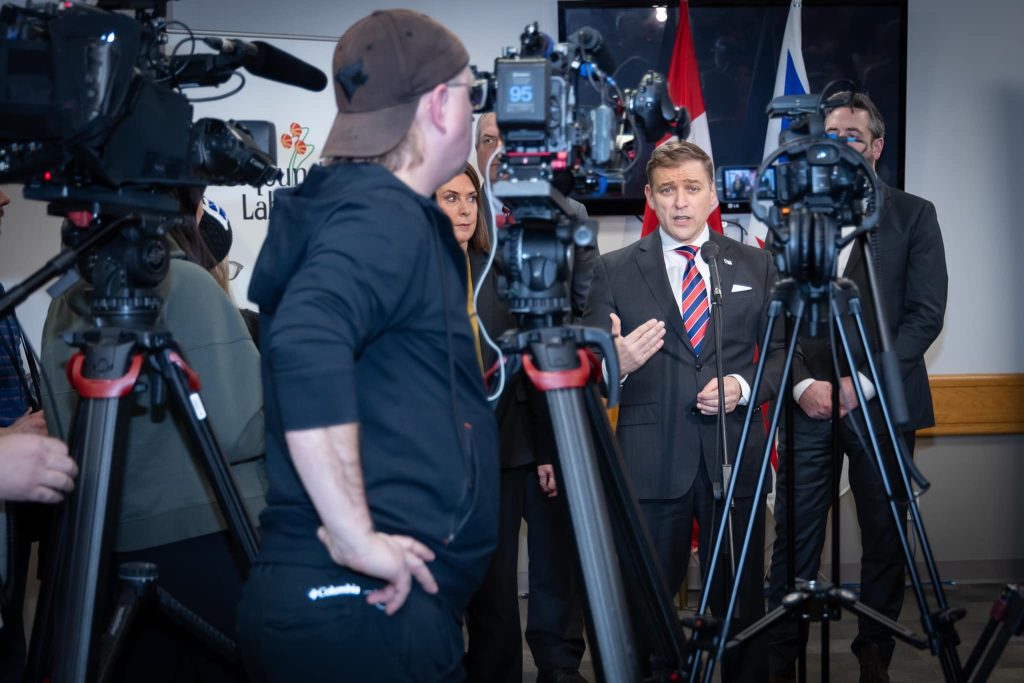
Beyond anything Newfoundland and Labrador has seen since Confederation, including the cod collapse, American President Donald Trump’s “trade war” with Canada presents our province with the greatest uncertainty in modern history.
It would be irresponsible and potentially devastating to the provincial economy for Premier Andrew Furey to call a snap election anytime in the near future — and possibly any time before the legislated fixed election date of Nov. 24, 2025.
On Saturday Trump followed through on his threat of massive tariffs on imported Canadian goods, slapping a 25 per cent levy on goods and 10 per cent levy on energy (like oil and gas and hydroelectric power). Prime Minister Justin Trudeau held an emergency call with provincial and territorial leaders to develop a united response. On Saturday evening he addressed the nation, saying that while Canadians “don’t want to be here” and “didn’t ask for this,” Canada will impose targeted tariffs on $30 billion worth of U.S. goods beginning Tuesday, and another $125 billion in three weeks.
In his own statement Saturday evening, Furey said that, “in this time of crisis, we will stand shoulder-to-shoulder by those impacted as a united Team Canada,” adding he expects the federal government to “action a comprehensive approach to help impacted businesses, workers, and support and service sectors.
Will you stand with us?
Your support is essential to making journalism like this possible.
“We are also working on a variety of initiatives including helping identify new markets for Newfoundland and Labrador businesses, as well as opportunities to diversify their supply chains.”
Earlier Saturday, Furey called Trump a “bully” and told the CBC that “appeasement and capitulation is not the appropriate stance for the Canadian people.
“If we bend the knee to him, he’s just going to take more,” Furey said, calling Trump’s tariffs a “four-year problem,” and adding, “we need to make sure that we’re working across industries to mitigate it for the workers and businesses across the entire country.”
The four-year-problem remark refers to Trump’s four-year mandate as U.S. president, a term that will largely overlap with the next Newfoundland and Labrador government.
Tariffs part of a bigger problem facing N.L. and Canada
While political leaders are stressing the necessity of a united approach to Trump’s “trade war,” others are speculating about much broader implications, particularly in light of Trump’s brazen remarks about annexing Canada.
Newfoundland cultural historian and author Ainsley Hawthorn has pointed out how American tariffs on Canada, and the U.S.’s threat of invasion, spurred Confederation in 1867. “The current conversation around annexation is likewise uniting Canada’s leaders to a degree we’ve rarely seen in recent years,” Hawthorn wrote for CBC on Jan. 19.
“Representatives across the political spectrum are sharing a common message, the same message as British North Americans in the late nineteenth century: despite our problems, Canadians value Canada.”
Meanwhile, other reports have drawn attention to Trump’s recent references to “Manifest Destiny,” the belief that it is the United States’ destiny to expand across North America, as well as his statements about making Canada the U.S.’s 51st state, annexing Greenland, and taking the Panama Canal.
While some observers have dismissed Trump’s remarks as infantile, others argue that weakening Canada’s economy through trade is a step toward creating the conditions for annexation.
Moreover, the United States’ ability to acquire territories is “ingrained in the U.S. Constitution,” says Robert Huish, an associate professor in International Development Studies at Dalhousie University in Halifax.
“Every Canadian needs to pay attention to this bit of American history,” Huish writes. “In one treaty, the U.S. annexed the present-day states of California, Nevada, Utah, New Mexico, Arizona, Colorado, Oklahoma, Kansas and Wyoming. It subsequently illegally invaded Indigenous territory in the west.
“Canada could be next — perhaps not immediately as the 51st state, but quite possibly as a U.S. territory that would deny Canadians any voting rights for Congress or the presidency, allow only some autonomy and make questions of citizenship ambiguous. The constitutional architecture exists in the U.S. to make it happen.”
Huish stresses the risk of downplaying Trump’s threats and rhetoric. “There is both potential and precedent for the U.S. to acquire territory through cession or subjugation.”
Furey to show his true colours, one way or another
From addressing the climate crisis, to recognizing Indigenous rights, to fixing a broken healthcare system and otherwise improving the quality of life for all people in Newfoundland and Labrador and Canada — there’s a lot going on right now.
The last thing Furey and the Liberal Party of N.L. should be thinking about is calling a snap election, inhibiting the provincial government’s ability to open the legislature and have perhaps the most important discussions and debates in decades. The province also needs solid daily leadership at a time when Trump is weaponizing chaos and confusion in his apparent effort to destabilize Canada’s economy.
Trump “uses chaos as a potent tool of disruption,” Michiko Kakutani writes in Time Magazine. “Like many dictators and would be autocrats before him, Trump consciously or unconsciously recognizes that confusion and mayhem create a fertile petri dish in which fear and anger thrive—the perfect environment in which a demagogue, practiced in the art of propaganda, can rise to power and persuade followers to support policies that defy common decency and common sense, not to mention their own self interest.”
The consequences of that chaos are spreading across the globe, including here at home. “The only thing that’s certain is uncertainty when it comes to the president of the United States,” Furey recently told CBC, adding the implementation of tariffs could represent “a consequential moment in Canadian history.”
Union and industry leaders in Newfoundland and Labrador’s fishing, oil and gas, mining, transportation and technology industries have also been sounding the alarm. “We depend on […] the established partnership with the U.S. for trade,” St. John’s Board of Trade CEO AnnMarie Boudreau recently said. “So a 25 per cent tariff would certainly be devastating for a number of […] very significant employers and very significant sectors here.”
But leading up to Trump’s tariff announcement, Furey consistently played coy about a potential snap election. During a CBC interview, he was asked how Trump’s presidency might affect his decision on whether to call an early election. “We knew that there will be either a renewed or new administration in 2025; we also know there will be a provincial election in 2025,” Furey said, prompting CBC radio host Jen White to call him out. “You’re skirting the issue here, premier,” she said. “No, I said there would be an election in 2025, and 2025 has 12 months in it, and one is almost done, so you can do the math,” Furey shot back.
On Friday, NDP leader Jim Dinn called on the Furey Liberals to reopen the legislature for an emergency debate. “If we want to have a Team NL approach, the Premier must call the House of Assembly back so that all elected members who represent the people of the province can openly discuss the worries and issues in their districts around tariffs.
“We know that many people in this province are living paycheque to paycheque, and any changes to our country’s trade deals could push people over the edge. I think of seniors on fixed incomes who already struggle to afford their groceries and medicine,” Dinn said. “I think a very important piece of this conversation is missing from main discussions. These groups will be imperative to help ease the impact on everyday people.”
Furey needs Newfounlanders’ and Labradorians’ trust right now more than ever. Part of earning that trust in such tumultuous times will include assuring voters he will not send them to the polls amidst Trump’s chaos and confusion. Doing so would be to weaponize Trump’s tactics against our own people for the benefit of the Liberal Party of Newfoundland and Labrador.
Instead, Furey should heed the calls to reopen the legislature and engage Newfoundlanders and Labradorians in the biggest collective discussions we need to have about the future of our province.
This article was first published in The Independent’s free weekly newsletter, Indygestion, on Sunday, Feb. 2, 2025. Click here to sign up.

Author

Related Articles

Thank you Air Canada flight attendants
Why the CUPE-led flight attendants’ strike and labour victory is a win for us all
