
Churchill Falls MOU2: Hold your nose for a tiny sliver of Hydro Quebec’s 7500% profits
Rather than lock ourselves into another half-century deal, maybe N.L. should consider merging with Quebec instead
The fridge reeks in our camper – the one we parked on the scorched earth where our cabin used to stand, in a place not afraid of hyphens: Small Point-Broad Cove-Blackhead-Adam’s Cove, in Conception Bay North. A place that took a ‘if you can’t beat ‘em – join ‘em’ attitude back in 1968, a year before the OG Churchill Falls deal was signed. A place we continue to love despite the skeletal, blackened trees, and the lingering scent of ash and suspicion in the air from last August’s wildfires.
Anyway, back to the fridge. Someone – I know who – left some very ripe Riopelle (look it up: full fat, delicious) Québec fromage in the fridge and forgot to leave the door ajar. It stinks and it makes me think about the ‘new’ Churchill Falls MOU.
While MOU 2 and the various social media hot takes floating around may seem complicated, I’m reminded by the book I’m currently reading, Extraction: The Frontiers of Green Capitalism by Thea Riofrancos, that there’s really two simple questions to ask with any extractive project: Who benefits? Who is excluded?
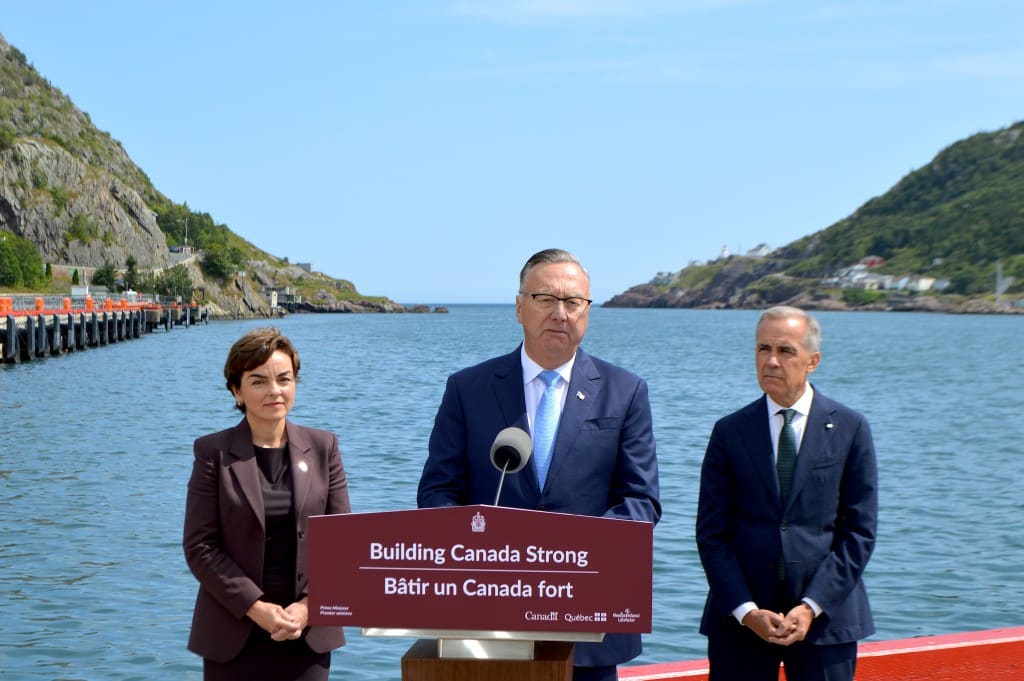
Let’s apply that focus to the provincial government’s Aug. 17 news release, which claims this new MOU equals, “more power, more value, more jobs, and more transmission.”
Will you stand with us?
Your support is essential to making journalism like this possible.
More power:
As part of a new agreement with Québec, Newfoundland and Labrador will now be able to retain up to 2,350 MW of electricity from Churchill Falls and Gull Island, 360 MW more.
What does this mean, exactly? A useful shorthand is 1 MW = approx. electricity for 1,000 homes. Which means there’s enough ‘new’ electricity in this deal to power 360,000 homes. Based on Statistics Canada’s 2021 census, there are 223,250 households in Newfoundland and Labrador.
If we assume that a household is equivalent to a dwelling, this ‘new’ power could be a game changer for Newfoundlanders and Labradorians facing the rising cost of, well, everything. I’ve said it before, and I’ll say it again: Why isn’t our electricity free? It’s perpetually flowing, naturally-sourced, local energy. Surely to God, the dam and powerhouse built in 1969 are paid off by now, and between the first and second MOUs enough ‘new’ megawatts have materialized from thin air to run all our stinky camper fridges in perpetuity.
Any Newfoundland and Labrador government could make the bold policy choice to make electricity available to its residents free of charge. Why not? For 57 years, we’ve been giving it to Hydro-Québec ‘free’ at 0.2 cents per kilowatt hour (kWh).
Fine. If free power for Newfoundland and Labrador households is not on, how about free power for the Labrador coastal communities now reliant on polluting and inefficient diesel? The price of diesel just hit $23.81 a litre on the Labrador coast. It’s going to cost families and communities a fortune this winter and next winter, and on and on. So free electricity for the coast of Labrador. I mean they’re relatively close to Churchill Falls, so why not?
No can do, you say? How about this: We all pay the same rate that Québec residents pay? Using Hydro-Québec’s residential electricity rate for Montreal of 8.29 cents per kWh, our modest empty nest home with a heat pump – with power bills on average $140 a month – would be cut in half. We’d be paying around $74.60 a month. Vive le Québec!
Here’s a Hydro-Québec map. Notice the ‘helpful’ note about the border with Labrador! Notice also, that, according to Hydro-Québec, Montreal is the only major city in North America with a residential electricity rate in the single digits.
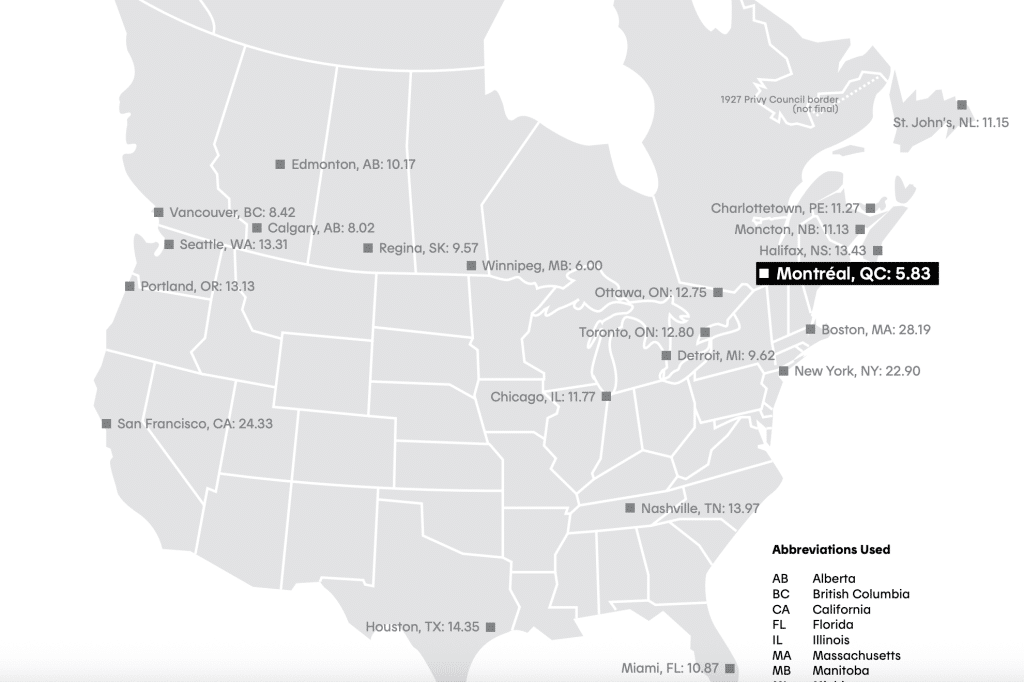
Another map in Hydro-Québec’s annual report shows the rate for industrial customers is also the lowest in North America, at an even lower rate of 5.83 cents per kilowatt hour. One of the main points made in a new French language book about Churchill Falls, Maitres Chez Eux, is how the wealth accrued from the original Churchill Falls deal laid the foundation of Québec’s massive economy.
Back to the news release.
The New ‘Churchill River Electricity Rebate’
In order to ensure the benefits of a new Churchill Falls and Gull Island agreement are shared by Newfoundlanders and Labradorians, Premier Wakeham further announced that, upon the finalization of the definitive agreements, the Government of Newfoundland and Labrador will introduce a 15 per cent ‘Churchill River Electricity Rebate’ for all residential ratepayers in the province on their first 2,000 kWh of electricity usage per month, a measure that will save ratepayers an average of $351 per year.
This is simply insulting. Whoever came up with this rebate is not the person buying the groceries every week. By my calculation, these days $351 is at most 1.5 trips to the grocery store, and you won’t have any fancy Québec cheese in your cart. Getting back to the simple question of who benefits, there’s a hint in this next section of the government’s Aug. 17 news release:
“Newfoundland and Labrador will maintain complete optionality in how it’s allotted power from the Churchill Falls base power plant is deployed, with the choice to either keep power for its own industrial development or, alternatively, to sell it, with Hydro-Québec agreeing to purchase this power at a 150 per cent price premium over base PPA prices.”
Nonsense word ‘optionality’ and bad grammar aside, the binary being presented here is: industrial development, or selling power to Hydro-Québec at an inflated price. How do you like them pommes Québec! That should make us all feel better for the 60-year-long-rip-off we’ve all lived.
This is megaproject-thinking that de-centers residents’ needs. If the government was centering its own people, it would do something about Newfoundland and Labrador’s outrageous rate of energy poverty, the highest in Canada. Approximately 13.7 per cent of households in this province are considered ‘energy poor’ as they spend more than 10 per cent of their after-tax income on energy.
Shouldn’t residents be the primary focus of any MOU? We elect MHAs to take care of our needs, not to make corporations like Hydro-Québec, Fortis, NL Hydro, IOC, Equinor, and others rich. Think that is too Pollyanna? Have a look at where deluded mega-project thinking has gotten us so far.
According to the federal National Advisory Council on Poverty report, in 2023 (the most recent available data) Newfoundland and Labrador’s poverty rate sat at 11.3 per cent, while Québec boasted the lowest poverty rate in Canada, at 7.4 per cent.
The gender pay gap in Newfoundland and Labrador means women have to work an additional 116 days to make when men earn, on average. Women in Québec, by comparison, have to work an additional 33 days, which is frankly still infuriating.
This province’s unemployment rate of 11.5 per cent is about double Québec’s, which sits at around 5.6 per cent.
And let’s not forget, Newfoundland and Labrador has the highest deficit among Canadian provinces.
All of this despite our province’s oily, polluting projects that are contributing to ocean and climate overheating.
But I digress. Back to the news release on the MOU.
More Value:
Counted in nominal dollars, the total value of the new deal is $273 billion compared to the previous government’s accounting of $225 billion under the old MOU.
Did Hydro Québec actually wobble and slide an additional $48 billion dollars across the table with MOU 2? Not likely. Focus instead on the word ‘value’. Who is calculating value, and how? Is ‘value’ being determined by the proposed number of jobs? Counting ‘person hours’ on megaprojects is more of a marketing exercise than science. Is ‘value’ counting future ‘chickens’ of construction activity before the deal is fully ‘hatched’?
More Transmission:
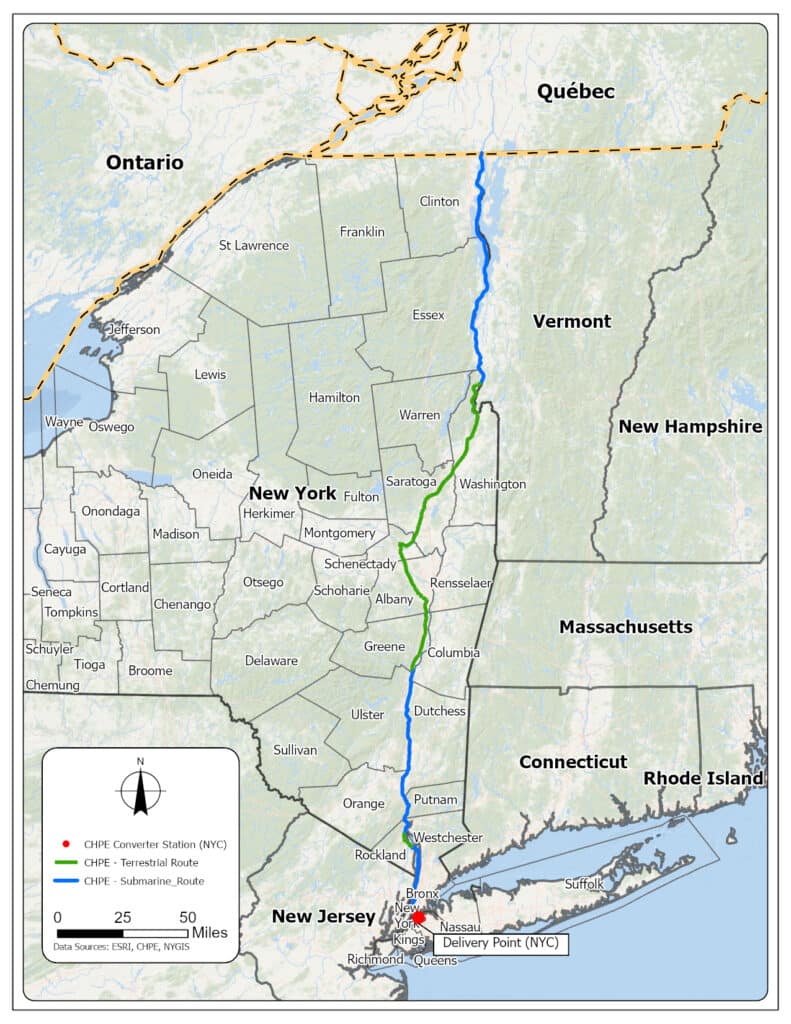
Unlike the previous MOU, Newfoundland and Labrador has secured the ability to transmit power from Churchill Falls and Gull Island through Québec to the U.S. marketplace through the Champlain Hudson Power Express (CHPE) and the New England Clean Energy Connect (NECEC). Newfoundland and Labrador will now have a guaranteed portfolio of transmission to other markets totalling 985 MW,” including “up to 240 MW of CHPE access into New York for Gull Island and Churchill Falls power that will be sold at the same price that Hydro-Québec receives for the power.
I’ve written about the CHPE for La Presse, along with the brilliant Labradorian and Universite de Montreal professor Kathryn Furlong, co-author of Maitres Chez Eux. Here’s a translated excerpt of our May 2026 op-ed:
“The Champlain Hudson Power Express (CHPE), links New York City to hydroelectric power from the Hydro-Québec grid. This energy will supplement the approximately 11.8 TWh that the Québec Crown corporation exports annually. This ‘green’ trade would not be possible without the import of roughly 31.5 TWh from the Churchill Falls generating station in Labrador—at prices that yield average profits exceeding 7500%.”
Let that sink in.
Hydro-Québec needs Newfoundland and Labrador to sign the MOU. It needs Churchill Falls energy to keep the CHPE going. Nice of them to let us in on a tiny sliver of that 7,500 per cent profit they are making from our energy. Why are we able to access only 240 megawatts when the power comes from our province?
If this is not a sign to walk away from MOU 2, I don’t know what is.
What about the $3.5 billion the feds are throwing in?
Here’s what the Government of Newfoundland and Labrador news release says about the federal (i.e. our) money:
- These investments include: Taking up to a 40 per cent equity stake in an adjoining Labrador Wind Project and providing value to Newfoundland and Labrador, totalling an estimated $1 billion (2026 NPV).
- Committing $1 billion (2026 NPV) to the construction of a Labrador West transmission line necessary to open new mining and other industrial projects in the Labrador Trough.
- Providing a federal loan guarantee for construction costs related to Gull Island, further de-risking the project and reducing overall capital costs.
- Offering $1.5 billion of value (2026 net present value) in support for Gull Island, Churchill Falls and transmission.
- Referring the Gull Island, Churchill Falls upgrades and Labrador transmission projects to the Government of Canada’s Major Projects Office upon the conclusion of binding agreements which will coordinate and structure federal financing while coordinating and accelerating regulatory and permitting requirements.
I read this section with my elbows up. The feds are throwing in $1 billion for a 40 per cent stake in a wind project that adjoins…something? Perhaps the wind will power the new iron-ore and ‘rare-earth’ mineral mine currently referred to as the Labrador Trough Corridor. In Québec, it is also known as the New Québec Orogen (hold onto your hats for more talk about 1927 borders).
There’s another $1 billion on the table for a transmission line – to the mine. This federal money is not about making electricity – it’s about increasing IOC mining capacity. According to Mark Carney’s dealbook, this transmission line would enable “increased production of high-purity iron ore and critical minerals […] to support mining electrification, industrial decarbonization and green steel value chains.”
This is one of those moments to ask: Who benefits, and who is excluded? This so-called ‘federal’ money will benefit mining companies, not the ratepayers of our province.
Would the feds stoop so low as to tie potentially controversial mines into this ‘clean’ and ‘green’ hydroelectric deal so that no one will ask too many pesky questions about mine pollution, tailings, Indigenous land use rights, water use, and why we need more mines in the first place?
Yes, there is $1.5 billion to ‘de-risk’ Gull Island and the entire Churchill Falls retrofit. How I wish someone would ‘de-risk’ the camper fridge and my next power bill. Oh, and don’t worry about those pesky environmental assessments – the federal and provincial governments’ red tape brigade are going to make all that go away.
I’m really torn about MOU2 because the future is electric, and we desperately need to transition from fossil fuels for our own health and survivability. I know developing Churchill Falls would bring Newfoundland and Labrador far more wealth than Bay du Nord ever will, and do so without polluting the atmosphere, leading to climate breakdown, and overheating the ocean. But I can’t help but feel like we’re being told to plug our noses – as I do every time I open the fridge – and accept MOU2 as the best we’re going to get.
If you can’t beat ’em, join ’em
Perhaps the only way to get a truly equitable deal from Hydro-Québec would be for Newfoundland and Labrador to join Québec. We’d only have to add another hyphen to the provinces’ already long name. We could call ourselves Labrador- Newfoundland-Québec. Rolls right off the tongue! Sheesh, we can’t let Albertans have all the fun reimagining geography.
Just like those practical Conception Bay North towns did in 1968, joining forces and hyphenating their names, Newfoundland and Labrador joining Quebec would greatly simplify things and have many benefits. Québec would expand our population 18-fold, which would make paying the piper for Muskrat Falls a whole lot less painful. Think about it. The feds and Québec view Newfoundland and Labrador as a raw-materials extraction zone; if we join Québec, we’ll finally have some political clout.
We’d finally be making a 7500 per cent profit on our own energy. Our electricity bills would be cut in half. Beer would be cheaper. Wine for sale in the corner stores (ok, it’s not good wine, but in a pinch). Québec cheese is incredible – just don’t leave it in an uplugged fridge. Our energy poverty level would fall from 33 per cent to 10 per cent overnight. Wages would go up, and our affordable daycare would be the envy of the country.
Québec has all those nice things because of the profits it made from Newfoundland and Labrador’s hydroelectric energy. In Maitres Chez Eux, Furlong and her co-writers detail how the silent revolution and Hydro-Québec’s war chest were largely financed by Churchill Falls. The very entity Newfoundland and Labrador is fighting for a fair deal accrued a large part of its power (and expertise) from Newfoundland and Labrador resources. The Innu Nation has estimated that Hydro-Québec has accumulated up to $80 billion so far from Churchill Falls energy, a figure it says could rise to $150 billion by 2041.
But after 2041 – just 15 short years away – they get nothing. Not a penny. I hope I’m around for the party. If we can hold out, our kids and grandkids may finally enjoy the full benefits of being Canadian.

Author

Related Articles

Throwing shade on solar myths
‘Someday the sun will shine and have-not will be no more,’ Brian Peckford famously said. Solar ‘someday’ can’t come soon enough, writes Angela Antle
Why taxpayer subsidies for Big Oil won’t create more jobs
As Equinor delays Bay du Nord decision, report finds less than 1% of Canada’s jobs now in fossil fuels
Dear Mr. Wakeham: Climate changes aren’t coming — they’re here
Not only are wildfires caused by climate change, new research links the heatwaves that cause them to oil companies active in Newfoundland and Labrador