
Who owns the wind?
How a trip to Scotland’s Orkney Islands raises questions of renewable energy benefits for communities in Newfoundland and Labrador
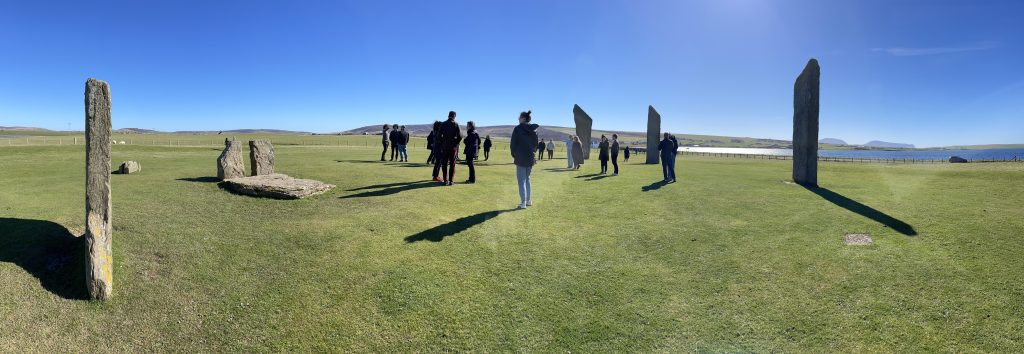
I met my first wind turbine on the Orkney Islands. This is it, I thought: the future! Until someone made a crack about how old-school it was. It turns out ‘my’ turbine was installed in the 1980s.
In April, I was on the Scottish islands with a group of energy humanities researchers from Norway’s Empowered Futures Research School. We were there to learn about community-owned wind projects.
The scenery in Orkney is stunning, and after a day or two you don’t really see the turbines. They’re no ‘uglier’ than power lines — they’re just a fact of life. It helps, of course, that in Orkney the turbines are few and far between, and the land—largely pastures—has already been cleared. This stands in contrast to the proposed mega green hydrogen/wind projects in Newfoundland, which would see clearcutting and road work to site hundreds of turbines. The visual and environmental impact of those much larger, much more plentiful, turbines will be much more severe.
I‘ve wanted to visit Orkney since reading Laura Watts’ book Energy at the Edge of the World: An Orkney Islands Saga, a readable mixture of cultural history, folklore and energy futures. There are many similarities between Orkney and Newfoundland and I’ve long wondered why we’re not taking advantage of wind, wave and tidal energy the way the Orcadians do. Like us, Orkney makes more energy than it can ever use, and like us it has one of the highest rates of energy poverty. If you spend more than 10 per cent of your income on energy, you are considered ‘energy poor.’
Watts describes how some towns in Orkney are solving these issues—and the challenges that come with their limited access to electricity—by way of community or individually-owned wind turbines that generate electricity and income.
Will you stand with us?
Your support is essential to making journalism like this possible.

On my first day in Orkney’s largest town, Kirkwall, I met a woman who owned a wool shop. Orcadians like to gab as much as Newfoundlanders, and when I told her about my interest in wind she said she owns a small sheep farm on one of the outer islands. In 2018, she remortgaged her house to purchase a ‘domestic’ wind turbine that produces about 5 KW/h of electricity annually. She told me that taking on the debt was a huge risk but the turbine paid for itself in less than two years. Now, she said, it covers her own electricity needs and she sells enough power back on to the UK grid to make about £20,000 annually. She reckons it’s better than a pension.
Hearing her story helped me see Orkneys’ turbines as symbols of the community’s independence, control over its energy use, for-profit energy projects, and the mainland-controlled grid. The turbines help Orcadians benefit directly from their harsh environment.
Some communities on Orkney have slightly larger turbines—up to about 900 KW/h—that make income for the municipal council. Orkney Council is one of 32 municipal councils in Scotland. Mark Hull, technical director of Community Energy Scotland (CES), a group that calls itself a ‘more than profit,’ helps communities develop their own decarbonized, renewable energy projects. He says the CES turbines sited in various towns fund everything from affordable housing, senior’s homes, mental health care, greenhouses, road work, ferries, flights to mainland hospitals, tuition and training courses, ports and harbours, and so forth. Hull says owning their own profitable renewable energy projects also builds confidence and resilience in rural communities.
Could N.L. communities benefit from wind?
Technically, yes. In 2017, Newfoundland and Labrador became the last province in Canada to introduce a net-metering plan, which gives individuals and communities the ability to install domestic or community wind turbines to power their needs and feed extra energy back to the grid. However, their profits would be defined by rates set by NL Hydro and wouldn’t be anywhere near what the Orkney wool woman makes with her turbine. She was amongst the first movers, and at that time the UK government paid very high rates to attract people to invest.
Think of how many small towns in Newfoundland and Labrador struggle to pay municipal salaries, collect the garbage, run their community centres or keep the lights on at the rink. Under the Orkney model, community-owned wind turbines could guarantee a steady flow of revenue; even if the profit-per-kilowatt is not that high, the money would flow perpetually. Although, there’s at least one hitch. It’s a challenge nowadays to find smaller, community-size turbines. The sector has scaled up so quickly, most turbine companies today are only manufacturing mega-sized turbines (there’s a business idea for someone).

Another way Scottish communities benefit is by partnering with commercial wind developers on larger wind projects. Part of such negotiations includes defining what community benefits the council would garner from a deal. A community benefit is payments on top of land-leasing for the locally-impacted communities and can take the form of a lump sum payment, a new set of soccer jerseys, or a serious slice of the perpetual profits. Community benefits can atone for the loss of water access where cables might come ashore, the loss of traditional sightlines, fishing access, or land access where turbines are sited.
Economist Sandy Kerr, director of the International Centre of Island Technology at Heriot Watt University on Orkney, is an economist who researches community energy. He says the negotiated benefits are a recognition of the extreme power imbalance that occurs when multinational companies come to rural towns to develop complex and potentially long-lasting wind energy projects.

Kerr, shown above pointing out the North Sea areas (in green) that are, or will soon be, offshore wind projects, says that in Scotland, the Highlands council is leading the way in demanding high benefits from wind companies. Highlands Councillor Morvin-May McCallum has said, “We want to ensure that local communities benefit directly from the use of our local resources. Any development that has an impact on the environment and local resources should have clear and direct benefits for those who live and work in the area.”
The power imbalance Kerr talks about was recognized in a discussion about benefits at a recent meeting of The Burin Peninsula Energy Board, a group of local mayors. At the May 8 meeting, Town of St. Lawrence Mayor Kevin Pittman noted that, for communities, equal is not the same as equitable, “because some places have one full-time employee while others have 10 or 35 employees.” The local leaders also discussed how larger towns should enjoy a larger portion of the benefits.
Now that there are delays in the Everwind project, the board will revamp their benefits agreement, to possibly include an infrastructure fund. They are looking for ideas, but they did warn that, “it is expected that contributions under the agreement may not be provided to those municipalities that don’t support the project.”
UK communities are sharing information, where they benefit from an open online registry through which towns can look up the benefits received by other communities in their area. This is why everyone knows the Highlands council is attempting to negotiate £5,000 per megawatt for a proposed on-land wind project, a benefit that would represent less than one per cent of the profits the developer will make but would represent ongoing revenues flowing into the community if the council succeeds in its negotiations. The Orcadian newspaper reported on April 3 that another community is seeking £7,500 per megawatt from an offshore wind development.
Wind is a resource and Scottish councils are ensuring their residents benefit. The community-benefits scheme is not perfect and issues have arisen wherein developers, for example, sell a wind project to another company that does not recognize pre-existing agreements.
When we flew from Orkney to Edinburgh on the way home, we passed over Seagreen, Scotland’s largest offshore wind farm. It was eerie to see over 100 turbines sited in a grid-like pattern in the ocean. I wondered how our seascapes in Newfoundland and Labrador may change now that the provincial government has opened bids for offshore wind, and what benefits our coastal communities may or may not see.

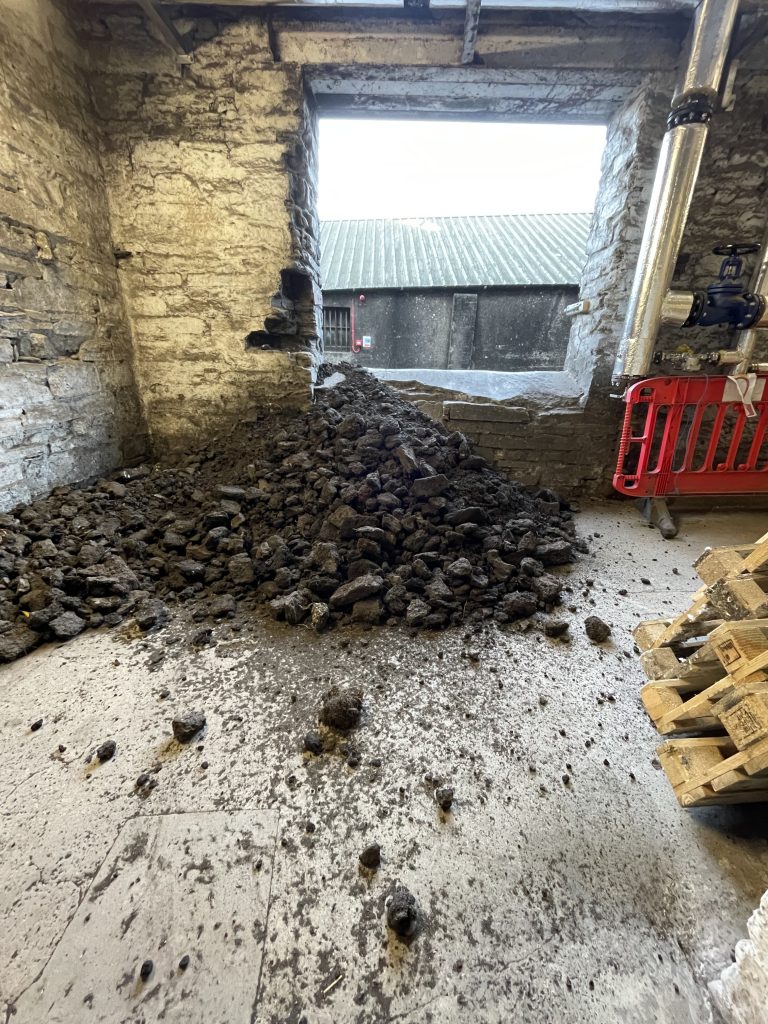
Here’s a photo of one of the oldest renewable energy sources: the famous Orkney peat. This pile of peat will be used to flavour a local scotch called Highland Park. Even if you support renewable energy like I do, you might still feel the need for a wee dram when you imagine how our land and seascapes will soon change.
Newfoundland and Labrador community organizations on Facebook—EnviroWatch NL, ProtectNL, NL’ers Against Wind Energy, Codroy Valley United, Proposed Wind Turbines and Ammonia Plant in Exploits: Concerned Citizens, and Environmental Transparency Committee (ETC) of the Port Au Port—recognize the extreme power imbalance that exists between them and the multinationals proposing industrial hydrogen plants and hundreds of turbines. Many of their posts decry the lack of communication and support from their elected officials, provincial and municipal. Who is ensuring all residents’ voices are heard? Who is negotiating benefits for communities that will see their natural landscapes irrevocably changed? At the recent Burin Energy Meeting, one mayor said 85 per cent of the people on the peninsula support the Everwind project, that Everwind documents are online and are therefore transparent. The meeting minutes also state there’s little opposition to the project. “Most people seem to be in favor of the project, the small group of people opposing the project are very vocal on Facebook but no one is coming forward wanting to have an open discussion about specific problems with the development.” That is certainly not the impression I got when I spent some time in the Facebook groups, some of which have thousands of members.
It’s not unusual for communities to oppose wind projects. It even happens in countries like Denmark, where the wind energy industry has existed for decades. Governments and businesses shouldn’t dismiss resistance as NIMBYism; protests are usually in response to the scale or siting of turbines. Residents aren’t necessarily opposed to renewable energy, but will resist when the engagement process is unfair, if there’s no common good, if the environmental damage is too great, or if they feel powerless in what is typically a very lop-sided power dynamic.
Residents will continue to protest these developments—as well as the upcoming offshore wind proposals—if the projects are not tied to bettering life here in Newfoundland and Labrador. Business-as-usual doesn’t cut it anymore. Replacing inefficient and polluting oil and mega hydroelectric dams with another mega scale, mega pricetag, unjust, resource-guzzling, for-profit, tied to global supply-chains, environmentally-damaging energy project is not leadership; it’s lazy, unimaginative, and leaves us exposed to a multitude of climate change harms when our ‘world-class’ wind—at a much smaller scale—could be lowering everyone’s electricity bills, powering innovation and life in communities, allowing us to live safely and securely in harmony with our environment, with perpetual free energy that’s not tied to anyone else’s balance sheet or political platform.
That’s the future I glimpsed in Orkney.

Author

Related Articles
Why taxpayer subsidies for Big Oil won’t create more jobs
As Equinor delays Bay du Nord decision, report finds less than 1% of Canada’s jobs now in fossil fuels
Dear Mr. Wakeham: Climate changes aren’t coming — they’re here
Not only are wildfires caused by climate change, new research links the heatwaves that cause them to oil companies active in Newfoundland and Labrador

‘Close to panic level’: Survey respondents chime in on climate crisis
More than 100 readers responded to The Indy’s first climate survey, and almost all share deep concerns