
In Search of Lost Pine
Newfoundland’s white pine used to be a defining feature of the landscape. What happened?

I’m paddling across Adies Lake, looking for the head of the Adies River, with my buddy in an old green canoe. My paddle plops rhythmically in and out of the water, leaving little swirling eddies with each stroke. There’s a nice lop on, but not enough to distract from the view. It’s stunning. We had put in that morning at Deadwater Brook, a small tributary that feeds into Adies Lake, just north of Cormack on Route 422. Our rides are parked at Dancing Point, past Adies Lake, past the Adies-Humber confluence, just upstream of Sir Richard Squires Memorial Provincial Park on the Upper Humber River, four days and about 50 km away. I switch my paddle to the other side, and my eyes scan slowly from left to right.
For most of the trip across the Upper Humber watershed, I have a panoramic view of the Long Range Mountains. They truly are a long range. They look like a long-exposure photo, an endless green wall of balsam fir and black spruce, stretching off into the distance – endless, that is, until my gaze stumbles across a cutblock. Nothing quite lowers the spirits like a cutblock deep in the backcountry, a barren geometrical section of brown in an otherwise green sea of spruce and fir. “Oh, come on,” I thought. I was trying to experience some “wilderness” and see some “wildlife.” The whole point was to avoid coming face-to-face with the relentless appropriation of nature that makes my life possible for a few days. Major vibe killer.
A few more paddle strokes and I’m back in my backcountry Disneyland. I wasn’t disappointed. In four days, I saw two arctic tern, several common merganser ducks, a line of goslings waddling up the bank after their parents, a baby moose (a mosling?), swallows, kingfishers, ring-necked ducks, a pair of mating loons, a fox, and what can only be described as a sprawling subdivision of beaver dams. I saw innumerable black spruce, balsam fir, juniper, ash, alder, and many fine, regally-crowned white birch trees. I saw three moose and two caribou before I even left the highway. I saw Venus rise and dip over the horizon in a bright, creamsicle-coloured late spring sunset. In one sweep of my homely, ursine visage, I had my attention divided between a bald eagle taking off from its perch on the left, a flock of geese forming a V dead ahead, and a caribou cow and calf standing in a broad, reedy marsh, framed by a stunning view of Gros Morne’s backside on my right.
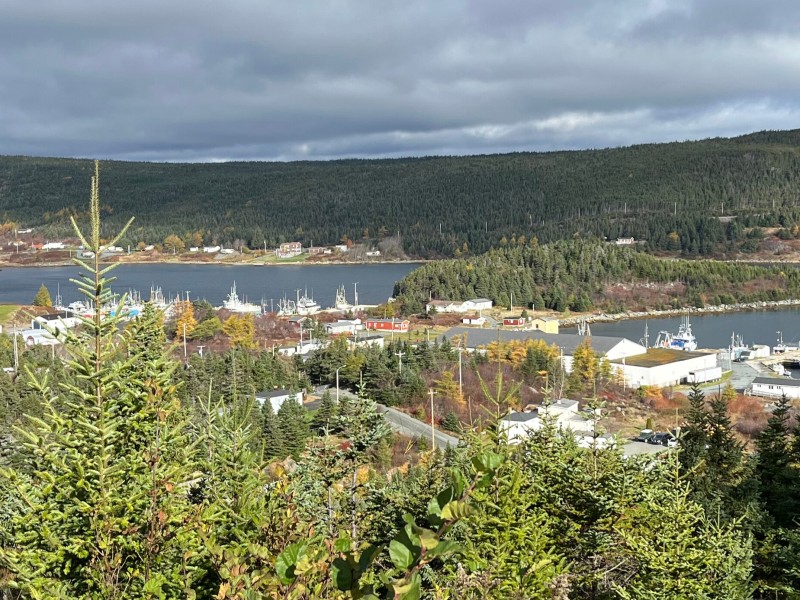
But in all that time, I saw only one single, solitary, striking white pine. It raises the question: whither all the pine? It’s supposed to be a defining feature of the landscape, isn’t it? I mean it’s right there in our theme song: “When sun rays crown thy pine clad hills.” So, where did they all go?
Will you stand with us?
Your support is essential to making journalism like this possible.
Pine Clad Hills?

Turns out, like many of the island’s most abundant resources, settlers exploited them to the point of exhaustion within a generation or two. For a few decades around the turn of the last century, Eastern white pine (Pinus strobus L.) was the most important tree species for Newfoundland’s forestry industry. Its tall, straight, limbless trunks and its light, creamy wood made it both beautiful and functional for windows, doors, cabinetry, interior and exterior finishing, framing, and shipbuilding. Growing to 80-feet high and 3-feet in diameter, Newfoundland’s pine was considerably smaller than its North American cousins, but it served the country’s needs.
By the 1870s, however, the declining supply of pine in other major producer areas increased prices for Newfoundland’s white pine. This, combined with the opening of new harvestable stands via the railroad, made white pine an attractive arena for Maritime investment. A pine boom followed, with Newfoundland emerging as a leading global exporter–for a few short decades. It wasn’t pretty. Nova Scotian companies reproduced the wasteful clear-cutting practices that had exhausted their own pine supply. Large areas were clear cut, and only the most desirable and profitable trees were milled.
“The shores,” as one government agent in 1875 complained after an inspection of the Humber River, “are now strewn and glisten in the sun with Pine Logs of all dimensions and quality, cut at least twelvemonth since.” By the early 1900s, the most profitable timber resources were strip-mined by hand and the attendant waterways were fouled by careless dumping of sawdust. The pine party only lasted twenty years. As the twentieth century got underway, a shortage of large trees plus the spread of the fungal disease “blister rust” ended the pine boom, just as the forestry industry was shifting to pulp and paper. One surveyor noted by 1945 that white pine was already quite scarce.
Pine-Stripped Hills

Photo By: J.C. Parsons. Source: The Centre for Newfoundland Studies.
Setting up camp in Beaver Town, I came to terms with the cutblocks on the Upper Humber. Settlers in Newfoundland have long had an impact on the indigenous forest cover. They started early too. John Guy built North America’s first sawmill in 1610 on South River, near Clarke’s Beach, Conception Bay. By the late 1700s, the effect of settlement would have already been visually striking, with coastal forest cover having rapidly retreated around the settlements. The forest we see now has already been radically altered.
It may have been the Beaver Fever talking, but looking around at the chewed-up alders and intricate, crisscrossing trail systems around my camp, I realized that we’re not so different from beavers, the earth’s second-most sophisticated environmental engineers. They too change their ecosystem. Their dams store water and divert drainage, but they also slow erosion, boost water quality, create firebreaks, and support fish and bird life. Perhaps we’re not the more sophisticated ones after all. Maybe we’re just bad beavers. Settlers tend to make our environments less resilient, hospitable, and productive, often in less than a single human generation.
Accepting this, I had to take my red pen to Cavendish Boyle’s Ode to Newfoundland so that it reflected more accurately our transformed land. It was first performed in 1902, a few short years before the end of our pine boom:
When sun rays crown thy pine stripped hills,
And settlers spread their hand,
I ‘spose them all we had to kill,
We love thee, clear cut land.

Author

Related Articles
An LNG future for Fermeuse?
Proposal for massive liquefied natural gas hub exhumed on Newfoundland’s Southern Shore

Thinking beyond the crisis in journalism
There are many legitimate reasons for concern, but news media have an unprecedented opportunity to innovate and create a new era of journalism

Why taxpayer subsidies for Big Oil won’t create more jobs
As Equinor delays Bay du Nord decision, report finds less than 1% of Canada’s jobs now in fossil fuels