
‘One of the nicest areas in the west end’
Hazelwood rezoning is axed. Sheffield Estates is safe for now. Tom Davis gets sworn in. Truth and reconciliation is formalized, and density increases, one micro unit at a time.

After much ado about nothing — or rather what Counc. Maggie Burton called, “the abstract idea of a rezoning” — city council unanimously rejected the application to rezone 46 Hazelwood Cres. which would have changed it from Residential 1 to Apartment 1. The property is already a small apartment building; the issue is that it doesn’t conform to the zone it’s currently in and rezoning would correct that.
No doubt, the rejection came as a relief to the concerned residents of Sheffield Estates, some of whom sat in the gallery during Tuesday’s meeting. After the city had notified them last month about the application’s existence, many residents took “rezoning” to mean “development,” which set their imaginations astir. The application, however, was submitted exclusively for rezoning, and there were no development plans shared. In the absence of information, residents wanted reassurances that the untold horrors they imagined about a non-existent development weren’t going to come true.
Over 100 people from the west-end subdivision signed a petition asking the city to delay its deliberations. They wanted to hold a public meeting to discuss the possible rezoning implications. But a public consultation is only useful when there is something real to discuss. “If you don’t know what the development is, then you can’t really say anything at all,” Counc. Ophelia Ravencroft remarked.
Nevertheless, the residents did have a lot to say. The city received feedback from a number of residents over email, the majority of whom were “strongly” and “vehemently” opposed to the rezoning and any developments it could usher in.
Will you stand with us?
Your support is essential to making journalism like this possible.
The property, which has seven dwelling units with shared amenities, is presently being used for transitional housing. As of last fall, according to CBC, it was operating as a for-profit shelter, paid for by the province. Before this, it was an elderly care home for retired priests called “O’Dwyer’s Apartments.” One resident however, wrote in to say that because the units are not self-contained, calling them “apartments” is “a misnomer.” That’s a pretty ironic statement coming from someone who lives in a place called “Sheffield Estates.” The area’s modern, mostly mid-sized homes are nice and all, but they’re a far cry from the Edwardian mansions on sprawling old-world acreages its name is clearly trying to evoke.
From what I gleaned from the comments, it seems like many residents aren’t happy with what’s currently there, and are unsure about how it was permitted in the first place. Though a hypothetical apartment building might seem preferable to transitional housing, the unwelcome changes the property has brought to their neighborhood already, have soured some residents on anything and everything that doesn’t align with a Residential 1 zone.
Not all the responses the city received were negative. One person wrote, “We need as many apartments as we can get in the city as supply is the only way to decrease the pressure to increase rents. Approve this project.” Of course, there was no project to approve, and in the end that was the deciding factor for council.
While they all wanted to support any potential developments that could increase density, they didn’t feel confident approving an application without any sense of the applicant’s long-term plans for the property. Inevitably, the strong reactions from the residents also factored into their decision.
On its own, insufficient information is a perfectly good reason to reject an application. The takeaway from this should be that rezoning applications submitted without development plans are likely to get rejected. We should be paying closer attention to the important role zoning plays in limiting and supporting development.
Instead, this has been overshadowed by the intensity of the outcry from residents. Because their feedback wasn’t based on an actual development, all it really revealed in the end were antisocial attitudes. Council’s rejection of the application runs the risk of demonstrating that these kinds of bullying tactics can be used to effectively influence municipal decisions, and what’s worse, that it’s socially acceptable to entertain them at all.
Belonging to the zone you’re in
Rezoning applications are almost always submitted with a development plan. However, it’s clearly still possible for someone to submit a rezoning application on its own. Council seemed uneasy about why anyone would do so.
“We feel a little uncomfortable about what might be happening here,” Counc. Ron Ellsworth said. He stated that the proponent has a responsibility to be upfront about any foreseeable plans for the property, and that residents have a right to know about them. A development plan offers that reassurance, while a rezoning application on its own, doesn’t.
The implication is that the applicant could purposefully be withholding information to remove obstacles for future developments plans, or make the property more marketable in case they want to sell it. Counc. Burton later indicated that this wasn’t the case; the application was merely the property owner doing their due diligence.
It’s easy to see how someone might want to rezone their property after finding out it’s out of place. In municipal zoning terms, the property is after all “nonconforming,” which sounds like a wrong that needs to be rectified. It might be impractical to offer a bid to belong where we don’t, but it’s a very human thing to do.
It’s plausible too that someone might not know that under municipal logic, zoning is really a tool for land development, and it is used by the city and its residents to determine who can and should belong.
“Once the zoning has changed, even a public hearing doesn’t make any difference at that point,” Mayor Danny Breen said. Decisions could then only be made on the development aspects of a project, and not the planning. Meaning, if an apartment building is already onsite, and it’s zoned correctly, there might not be any valid reason to object to a similar, but undesirable development.
Tethering zones to the development process isn’t in itself a bad thing — it’s a safeguard against inappropriate projects, or careless and poorly thought-out ones. While the rezoning of 46 Hazelwood Cres. is off the table for now, it will likely return.
“I think that what we can do is ask that the applicant come back with a concrete plan for what they would like to do on the property in question,” Burton added. “At that point we can have a proper public meeting and a debate about the merits of the individual application as opposed to a more abstract idea of a rezoning on the lot.”
If the feedback the city received from Sheffield Estates residents over the past few weeks is any indication, however, when a development application appears at their door, there’s a good chance it won’t get a very warm reception.

Low-density character
Since the priests left, some of the respondents note, the building has changed. There has been more “activity” on the property by “a different segment of the population,” one letter reads, citing noise, stolen and damaged property in the area, and “drugging [sic] people hanging around bothering people in the building.”
Across the letters, there was a sense of certainty that rezoning would lead to a bigger development, which would increase density, and ruin what one resident described as “the low-density character” of the neighborhood that attracted residents to the area in the first place.
“Sheffield Estates is currently one of the nicest areas in the west end,” one resident writes, adding “in my opinion it’s a hidden gem and changing this building to become an apartment will significantly impact the quality of our neighbourhood for the worse.”
“For the worse,” according to the letters, means lowering property values, rising crime rates and police presence, and a decrease in safety.
One resident worried — getting strangely specific — that should a multi-storey building be built there, it “will degrade the privacy of existing properties due to the ability of persons to peer down into the gardens, decks and windows of the existing single-family dwellings.”
Another resident accused the city of “blindly ignoring the potential cons resulting from approval of the rezoning application,” and showing “indifference and disrespect to all City residents and in particular all tax paying property owners in the Sheffield Estates area.”
“I am not opposed to the development of apartment buildings,” one resident claims. “But as with everything some are much better than others and we do have what I would call slum landlords in our City. And I would hate to see this property become an issue in our area.”
“There are other areas in close proximity to the Village [Mall] with access to public transport routes which could provide a more appropriate location for such developments,” another letter reads.
“It is unfair to change the zoning for the benefit of one and the detriment of many,” writes another, failing to consider that rezoning may in fact benefit many people, especially those looking for homes in transit areas close to services like schools.
Density can increase city revenue and keep taxes low, which is something that can benefit us all. How density is introduced matters, of course, and public engagement is important. But there are clearly people in St. John’s who don’t consider themselves as part of any public. They don’t seem to care about the basic human needs of others in our community; or if they do, they just don’t want to be reminded that those needs exist, and they expect the city to help protect them from it.
Welcome newly-elected councillor Tom Davis
This week’s meeting lasted over two hours. With a swearing-in ceremony, three proclamations, and 29 votes, the agenda was full — and so too was the gallery, much to Breen’s delight.
“Councillor Davis picked the absolute best time to come in here,” Ravencroft said by the end. “I’ve heard of trial by fire, this was trial by flamethrower.”
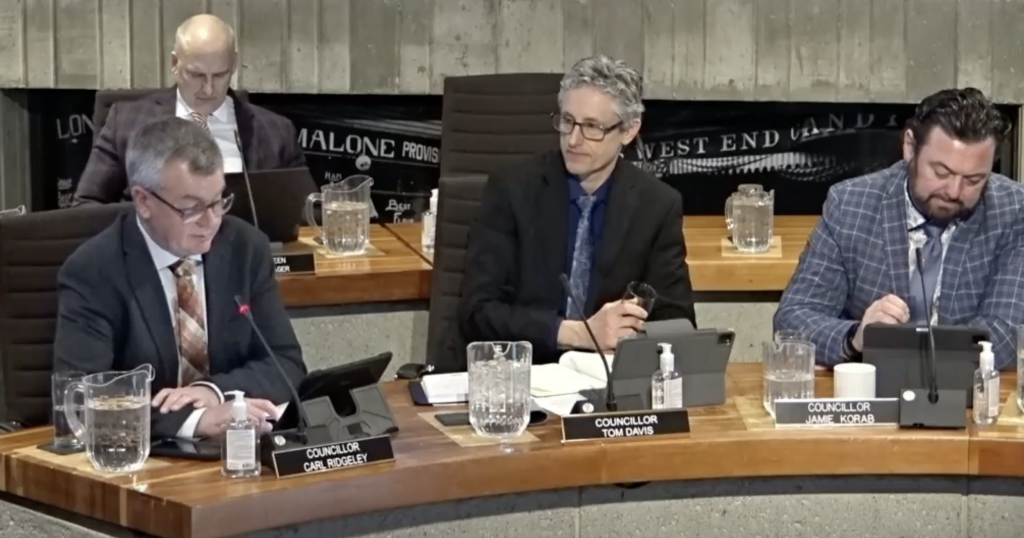
Counc. Tom Davis won by over 550 votes during last week’s bi-election. Only 2,790 votes were cast, which amounts to a little less than 20 per cent of eligible voters.
He received a warm welcome from council, and in return said he looked forward to “hopefully injecting a little bit of my DNA into council chambers.”
Poetry, heritage & Indigenous rights
Breen proclaimed March 21 World Poetry Day, and poet laureate Mark Callanan was back to read his poem, How to Make a Perfect Paper Airplane — a reminiscence on the beautiful boredom of those early pandemic days — and remind us that it’s mid-March and it’s been exactly four years.
For nearly 20 years Heritage NL has been holding its Heritage Places Poster Contest, an opportunity for K-12 students around the province to honour heritage places. They received around 1,000 submissions this year. Some of the selected winners from the metro area were in attendance with their families. They each offered up a few words about their entries, which were all inspired by relatives as much as landscapes.

Representatives from First Light St. John’s Friendship Centre and the First Light Coalition, including Justin Campbell, director of research and strategic partnerships, were on hand to announce the establishment of the St. John’s and First Voice Joint Coordinating Committee on Indigenous Rights. It’s a formal committee committed to advancing truth and reconciliation in St. John’s and across Newfoundland and Labrador.
Council approved the committee’s terms of reference, but not before Davis provided one of the more cringeworthy moments of the afternoon by bringing blood quantum into a conversation about Indigenous rights. He took issue with the line from the terms of reference document that read: “The culture of the Beothuk has been lost forever and can never be recovered.” He said it might be a bit “problematic” given that new evidence shows Beothuk DNA exists in parts of Atlantic Canada and Quebec.
Culture, I hope Davis knows, is carried and kept by communities, not by DNA.
The weight of water
While the town of Portugal Cove-St. Phillips is part of the regional water authority, Ellsworth cast aspersions on its commitment to safe drinking water, because the town referred an application to council that very clearly goes against regulations.
“They seem to fail to understand that we’re trying to protect the drinking water that their residents are drinking,” Ellsworth said, “and by playing politics and sending [the applications] over here rather than dealing with them internally themselves, they’re being disingenuous and doing nothing to protect the water.”
Deputy Mayor Sheilagh O’Leary also wondered if there was a more efficient way to process the applications, but alas, Breen concluded that referring them to council for voting is just part of the process.
Micro-unit on Queen’s Road, houses in droves on Groves Road
Council approved a discretionary use application for a micro-unit dwelling — no bigger than 450 square feet — at 149 Queen’s Rd., which sits at the corner of Bates Hill.
Ravencroft was happy to support it, noting it has been empty for some time. “Generally speaking, when properties have been sitting vacant for this long, regardless of whether they’re zoned commercial, or what the story is, given the housing crisis we’re in right now we need all the units we can get. This is an excellent dense development right on a transit route.”

The micro-unit demonstrates how properties in the downtown core can be easily re-utilized, Ellsworth noted, and is an example of the many things the city is doing to address housing by increasing density.
Council also approved the sale of a strip of land on Groves Road, north of Thorburn Road, for proposed infill housing for a whopping 20 new dwellings.
Let’s call a shed a shed, and a road a road
An accessory building — a shed or garage — was approved at 48 Barrow’s Rd. in Quidi Vidi. It’s part of an existing development plan that already includes a single detached dwelling with a pool and a patio.
O’Leary raised some concerns about how it might impact Powers Road, the inherited pedestrian access that goes between Cuckolds Cove Road and Barrow’s Road.
City Manager Ken O’Brien assured O’Leary the application wouldn’t have any more impact on the area than what’s currently there. He was also quick to point out that Powers Road “is not really a road, it’s more of a cart path, a very informal trail.”
Capital projects and strategic initiatives
Council approved funding for a number of capital projects out of the $25 million allocation available this year. More than half was already promised for city equipment, water system projects, and the Mews Centre replacement. Grind and patch asphalt rehabilitation, street widening, and sidewalk gutter repair were some of the bigger ticket items approved for funding, as well as a public washroom for Chafe Lane Park, the acquisition of 32 George St., the Wetlands Phase 2 study, and the replacement garbage cans for downtown.
Canada Games, the multi-sport competition for the country’s best athletes that the city is hosting in the summer 2025, came out a big winner, receiving one capital commitment of $750,000 and an additional one for $475,000.
Meanwhile, some of the new initiatives the city approved to support in its strategic plan include housing, shared-use paths, crime prevention, and hybrid metrobuses among others.
It’s not the city, it’s you
Council approved a motion to consider rezoning 188 New Pennywell Rd. as Residential 2 Cluster to accommodate an application for a townhouse cluster. According to the site plan, the property straddles both Residential and Rural zones. Council previously considered rezoning the Residential section of the property in 2022; this new application now considers the Rural zone as well. The city alleges that the present site plan is larger than what was originally proposed which has made this additional rezoning process necessary.
Ellsworth noted that the city often gets unfairly blamed for causing delays in rezoning and development applications; he pointed out that this delay is on the developer.
Later, speaking freely during the Go Round, Ellsworth said he’d been asked about the delays in Galway, the sprawling development led by former premier Danny Williams. He wanted to clarify that the hold-up is not on the city’s end. It’s a muti-phase project, he said, and developers are required to invest in infrastructure upgrades to the area they’re working in before they can proceed.
The city and Williams have had some conflicts since the beginning of the development process.
It’s grant season
As part of its capital grant program, the city allocated $500,000 to various non-profit groups and organizations, including Stella’s Circle, Celtics Centre Hockey Corporation, Quidi Vidi Rennie’s River Development, Association for New Canadians, Easter Seals, and Old School Intergenerational Projects.
Council approved the allocation of about $1.2 million to arts organizations and artists, community groups, sports organizations, and festivals and special events.
Many conflicts of interest were brought up during the process of trying to approve the recommendations. At one point, there were five abstentions. It turns out, our city council has almost as much involvement in the arts community as it does with real estate!
According to the newly revised Councillor Code of Conduct, a conflict occurs not only when a councillor’s private interests are affected, but when there’s a personal relationship involved, too. Council cannot act impartially “where a reasonable Person may conclude that the Councillor’s personal relationships would result in favoritism or prejudice.”
Some of the recipients included: NSO, RCA Theatre, Geo Centre, Boy and Girls Club, End Homelessness, Thrive, NL Folk Arts Society, Spirit Song Festival, Lawnya Vawnya, Neighborhood Dance Works, St. John’s Minor baseball, Cygnus Gymnastics, among others.

Public understanding of municipal process
O’Leary noted she’s been getting a lot of emails from concerned residents about 57 Margaret’s Pl. There is a proposed development for town houses on the property, and a redeveloping of St. Michael’s convent, the Belvedere Heritage building adjacent. She asked staff for guidance on the engagement process.
Because of changes to the Envision regulations, which include the city’s municipal plan and development policies, Ken O’Brien explained, now when developers prepare their land use reports for their applications, they have to talk with neighbours first. Connecting with residents earlier is meant to address potential issues ahead of time.
“People may be uneasy that decisions have already been made — but that’s not the case,” O’Brien said.
Once the land use report is completed, and the application is submitted, then it will go through public consultation and other oversight processes. People should know this, but they don’t. What else don’t they know?
I was reminded of the only email the city received regarding the micro unit application for Queen’s Road. “I hope you are doing well. I received a notification about 149 Queen’s Rd.,” it read. “I do not know what it means. Please clarify what this is about.”
It makes me wonder how much the public understands about municipal procedure. Its language games really do have a way of making meaning elusive, confusing, or incomprehensible to an untrained listener. I’m a listener in training, but sometimes even I struggle to understand what’s actually being said. I may not know what the words mean, but I know what they do: they exclude me from learning about what’s really happening in my city.
Challenge accepted!
This is a corrected story. A previous version said council had rezoned 188 New Pennywell Rd. in 2022, when in fact they had only considered rezoning it for the preliminary development application process.

Author

Related Articles

Signs of the Times
Korab joins Team Furey. A slipway ties the whole community together. An apartment building downtown. A tale of two experiences from two city parks.

St. John’s women of influence
Awards, birthdays, marriages, and retirements are celebrated as two distant food trucks duel for the night in the parking lots of old establishments history forgot

Holidaying on Indigenous land
June Day is renamed no thanks to Tom Davis. A questionable debate about parking relief. Minor sport, major expense. Trash is a symptom of a bigger problem.