
Signs of the Times
Korab joins Team Furey. A slipway ties the whole community together. An apartment building downtown. A tale of two experiences from two city parks.
The jugs of water sitting on the tables at Tuesday’s St. city council meeting were foggy with condensation, a sure sign that the heat of summer hasn’t left us yet. Mayor Danny Breen, Councs. Maggie Burton, and Carl Ridgeley were away, and so too was Counc. Jamie Korab, whose empty seat in chambers became—in hindsight—a sure sign of a St. John’s Ward 3 by-election to come.
Korab won the provincial by-election on Thursday night, taking nearly half of the votes in Waterford Valley. The Liberals took that as a sign that voters still have confidence in Andrew Furey’s leadership. Preliminary numbers show that only 43 per cent of those registered actually voted. Nonetheless, the Liberals—ahem, Team Furey—successfully secured their precious seat in the House of Assembly.
Signs and sight lines were a bit of a theme this week. Deputy Mayor Sheilagh O’Leary noted that illegal signs for roofing, paving, and construction are proliferating on poles around town. They’re creating a lot of visual noise that impacts “how we move around in the city, and sometimes it could be problematic for sight lines,” she added, encouraging residents to follow the by-laws and report illegal signs to 311. (Election signs as it turns out, don’t require a permit, but they have to be removed within three days of an election).
Signs are essential for navigating the world. But, they can mean different things to different people, assuming people even see them at all. That’s the tricky thing about sight lines, the hypothetical trajectory between someone’s eyes and what is seen. We aren’t all sharing the same perspective, and our attention isn’t always moving in the same direction.
Will you stand with us?
Your support is essential to making journalism like this possible.
Common sense is not a given but something we have to actively create. And that means agreeing on what should and should not be foregrounded in public spaces.
‘A crucial piece of infrastructure’

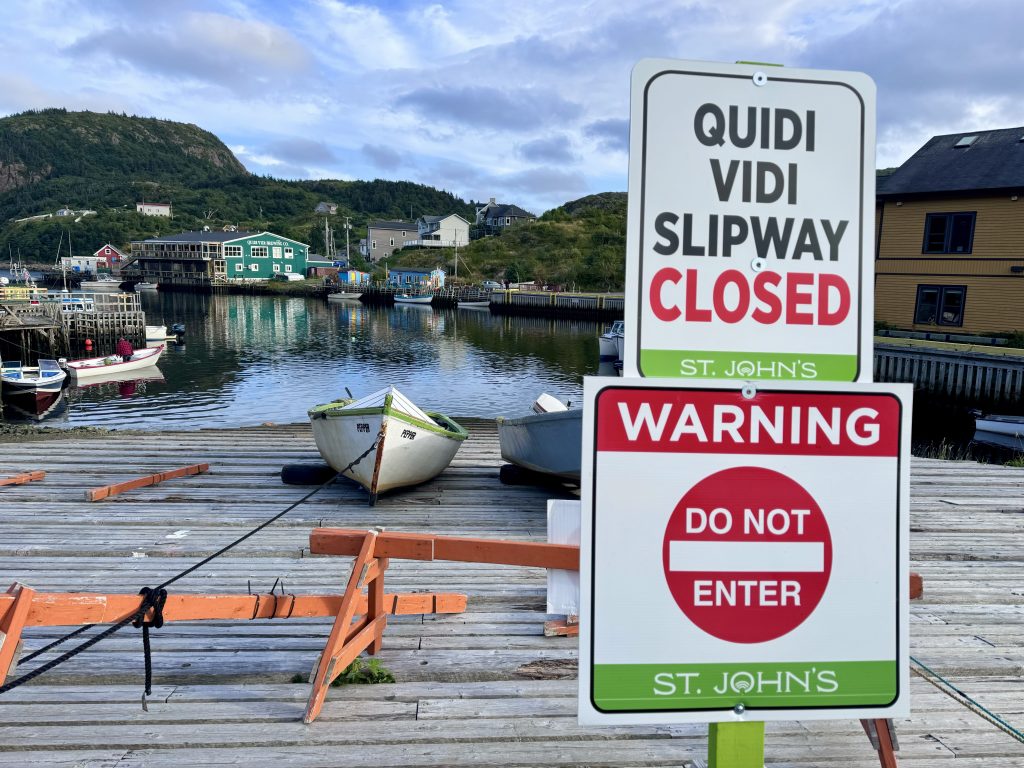
Twenty more cruise ships are expected in the St. John’s harbour before mid-October, according to Counc. Jill Bruce. There’s a good chance their passengers will be making a beeline for Quidi Vidi Village upon their arrival, one of the city’s most popular attractions. The slipway in the picturesque harbour was one of the hot topics this week, as Counc. Ophelia Ravencroft presented feedback from the extensive public engagement the City conducted that will help determine its future.
The derelict timber structure, located at the north side of the Gut, slopes into the water, providing access to Quidi Vidi Harbour. It has been closed for repairs for nearly a year, after it was deemed a safety risk following an assessment by DBA Consulting Engineers in September 2023. It turns out the structure needs more than repairs–the entire thing will have to be replaced. First it will have to be torn down.
Many Quidi Vidi residents were upset by the prospect of removing the slipway, especially without a guarantee from the city that it would go back up. The residents of the area already feel that development is eroding the defining character of their fishing community. They established their own Facebook group in response, Save Our Slipway (S.O.S), and submitted a petition signed by 171 individuals asking that the City salvage it, or guarantee it will build a new one.
The structure has been the City’s responsibility since 2013 when it was granted by the Government of Canada. It’s likely been in disrepair for a while; according to one environmental assessment, the Department of Fisheries and Oceans was trying to have it demolished as far back as 2005. It was originally built in 1985.
The City estimates a new structure will cost $500,000, possibly as much as $750,000 with removal. It’s not clear where exactly these estimates come from, but they are definitely high. Suffice to say, the City is interested in exploring cost-effective solutions. It has engaged the public to learn more about how they use the slipway and what it means to them.
It means a lot, apparently. What the City heard was that residents are passionate about keeping the slipway, and if it must be removed, it should be replaced with something wooden, comparable to what is already there.
Ravencroft remarked that when she attended the community meeting at The QV Artisan Studios last month, “it was the most boisterous and memorable public meeting I’ve ever attended. It was a joy to be in the room.” She lauded the residents of Quidi Vidi for their dedication and advocacy. Many of them were present in the gallery for Tuesday’s meeting to demonstrate their support.
There is another slipway in the area—located right between the QV Artisan Studios and The Wharves at QV—but it’s privately-owned. It remains available for residents so they can get their boats in and out of the water. However, the narrow stretch of crumbling asphalt and gravel doesn’t offer much more amenities than that. Plus, the sight line leaves much to be desired.

The public wooden slipway, by contrast, is a significant feature of the community. “The slipway is a visual indicator of the fishing village in its history, an iconic landmark for tourists, visitors, photographers, and others,” Ravencroft said, reading from the report. It’s a popular perch for locals and visitors where they can sit and take in the atmosphere, it’s also frequently used by seals wanting to soak up the sun.
Most importantly, it’s also very much a place for tying up, launching, storing, and repairing fishing boats, as well as other recreational vessels like kayaks.
“For such a seemingly small structure,” O’Leary observed, “it has such a multi-faceted component of use in the community.”
It might be small, but it is an integral piece of the larger fishing structures in the harbour, which include everything from stages, sheds, and wharves, to boats, lines, and buoys.
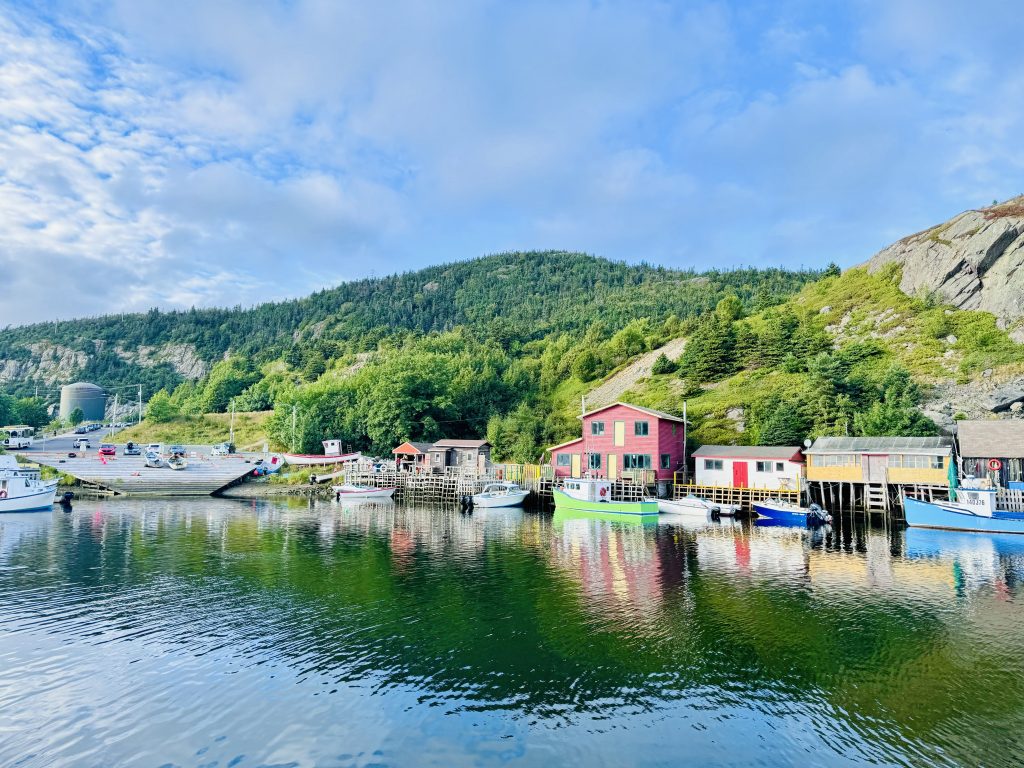
In the end, Ravencroft concluded that the slipway “is a crucial piece of infrastructure for the urban fisheries, for their way of life, not just for their heritage, for their present.”
Quidi Vidi Village is often described as “quaint,” which means “old-fashioned but charming,” as if it were a vestige of a bygone era. The discussions about the slipway have renewed attention to the fact the small harbour remains an active urban fishing community.
The slipway doesn’t just connect land and water— it also brings together the past and the present, while supporting the practices that connect people to the place.
City staff will have to come back to council with recommendations based on the feedback received, which will be discussed ahead of the capital budget, later this year or early next year.
‘Getting life in downtown is important’
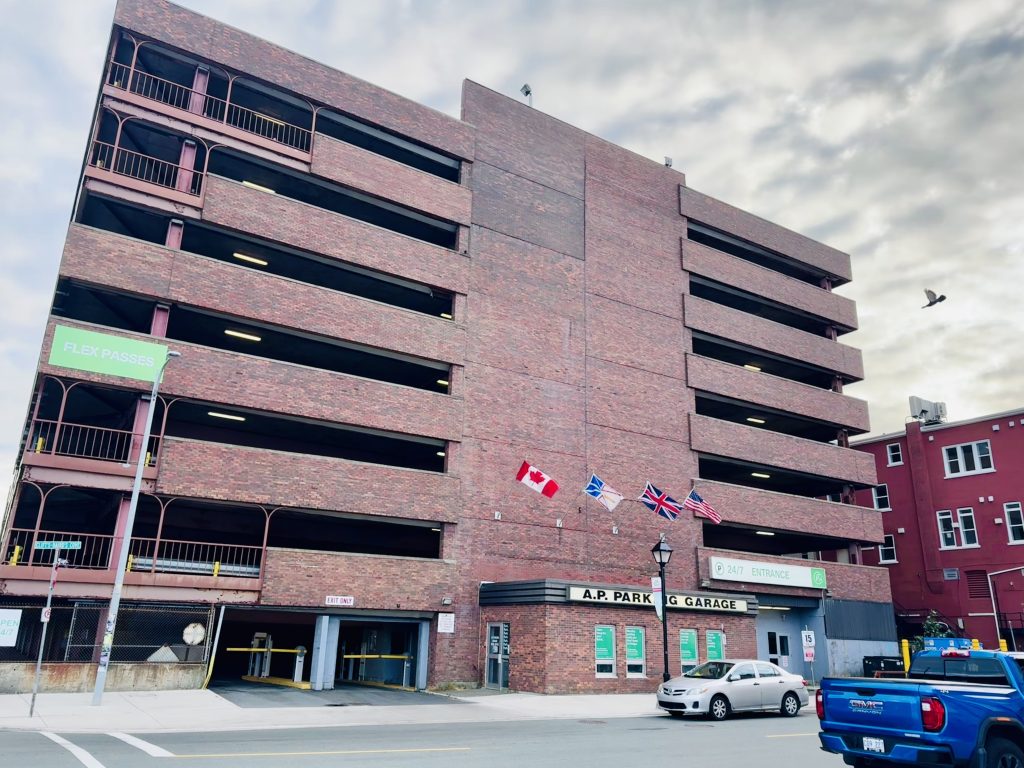
Move over gulls and pigeons, the City received a proposal for an apartment building at 1 Clift’s–Baird’s Cove, at the Atlantic Place parking-garage-of-broken-dreams on the corner of Harbour Drive.
Council approved the terms of reference for a Heritage and Land Use Report, and a motion to consider a text amendment to the Atlantic Place Parking Garage (APG) Zone to accommodate it. It’s hard to believe that the garage has its very own zone, but almost everything about that building is hard to believe.
In addition to having the best view of the Irving Oil tanks of the South Side Hills, Mayor Breen once described the big, brutalist, brown-brick beauty as “the ugliest structure that we have right, by far, in the downtown.”
At that time, in 2020, he was excited at the prospect that it might be getting an overhaul. The council was considering another proposal for the site then, from the same owner, Sonco Group Inc. The company, based out of Halifax with offices in St. John’s and Toronto, owns, operates, and develops commercial and residential properties, as well as casinos. They wanted to retrofit the parking garage and develop a boutique hotel on top of it. That application was ultimately rejected.
But the building is an eyesore for another reason: it represents one of the city’s most unprofitable capital investments. The parking garage was built in the 1970s to serve the parking needs for the 300-room hotel originally planned for the Atlantic Place shopping and convention centre. In the end, there was no hotel, just 728 parking spaces, and a bill for for nearly $8 million. The project went so over budget, it was subject to a public inquiry.
This latest proposal was submitted by John Hearn Architects Inc. on behalf of the owner. The current plan is to demolish part of the garage to build 100 rental units. While it’s still early, many council members welcomed the plan for its promise to increase housing stock and density.
“What joy it brings me to see something like this coming forward,” Ravencroft said, “in which human beings and their need for homes are taking precedence over parking.”
“This isn’t purely a commercial development,” she said. “This is being designed to support residents right here in St. John’s and to bring one hundred of them plus, right back into our downtown core, which is wonderful to see.”
Counc. Sandy Hickman added that he too was happy to support the proposal at this point in time. “Getting life in downtown is important. Getting homes for people is important,” he said. “And let’s not overlook the need to expand our tax base. If we don’t expand that tax base, that means the more money we need every year has to come from the same people,” he added, with a copy of Atlantic Business magazine’s latest issue open beside him.
Incidentally, it has a feature about the city’s downtown core in it. It references the high vacancy rates, low residential density, social issues, and parking debates that are challenging businesses — and it raises the question of whether or not it’s still “the heart of the city.”
The building surely won’t provide affordable housing, but it’s a move in the right direction. One of the biggest takeaways from the public engagement for the St. John’s Downtown Neighborhood Plan was to get more people actually living downtown.
If the council decides to consider a text amendment, the proponents will submit the Land Use Report and a Heritage Report, after which a public consultation will be held.
‘This is about creating units’
The City also held its first open house to discuss its Housing Accelerator Fund initiatives. “We were a little bit overwhelmed with the attendance,” Ellsworth said, noting that upwards of 75 people showed up, including large numbers of developers and individual property owners.
The City was allocated $10.4 million in federal funding through the Canada Mortgage and Housing Corporation’s Housing Accelerator Fund to stimulate housing growth. As a result, it is offering grants for homeowners to build additional housing units, and an incentive program for developers building multi-unit rentals.
“I keep reminding people this is not about affordable housing. This is about creating units,” Ellsworth said.
Half the funding coming from the Housing Accelerator Fund is about “creating living space in our community,” he explained. The affordability piece “kicks in” if people want to partner with the Newfoundland and Labrador Housing Corporation to pick up the additional funding potential. Homeowners and developers who opt for that route will have limits on the rent they can charge.
‘We’re music city north’
As the meeting wrapped up, council members reflected on the success of the Churchill Park Music Festival. The event, held over two weekends, attracted an estimated 45,000 people and transformed the park into a veritable time machine. It delivered concert-goers back to the late ‘nineties’90s and the early aughts to see the likes of Nickelback, Pitbull, and Shania Twain. It’s an accomplishment given the logistical and financial challenges of luring big names to the island, then and now.
People came from across the province, and outside of it too. “The focus of Atlantic Canada was really on us,” Hickman said, his copy of this month’s Atlantic Business Magazine still laying open beside him.
“The last couple of years I’ve been thinking you can go a whole summer and have great music,” he said, “We can truly say, we’re music city north.”

The festival was also “a tale of two experiences,” Counc. Tom Davis said. I thought he might be referring to the contrasting experiences of the VIP ticket holders and the peasants in general admission, but he meant those of the concert-goers and the nearby residents.
There was some negative feedback from the neighbours. Apparently only about 12-15 people complained, which isn’t bad for a place that was once the city’s first suburb. The main source of contention was the noise, with music running late, past the 11 p.m. ordinance, and starting early with sound checks happening throughout the day.
“You can’t have that many people in one area without having some issues and concerns,” Ellsworth said, noting similar complaints have previously followed other events like the Folk Festival and Iceberg Alley.
Council encouraged Churchill Park residents to get in touch with any additional feedback, and assured them that they would take them seriously and work with promoters to resolve them going forward.
“[We] do everything we can to make the events better run, more inclusive, more peaceable for anyone in the area,” Ravencroft said.
“Ultimately we understand them as creating a lot of community benefit. We want that benefit to be as positive as possible with as little negative mitigating it.”
‘We can’t tolerate that kind of hate in our city’
The festival was a highlight for the city, but an incident at Sunshine Park a couple of weeks ago was definitely a lowlight. The incident in question made the news after a video of it circulated online. In it, an unidentified white man can be seen and heard yelling racial slurs and making death threats. Taranpreet Singh was one of the men targeted, along with two of his companions. They were hanging out near the pond at the park when the man approached them.
While Churchill Park commemorates a British imperialist, Sunshine Park has much nicer origins. It was established by The Rotary Club nearly a century ago as one of the city’s more inclusive spaces. It began as a summer camp for underprivileged children, and later it became a camp for children with disabilities. It’s now run by the City.
O’Leary concluded the meeting by condemning the racial violence that took place there. She wanted to emphasize that it is everyone’s civic duty to respond to racism whenever they encounter it. “I ask everybody to stand against it, when it comes in any of our sight lines, in any way, shape or form,” she said.
“Each and every one one of us need to take a stand and be very, very proactive in antiracism,” she said, offering a timely reminder that we are all personally responsible for creating the community we live in, whether we’re doing it actively or passively, consciously or not.
Having the choice to notice racism or ignore it, or engage in or avoid confrontation—these are all privileges that many people do not have. Anyone in a position to intervene has an ethical obligation to do so.
Racism isn’t just about thoughts and feelings, opinions and beliefs. It’s also about practices and actions. Remaining neutral only contributes to the harm done, and amplifies and extends its effects.
“We need to support each other,” O’Leary reiterated, “and we can’t tolerate that kind of hate in our city.”
Because really, by passively allowing the angriest, meanest, most anti-social and misguided among us to behave that way, we’re essentially signing over our responsibility, making them the architects of the communal space we all share.

Author

Related Articles

St. John’s women of influence
Awards, birthdays, marriages, and retirements are celebrated as two distant food trucks duel for the night in the parking lots of old establishments history forgot

Holidaying on Indigenous land
June Day is renamed no thanks to Tom Davis. A questionable debate about parking relief. Minor sport, major expense. Trash is a symptom of a bigger problem.

The litter, my friend, is blowin’ in the wind
Land uses near landfills. Home businesses are trending. Market Family moves ahead. Sheila’s Brush abides. A private clinic…with MRI.