
Unwelcome to the neighborhood
Building safer communities. Inertia when a motion dies. A nordic spa, maybe. Child care and dog hair. Ward 4 by-election. Hickman is a poet and he knows it.

This week, council approved funding for three projects as part of the Building Safer Communities Grant Program. Counc. Ron Ellsworth explained that the city received 18 applications totaling over $2 million in requests. With only $477,000 at council’s disposal, they opted to invest $130,000 in a counseling services program for children and youth living temporarily at the Iris Kirby House shelter; $150,000 in a street-based outreach program downtown led by Thrive CYN St. John’s Inc., and $197,000 in programs for children that will address the root causes of violence in eight low-income neighborhoods.
Deputy Mayor Sheilagh O’Leary commended the efforts by staff and community advocates who participated in the initiative. “Oftentimes when we’re dealing with issues of violence and criminal behaviour in our communities […] we’re using a bandaid,” she said, “and we’re coming in after the fact and it’s too late. We want to get at the root causes.”
O’Leary’s words continue to resonate. A St. John’s woman was found dead on Tuesday in an abandoned house in Outer Cove, after being last seen at her home in Virginia Park. Her death has since been ruled a homicide. Her estranged husband has been arrested and charged. CBC is reporting he has a history of prior assaults against her.
The RNC said Saturday there was no threat to public safety, as this was a targeted attack. It’s a common refrain after a homicide resulting from intimate partner violence. The violence is considered contained. There may not be an immediate risk to others, but this is still a matter of public safety, and we should be treating it as such.
Will you stand with us?
Your support is essential to making journalism like this possible.
Intimate partner violence often remains hidden, secret, and targeted at particular individuals—but there is nothing contained about the harm it causes. Intimate partner violence moves. It’s communicable. It extends far beyond individuals, it makes its way through families, and communities. It also follows a predictable pattern. Homicide in intimate partner violence cases is often the culmination of a longstanding and escalating pattern of coercive and abusive behaviour. Perpetrators of intimate partner violence do not just pose a risk to their partners, but to their children, and anyone else who ends up in their orbit. They are a public menace.
At a coroner’s inquest in Ontario a couple years ago, in the aftermath of a triple-homicide, a jury made 86 recommendations for addressing intimate partner violence. Many of the recommendations include measures for addressing perpetrators especially; supporting victims and survivors is clearly not enough.
But the first recommendation on the list is to declare intimate partner violence an epidemic. Since the report was released, 74 municipalities in Ontario, including Toronto, have done exactly this, hoping that their province will follow suit. It hasn’t yet.
Nevertheless, the Ontario case illustrates that municipalities do play an important part in building safer communities through their involvement in housing, transportation, and other supportive services. But to be really effective, these efforts have to be supported at all levels of government.
As long as we’re harboring intimate partner and gender-based violence in our relationships, our families, and our communities, no one is really safe.
Unwelcome to the neighborhood

A couple of weeks ago, in the spirit of February being heritage month, I was perusing old editions of the Daily News when I stumbled upon a piece about the opening of Moon Palace Gardens on Military Rd., from the summer of 1962. I was struck, not so much by the half-page article, but the ads that filled up the rest of the page. All placed by local businesses, they welcomed the new restaurant to the neighborhood, congratulated them on their new venture, and wished them well.
I was reflecting on this warm welcome as I watched the cool reception of Market Family’s discretionary use application this week, for a take-out at 319 Hamilton Ave. The application had been deferred at the last meeting. Market Family is a catering company that specializes in local, homemade, multicultural food, and they used to operate out of the Ches Penney YMCA on Ridge Road.
The property on Hamilton Avenue is currently zoned commercial neighborhood. It’s a stone’s throw from Urban Market 1919 general store, which is playing a significant role in revitalizing the historic Brookfield district. The building in question has been previously occupied by a smoke shop, and before that a flower shop, which has since moved next door. It also happens to be adjacent to a Marie’s Mini-Mart, and a lash studio among other things, including a medical supplies store at 323 Hamilton Ave. In fact, council recently rezoned that building and granted it parking relief to accommodate six new residential units on the second floor.
Despite all this, city staff recommended that council reject the application for a take-out on account that it constitutes a more intensive use, and determined that the property has insufficient on-street parking to support it. There is no parking directly in front of the building, which is, according to city staff, in effect to protect sightlines for drivers exiting onto Hamilton Avenue from Richmond Street. Therefore, parking would likely move down to the side streets, which could potentially block driveways.
“The service providers,” Ellsworth said, referring to SkipTheDishes and Door Dash drivers, “they’re one of the worst when it comes to parking, because they don’t care where they stop or where they go.” (It’s almost as if timely pick-ups and drop-offs are their job, or something).
Ellsworth, along with Councs. Jill Bruce, Jamie Korab, and Maggie Burton were persuaded by the city staff’s recommendation, and supported the motion to reject. They all emphasized that while they do want to support local businesses, they were certain that the lack of on-street parking was definitely going to be a problem.
One of the issues with operating under the assumption that everyone travels around exclusively in cars, is that it then becomes a self-fulfilling prophecy. Rejecting pedestrian-friendly developments and supporting car-friendly developments instead, are a really effective way to further normalize and encourage car use.
O’Leary, Mayor Danny Breen, and Councs. Sandy Hickman and Carl Ridgeley, voted against the motion to reject. O’Leary felt the proponents made a strong case for balancing foot and vehicle traffic, and she was happy to support them.
Hickman didn’t see how the take-out location was any different than the stretch of Miliary Road where Venice Pizzeria sits in between Needs Convenience and The Parlour. “I’m certainly willing to give this place a chance,” Hickman said, “and I commend them for what they’re doing.”
Motion tied, lost, then died
The motion to reject, however, was tied 4-4. Counc. Ophelia Ravencroft would have likely broken the tie, but she was absent this week. The tie was a first for Breen, who was visibly flummoxed. “Can we get some clarification please?” he implored city staff.
After some discussion, another motion was put forward to accept the application, but that too was tied, therefore the motion was lost. An application requires a majority in order to be approved. Korab wondered, as much as it pained him to suggest it, if another deferral was appropriate. It wasn’t.
“It just goes to show the importance of having a full council,” Burton said. Indeed, there were a few empty seats this week. In addition to Ravencroft, Counc. Debbie Hanlon is on indefinite medical leave (get well soon, Debbie Hanlon!), while the future Ward 4 councillor has yet to be elected.
“What happens now,” Breen said, “is that…the motion dies?” As for next steps, City Manager Jason Sinyard chimed in to say the proponent can re-apply, and the process can be done all over again.
“But this application, as I see it,” he added, “has been dealt with by council. It’s been dealt with.”

March is Easter Seals month
Breen proclaimed March as Easter Seals month, and former Easter Seals ambassador Brandon Bowen was in attendance for the occasion. The charitable organization is named after a successful envelope “seal” fundraising campaign that was held around Easter in 1934 as it turns out. It seeks to enhance the quality of life for people with disabilities by providing services and creating opportunities for them to be meaningfully included in society.
A fantastical nordic spa
Speaking of quality of life, council approved a discretionary use application for a nordic spa in a rural zone at 125 George’s Pond Rd. near the west end city limits. The application was submitted by Iceavik Nordic Spa & Village, which was previously vying for a place on Blackhead Road before that effort was shut down by local residents.

The proposed development will include a main building and smaller buildings for reading, meditation, and yoga. There will also be sauna huts, treatment domes, and a restaurant. There will be three buildings for overnight accommodation, seven pool/water structures (four hot pools, two cold water plunges, one cold waterfall plunge). I couldn’t find any information about whether or not these facilities will be accessible.
The city received a substantial number of submissions from residents, many in favour of the development. Some voiced concerns about disruption to wildlife in the area, as well as the potential pollution of Kitty Gaul Brook, the freshwater stream that runs through the area.
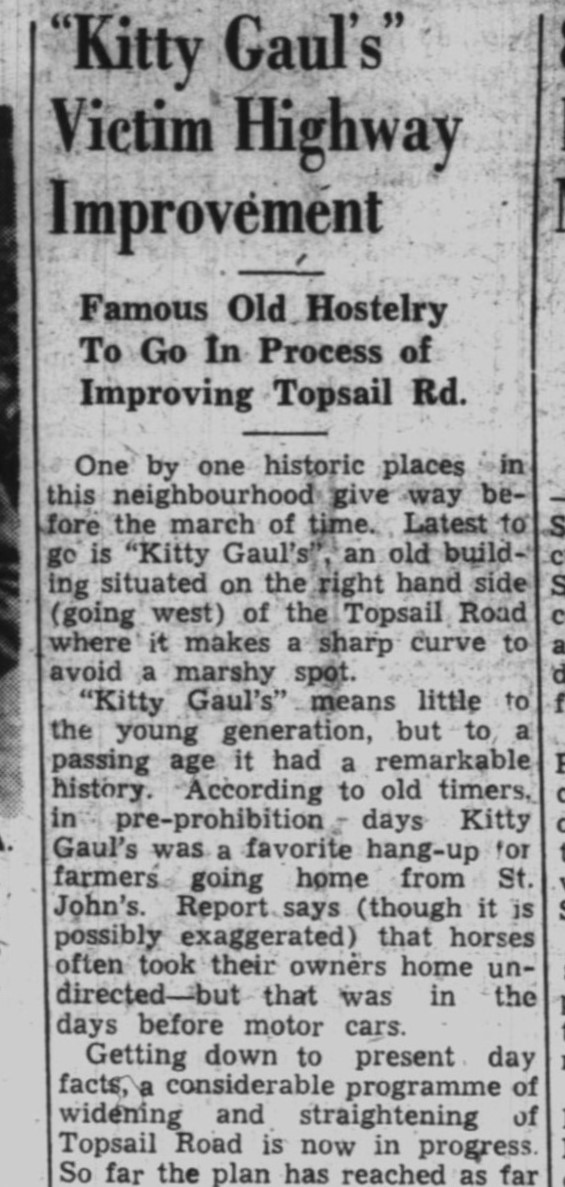
Fun fact: the namesake of that stream and the adjacent Kitty Gaul Park, used to run a public house in the pre-prohibition days. Kitty Gaul’s was the first stop on a longer pub crawl for people making their way back to Topsail from St. John’s. In 1945 it too was deemed a casualty of development. The Daily News called it a “victim of highway improvement” when it was torn down as part of the widening and straightening of Topsail Road.
No one really likes change, but change is inevitable. At the same time, some changes are far worse than others. In fact, one resident said they hoped the city would reject the application for the spa in favour of “allowing for real development to take place in this area,” by which they meant 50-plus condominiums.
Likewise, Ellsworth implied that developers are circling the area. The development challenges at the site and the high cost required to address them are an obstacle. Council members were enthusiastic about the concept at this stage, but Burton, O’Leary, and Korab were not overly optimistic about its viability given the number of conditions that will have to be met for it to become a reality. Ellsworth, ever the realist, said, “I’ll be shocked if this actually happens.”
Child care and dog hair
Council approved two discretionary use applications for small home daycares, one at 106 Old Pennywell Rd. and another at 47 Oxen Pond Rd. It also approved a discretionary use for a larger daycare in an industrial commercial zone at 50 Airport Rd., which was put forward by Treehouse Daycare Ltd. for 118 Children and 20 employees.
A discretionary use application for a home occupation at 29 Palm Dr. in Southlands to allow a dog grooming salon was also approved.
Money on the table
Council awarded a contract to Pinnacle Engineering, which bid $407,407 on the preliminary engineering, design, and related services for the detailed design of the shared-use path from Airport Heights to Paul Reynolds Community Centre.
Council ratified the award of a contract to Farrell’s Excavating Ltd. for $339,000 to manage snow clearing in the Kenmount Terrace area. After nearly two weeks of back to back snow storms, apparently a lot accumulated in Kenmount Terrace; Ellsworth took a moment to thank staff and residents for their patience, and for their coordinated efforts to work together to remove the build-up of snow in the area.
Council also approved the purchase of two Toromont CAT loaders for $213,800.00. Leased in 2017, they are now at the end of that lease term. Given these loaders are now seven years old, Ellsworth wondered, how does this purchase fit into the city’s fleet replacement policy? Breen promised, “we can get the answer to that question.”
Rezoning in the Goulds
The city’s recent improvements to the municipal sewage system in the Goulds has brought land — currently zoned rural residential infill — into municipal service areas. Therefore, council will now consider rezoning this area as residential, extending it along Main Road and Shoal Bay Road. The rezoning would allow existing property owners to subdivide their properties, and for new residential developments in the area. There will be public consultations, which will inform a comprehensive development plan.
Apartment building at 39 Janeway Pl.
Council also agreed to consider the rezoning of 39 Janeway Pl. from the residential 2 zone into the apartment 1 zone. There will be public consultation once a site plan is submitted. The application was put forward by the Association for New Canadians with the intent to develop a three-storey building with 33 units that will serve as affordable housing for newcomers. The property formerly housed the Janeway Hostel and currently belongs to the provincial Department of Transportation and Infrastructure.
“I appreciate the initiative by the provincial government to look at turning over the land to help with the affordability,” Ellsworth noted. “Maybe our federal government could learn a lesson from our provincial colleagues.”
He pointed out there is currently an abundance of crown land in Pleasantville, but its cost-per-acre is prohibitively high, which is limiting opportunities for development.
46 Hazelwood Cres. decision postponed
Korab explained he received a petition with over 100 signatures from the residents at Sheffield Estates requesting that the decision regarding the rezoning of 46 Hazelwood Cres. be postponed until a public meeting has been held for the residents.
No development plan has been put forward yet as part of the rezoning application. Korab recommended that council reject the rezoning unless the plan is put forward so the residents can learn more about it.
Ward 4 Bi-election is March 12
“I want to really emphasize how privileged we are to have the democratic ability to vote in people in our council,” O’Leary said. “We’re looking at the empty seat for our Ward 4 councillor, we’re anxious to fill the seat at our table.”
Information about voting is available on the city website. Anyone who hasn’t received their mail-in ballot should contact the city at election@stjohns.ca.
Ward 4 has four candidates in its roster, all of whom are strong contenders. Former What Odds at City Hall columnist Elizabeth Whitten has shared some of their priorities here. Meanwhile, Happy City hosted a roundtable with the candidates on Wednesday, and has compiled more information on where the candidates stand on hot topics like taxation, crime, transportation, and housing.
The candidates
Candidate Tom Davis previously ran for Councillor-at-Large in 2021. He’s an experienced entrepreneur, a community advocate, and a long-time caller to VOCM’s Open Line. He offers a benevolent presence, a passion for good governance, business sense, and seems to have a good grasp of the broad strokes of municipal matters. He’s worked on policy with the Liberal Party, and has interests in working with other levels of government to align priorities.
Greg Smith, in his third time running for a council position, is delivering positive messaging and promoting inclusion. He has a good transit platform that includes cross-municipal planning. He seems to value a cooperative, collaborative approach to working with council, staff, and residents to make slow, incremental change. He’s all for getting rid of the sport and entertainment subsidy for Mary Brown’s Centre, which means a lot coming from a professional curler.
Nicholas Hillier, meanwhile, is a first-time candidate, a substitute teacher, and community volunteer who does communications for St. John’s junior hockey league. The fact he is also a long-time resident of Ward 4 gives him a competitive advantage. He seems genuinely keen on prioritizing the needs of the residents in the area first and foremost, and has committed to being available to advocate for their interests.
Myles Russell is also a first-time candidate, but he has a long-time working relationship with city staff thanks to his professional background in civil infrastructure and urban planning. In his involvement with Strong Towns he has demonstrated commitment to researching creative solutions to complex challenges of urban planning. He has the most detailed platform of all the candidates, demonstrating an appreciation for the importance of design, planning and development, and the overlaps between issues facing current municipalities.
Hillier, Davis, and Smith are all committed to lowering taxation by finding inefficiencies, and reducing unnecessary spending. Russell is the only candidate to offer a persuasive alternative to lowering taxes and raising revenue: increasing land value by increasing density, a move which will also address the housing shortage. This move also has the potential to bolster transit. His experience working with developers gives him competitive insights.
For example, he claims that many developers actually don’t want to have to build car infrastructure into their properties, and would prefer to invest in metrobus instead. He is also the only candidate to make the point that people who don’t own cars currently pay for car infrastructure they don’t use. It’s a welcome counterpoint to the common complaints that drivers don’t want to invest in public transit because they don’t use it.
Heritage grants, road reductions, spring recreation
Burton reminded people with heritage homes that applications for maintenance grants are now open.
Bruce reminded residents that there will be lane reductions downtown on March 17, 2024 from 11 a.m. to 12 p.m. to accommodate the Shamrockin 5K Road Race.
She also announced that registration for spring recreation programs is now open. The city is also taking applications for summer hires, and inviting feedback to be included in the city’s new recreation master plan.
World Poetry Day
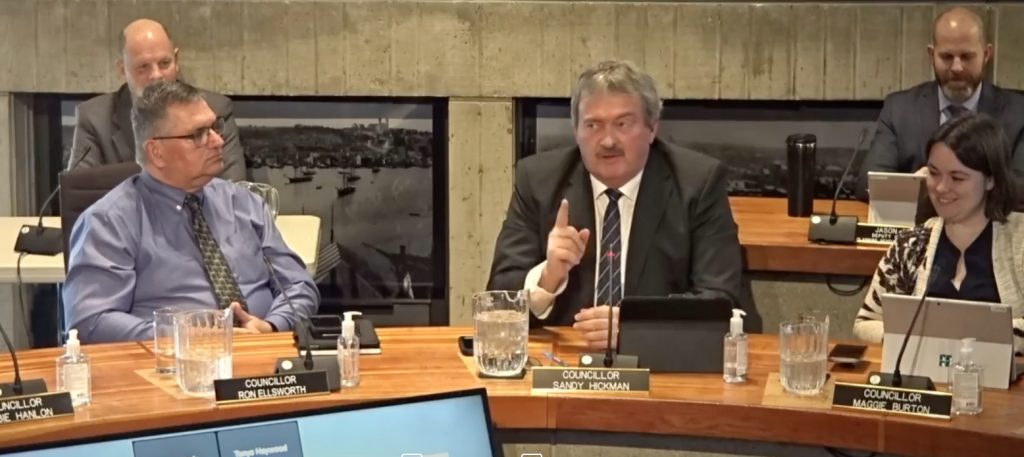
Hickman closed the meeting on a poetic note, sharing that St. John’s poet Laureate Mark Callanan would be back in chambers on March 21, entirely in verse:
World poetry day we are going to Mark,
so I would like you all to hark
March 21 at city hall
our poet laureate will welcome you all,
a 7 p.m. start
soon after dark
The room erupted in laughter. “That was impressive, Councillor Hickman,” an amused Breen said.
Korab said Hickman should read a poem at every meeting in April. Indeed, we could probably all use more poetry in our lives.

Author

Related Articles

Signs of the Times
Korab joins Team Furey. A slipway ties the whole community together. An apartment building downtown. A tale of two experiences from two city parks.

St. John’s women of influence
Awards, birthdays, marriages, and retirements are celebrated as two distant food trucks duel for the night in the parking lots of old establishments history forgot

Holidaying on Indigenous land
June Day is renamed no thanks to Tom Davis. A questionable debate about parking relief. Minor sport, major expense. Trash is a symptom of a bigger problem.