
Rape is not an impulse, it’s a structure
The Parole Board of Canada’s decision to release Doug Snelgrove minimizes the harms of sexual assault
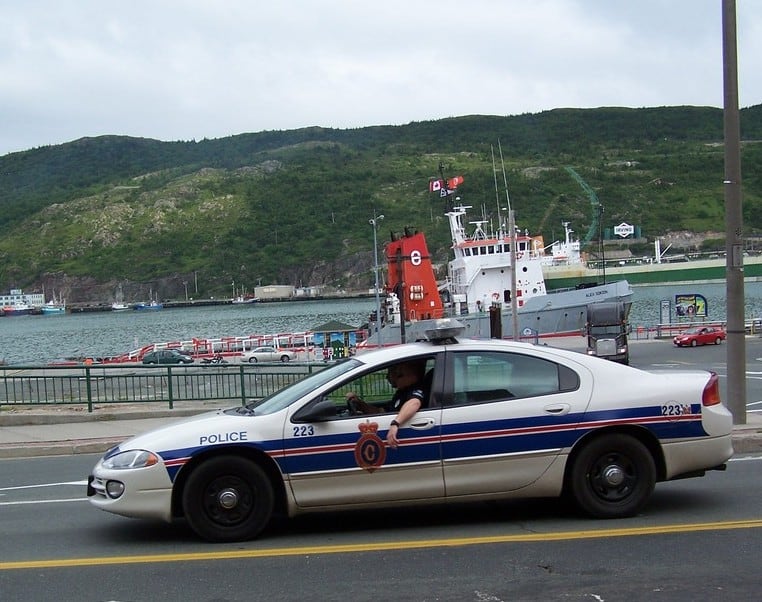
About 30 years ago I was walking along Bond Street in St. John’s on my way to a night shift at work. It would have been about 6:45 p.m. because it was a 15-minute walk and my shift started at 7 p.m. I think it was in September; it was dusk, but people were not out on the street. They were in their houses, perhaps, eating supper.
A police car pulled up beside me. The officer told me it was dangerous for me to be walking outside at this hour by myself. I think I was in my late 20s at this time. The officer told me I should get in the car and he would give me a ride.
I was afraid. I didn’t know if there was an immediate danger unfolding in the neighbourhood. I did know I didn’t want to get in the car. I looked around for witnesses.
“No thank you, I am fine,” I said. I picked up the pace, walking very fast. The police officer continued to roll along beside me.
Will you stand with us?
Your support is essential to making journalism like this possible.
“I think you should get in the car,” he said.
During that year, I had been walking Bond Street to get to work three times a week at this hour, sometimes four. I had never run into any trouble; no one had ever harassed me. Not even with a cat call. Did the officer have some information about this particular night that he wasn’t sharing with me? I looked up the street. I glanced behind me. The street looked the way it always looked, pleasant and benign. But would it look any different if it was dangerous?
I was afraid there was someone with a gun or knife hiding behind a corner nearby. But I was also afraid of the officer. Did he have the right to order me into the car? Was I being arrested? I didn’t know my rights; I didn’t know what choices I had. I just kept walking, looking straight ahead. And still the cop kept rolling right along beside me.
The third time he asked me to get in the car, my anger began to rise. Why didn’t the officer consider how frightening it might be for a woman walking alone to be coaxed into a car by a stranger, on some vague pretext? Why didn’t he understand the power his uniform and his police vehicle might have in adding confusion to an already frightening situation?
Then another thought hit me: perhaps he did understand the power of his uniform, and he was using it to get me in the car. And that’s when I was flooded with a sudden, overwhelming rage. Blood pounding in my ears, my face instantly hot, I screamed at the top of my lungs.
“LEAVE ME ALONE.”
My voice seemed to bounce off the clapboard faces of the houses.
The cop put his foot on the gas, and the car tore around a corner and out of sight. I never saw him again, and I have no memory of what he looked like. I still don’t know if he was acting on information about a legitimate danger in the neighbourhood; though no incidents were reported by the media afterwards. I’ll never know if he was a good Samaritan trying to protect me, or a predator luring me into a car in order to perpetrate a sexual assault.
It took me years to understand why I became so frightened that night, and why I screamed at the top of my lungs. I have been trained since I was a young child not to get into cars with strangers, that it isn’t safe for girls and women to do that. I was afraid because the stranger who approached me didn’t look like I expected. He was dressed in the uniform I had been taught to trust and yet, I did not trust him.
I wasn’t sure of the power he had over me as an officer of the law. But I knew he had power and I was very afraid of that power. The world had told me from the moment I was old enough to listen to protect myself from people like him. But because he was a police officer, I questioned myself. I did not know how to react. I didn’t know what the right thing to do was. I didn’t get into a police car that evening, but on another evening, I might have just as easily gotten into one without giving it a second thought.
Doug Snelgrove released on day parole
On August 7, former police officer Doug Snelgrove was released from prison on day parole. Snelgrove was convicted in 2021 for a sexual assault he committed while on duty. In 2014, he gave a young, heavily intoxicated woman, named in the press as Jane Doe, a ride home in his patrol car. He sexually assaulted her at her residence.
The Parole Board of Canada’s decision sheds light on its rationale for granting him day parole. I take issue with how the Board has characterized Snelgrove, his motivations, and the meanings they draw from his actions and speech.
The Board tells Snelgrove: “you are typically a good problem solver, and you are not impulsive. The night of the offence was an exception to this, and your actions were impulsive and very spur of the moment.”
It also states, in its decision: “You realize the huge mistake you made, and you have to accept the verdict of the jury and are trying to move on.”
By describing the sexual assault he committed as “impulsive and very spur of the moment,” “an exception,” and “huge mistake,” the Parole Board is making it sound like Snelgrove’s actions were an impulse, borne of the circumstance, rather than a consequence of profound misogyny, toxic masculinity, and an abuse of power. Snelgrove was wearing a RNC officer’s uniform and carrying a gun when he gave Jane Doe a ride in his vehicle. He used his authority to gain her trust. He also did not inform his superiors, like he was supposed to do, that he was driving an intoxicated woman home. He purposely withheld that information. This was a premediated sexual assault. Sexual assault is not perpetrated on a whim. It is a learned behaviour, condoned and normalized by exactly the kind of sexism demonstrated in the Parole Board’s casual dismissal of an extremely damaging incident of gender-based violence, as a mere “impulse.”
The Parole Board also tells Snelgrove it acknowledges his state of mind prior to committing the rape: “You advised the Board that at the time of your current offence, you were emotionally disconnected from your spouse and not able to communicate or ask for help from your partner.”
Why does the panel bring up this emotional disconnection between Snelgrove and his spouse? Why would any rapist’s spouse be expected to “help” her husband control his sexual violence against women? Is the panel implying that his spouse is somehow supposed to help Snelgrove mitigate his sexually violent behaviour? And is the idea here that if Snelgrove had been “emotionally connected” with his spouse he wouldn’t be out sexually assaulting a stranger?
Or does the panel mean to suggest that Snelgrove was seeking emotional connection through sexual assault? If so, the panel needs to understand that sexual violence against women does not create positive emotional connections — it is violence, brutalizing and horrific. The panel also needs to acknowledge that Snelgrove and his spouse may not have been emotionally connected because of how he relates to women. He was capable of sexually assaulting women and he proved that with Jane Doe. Therefore he is a dangerous man.
The members of the Board also address Snelgrove’s self-assessment: “The Board asked for your definition of a good cop. You stated that you believed you were a good cop and treated people fairly.”
With this comment, the Board members seem to take Snelgrove’s self-assessment at face value, and trust his capacity to judge himself fairly. Is committing sexual assault treating people fairly? It seems Snelgrove has learned nothing about the gravity of his crime. He thinks he is a good guy. He doesn’t recognize that he violated the trust of the public or acknowledge the repercussions of that violation. The violation of this trust means that if a woman finds herself in danger, she will be less likely to call for the aid of a police officer. He has made life more dangerous for women. He has made it harder for honest police officers to do their work. Is this the work of a good cop? The Board appears to support Snelgrove in his self-assertion. They do not seem to recognize that when a police officer uses his uniform in order to perpetrate sexual assault, he is the opposite of a good cop.
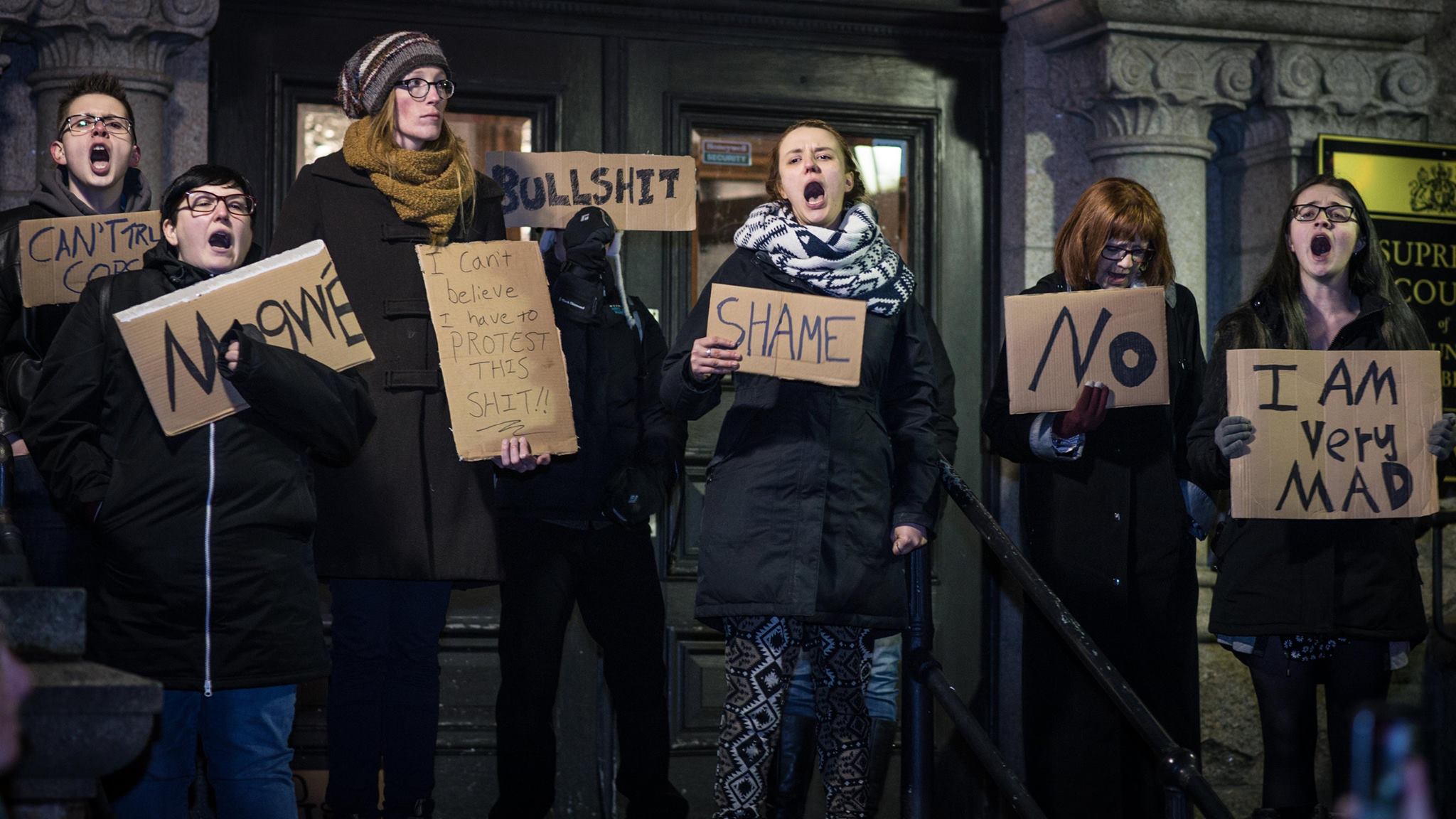
I attended one of the many protests against Doug Snelgrove in the police station parking lot in St. John’s. Hundreds of people were in the crowd. The police were in attendance, in uniform, perhaps ordered to be there in an effort to keep the peace. Nevertheless, they did not behave, by the looks I saw on their faces, as if they thought Snelgrove was a good cop.
The Board writes that they asked Snelgrove about his offence and the harm he caused: “You stated that you wanted to apologize to the victim as you can appreciate how difficult this process has been for you and can appreciate what they must have experienced as well.”
From this comment, it appears Snelgrove doesn’t understand that he is the perpetrator of a crime of extreme violence, and Jane Doe was the victim of that violent crime. By drawing a comparison between what they have both been through, the Board seems to suggest they are equivalent. They are not. The Board doesn’t comment on this lack of understanding.
“You realize the shame you have brought on your family, your former employer, and the community and that you do not want this event to define you,” the Board states in the report.
With this comment the Board is emphasizing that shame is the consequence of Snelgrove’s behaviour, not the harm he has caused the victim. There is also nothing here about Snelgrove’s own personal shame over his perpetration of a sexual assault, only that he simply doesn’t want this “event” to define him. The Board does not suggest that Snelgrove has harmed a young, vulnerable woman in committing this vile crime. If he can’t feel remorse for this act, it will likely define him.
Finally, the board describes Snelgrove’s release on day-parole as good for the community: “It is the Board’s opinion that […] your release will contribute to the protection of society by facilitating your reintegration into society as a law-abiding citizen.” The members of the Board are seemingly unaware of the sexism and misogyny evident in such a statement. Or any of the other lines they’ve written, as reported by the CBC. They do not seem conscious of how revealing their statements are of systemic abuses of power against women that are prevalent throughout the justice system.
There is no understanding of gender-based violence in these excerpts from the Parole Board’s report on their decision. There is no understanding of the violence women put up with in this community and other communities everywhere on a daily basis. And most disturbingly, there is absolutely no understanding of the casual violence in their own report. In the words they’ve written, the Board seems to have no understanding of how its rationale minimizes, perpetuates, and condones violence against women. The Board’s complete lack of awareness of where sexual violence stems from, its framing of Snelgrove’s crime as an “impulse” rather than a symptom of toxic masculinity and systemic sexism, and the failure of the justice system to protect women, should put all women on high alert.
Though these excerpts from the Board’s decision directly address Snelgrove, they indirectly address women too.
What we are left to learn from the report is: we should be ready, always, to scream at the top of our lungs.

Author

Related Articles

Slowly killing research at Memorial University
A university is not its buildings, and it doesn’t exist to serve private-sector interests. It is about the pursuit of knowledge.
An LNG future for Fermeuse?
Proposal for massive liquefied natural gas hub exhumed on Newfoundland’s Southern Shore

Thinking beyond the crisis in journalism
There are many legitimate reasons for concern, but news media have an unprecedented opportunity to innovate and create a new era of journalism