
A Place to Call Home
Residents of a supportive housing program in St. John’s highlight that more than shelter, what people really need is a space of their own.

Once a week, staff and residents of Marguerite’s Place, a supportive housing program run by the St. John’s Status of Women Council, sit down to share a meal together. Sometimes we talk about living in shared spaces, sometimes we discuss programming to support people who use substances, and other times we chat about the weather.
We recently asked residents if they would be ready to share their experiences navigating the housing crisis. We all hear about this issue on the news, in the local rental groups on Facebook, and in conversations with our friends and family when they’re looking for a place to call home. But the residents of Marguerite’s Place have lived the reality of the housing crisis firsthand, and when their time at the supportive housing program is over they will be looking for “home” once again.
Residents here are all too familiar with the struggles and barriers people in our province face while trying to find stable and affordable housing. As folks convened over barbecued pork chops, roasted veggies, and mashed potatoes, conversation was buzzing. “There was something on the news today about the cost of renting here in town,” one woman noted. Another confessed: “My son has to walk the streets with nowhere to live.” After a quiet moment around the table, someone chimed in, “I am thankful to be here.”
At Marguerite’s Place eight residents live in independent units in a shared, communal living environment. The units are in a secure building, with support staff working 24/7. Women and non-binary people over 30 can live here for up to three years. During that time, not only do they avail of safe and affordable housing, they can also access support for their mental or physical health. They have opportunities to learn how to develop healthy relationships, employ practical life skills, while building community connections that can help them navigate challenges and crises. People don’t need to be well or sober to live at Marguerite’s Place.
Will you stand with us?
Your support is essential to making journalism like this possible.
Safety, security, and support
Since every resident of Marguerite’s Place has experienced being unhoused, and as their residency is limited to three years, folks living here have a keen sense of how challenging it can be to find a spot like this.
One resident, Mary, recalls what brought her to Marguerite’s Place. “Five years ago, I was at a shelter and the staff kicked me out for no good reason. I was accused of something I did not do. There were two police officers outside my door and the staff watched me the whole time as I packed up my things. Here I was with nowhere to go.”
Another woman, Tish, spoke next. “I used to live in a basement apartment with my daughter; we shared the rent. Then I ended up in hospital and after that I was in a [long term care] home. Now I use a wheelchair and a basement apartment doesn’t work for me anymore. I was living in a private shelter for months before I got into a community shelter. At the private shelter they don’t feed you. The only thing they granted me there was a ramp for my wheelchair. I had to stay there to wait to get a room somewhere else. I was there for three or four months. I don’t know how many seizures I had there. There were men and women staying there and everyone was robbing each other. It was horrible,” she recalls.
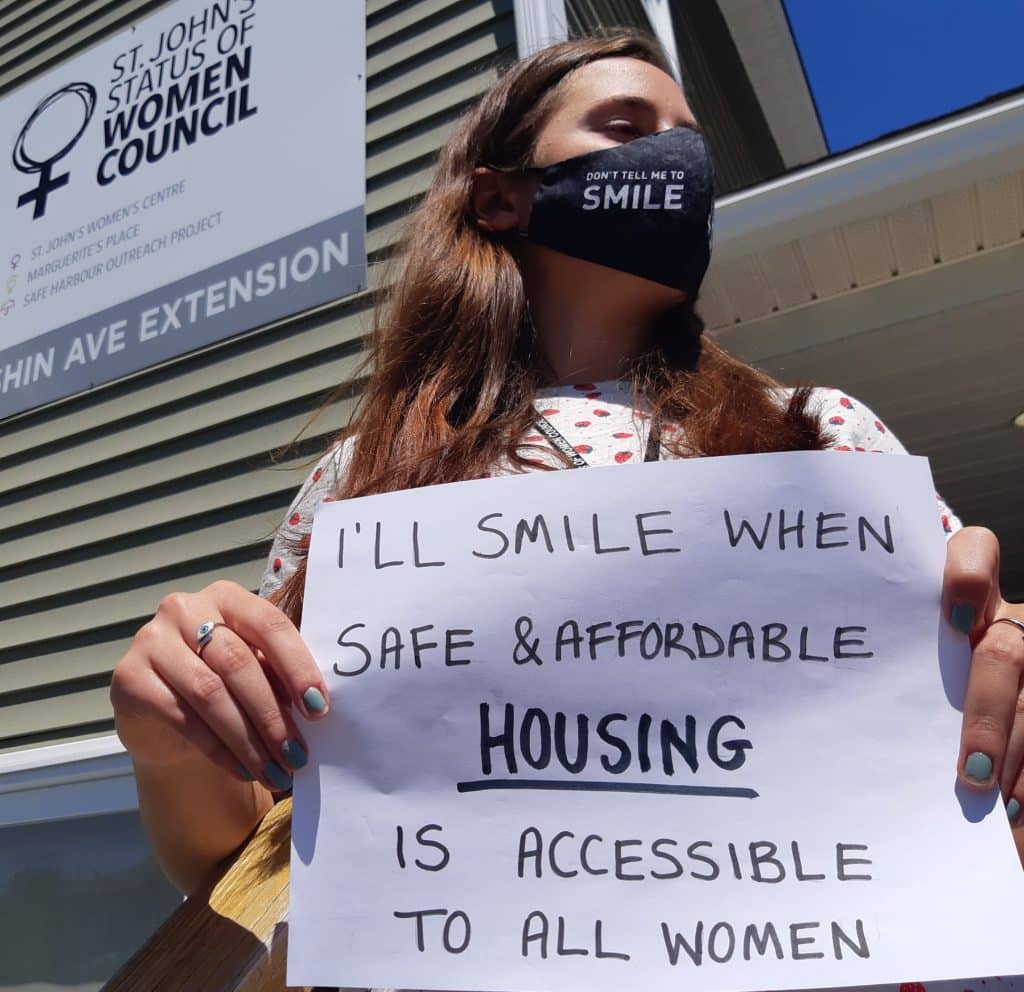
“After that I ended up here. I’ve been on a wait list for two and a half years for my own housing unit. If I don’t find housing in the next year I’m going to Ontario where I can live with my family. I don’t have anyone around me who causes me trouble, I just want a place of my own that I can go home to. I know I’m safe here, but I’m still waiting on a place of my own. It’s harder for me because I’m in a wheelchair, I need accessible housing. It’s been years. I feel hopeless about it everyday.”
Alex shared similar experiences with safety and wait lists. “When I lived up North I had my name in for housing for 15 years. It seems like it’s about who you’re related to. Now, I want a place with good locks, good windows.”
“I want to walk out this door and right into another one,” said Dorothy, another resident. “I want to be close to a grocery store. A nice, comfortable, clean place—nothing fancy.”
Landlord roulette
When staff brought up the topic of landlords, Mary jumped in. “No perverts—too many landlords are perverts. And someone who will give you notice before walking in and up over the stairs,” she said.
“No bullying from landlords would be good and fixing things that break,” Alex offered. “In my old place they were supposed to do all these things to fix up my place but they didn’t do anything. Three years later they kicked me out. I had five days to get out. I’ve only had a good landlord once and it was me, in my own house.”
Tish added, “I’ve lived in unsafe housing all my life, except for when I was living at home as a kid.”
Dorothy had similar concerns. “One of the biggest stressors is security, having your own door that works.”
“The front door [at Marguerite’s Place] is heavy but I’m always thankful for it. Whenever I open it I think about my old door that didn’t work,” Alex added.
“You know, I can’t say that I’ve had a bad landlord. The last place I lived was privately owned, they worked with NLHC [Newfoundland and Labrador Housing Corporation] through a subsidy program,” Dorothy said of her experience. “There wasn’t a washer and dryer hookup, but it was a beautiful apartment. I didn’t have any issues with him. I think there should be more subsidies like this for people in the private market.”
Even when landlords are taking care of residences, the financial and structural barriers to housing are real.
A systemic issue
As an organization doing system navigation and housing support work, what we have seen in the last few years especially is a dire, discriminatory, and dwindling private rental market. It’s a highly competitive market and landlords are well aware of the heightened monopoly they hold as property owners. Time and again we see landlords discriminate against potential tenants who appear to be or are newcomers, who have experience with the criminal justice system, and who are receiving income support.
As Marguerite’s Place residents point out, we continue to hear about landlords who breach other aspects of the Residential Tenancies Act because they know they can.

Recent information shared with us by the Newfoundland and Labrador Housing Corporation reflects many of the issues residents have identified. The wait for NLHC units across the province has grown steadily. In March 2021 there were 1,531 people waitlisted. Less than two years later, in December 2022, that number grew to 2,471. They are also seeing more applicants who are vulnerable, including victims of violence, people who are currently homeless, and those with complex needs.
Between 2022 and 2023, more than a third of the housing corporation’s selected applicants for affordable housing and rent subsidies belong to these prioritized categories. Two thirds of people on the waitlist are single adults without dependents, who qualify for a one bedroom unit. Even more, the demand for emergency shelter is growing and is exceeding the province’s capacity. In July of 2020 there were 95 documented shelter users, and in February of this year there were 268. According to NLHC, this trend goes well beyond the province.
It is clear that we need long-term investments to increase and diversify the available housing stock. Most of all, we need affordable, accessible, and smaller rental units with fewer bedrooms. We need more low-barrier housing options that have varying levels of wrap-around support. We need places that exist beyond the private market, like community and non-profit housing. This is especially critical because we all have the right to live and be housed, whether or not we are well or sober or deemed “deserving.”
There are community housing models in Nova Scotia and British Columbia that offer affordable housing with occupational therapy, harm reduction programs, counselling, peer support and other healthcare services all under the same roof. Based on the statistics from NLHC, and on what we see at Marguerite’s Place and across the community, we know models like these would serve our community well.
By Ashley Power, Marguerite’s Place Coordinator, and Bridget Clarke, Advocacy Coordinator. With significant contributions from Mary Day, Dorothy Leviena, Alexandra Pamak, and Patricia Reid.

Author

Related Articles

May Day Rally Shows New Face of Today’s Labour Movement
Turnout for May 1 march and rally in St. John’s one of the biggest yet in this province

Recimply the Best: Pitch and Pick Competition Winner Aims to Reduce Paper Waste
Recimply won big at Genesis’ annual Pitch and Pick competition last week. The startup is solving the problem of non-recyclable paper receipts.

Coming Home Queer for the Very First Time
For three days in July, queer Newfoundlanders and Labradorians from all over the world celebrated a rural homecoming 30 years in the making.

The realities of conflation
How mislabeling sex work harms vulnerable communities

We’re Sex Workers and We’re Proud
Though we’re in one of the world’s oldest professions, sex work is still highly stigmatized. But we are proud of what we do.

Dancing My Way to Joy and Empowerment
Looking back on Pride month, this writer reflects on the importance of movement and collective joy.