
The realities of conflation
How mislabeling sex work harms vulnerable communities

Last month, Conservative MP Clifford Small stood up in the House of Commons to make claims of ongoing violence and exploitation in his Central Newfoundland riding. He referenced sexual exploitation of youth, as well as ongoing threats to seniors’ and other residents’ safety. Given the very real and serious issue of rising rates of certain types of crime, it’s troubling that Small appears to have fabricated or exaggerated his claims after the RCMP could not corroborate some of them.
We can’t rely on police data alone to represent survivors’ experiences because so many do not report to police. We also can’t rely on often misguided political figures to represent the nuance of survivors’ experiences. In this case, we have to think for ourselves.
It’s alarming to see a leader exploit the public’s hopes and fears in this way, seemingly using misinformation to gain political advantage. But it’s not the first time political leaders have let us down.
Just last March, then provincial Minister of Justice and Public Safety John Hogan claimed it is “impossible” for lawyers to retraumatize victims of sexual assault. “The lawyers in this province are not retraumatizing sexual assault victims; whether it’s a Crown or a legal aid or a private lawyer in this province. It’s not the way it works. It’s actually impossible for it to happen,” he said in the House of Assembly.
Will you stand with us?
Your support is essential to making journalism like this possible.
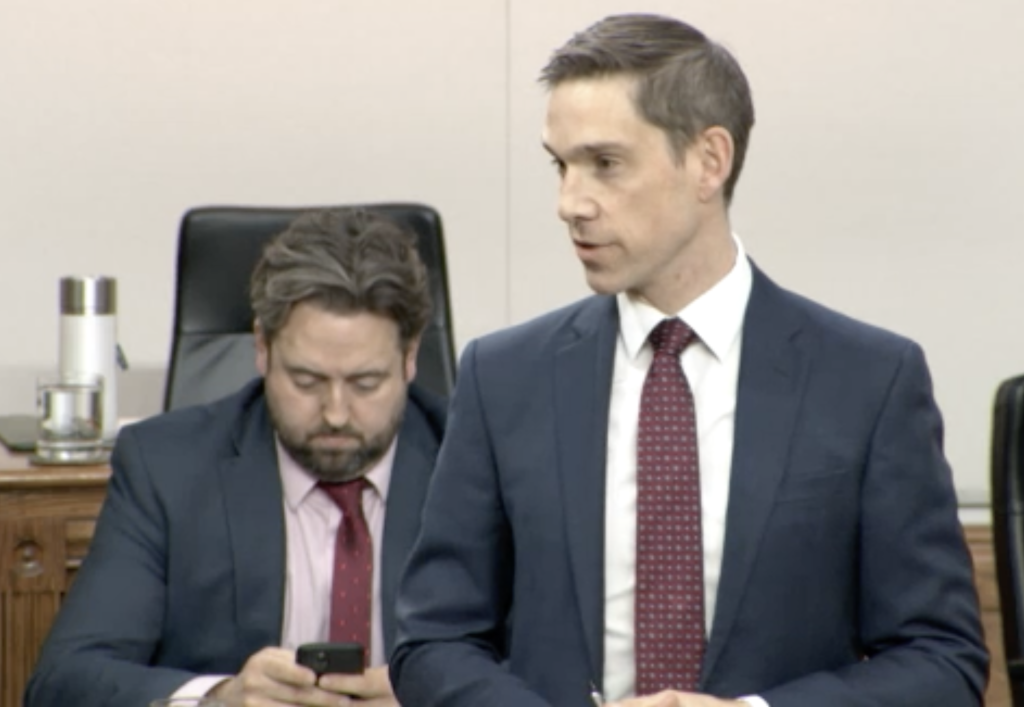
Sexual assault victims and survivors who decide to access the public justice system know too well the various ways the system causes harm: from a forensic exam, to interactions with the police, all the way through the justice process. For a justice minister to imply he understands the experience of survivors is itself harmful.
So Clifford Small isn’t the only politician attempting to speak on behalf of survivors without first educating himself on their experiences.
Gender-based violence — an umbrella term encompassing experiences like sexual violence, exploitation, abuse and coercion — continues at epidemic rates in our province. In August 2024 alone, nearly 50 per cent of those attending the St. John’s Women’s Centre’s drop-in counseling program came to speak about gender-based violence in their lives. With such a pressing issue, we recognize the value in bringing vulnerable and often overlooked experiences to the forefront of decision making. At the same time, we have to ask ourselves: Whose stories are being told? Who is telling them? And to what end are they being shared?
While Small used other words to describe these claims, we understand sexual exploitation as coercive abuse of power or trust for sexual purposes, where there is profit or benefit (financial, social, political, etc.) gained. When this happens to children and youth, there are distinctly heightened vulnerabilities and risks. Human trafficking for the purposes of sexual exploitation is when this coercive abuse of power includes the movement or harbouring of people. We should all be deeply concerned about sexual violence and exploitation, including through human trafficking.
In addition to the harms that come from a political leader sharing unsubstantiated claims, Small caused further damage by reinforcing a harmful misconception when he claimed rural youth are being “sold into prostitution”.
The adult sex trade is often conflated with sexual exploitation, but they are very different. Sex work is just what the term states — work, like any other work from sitting in an office to working at a local grocery store. This is far different from sexual exploitation, which is a form of gender-based violence. While we know that gender-based violence follows so many women and gender-diverse people to the workplace, that alone doesn’t make the nature of their work inherently violent.
The conflation of these two very different experiences is responsible for decades of harmful laws and policing tactics which target sex workers, particularly those who are women, migrants, people of colour, 2SLGBTQIA+ individuals, substance users, or who are street-based. This deeply ingrained conflation has been used to support policies, laws, and stigma that cause serious harm to both survivors of human trafficking and sex workers. When human trafficking is discussed as synonymous with the sex trade, it denies and dismisses the many other kinds of human trafficking beyond sexual exploitation, in industries like domestic labour, factories, agriculture, and organ removal.
While claims like Small’s are disturbing, we can’t rely on unverifiable anecdotes alone to inform federal policy. In this instance, Small employed a common party line that uses fear-mongering tactics and preys on moral panic to support the Conservative Party of Canada’s reform policies.

Highlighting a concerning story, whether or not it’s substantiated, can be an incredibly effective way to gather support for ideologies that are constructed around protecting vulnerable groups like young people, migrants, women and gender-diverse people. This approach, known as “fear appeal,” is used to manipulate the public, to create fear of each other and the unknown, and it often results in creating unhelpful divisions in our communities which can and do lead to violence.
We can point to recent examples, too. Fear appeal was used to foster transphobia and hate-mongering against 2SLGBTQIA+ people in our community here in St. John’s and across the country. Understanding how and why sexual violence and exploitation happens in our communities allows us to think critically when some survivors’ experiences are extracted and shared in spaces like the House of Commons to push one kind of narrative in the midst of our tangly federal landscape.
When it comes to human trafficking for the purposes of sexual exploitation, even international organizations and campaigns aimed at ending human trafficking recognize the serious risks of sensationalizing accounts of exploitation. In fact, there are informative resources that exist to help us think more critically so we can better understand the harms of mainstream anti-trafficking narratives and instead create effective change while working towards safety for survivors.
The elephant in the room in all of this is the important role decriminalization of sex work could play in building safety for both sex workers and those experiencing sexual exploitation and trafficking.
The Protection of Communities and Exploited Persons Act (PCEPA), federal legislation criminalizing sex work, actively endangers sex workers and infringes on their human rights. While the act claims to end the exploitation of women, it has the opposite effect of creating unsafe working conditions. It makes it difficult for sex workers to screen clients and pushes them into more isolated areas of our cities, increasing their vulnerability to violence. Under the PCEPA, the legislated conflation of sex work and exploitation creates further mistrust and fear between sex workers, survivors of gender-based violence and police.
When someone is experiencing violence, they should not have to consider the risk of being mistaken as a sex worker and the threat of criminalization when making the important decision to access emergency services and reporting processes. The decriminalization of sex work would allow sex workers to get on with their work, while authorities could focus on all forms of human trafficking, including investigating charges of sexual exploitation and trafficking.
Let’s let sex workers live and work safely through decriminalization. Let’s review the evidence around “tough on crime” approaches and the ways that they have been shown to actually increase harm and decrease safety in communities. And let’s focus our energies on the countless ways communities and policy makers can better serve those who are experiencing gender-based violence, including sexual exploitation.
And let’s listen to those in positions of power with a bit of skepticism. Let’s take them to task when they try to use emotional appeals to sway us. Let’s not be afraid to ask them for the evidence and to demand that they are accountable for their words.
Clifford Small, let’s start with you.
Feminist Files is a collaboration between The Independent and the St. John’s Status of Women Council.

Authors


Related Articles
Sobriety is Not Superior
Challenging oppression requires us to check our own biases

We’re Sex Workers and We’re Proud
Though we’re in one of the world’s oldest professions, sex work is still highly stigmatized. But we are proud of what we do.

Dancing My Way to Joy and Empowerment
Looking back on Pride month, this writer reflects on the importance of movement and collective joy.