
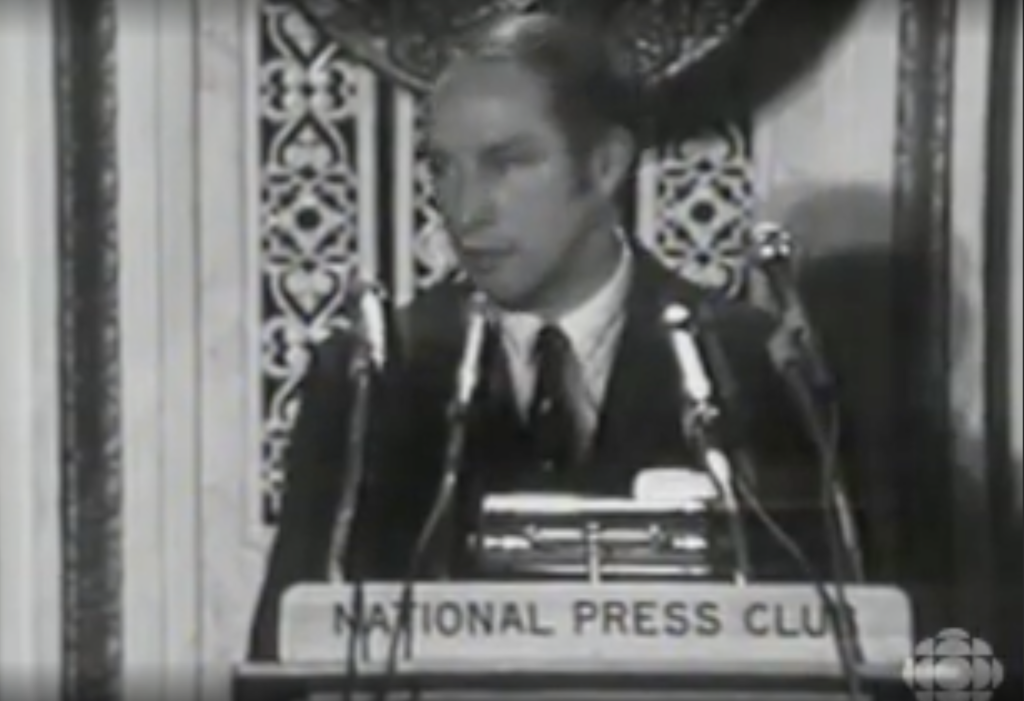
A little over half a century ago—when Trudeau the Elder was in his first term as our prime minister—he gave a speech to the National Press Club in Washington where he described Canada’s relationship with the United States as akin to sleeping in bed with an elephant.
“No matter how friendly and even-tempered the beast,” he joked, “one is affected by every twitch and grunt.”
No kidding. Whether or not we were ever really spooning a gentle giant, that elephant is now foaming at the mouth, shitting all over the carpet, and looking to eat us alive. And it’s actually not clear how Canada gets out of this jam.
You can make a reasonably compelling argument that the central organizing problem of Canadian political history—besides “handling Quebec”—is maintaining and justifying our existence as a separate polity from the American republic. Do we cling for dear life to the British mothership? Do we latch onto the Leviathan next door like barnacles on the belly of a whale? Or do we learn to swim on our own—safely in the shadow of the Anglo-American empires, to be sure, but still free to chart our own course?
Will you stand with us?
Your support is essential to making journalism like this possible.
Canada may be more or less riven by its many regional and/or ethnolinguistic solitudes at any given time, but “not becoming part of the United States” has been our main raison d’etre since the end of their last civil war. Whatever your stance on multiculturalism, the monarchy, or our mostly-universal healthcare system, “Not Being America” is the one unifying core of Canadian identity that almost everyone can shout with their whole chest—as you have no doubt probably noticed.
Best frenemies 4 lyfe
Of course, up until a few months ago, Canadian sovereignty vis-a-vis America hasn’t been a live question for a long time. After the British empire ceded leadership of the liberal world order to the US following the Second World War, Canada has been our neighbour’s stalwart, if not always uncritical, ally. We are pretty firmly on the same team: democracy, freedom, human rights and capitalism for everybody, but with added maple flavouring: hockey, official bilingualism, the welfare state, Terry Fox—things of that nature.
The rest of the world tends to see us as Uncle Sam’s gentler, somewhat self-righteous little brother who wears a lot of plaid and likes to go canoeing. Most of the outstanding concerns about Canadian sovereignty dealt with our economic and cultural entanglements; the latter is why we have Canadian content regulations and the CRTC (boo, hiss).
Once upon a time there was a very spirited debate in this country about shoring up our own industrial capacities and keeping control of the Canadian economy firmly in the hands of Canadians themselves. Not all Canadians, obviously, but a made-in-house capitalist class whose primary residences could be found in Toronto, Ottawa, Montreal, Calgary or Vancouver—and who therefore had an incentive to reinvest their profits at home in line with national economic and social development goals.
But this faintly left-nationalist dream lost its argument against the nascent neoliberalism of the late 1970s; if you accept that “GDP line go up” is the most important goal your society can pursue, globalized capital flows will win every time. So from the 1980s onwards, breaking down trade barriers and liberalizing investment regulations has been the name of the game: first through the Canada-United States Free Trade Agreement in 1989, and then having Mexico join the party with NAFTA in 1994. By this time, of course, history had come to an end—the Soviet experiment was over, American capitalism was doing victory laps—and so the obvious path forward for Canadian prosperity was a more complete integration into the industrial circuitry of the world’s sole superpower.

The freer the markets, the freer the people, as it were. And besides, we’re both playing for the same team. America is our best friend and closest ally. Canada could safely become a de facto American client state precisely because our political leaders were on the same page ideologically and we could trust that there was no reason or desire for them to directly intervene in our domestic affairs—let alone literally annex us.
So much for that. As it turns out, those mid-century economic nationalists may have had a point about the long-term problems with turning over the locus of control for the Canadian economy to the United States of America. But I don’t think anyone could have predicted our present state of affairs in the dumbest of all possible timelines.
Rage against the dying of the light
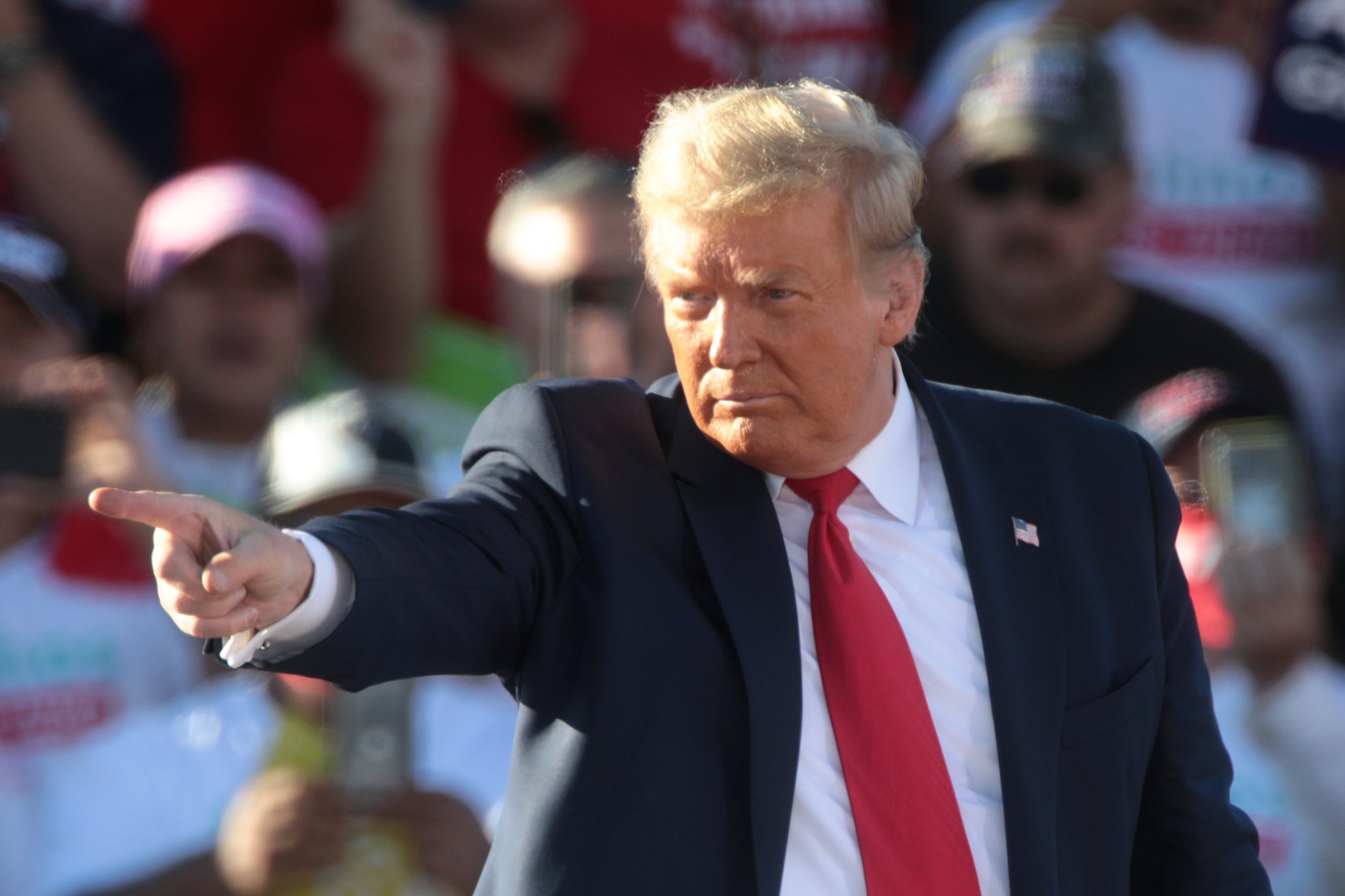
The second Donald Trump presidency is already much more unhinged than the first. Not only is he determined to launch a brutal trade war against Canada and Mexico, he appears genuinely fixated on the idea of annexing our country as the first step in a new era of American expansionism. “Empire in decline still got plenty of paper,” to quote rapper billy woods, and the US seems to be coping with the ebbing of its global power by slamming amphetamines and flexing as hard as it can. This kind of belligerent swagger is a classic hallmark of inner weakness, and there are few things more dangerous than a weak person—or state—desperate to prove that they’re strong.
Let me put my cards on the table for how I understand the situation. The idea—at least according to leaked comments Trudeau the Younger made in a closed-door meeting with Canadian industrialists—is that the president of the United States is earnestly entertaining annexation as part of a strategic resource grab. For all intents and purposes, the American military-industrial complex either already has access, or already has the lawful means to acquire access, to all the Canadian resources and minerals and whatever else it might conceivably want to incorporate into its supply chains. I’m pretty sure that’s been a big driver of North American economic integration going back to the Cold War.
Besides this, we are both part of NATO—at least for now. Our geopolitical interests already overlap almost entirely, and even where they diverge, again: our economy is almost totally integrated with theirs. They pay the piper, and they call the tune; for good or for ill, this has been the basis for Canada-US relations since Hitler ate his gun. Trump’s concerns about Canadian “border security” are a contrived and essentially false justification for waging economic warfare. The idea that Canada can only work alongside or otherwise serve American state interests if they forcibly raise the star-spangled banner over the Peace Tower is an adolescent power fantasy. It is a child’s understanding of how international political economy works.
But then again, why shouldn’t it be? It’s adolescent power fantasies all the way down here at the twilight of the American empire—whether the magical thinking of the Christian nationalists who propelled Trump back to power or the puerile resentments driving Elon Musk and his fake federal agency to strip the copper wires out of the walls in Washington. Imperial decline and cognitive decline apparently go hand in hand, and it’s hard to outwit delusion. Whoever wins the next Canadian election—coming imminently upon the (likely) coronation of Mark Carney as Liberal leader—will need to bear this in mind when they negotiate with the American Nero.

Arguably, the one upshot of all this is the surging patriotic pride sweeping the country. We’re buying local, we’re waving the flag, we’re booing the US national anthem and humiliating them in hockey. Which makes sense: the core feeling uniting nearly all Canadians—rich or poor, left or right, French or English, east or west—boils down to, “Yankee Go Home.” I consider myself a Newfoundlander first and spent most of my academic and journalistic careers challenging the very concept of “Canada,” but I’m also ready to wrap myself in the maple leaf because despite all its flaws this country’s fate is ours to decide—not theirs.
And yet. I am reminded of Freud’s wry observation that “defiance signifies dependence as much as obedience does.” I wonder if we’re raging so hard against the machine because on some level we recognize that we have locked ourselves in a room with this feral elephant—that we sealed ourselves in here when control over the Canadian economy was first sold off nearly 40 years ago.
We chained ourselves so tightly to the American Titanic because we thought it was unsinkable. Now, watching helplessly as its captain slams headlong into an endless stream of icebergs, I wonder if we protest so loudly because we know we’re doomed to go down with the ship.

Author

Related Articles

The pendulum swings back toward Canada’s ‘common sense’ Conservatives
Politicians of all persuasions shut down critical thinking by invoking “common sense”—which is never as obvious as it’s made out to be

On living the dream in Canada’s happy province
Wherein the author eschews the hot take-industrial complex for a project where everything is grist for the mill.