
International Women’s Day is not a celebration
How do we build a fighting feminist movement?
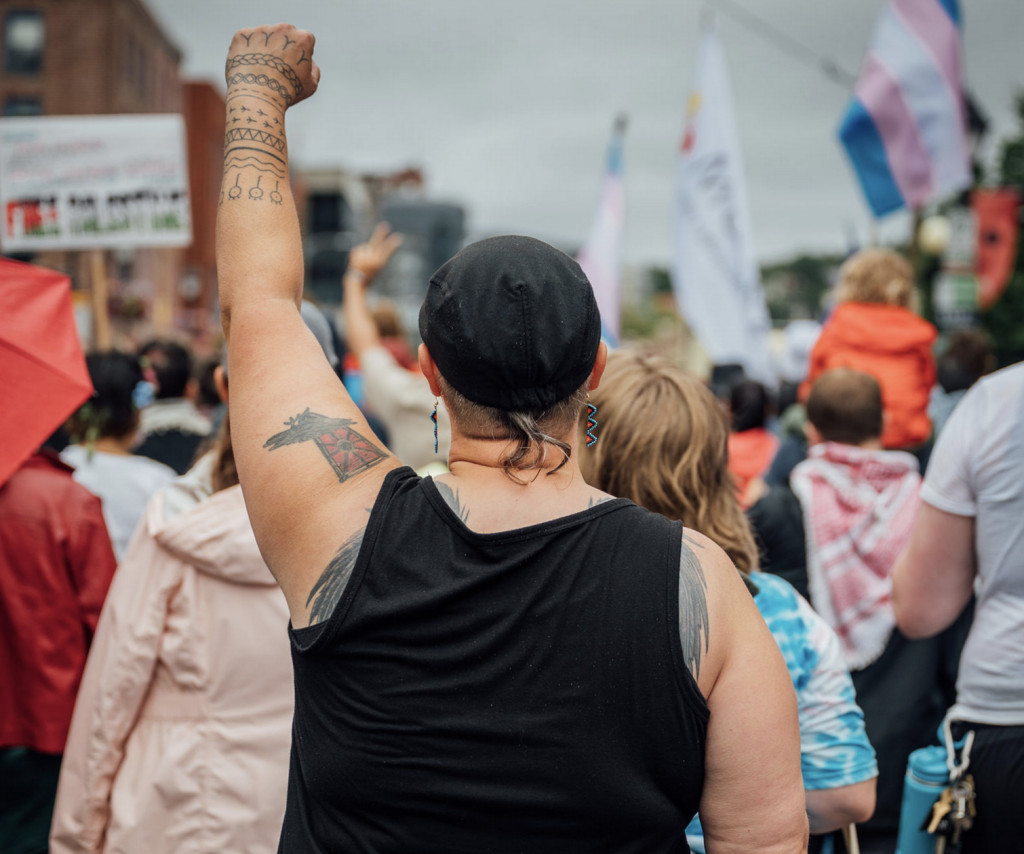
International Women’s Day is not a celebration. Let’s get that out of the way first.
How many IWD events have I attended over the past decade that opened with some variation of: “While there’s still work to do, we ought to take this occasion to celebrate our gains.”
But in today’s world of far-right conservative men waging war on women and other gender minorities, and with the past century’s human rights gains rapidly unraveling, there should be no illusions that we have time or cause to celebrate anything. A sex predator is president of the United States. An elected Conservative politician in BC recently tabled a bill to abolish the Canada’s Human Rights Code in that province. Multiple Canadian provinces have flagrantly abused constitutional measures of last resort—the so-called notwithstanding clause—to attack the human rights of the smallest gender minorities in their jurisdictions, purely for political gain. Global reproductive rights are under threat because of the rise of fascism in the US.
There’s nothing to celebrate in any of this.
Will you stand with us?
Your support is essential to making journalism like this possible.
Nor is the rise of women to positions of prominence any cause for celebration in and of itself. Today’s world provides clear evidence that simply putting women in positions of prominence doesn’t improve conditions for women as a whole, or other minorities. Right-wing, fascist, anti-feminist women have been propped into positions of prominence around the globe. In Canada and the US, some of the most virulent, anti-woman legislation is being put forward by conservative women. Even in this province, the presence of wealthy women who rose on the winds of inherited privilege has never been any guarantee of feminist, pro-women advocacy.
Yet our awareness days have become showcase events, where the powers-that-be and social media platforms try to convince us that the celebration of a handful of privileged minority representatives, whether they’re women, Black people, Indigenous people, trans people, or others, ought to reassure us that life is getting better for all of us, when it so clearly is not.
A fighting feminist history
There’s a reason why, in its early incarnations, IWD wasn’t just “International Women’s Day.” It was always “International Working Women’s Day,” emphasizing that the day is by and for the efforts of poor, middle-class, fighting, working women. Not the wealthy women of privilege who ride their coattails.
IWD has always been about the fight. The earliest references to “Women’s Day” were protests organized by socialist parties in the early 20th century. In 1910, an international socialist women’s conference adopted a resolution calling for the establishment of a ‘Women’s Day’ “to agitate indefatigably among the laboring masses, enlighten them by discourses and literature about the social necessity and importance of the political emancipation” of women, and to “promote Women’s Suffrage propaganda.”
The fixing of IWD in early March was intended to commemorate a 1917 strike by women textile workers in Petrograd, Russia, which turned violent and sparked the Russian Revolution. As revolutionary leader Leon Trotsky later wrote, March 8 “was International Woman’s Day and meetings and actions were foreseen. But we did not imagine that this ‘Women’s Day’ would inaugurate the revolution. Revolutionary actions were foreseen but without a date. But in the morning, despite the orders to the contrary, textile workers left their work in several factories and sent delegates to ask for the support of the strike […] which led to mass strike […] all went out into the streets.” Within a week Russia’s Tsar had stepped down and women had won the right to vote.
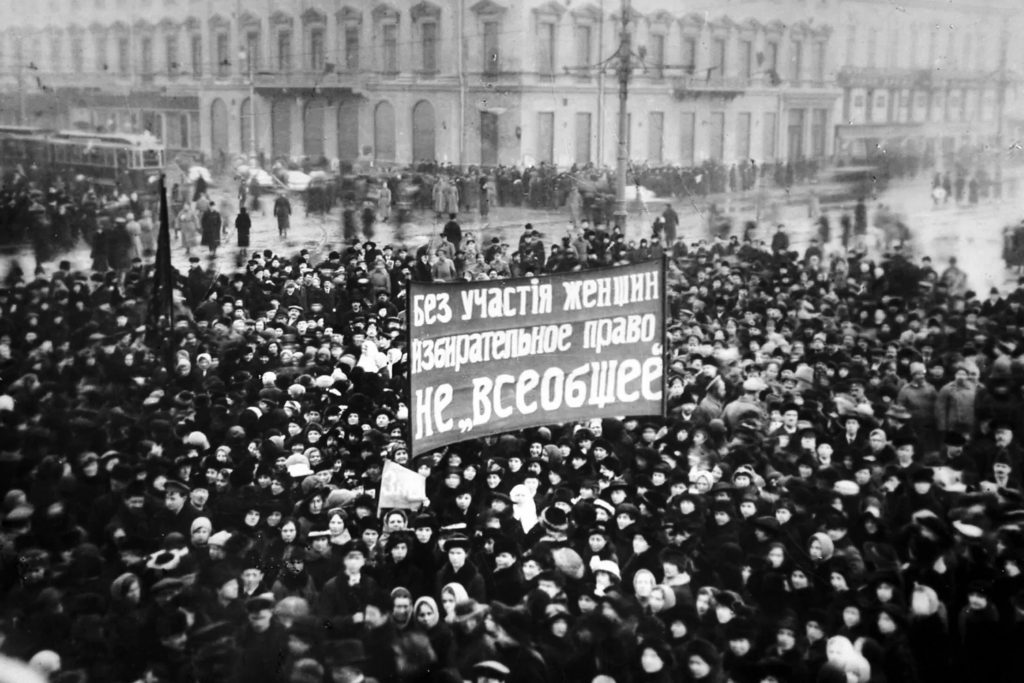
Let’s reflect on some of Trotsky’s key words: “despite orders to the contrary.” One could argue everything women and other minorities have gained throughout history is the result of taking action, “despite orders to the contrary.”
Of course, there have been many gains since then. But the past few years have seen an unraveling of human rights, including women’s rights, on an unprecedented scale. In a world where women are being bombed with impunity (with Canadian weapons) in Palestine, Iran and elsewhere; where Black and racialized women are being kidnapped, tortured, deported and murdered with impunity by ICE squads in the United States; where police killings of minorities including women are on the rise in Canada; where proposed Canadian legislation is setting the stage for ICE-style horror stories as well — we don’t have time to celebrate.
We need fighting movements
Who’s going to fight for women and other marginalized groups in today’s world? If there’s any reflecting to do on International Women’s Day, it ought to be about the state of organizing in our movements. The revolution sparked by the 1917 strike in Petrograd was the result of women workers mobilizing around the issues that concerned them: low pay, poor working conditions, food shortages, their country’s participation in foreign wars. They were forbidden from protesting or marching by the authorities; they were also ordered to stand down by the (male-dominated) political opposition and revolutionary groups they organized with. Women workers met, deliberated, and decided to strike and march anyway. Their militancy took authorities off guard and sparked a literal revolution.
We’d be hard-pressed to find grassroots organizations able to do that today. This is no shade on the important work done by the many community groups that work for women across this province, country and beyond. But there has been a gradual co-opting of many of our community organizations by the state itself, which has rendered it more and more difficult for community organizations to do their job of confronting and challenging the status quo.
Community groups have become heavily reliant on government funding for the work they do and the people they employ. This isn’t a one-way street: governments have been—grudgingly, and stingily—amenable to funding community groups not because it improves peoples’ lives, but because it takes the onus off government to do that hard work (the very work government exists to do). We’ve seen a wholesale downloading of social services onto not-for-profit community agencies. It was never supposed to be this way. Community agencies were supposed to be the ones fighting government to provide better, more equitable services, and organizing community members to expand the fight. But instead of fighting, mobilizing and organizing protests, we’ve seen many community organizations settle back into a pattern of providing peer support, system navigation and other activities which, while helpful in a short-term practical sense, don’t actually change systems.
We’ve seen a wholesale downloading of social services onto not-for-profit community agencies. It was never supposed to be this way.
Is it really possible to talk about peer support in the context of service providers that are government funded, with those groups facilitating the support that is reliant on the very state that perpetuates the oppressive conditions from which community members are seeking respite? And what does it mean for community groups to offer system navigation when those very systems are the problem, and are often designed to keep poor and dispossessed community members marginalized, disempowered and locked into poverty and precarity? That’s not to deny the importance of acquiring food, medicine and shelter from any source one can. But whatever energy our community groups are expending in system navigation support, they ought to be expending even more energy into dismantling those systems.
Membership-based community organizations, which are supposed to be democratic and rooted in community, have increasingly witnessed their governance structures co-opted. Our community organizations are supposed to hold regular open, public general meetings—at the very least an annual general meeting—to provide space for members of the public to set the agenda of those organizations, or even to run for leadership positions. Instead, we see poorly attended AGM’s that focus on audits instead of actions.
In lieu of open community elections, we see slates of pre-determined board members put forward and rubber-stamped by the few people who do bother to show up. Meanwhile, members of the corporate community and those with a vested interest in maintaining the status quo have wound up stacking community boards and getting themselves appointed to leadership positions, further undermining the ability of community organizations and not-for-profits to fight for meaningful, radical change.
All of this has led to a tremendous weakening of our community organizing capacity, not just among women’s organizations but among community groups broadly. I’ve witnessed a dramatic change in a matter of years. When I worked for the student movement in the early 2000s and once called up a local disability rights organization to let them know about a student whose rights were being violated, they had a couple of dozen protesters with bullhorns occupying the university administration’s lobby the very next day. Ten years later, I phoned the same organization with a similar concern, and was informed, by an executive director hired from Ontario with a suite of letters after his name, that the group’s new ‘strategic plan’ and ‘mission, vision, values’ statement no longer ‘aligned’ with direct action advocacy, and there was nothing they could do for the student.
In Everything is Police, Tia Trafford warns about these processes in the context of abolition. Policing, Trafford explains, arose as part of the system of slavery, and was about enforcing white supremacy and control over Black people. Modern policing stays true to its roots: witness the disproportionate targeting of Black people for searches or traffic stops, and the impunity with which police officers murder Black and Indigenous people, even in Canada. But a disturbing recent twist, says Trafford, is the co-optation of community agencies into this process.
Overwhelmingly run by white folks, and reliant on government grants that come with all sorts of strings attached, non-profits have found themselves performing the first line of action in this broader structure of patriarchal white supremacy: offering ‘support’ to marginalized populations—the poor, the unhoused, women and gender minorities—but instead of organizing and encouraging them to fight for better conditions they’re directing them into navigating a system that does not have their best interests at heart. Shouldn’t our overworked, overburdened housing shelters be the ones taking the lead in organizing housing encampments and occupation of empty real estate in our cities? Instead, we see them led by former politicians and retired cops, policing the very unhoused people they’re supposed to serve.
Reclaiming the ‘feminist killjoy’
How do we build fighting community-based movements again? How do we shift from peer support to peer organizing, to strategizing not just how to get by amid all the daily oppressions and microaggressions we experience, but how to transform the structures of government and society so that we no longer experience them? How do we shift from a model that offers support to one that demands transformation and revolution?
Answers to these questions can never be crafted by a single person, which is why community organizations, like the social movements that brought them into being, ought to start dismantling ‘Executive Director’-based structures—where one person is expected to produce impossible results—and back toward collective and grassroots leadership models. Before we can imagine answers, we have to start asking hard questions.
I’d like to close with the words of one of the feminists who inspires me most, Sara Ahmed. I highly recommend all of her work but especially her Feminist Killjoy Handbook. I always feel like a bit of a killjoy reminding folks that occasions like IWD are not about celebrating a handful of privileged women but about fighting for change that helps us all. Feminism itself is rooted in the ‘killjoy’ ethic, and it’s an ethic we ought to reclaim proudly and defiantly. Perhaps that’s the first step toward creating more inclusive, fighting movements.
As Ahmed writes:
When so much violence is passed over, you become a killjoy because of what you do not pass over. You can just try to make something visible – the violence directed toward a Black woman, say – and you will be heard as getting in the way. This is also why feminist killjoys do not disappear when we create feminist spaces. Audre Lorde, bell hooks, Sunera Thobani, and Aileen Moreton-Robinson, among others, have taught me to think about the figure of the angry Black woman, the angry brown woman or woman of color, as well as the angry Indigenous woman. They are feminist killjoys in the sense of killers of feminist joy. To talk about racism within feminism is to get in the way of feminist happiness. I am willing to get in the way of feminist happiness.
Reclaiming the feminist killjoy is about more than taking her name for ourselves. It is also about what we are willing to keep encountering. If questioning an existing arrangement makes people unhappy, we are willing to make people unhappy.
Ahmed reminds us: “Discomfort can be a connection.” It’s how feminism began. So on this IWD, I’d like to honour all the feminist killjoys, especially trans and gender diverse people, sex workers, Black and Indigenous and migrant women and gender minorities, who have no time for celebrating because we have not achieved a liberation worth truly celebrating yet.

Author

Related Articles

It’s time for equity consultants and community organizers to ditch AI
Tools are never neutral, and artificial intelligence has no place in social justice work

External consultant controversy a first test for Wakeham government
After being sworn in as premier Wednesday, Tony Wakeham called right-wing conservative strategist and PC transition team hire Steve Outhouse “one the best political minds in the country”

More police is not the solution
We need to challenge the public safety discourse in the provincial election