
Photos by Tania Heath.
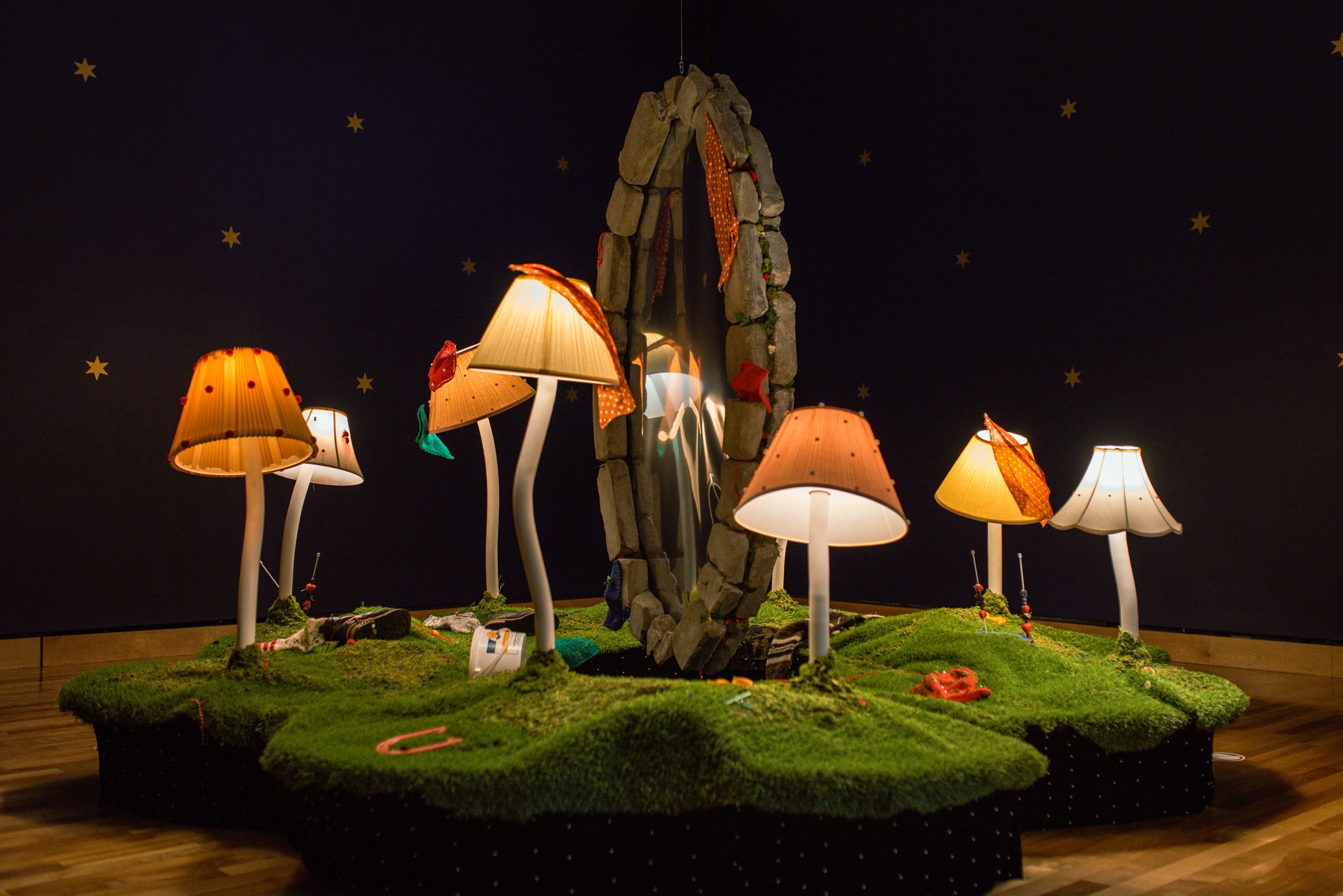
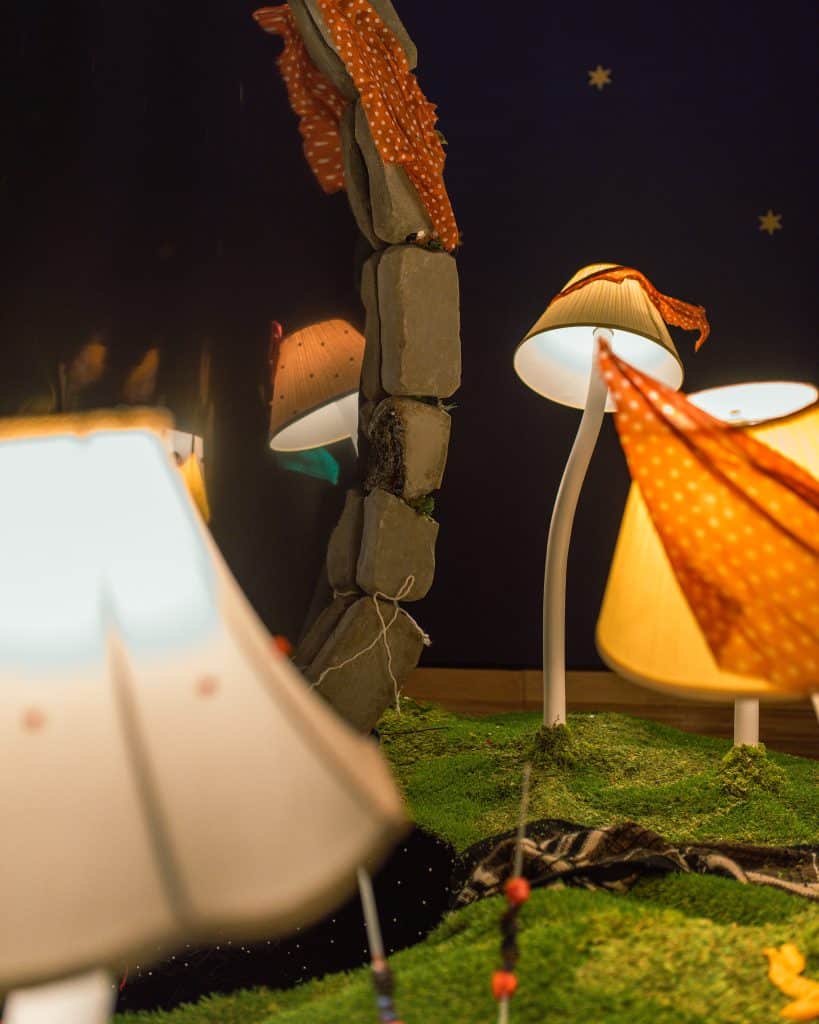
Fairies, queerness, and Newfoundland and Labrador converge in Nicholas Aiden’s powerful work “Otherside,” running until September 4, 2023 at The Rooms in St. John’s. The work—a multimedia installation incorporating light and sound within a stylized fairy ring—weaves together elements of local fairy folklore to create what Aiden calls, “a visual experience of queerness.”
Independent writer Rhea Rollmann and photographer Tania Heath met with Aiden to discuss their innovative exhibit. They talked about how it engages with themes of sexuality and gender identity, Othering, and what it has to say about the experience of queerness past and present in this province.
RHEA ROLLMANN: How did the idea for this project come about?
NICHOLAS AIDEN: Last year I was working through a project called “My Window.” I was exploring my domestic space and what that’s provided me as a sacred magical environment, as a queer person who tends to shy away from the public.
Will you stand with us?
Your support is essential to making journalism like this possible.
When I was making that project I was trying to find different symbols and things pulled from my Newfoundland culture that would speak to queer experience, and one of the things I was really interested in was the fairy ring or the fairy circle. So I actually made a different version of it, but I just wasn’t satisfied with it—I felt it needed to be bigger or more dramatic, and not locked behind the gate of the photograph. I wanted it to be something people could come to and experience and have their own physical relationship with.
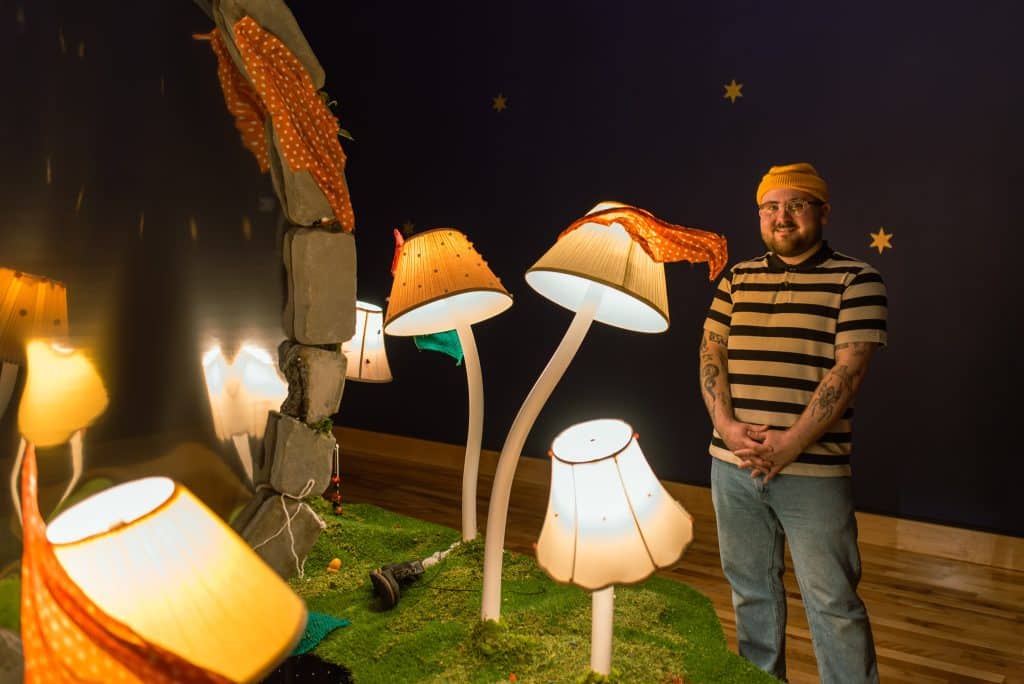
RHEA ROLLMANN: There’s so much in this piece. Can you point out some of the elements that have particular resonance to you, either personally or in terms of queerness?
NICHOLAS AIDEN: Yes, there’s lots of little bits and bobs! They’re either rooted in different written or oral folklore traditions, or from my personal history. Things like buttons and string – it’s said that if you’re hit by a fairy that’s what’s going to pop out of the wound. So I think I subconsciously was focusing a lot on the idea of there being a wound made by a fairy. I’m coming at this from some kind of reconciliation of isolation and trauma, but also the pejorative meaning of ‘fairy’ and having that used as an insult towards me. So that’s where those things came from.
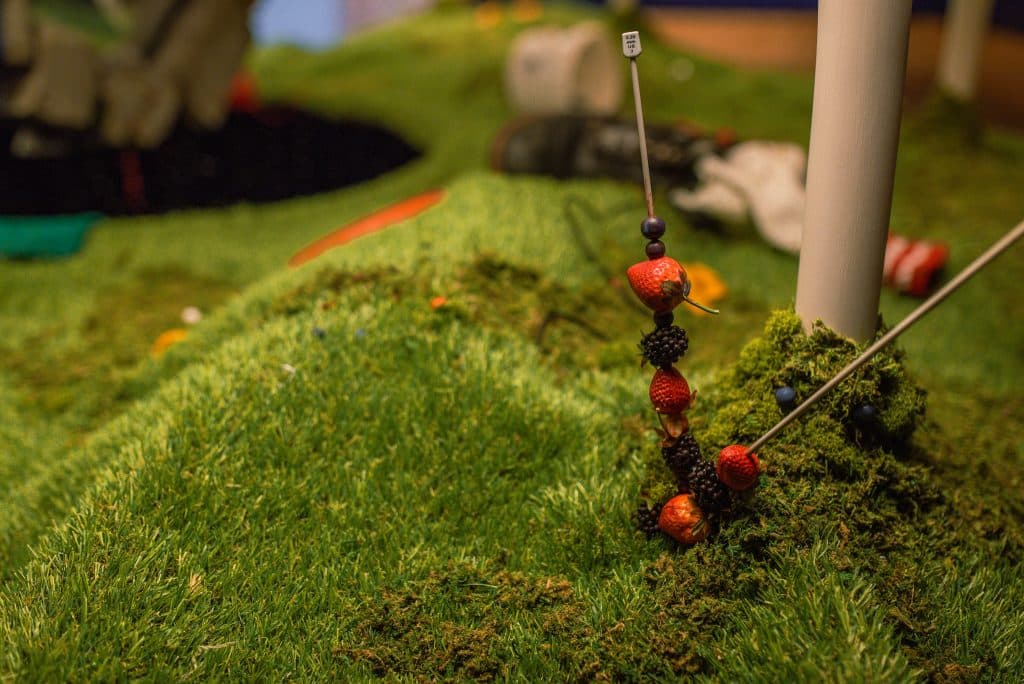
Things like skewers of berries on knitting needles, that was actually plucked from a story that was included in Barbara Rieti’s book Strange Terrain. And then there’s elements of clothing, and those are my clothing. I sacrificed my favourite sweater, and the socks over here were knit by my Aunt Therese.
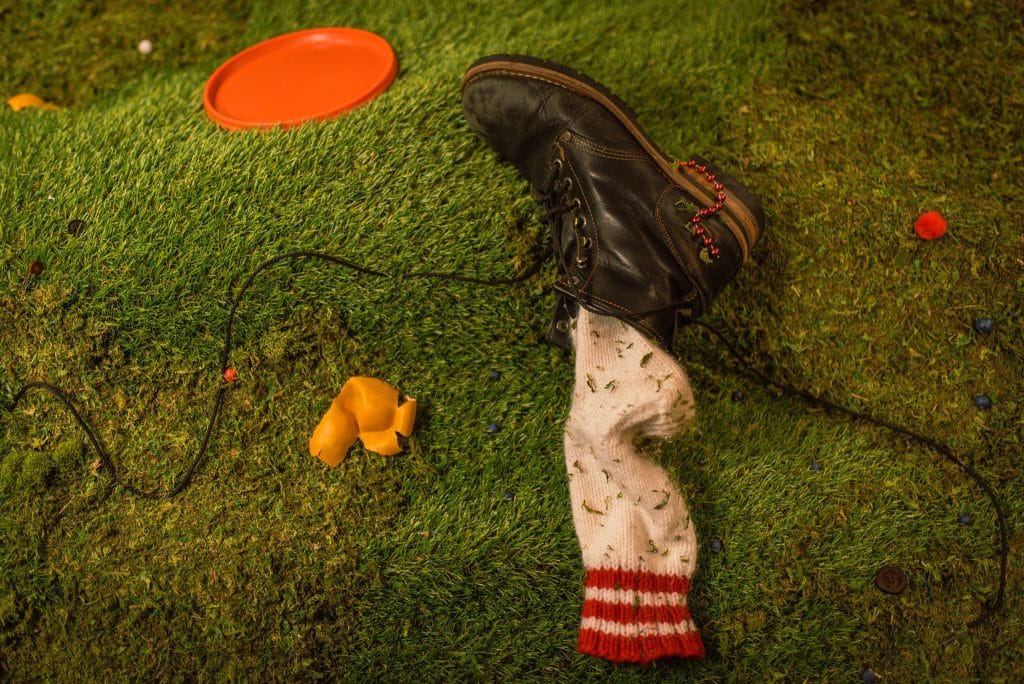
RHEA ROLLMANN: I always think of the fairy ring as a space of transformation, and it spoke to me of my own gender transition. When I saw the discarded clothes I thought of all the clothes I’ve discarded along that path of becoming. That’s one element that really spoke to me.
NICHOLAS AIDEN: The discarded clothing definitely speaks to transformation. We use clothing to become ourselves every single day. And to undo ourselves every single day. I fight with clothing all the time. I’m always reinventing myself.
So to shed it in this shambolic scene, it felt like: do I decide to let go of those protection charms and let myself be seduced into the world of fairy? Is that what this is? There are odd socks – that’s something that’s supposed to protect you from them. The sweater’s inside out – that’s supposed to protect you from them. So it’s kind of like shedding those protection charms, and allowing myself to be seduced into that world.
RHEA ROLLMANN: Growing up queer in Newfoundland I spent a lot of time in the woods, and I thought a lot about fairies. I think in some ways I was looking for fairies, because the idea of the fairy ring, of finding these powerful allies in a place where you feel so alone, is a very attractive notion. I think I went looking for the fairies.
NICHOLAS AIDEN: I grew up in St. John’s, but any kind of escape into nature is all I’m about really. I actually had a very similar experience to what you’re describing. To me, being insulted with the word ‘fairy’ – on the one hand I didn’t like that!
But on the other hand, what the fairy represented was just so interesting and so seductive. Because if there was this other hidden world that was running alongside ours where strangeness and otherness is power, that’s where I want to be. Fairies, vampires – any kind of mystical creature – maybe they’re really here with us, maybe they’re not, but those are my friends. They got me through it. So this is kind of an ode to that.
RHEA ROLLMANN: Fairies are an interesting archetype because, on the one hand, they’re feared, they’re shunned, they’re Othered. But at the same time, they’re valued and respected – they’re strong and powerful. Look at how they’re portrayed in popular culture, as powerful magical warriors. So there’s something special about the idea of this Other that is feared yet also powerful and valued. People leave gifts for the fairies. They have a place in our culture. I think that’s a really interesting archetype for queer identity.
NICHOLAS AIDEN: I think so for sure. A lot of people fear them. Nobody wants to cross them. But at the same time everybody is kind of seduced by them. They want to enjoy them from the sidelines maybe. And that’s something we probably find true in our day to day life in a lot of ways. I always felt a real kinship with that folkloric figure.
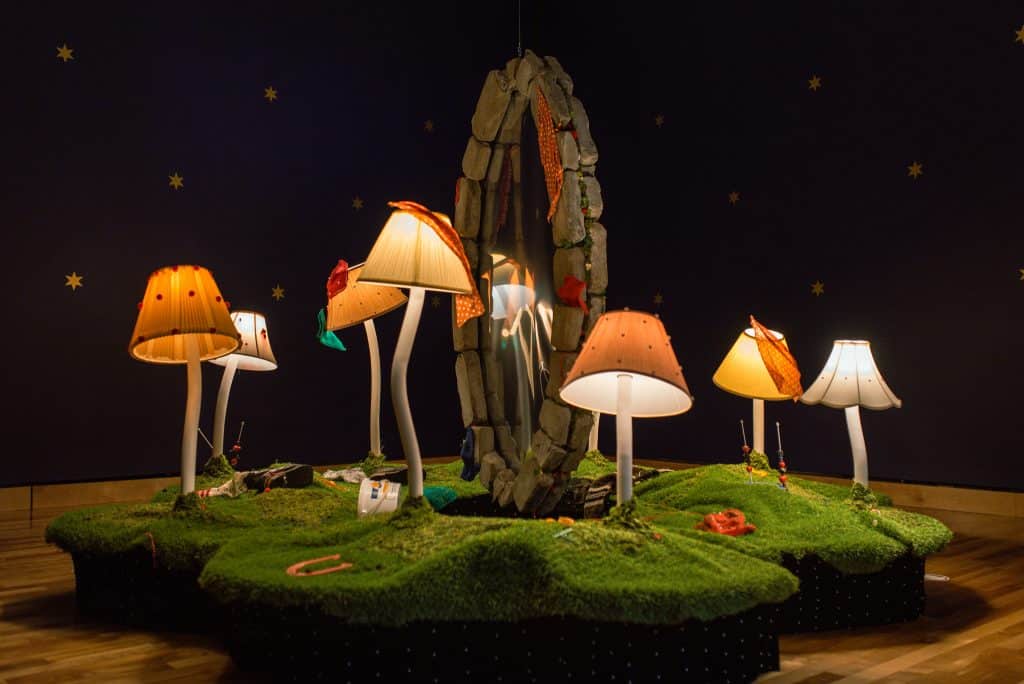
RHEA ROLLMANN: I used to read stories about how people would enter the fairy ring – enter the fairy world – where they are welcomed and have a wonderful time, and then hundreds of years later they re-emerge. It seems to me almost a metaphor for queer family, for chosen family. In those stories, I never understood why the humans wanted to leave the world of fairy and return to the outside world. Why didn’t they stay there?
NICHOLAS AIDEN: Absolutely! I think if I had the opportunity to disappear into that magical world I wouldn’t come back. On one hand, that unseen world is really inviting, but I think for a lot of people it’s really scary.
I’m also interested in the quiet moments between people, where eye contact says a lot more than anything else could. I think as a queer person, there’s moments where we recognize each other – like if someone’s closeted for example and you see them in the grocery store, and our recognition of each other in that space is maybe unwelcome on the part of the other person, and that’s something that really fascinates me.
I’m really interested in the way we organize those social experiences. What is the delineation between an interior space and an exterior space? Whether that’s emotional and physical, or social and natural, or queer and non-queer; I’m really interested in that. I think that this was a way for me to point towards the gate between those two worlds. Because you can catch a glimpse of yourself in this mirror here, and depending where you’re standing there’s three of you. It’s a very subtle effect.
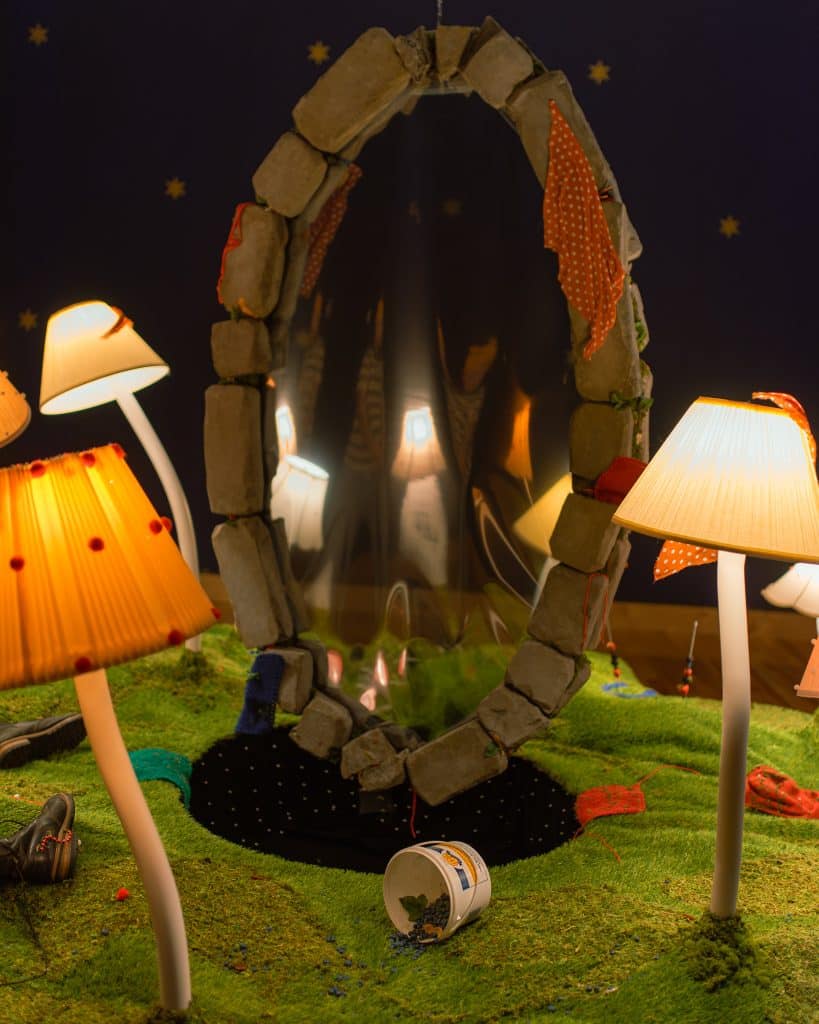
RHEA ROLLMANN: There are multiple versions of you reflected in the mirror.
NICHOLAS AIDEN: Yes! As you move around you can catch yourself in it. I’ve spoken about wanting to create an experience of visual queerness, an experience of queerness. I’ve been making all these self-portraits and trying to talk about my experience as a queer person and share that with everybody. The people that get it, get it, and the people that don’t, don’t. And I’ve been really frustrated with that. Because I don’t want to exclude anybody. Maybe that’s naïve, I don’t know, but I would much rather try and create something that everybody can enter in and have their own relationship with.
So this room and this installation is inescapably queer. When you step in here, you are queered. I’m kind of forcing your hand in certain ways, making you see yourself distorted. That’s what I’ve been doing photographically since I got my first camera.
RHEA ROLLMANN: Questioning how we are seen and how we appear?
NICHOLAS AIDEN: Yes. So hidden in the grass are these red beads. Those red beads are from my Aunt Leslie’s Christmas tree. She passed away when I was in Grade 8, but growing up she lived downstairs. She was like my Mom #2. She was very encouraging of all my creativity but also she took photography lessons when I was in Grade 5. She sometimes would take pictures of me as she was trying to learn. And I’ll never forget how I saw a photo she took of me, and I just didn’t know who that person was! I was like – Who is this? This was me – allegedly – but I didn’t feel connected to that. There was this moment where I couldn’t recognize myself. I think it’s because I hadn’t found myself.
RHEA ROLLMANN: When you took up photography, was that connected to your queerness?
NICHOLAS AIDEN: I think I was trying to reconcile that feeling I just described. I didn’t recognize that person – and I still don’t, because even when I look in a mirror I’m unsure of that, and I’ve changed my appearance in so many different ways over the years. Photography was definitely a way for me to explore other versions of myself.
Usually my face isn’t included in any of my photos, because I found it helped me open up the reading of the body that’s in the image, to a certain degree. It’s kind of impossible when you’re photographing a body to escape body politics, and that’s why I’m moving away from photography, because I’m frustrated with that. But I could always find a new version of myself in a photograph, where the decoration of everything is really guiding the understanding of it.
RHEA ROLLMANN: The mirror in your piece says so much. One of the things that I realized, especially going through my own transition but also more broadly, is just how much of our identity is mediated by the gaze of others. The way other people see you matters. You can’t help but see how others see you. It reflects back on you and impacts how you experience yourself and understand yourself.
NICHOLAS AIDEN: Yes, that is just so true. A couple weeks ago I was complaining to someone that no matter what I do or how I frame myself socially, it’s inescapable. I’m always at the mercy of someone else’s understanding of me. And I think I’m trying to get to a peace with that, and embrace that.
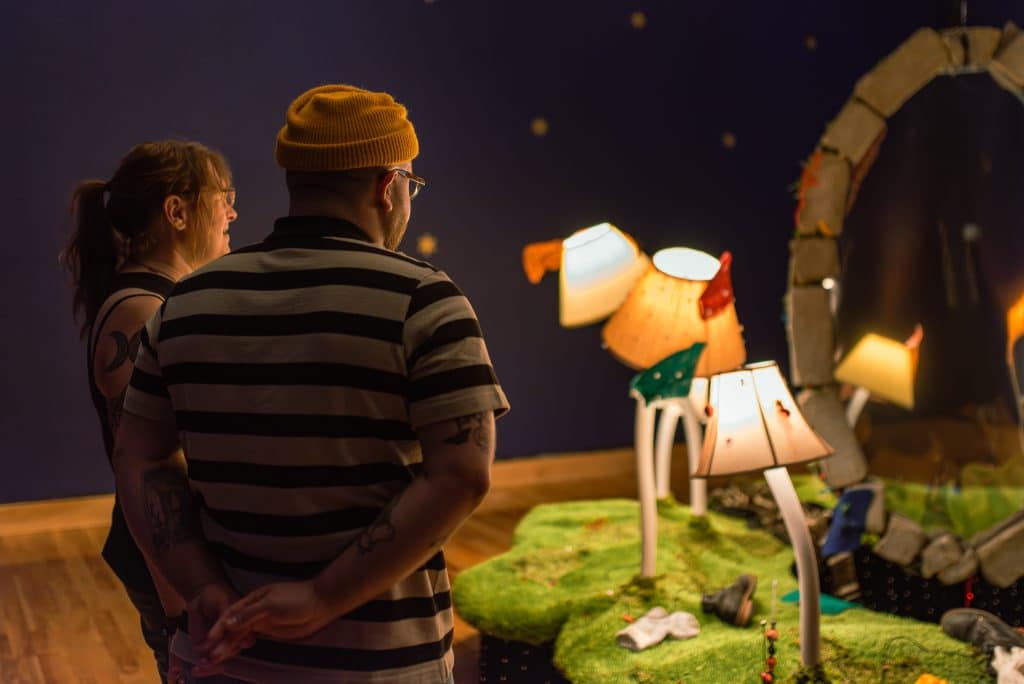
RHEA ROLLMANN: The other thing that occurred to me about the mirror is that it distorts not only the way we see ourselves, but it also distorts how we see the world around us. It unsettles and disrupts everything – not just us, but the background, the world around us too. And this really underscores the fact that the way we understand our social reality, the way we understand what is normal – all of this is socially constructed, and can be completely disrupted by simply looking at it in a different way, or through a different lens.
The disruptive quality of this distorting mirror reminds us that the social world with all of its norms is nothing more than an invented fiction, subject to being seen differently and reinterpreted depending on the gaze of the viewer.
I’ve interviewed a lot of queer folks who grew up in small communities here in NL where they were taught: this is the way things are, this is how it’s always been, here’s how you live your life, here’s all the things you do. For them to deviate outside of that could provoke serious Othering, violent Othering sometimes. Your mirror helps remind us that all of those norms were just constructions. It disrupts our understanding of the ‘normal’ in a way that a lot of queer people in Newfoundland didn’t have growing up.
NICHOLAS AIDEN: Absolutely. We’re all the mercy of the environment we’re immersed in. We can try our best to try to find the right place to be, and to shape the society that we’re in, to try and make positive change and to make people feel better understood, but we’re at the mercy of a lot of things.
Getting back to the figure of the fairy, I think its ultimate purpose was to explain things that people didn’t understand. If a person was different, and they didn’t really understand why, people said they were ‘fairy-led.’ It was a convenient thing that glossed over a lot of different aspects of people’s personalities, and the way we moved socially.
It seems like the fairy was just a way for people to put up a bit of a barrier between each other. It’s like – we can accept you to a degree, but here’s this convenient explanation for everybody else. It’s a little supernatural, it’s a little magical. That function of fairy stories and the figure of the fairy was really interesting to me.

RHEA ROLLMANN: You spoke about reclaiming the word fairies. I think reclaiming is a very Newfoundland thing. It seems that Newfoundland is in a constant process of reclaiming. People talk endlessly about reclaiming identity, culture, heritage, political autonomy. But then there are also darker sides to this past that some people look to nostalgically – there was all of the violence, the homophobia, violent Othering and divisions based on differing identities. How does your work engage with this complexity?
NICHOLAS AIDEN: I’m stuck in this endless cycle of trying to unearth myself. I’m trying to find connection to the people and the place and the society that raised and shaped me. So I’m in a constant dialogue with myself just trying to understand who am I, why am I here, and what can I do for other people?
For a while I thought my practice was very selfish, because it’s all self-portraiture. But I realized a bit later that what I was really trying to do is that I’m trying to create a moment where someone can feel safe or seen or understood. I had a few people at the opening come up to tell me that they felt really safe in this room. And that made me cry.
TANIA HEATH: I’ve been on the verge of tears the entire time. This is a safe space. I feel like I could cry in this space. As a photographer, as a person who just came out four years ago—and having started photography before I came out—when I consider the journey I’ve been on with myself and my photography work since then, I can see bits and pieces of your story woven into my story.
NICHOLAS AIDEN: I think I’ve struggled with the idea that I need to be unapologetically here, and be honest in my work and make something that’s true to who I am. I really don’t hold back with my artwork – it’s maybe the only realm where I don’t. As I was installing this they tried to have that [homophobic] protest at Confederation Building. That happened as I was installing this. And I had this moment where I realized: Right, it’s not over, we still have to be here, we still have to be very loud, very proud, and I need to just try and be as brave and as open as the people that came before me. I owe it to them. I owe it to the community to just be here and be seen. It felt really good to have that realization. I realized – you know what? I’m not just here for myself.
TANIA HEATH: I think by being aware of that, and by doing that, you are also opening up the door for so many other queer people who are creative to realize – yes, we are here and we do amazing work and we are amazing people, and we deserve this, and we can do this too.
NICHOLAS AIDEN: It’s so important. I’m glad that I can be here for other people because, I don’t know about you guys but, for me it’s always been a struggle to be here.
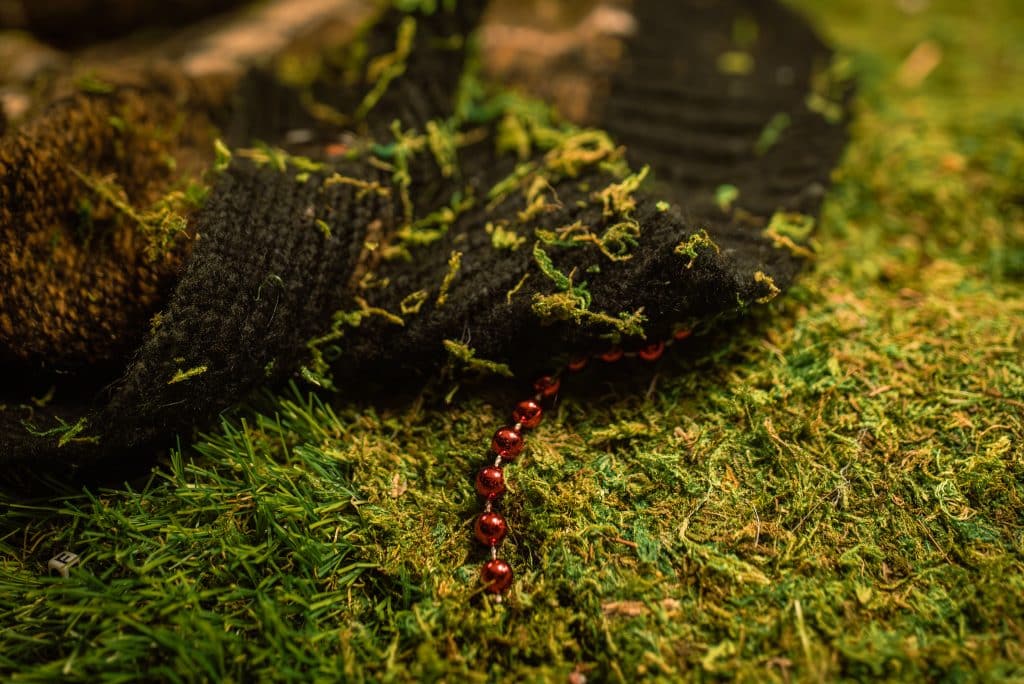
RHEA ROLLMANN: I think that’s so true though. Especially as queer Newfoundlanders, we’ve struggled not only to tell ourselves into stories in the present, but also to tell ourselves into mythologies, into the stories of the past and it’s powerful to see you doing that. The power of storytelling I think for us as queer people is really important. The way we situate ourselves in stories, the stories we tell about ourselves, and the fact that we’re always constantly doing that, drawing on elements from the past or creating new ones.
Considering where we are today, I’m wondering how this piece speaks to the present. We are in this very fraught moment where, as you point out, there is this backlash against the civil rights gains of all marginalized peoples. How does your work speak to the present challenge and where we are today?
NICHOLAS AIDEN: I want people to see each other. I want to see people see each other, and I want to see myself in other people. And I want to have other people see myself in them. That’s what this mirror is about. You can try and find yourself within it. It’s a space I’ve made, it’s really a self-portrait in a sense with all of the objects that are important to me and the clothing and the time that I spent to make this.
I made this whole thing by myself. I’ve never really done anything like this, and I learned a lot about myself in doing it. I think if people just took the time to slow down and reflect on what you’re doing to get by, and what everyone else is doing to get by, maybe it would just be easier. I want people to see themselves in everything. And everything in themselves.
RHEA ROLLMANN: I think that’s a beautiful message. If everyone did, the world would be such a better place.
NICHOLAS AIDEN: Right? Everybody’s doing their own thing and trying to get by. This is also meant to be a moment of fun, and whimsy. I’m trying to make something more fun out of something that might be a bit scary. I’m trying to make queerness a bit more inviting to people who aren’t [queer]. I don’t want to chastise people, or say ‘Listen to my story.’ I just want to make work that is more akin to an embrace. I made this with my experience and my visual vocabulary and everyone gets to come to it with theirs. So no matter what, there’s a form of intimacy between myself, the work, and the viewer.
TANIA HEATH: How have you found the transition from photography to work like this?
NICHOLAS AIDEN: It just felt right. I was struggling with the frame of the photograph and it being limiting, at least in my experience. I think other people can fall into a photograph very easily. I can’t. I’m just trying to open it all up, and I’ve always been sewing something or embellishing something for the photograph. So now it just feels like a more holistic way for people to engage with it.
TANIA HEATH: I love the fact that this entire piece is a self-portrait. It really underscores that a self-portrait doesn’t have to just be me and my camera and my image in the frame.
NICHOLAS AIDEN: Lately I’ve been asking myself: what even is a body? I think this is a body. It has an entry point and an exit point and everything in between. I’m always asking myself: What is a self-portrait? What makes it a self-portrait? Is it my physical presence? Or is it what I’ve imbued into it? What is the body? I don’t know!
RHEA ROLLMANN: That’s a question I’ve wrestled with. What is the body, especially when the body changes and you change, when you transition or transform. How does all this speak to what bodies are?
NICHOLAS AIDEN: When I was younger, everybody thought I was a girl. And then all of the sudden my body became very masculine and I really rejected that. And I did everything in my power to not have a very masculine body and a very masculine look. Now I’ve come around and I don’t really fight against it, but constantly I’m wondering: what is my body and what is it doing to me? It’s such a big heavy topic. It’s exhausting.
RHEA ROLLMANN: Especially added to the fact that other people’s gaze is superimposed on your own sense of self. It adds a whole other layer to how you deal with your identity.
TANIA HEATH: The struggle is real, for sure. But it is one we engage with through art, and through whatever other tools we have at hand.
NICHOLAS AIDEN: I think it’s the best way I can, honestly. At least at this point in my life.
Authors

Related Articles
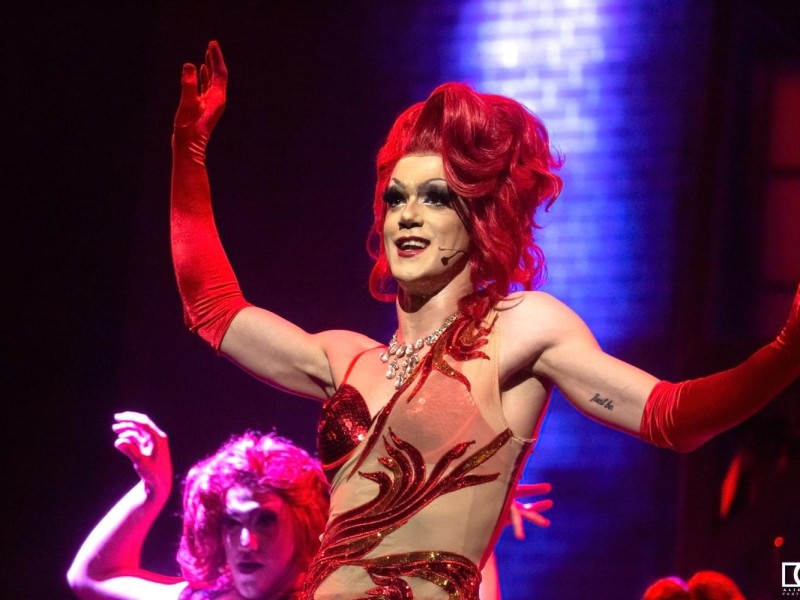
‘Honest storytelling’: N.L. drag icon set to unveil new show
Barbra Bardot brings her personal journey to the public stage in new St. John’s production ‘Becoming Barbra’
Queerness, science, and the Mistaken Point fossils of Newfoundland
Art meets science in a unique Eastern Edge residency

‘Our strength is in community’: the creative life of Beverly and Elizabeth Glenn-Copeland enters a new era
Acclaimed musician/writer couple Beverly and Elizabeth Glenn-Copeland share reflections on their love story and history together, on visiting Newfoundland, and on fighting hatred with courage and song