

Stay Here Stay How Stay is Daze Jefferies’ first solo show at The Rooms. A multidisciplinary exhibition of complexity and depth, its layers of meaning wash over the visitor in waves, revealing ever more profound ideas with each reflexive ebb and flow. The mediums are myriad: sculptures in textile and wax, woodcuts, sound, visual projections, illustrations, poetry, and more. The visitor effectively floats through the gallery, drifting through richly imagined waters populated by schools of ideas: about outmigration, colonialism, intergenerational connections, loss and healing and change.
Matrilineal relationships with trans women and sex worker foremothers are at the heart of the exhibit, she tells The Independent. Some of Jefferies’ earliest encounters with trans and sex work histories were as an academic. Her Master’s thesis explored the historical lives of trans women in the province, and she’s worked on a number of other similar historical projects.
But working with archives – a site of pain and tragedy as much as history – as a grad student took its toll on Jefferies, the effects compounded by the death of a partner during that same period. She recalls the time as one of grief, which also underscored for her the limitations of archives. Because they only provide a partial glimpse at the past from the vantage point of the powerful, archives omit the experiences and perspectives of others – trans women and sex workers in particular.
“I came to a point where I realized the research couldn’t hold space for what I needed,” she says. “And so from that point on, art became my main method of responding to archives.”
Will you stand with us?
Your support is essential to making journalism like this possible.
She discovered an unexpected resonance between artistic craft and archival research. Sculpture was one of the mediums she explored. sea whore depicts a mermaid – a beautiful, transformative hybrid creature central to a lot of trans and sex worker lore, and a figure that also recurs throughout Newfoundland and Labrador’s sea-based historical iconography.

“There was a lot of healing involved in that piece,” she reflects.
Research – like sculpture, and other forms of art-making – are embodied processes. This is a key point for Jefferies. “Those of us who have worked in archives know – those experiences are felt in the body,” she explains. Reading stories about death and violence, perusing court records and police reports, encountering years and decades’ worth of concentrated pain, produces a visceral response in the body of the researcher.
Art-making elicits such reactions as well.
“It’s been an exercise to let go of some of the archival research that was quite damaging in some ways. To sit in that process and massage things while also reflecting on the research process, became a big part of the work. So the tactility and the release through sculpture brought a lot of healing,” she says. Poetry has also been therapeutic for her, she adds, but the artwork engaged her body in a way that allowed her to make the connection between the research and letting it go.
The decision to shape sea whore out of wax, a very changeable material, is also meaningful for Jefferies. To work with wax is itself an archival gesture, she observes. “Every time I touch the mermaid sculpture, salt and wax flakes off. The future of her lifespan is one of change, and one of care and carefulness.”
The material and how it is handled is an invitation to consider that change is necessary. “It’s not always loss – there’s something communicated through that breaking off and that fragmenting as well, which goes back to the challenge of working with archival fragments, but also acknowledging them as being enough for now. That kind of gentle relationship and that kind of softness and relationship built on touch and also trust has figured into this work.”
What do fabrics challenge?
Jefferies originally hails from New World Island, in Bay of Exploits. There is a beach at the end of the road she grew up on. It was known colloquially as Sea Glass Beach for the glass that washes ashore there. But the waters bring much more besides.
“There’s everything you could imagine, fabrics included,” explains Jefferies. “Some of those fabrics are just brought in with the tide, some of them would have been under the sand and they’ve been there for a while. With the coming and going of the landwash you’ll see this little thread sticking up, and I always have that curiosity to retrieve fabrics when I stumble upon them.”
Several of the found fabrics featured in the show were discovered there. A pair of stockings hold special significance for her.
“They were tangled in this mess of different fabrics that were knotted together in fishing line and coated in rocks and rust and rusted parts of nails and stuff. It was this brutal thing, in the form that it had taken on the beach.”
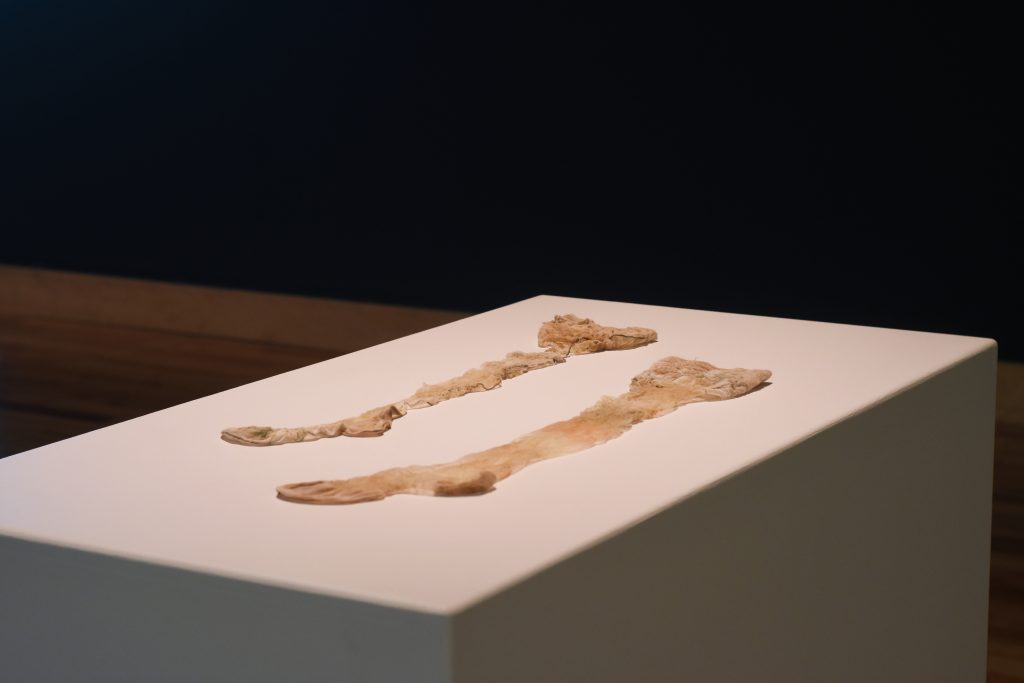
She recovered this brutal monstrosity, and proceeded to unravel it, picking apart the rocks and sand and mud to see what might be revealed.
“Sitting in the unraveling process really blew my mind because I wasn’t expecting to find something that I considered to be so beautiful in this dirty, messy wad of fabric.”
This, too, is a form of archival work. It bears a close kinship to the effort of digging through distorted historical records in search of the glimmers of stories and truths. A historian roots through dusty, grimy boxes of papers untouched for decades, struggling to discern the stories buried beneath smudged ink, frayed paper, and anachronistic vernaculars. In a similar fashion, Jefferies sits on a beach digging through sand and mud, brushing the detritus off of lived materials from times gone by. Both are trying to listen to the lived experiences that whisper through silences imposed by time and taboo.
“This work and relationship with the ocean has taught me an archival method,” she reflects. “The fabric opens up that different layer of thinking about how an object survives so much change, how it’s preserved and unmade. Because for some reason all these fabrics on the beaches have survived so much watery travel and they still have a lot of durability.
“This work for me has been about thinking beyond archives, thinking about all the different factors that shape how stories are told or how stories emerge – how we follow certain fragments toward a larger story.” Of the stockings, she says, they are one of the more special objects she encountered in this work. “They opened up this way of really sitting with softness and love when trying to approach sex worker histories, and the representations thereof.”
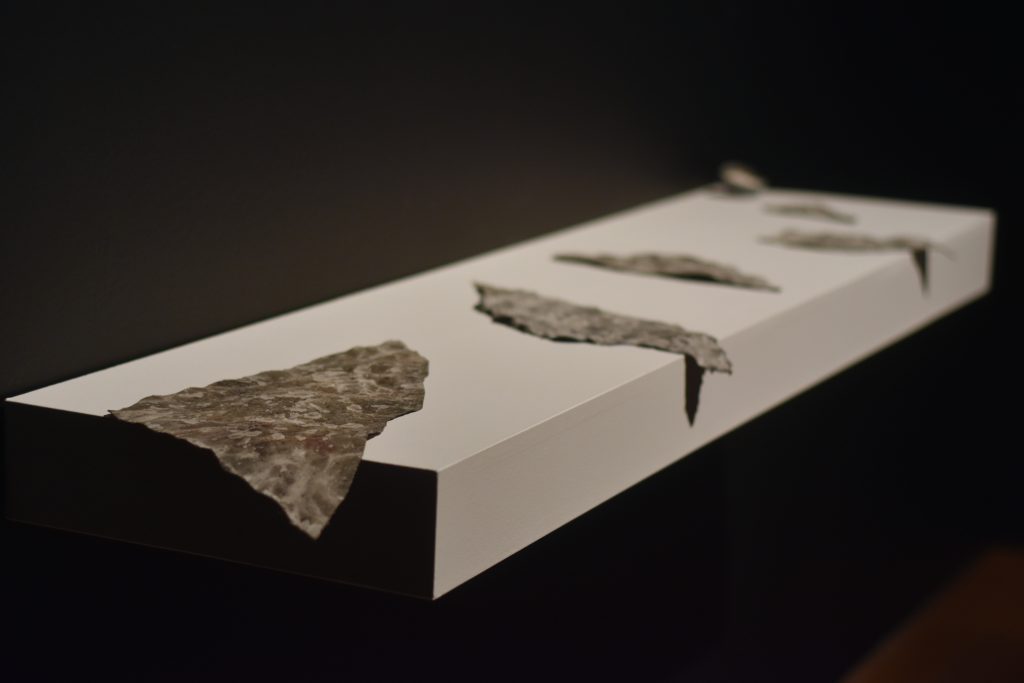
Fabrics hold another layer of meaning, too. Textile production has historically been a gendered practice, one whose practice connects Jefferies to her own matrilineal foremothers. But she observes a neglected history of resistance in the stubborn survival of fabrics against the elements.
Fabrics are often perceived as soft, especially juxtaposed against the hardness of sculptures. Sculpture–historically a masculine practice – is a medium intended to weather the elements. Here, through the tenacity of fabrics emerging from the sand at this beach at the end of the road, Jefferies reveals their hidden strength, and their unacknowledged capacity for survival.
“Fabric to me is a kind of skin. It relates to embodiment, it relates to touch, it relates to softness, and so this experience of encountering fabrics on the beaches that have survived all these forces against their will really strengthened those links for me.”
Finding our foremothers
Jefferies’ grandmother is a textile artist as well; she helped to inspire and shape Jefferies’ own interest in the craft.
Now, living with dementia, her grandmother no longer makes art, and many of her works were lost when she was moved into a care home following the death of her husband.
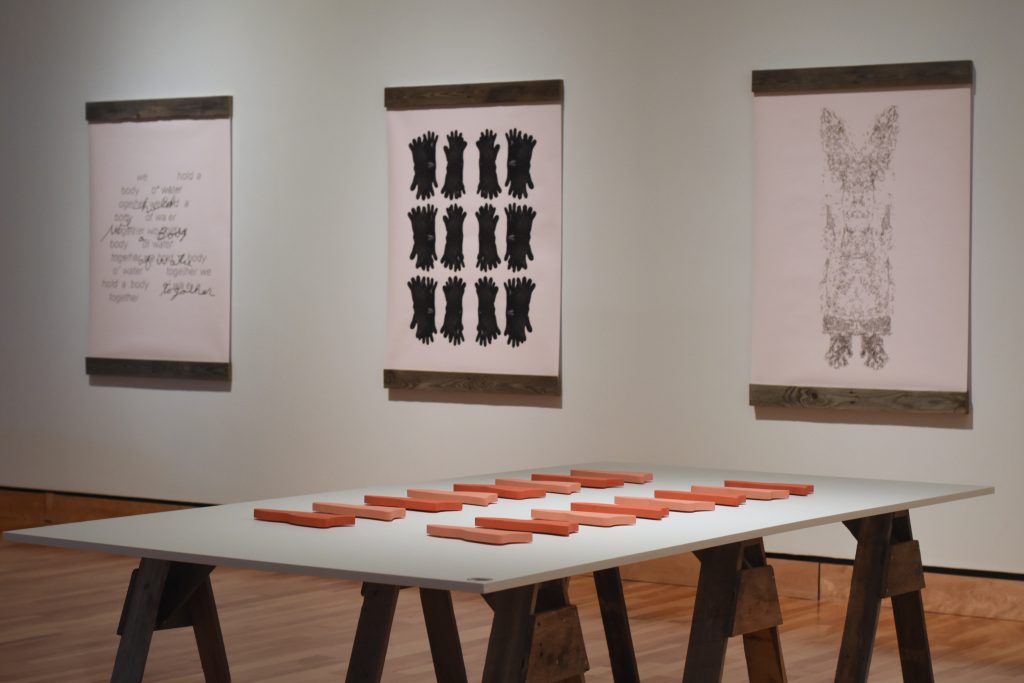
In the face of this change and loss, Jefferies struggled with how she might continue to collaborate with her. She got her grandmother to write some words, including the alphabet, which Jefferies then converted into a script using Adobe Illustrator. The script itself becomes a form of visual art in the show, engaging with Jefferies’ own poetry.
“For me the show is about matrilineal relationships with trans women and sex worker foremothers,” she emphasizes. “And matrilineal relationships from my blood family, and how they meet.”
There are a multitude of scripts speaking to the visitor in this exhibition; some of them meet on the plinth–the pedestal that supports the work–figuratively buried beneath the stockings.
Inscribed on the plinth is the custom Adobe Illustrator script she crafted out of a sans serif font. “It became this eroded one-of-a-kind, edited script,” she explains.
The bespoke handwritten aesthetic is purposeful. “I was thinking about language, and how it changes, how it’s inherited, how it’s withheld,” Jefferies continues. “I was thinking about the experience of holding archival materials in your hand and some of that being illegible, or having to piece things together on your own. Or sitting with cursive handwriting and having to really think about what you’re reading, and not always getting it right.”

Standing by the plinth and gazing around the exhibit, the visitor experiences a blurring of boundaries; of script and art, word and image. The spatially distorted word poetry on the plinth is juxtaposed with less legibly scrawled letters and words; an erosion of form and transformation of function.
As letters break down into lines, the line illustrations on the adjoining wall assume new meanings. Are they – were they – words? Or art? Is there, in fact, a distinction? Does the erosion of language render it a more pure form of art, or is art merely a nascent language of its own, a vernacular in which we read our own meanings?
Imagination is a political force
Poetry, visual art, and archival work all intersect in this space. Together they force reflections on the partial nature of any language, and on our differential abilities to access what is being said. None of these forms offer definitive truths.
What they do offer are opportunities for engagement that require the individual to decipher or decode a story for themselves; to find their own meanings in the work. That includes historical archives. Jefferies draws on theorists like Saidiya Hartman and Sonja Boon, who emphasize that archives and the records they contain are not the places of truth they are often imagined to be.
“Archives are the places that you go to put your own story together,” Jefferies says, paraphrasing something Boon once told her. “Archives aren’t going to offer you concise stories, you have to put them together on your own.”
In this process, imagination – poetic, visual, historical – becomes a key component; it’s the adhesive that holds together the stories we tell.
“Imagination is a political force,” Jefferies says. She resists the temptation to tell individual stories, which might expose contemporary sex workers to violence, or put false words in the mouths of those in the past. Instead she works to bring into being a story of the broader context in which they lived and struggled, and continue to do so.
“We are forced to imagine what liberation looks like – past, present and future – as an act of resistance against political structures, against the things that have been done to us, against the ways that we have been subject to oppression and we have in many ways survived it.”
Imagination is a reaction to oppressive conditions, but it is also a vital resource in surviving them. “For me, imagination has been a healing presence in the archival research process. Imagination is a necessary tool for doing queer art practice specifically, for using art as a way to say unsayable things.”

Where those unsayable things end up, and who gets to witness them is something Jefferies takes seriously. “It is a political action for me as a trans woman, as a sex worker, to resist historical narratives, to activate them, to attempt to hold them in an institution like the Rooms. It’s a responsibility that I’ve not taken lightly, and that I have thought really deeply about – who does the work serve?”
To that point, Jefferies wonders, “What would it mean for young trans girls to imagine that their stories matter? What would it mean for young trans girls to imagine that they are powerful and beautiful, and that their lives can be so much more than what the colonial histories hold?”
Stay Here Stay How Stay doesn’t provide tidy answers. “It’s a kind of refusal. Refusing the archives and desiring more. Desiring more life, and daring to create more life against this cultural discourse is a survival practice,” she says. But it’s just as much an affirmational practice, “it’s also a way of saying: ‘I won’t take this any more. We need something better. We need something softer.’ This show has been my way of trying to work towards what that might be.”
Daze Jefferies’ solo exhibit Stay Here Stay How Stay, curated by Emily Critch, is on display at The Rooms until April 7, 2024.

Author
Related Articles
‘Honest storytelling’: N.L. drag icon set to unveil new show
Barbra Bardot brings her personal journey to the public stage in new St. John’s production ‘Becoming Barbra’
Queerness, science, and the Mistaken Point fossils of Newfoundland
Art meets science in a unique Eastern Edge residency

‘Our strength is in community’: the creative life of Beverly and Elizabeth Glenn-Copeland enters a new era
Acclaimed musician/writer couple Beverly and Elizabeth Glenn-Copeland share reflections on their love story and history together, on visiting Newfoundland, and on fighting hatred with courage and song