


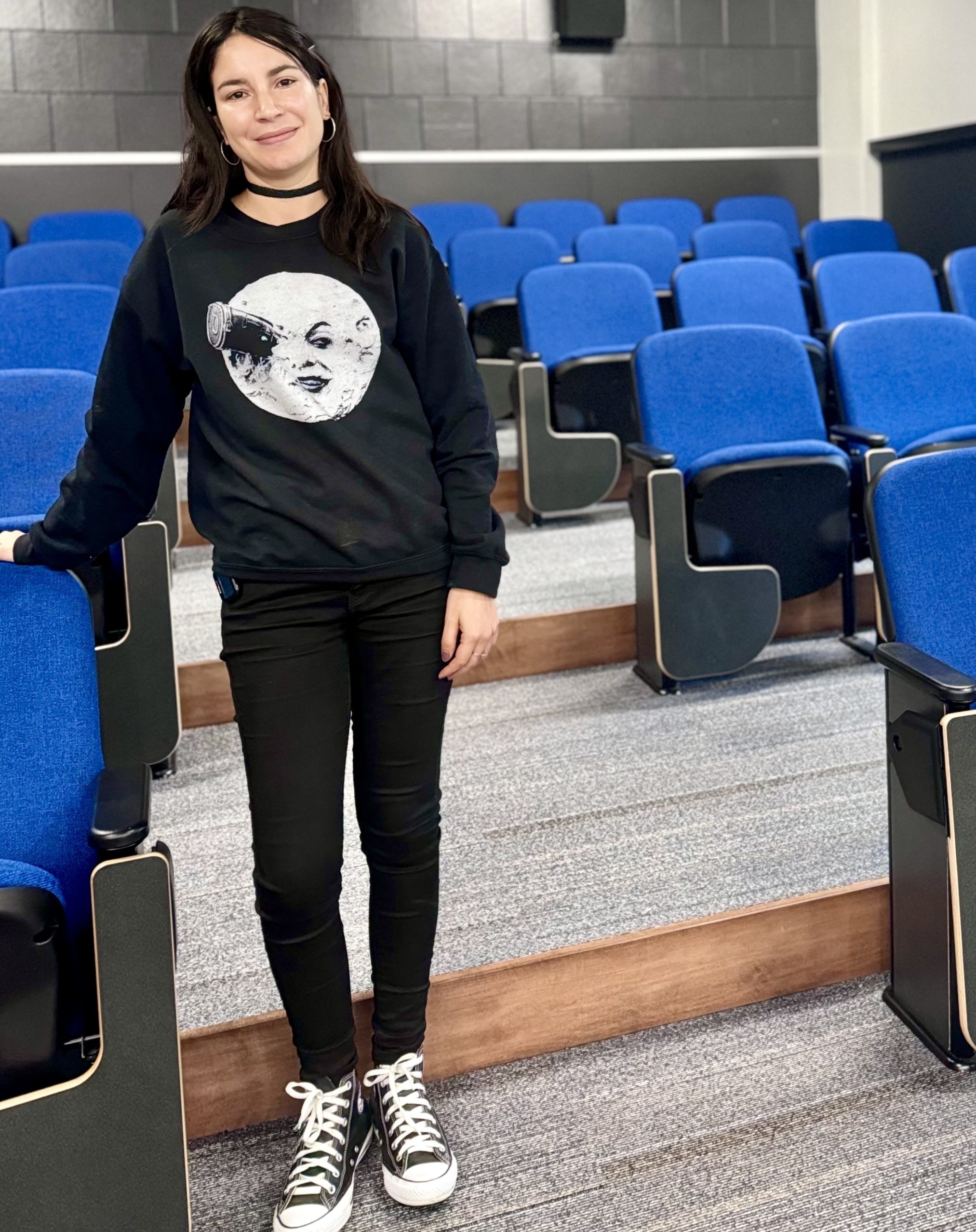
It’s a damp, overcast October morning in St. John’s when I meet Tamara Segura, a Cuban Newfoundlander and award-winning filmmaker. We are meeting to talk about Seguridad, her recent documentary about her late father. The film is a personal essay, an attempt to get to know the man from whom she was estranged, through the traces and memories he left behind. It’s been traveling the festival circuit for months, but the Oct. 25 premiere at the St. John’s International Film Festival holds special significance. “I am very grateful that I ended up here,” she tells me. By “here,” she means the island. Segura’s incredibly thankful for the support she’s received from the local industry over the years.
‘A community feeling’
Originally from Holguin, a city on the northeast coast of Cuba, Segura came to Canada in 2010 after accepting a fellowship at Concordia University in Montreal. Two years in, she was offered a screenwriting job in St. John’s. She didn’t know much about Newfoundland and Labrador at the time, but she knew she needed paid work. She sublet her apartment and headed east for what she assumed would be a short stint. At this point, she’s been here on and off for 14 years.
It was late spring when she first arrived, and before long Segura realized the project she was hired for wasn’t going anywhere. But she couldn’t go back to Montreal yet; someone else was living in her apartment. She planned to wait it out but then was renovicted from her Montreal apartment. Without a home to return to, or any work lined-up, it didn’t make sense to go back to Quebec.
Will you stand with us?
Your support is essential to making journalism like this possible.
“I kind of got stranded here,” she says. Segura had no money, no job, and she didn’t speak English; she’d been speaking French in Montreal.
Thankfully, she got hired at a Needs Convenience store in Mount Pearl. “That’s where I learned to speak English,” she laughs.
Segura was starting to think her filmmaking days were over. But all that changed in the fall of 2012 when she attended the St. John’s International Women’s Film Festival.
“There are interesting film festivals everywhere,” Segura says, “but this one has a community feeling that makes it really special, where you actually find people that will help you, that will support you.” At other festivals it can be hard to connect. Here, she says, “it’s just people like you, making films, and they are going to give you a hand.”
Segura had heard about the festival when she’d first arrived in the province; she signed up for its email newsletter. As festival season approached, she saw an industry pitch session on the schedule. She attended, and that’s when Segura met veteran film producer Annette Clarke. At the time, Clarke was leading the National Film Board’s Quebec and Atlantic studio.
“I don’t know what she saw in me. Desperation?” Segura laughs. “But she really offered me support.”
What’s more likely is that Clarke saw an accomplished filmmaker eager to keep working and developing her craft. Segura has been making films since the age of 17 thanks, in part, to the training opportunities available in Cuba, where education is free.
Fidel Castro’s government opened the country’s inaugural film school in 1959; film was one of the first industries to be established after the Cuban Revolution. Prior to that, the industry was small, and largely dominated by American studios like MGM. Segura graduated from the country’s other prominent institution, the International Film School of San Antonio de los Baños, which was founded in 1986.
Meeting Clarke and receiving a warm welcome into the industry was a huge relief for Segura. “I thought that I would never make films,” she says. “I thought, ‘I’m gonna stay here and just, you know, work at Needs my whole life.’”
That same year, Segura applied for the RBC Michelle Jackson Emerging Filmmaker Award. The following year, she won it. St. John’s filmmaker Ruth Lawrence helped her produce the resulting film, Before the War, about a father returning to his family after a military tour.
“I wasn’t even a resident yet, so it was like, ‘Oh my God, I’m definitely staying in Newfoundland,’” she says. “It felt like the right thing to do.”
Segura has made many other films since that time. Seguridad is her third project with the National Film Board of Canada (NFB).
The second project was the documentary feature Becoming Labrador which she co-directed with Rohan Fernando and Justin Simms in 2018. It explores the Filipino community in Happy Valley-Goose Bay, and focuses on some of their experiences settling into life in Labrador.
The 2014 short film Song for Cuba was the first one she made with the NFB, with Clarke as producer. Segura also stars in it. It’s about a Cuban couple trying to forge new lives in Newfoundland, all the while haunted by the ghosts of their former lives. The music and movement inside their little apartment holds their joy and grief, their love and longing, and glows on an otherwise dark winter’s night.
‘Shadows and bright moments’
Segura is drawn to coexisting dualities; especially darkness and light, which she references throughout our conversation. Growing up, she saw them in her own family dynamics which were painful and loving at the same time. There were “a lot of shadows and bright moments,” she remarks, and “that is a big part of my work.”
She returns frequently to relationships, especially the ones we are born into. “I’ve always been telling stories about families,” she remarks, and “I think I’ll be always coming back to those family dynamics. That’s where I feel the most informed and inspired.” Stories about parents and children, specifically, call her over and over again.
Segura’s filmmaking is personal. She can’t really separate it from who she is, she says. It’s how she processes her lived experience. “I always joke that if you watch all of my films in a row, you can just see the timeline of whatever crisis I’ve been having,” she remarks.
She honed her self-referential style and explored new modes of visual experimentation while completing her Master of Fine Arts in Film Production at York University in 2021. She has elsewhere described her thesis film, Father Figures, as Seguridad’s “little brother” because of their similarities in theme, storytelling, and style. She credits her mentors at York, Phil Hoffman, Manfred Becker, and John Greyson, for inspiring both films. Making her thesis film remotely during the COVID pandemic also played a part. “I was working with archive footage because we couldn’t go and shoot anything,” she says.
It showed her just how much she could do with archival materials and found footage. It also gave her more time and space to think, process, and prepare to make Seguridad.
She already knew the story she was going to tell. She had a sense of the material she was going to use from personal and national archives; the rest would evolve out of interviews with her mother Claribel, her paternal grandmother Yolanda, her cousin Gaspar, her sister Mayte—from her father’s second marriage—and her father’s childhood friend, Jesus.
Exactly how those conversations would unfold, however, was a mystery. Segura didn’t know what they would say, or how much they would be willing to share about their memories and experiences of her father.
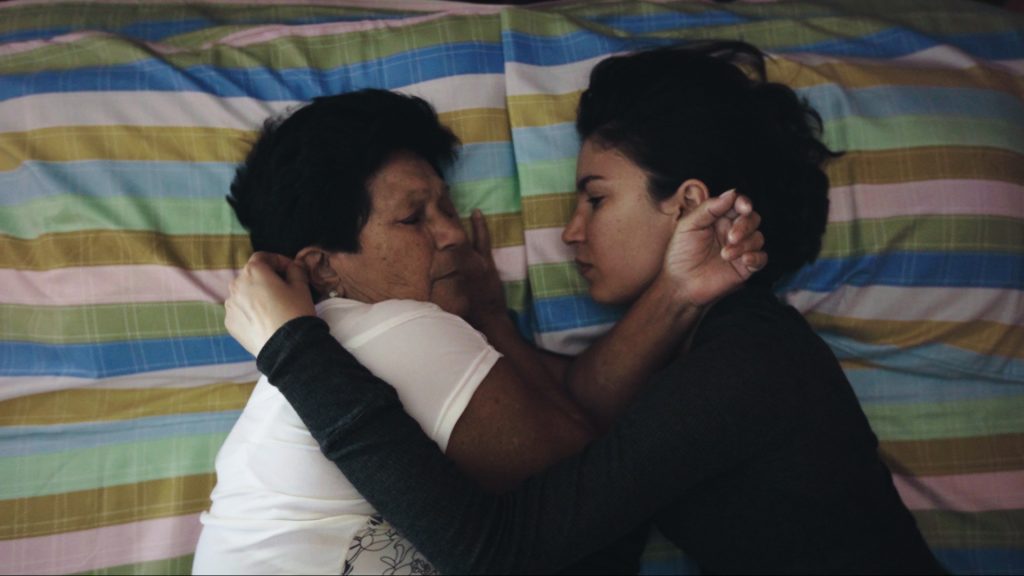
When I ask if she was nervous about having these conversations, she replies, “Oh, my God, yes, I was.”
“I threw up on […] the first day we started shooting,” she confesses. Her cousin had to help her through the panic. While she really pushed herself, she didn’t push her family. “I always said that I would let them speak as much or as little as they wanted.”
Being present in front of the camera with them was a big part of creating that emotional safety. Throughout the film she isn’t just sharing the frame with her family members, she’s also keeping eye contact with them, holding their hands, embracing them, as they share their experiences with and feelings about the man to whom they are all related.
‘My relationship with my father has healed enormously’
As a professor of mathematics, her father may have been inclined toward ordered systems, but his alcoholism, anger and abuse brought chaos into her family’s life. Her mother divorced him when Segura was very young, after which he was largely absent from their lives.
Moving to Canada gave her the distance she needed to begin processing her feelings. After four years of being away, she finally felt ready to go back to Cuba.
She never got to reconnect with her father, though; he died from a stroke just days after her return.
She had to find a way to reconcile with him in his absence. Making the film helped with that. In the 10 years since his passing, she says, “I feel my relationship with my father has healed enormously, even though he’s not around.”
The anger she carried toward him throughout her life, she realizes, came from not knowing why he was the way he was. Growing up, she knew he had the capacity to be a good father. She never understood why he couldn’t be one.
Going through the documents and photographs he left behind in his apartment, Segura was able to learn a lot more about the person he was, and the pain he carried but could never share.
“Everything made sense, and that brought a lot of peace,” she says, “Because at least now I know there was a reason. It wasn’t just my father being a monster.”
She was surprised to learn he wasn’t just a math teacher; he had a creative side, too. He was an artist, much like her and her sister.
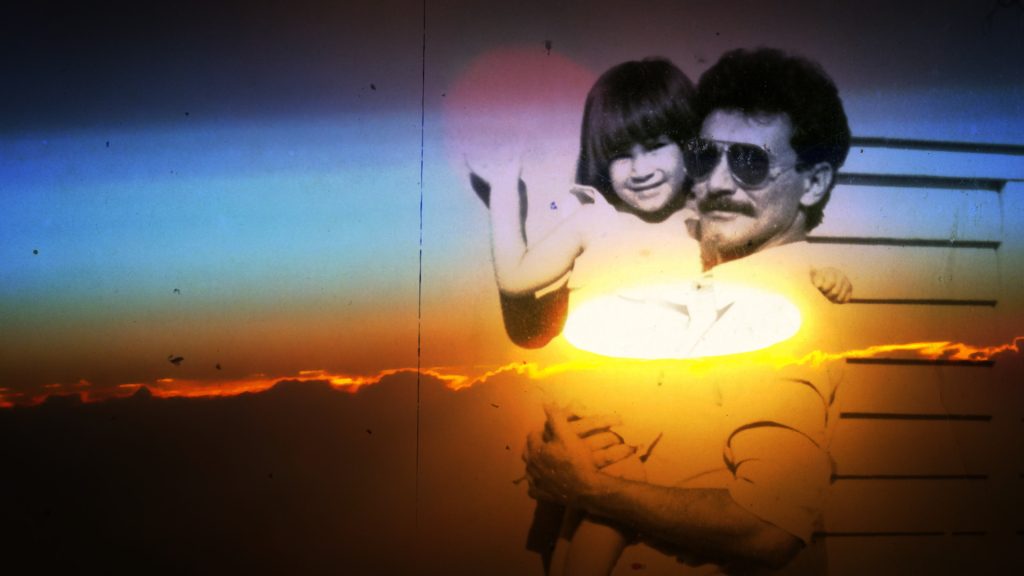
Among his belongings was a small archive of photos he’d taken and developed himself. Many of them were of Segura. His dark room also served as the laundry room, and their functions sometimes coincided. As a result, some of the pictures were doubly exposed, with one image superimposed onto another.
These visual artifacts are a remnant of her parents’ marriage. They’re physical evidence of a time when they were both co-present in the same place. Segura mimics this superimposition effect throughout her film; it serves as a metaphor for the layers of history she’s acknowledging, and at the same time, the coexisting dualities she likes. Photographs are created by light, after all, but they also need darkness to develop.
‘What’s happening outside your home will impact the inside’
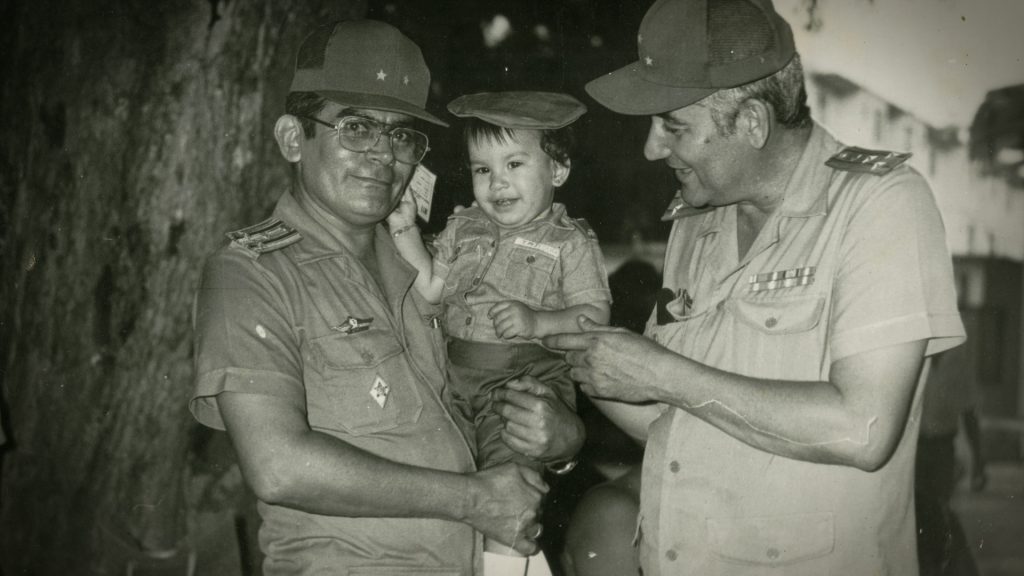
Like many Cubans, Segura’s life has been irrevocably shaped by the events of the Cuban Revolution and everything that followed. In an added layer of synchronicity, her birthday falls on Dec. 2, the Day of the Cuban Revolutionary Armed Forces, the military holiday that celebrates the 1956 arrival of the Fidel Castro-led revolutionaries to Cuban shores.
The year Segura was born, the local militia named her “Cuba’s youngest soldier,” claiming her as their own. As she states in the film, her mother was bestowed with baby items, while her father toasted their family’s good fortune with rum.
From the beginning, Segura’s life story unfolds in tandem with larger stories already underway — her family’s, her country’s, and its military.
While her own story may be unique, it also shows how political systems manifest and reproduce themselves in our identities, our interpersonal relationships, and our experiences of day-to-day life.
Segura has come to realize that “what’s happening outside your home will impact the inside of your home, no matter what.”
It may be more obvious in Cuba, she says, where the separation between the domestic and the political, the inside and outside, are less defined.
“In Newfoundland we tend to be always in our own space,” she remarks. It might make it easier to believe we’re immune from those larger outside forces, but we’re not
“We should all be paying attention to what’s happening outside. That applies to Cuba, to Newfoundland, everywhere.”
‘Two symbols of my identity’
Our conversion inevitably drifts to the similarities between the two islands. “They kind of mirror each other in so many ways,” she says. In terms of square kilometres, they’re almost comparable in size — the island of Newfoundland is slightly larger. The connection between their father figures has been well-documented, she notes, alluding to Joey Smallwood’s fondness for Castro. “There are some parallels when it comes to politics too,” she says. Both places experienced era-defining events in the middle of the last century: Cuba’s revolution in 1959, and Newfoundland’s confederation in 1949.
Cuba and Newfoundland were both objects of imperial conquest, subject to European colonization, and marked by violence against Indigenous Peoples and theft of their land. They were each implicated to different degrees and scales in global flows of indentured and enslaved labour and rum, one extracting value from sugar cane, the other from codfish. Their histories are by no means equivalent, but there are common themes: struggles for independence, leadership let downs, waves of outmigration, depressed economies, and a reliance on tourism.
What Segura is most interested in is how both places are characterized by the ambivalence of island life: “This sense of being trapped — it’s just something that will always define people from islands,” she says, “that love-hate relationship of feeling safe in a way, but also captured […] and isolated.
“I don’t know what that says about my psychology,” she laughs, running away from one geographical “jail” just to end up in another. What she knows is that this boundedness forces people together, for better or for worse.
In Cuba and Newfoundland, “traditional values are still kind of lingering,” she says, like the importance of family and community. In many other places, “these things are already fading away.”
Segura found this very reassuring when she first arrived in the province. The way people interacted with one another here reminded her of home. “Nobody I knew had a family in Montreal,” she said. “I never knew [any] of my friends’ parents. I never heard them say, ‘I’m gonna go have supper with my aunt.’”
In Newfoundland, by contrast, knowing one person often means knowing their family, too. “It was good […] to be surrounded by that at the moment where my own family was just so far away.”
‘Always a Newfoundlander’
Cuba and Newfoundland have come to present two different aspects of Segura’s personality, she says. “Both islands are a source of immense happiness and anguish at the same time.”
She considers herself “very much a Newfoundlander,” and she doesn’t see that changing. Even if she moved away now and lived elsewhere. “I will be always a Newfoundlander, in a way, because I came here when I was 25.” These were her formative years.
“All of my adult life, the biggest milestones—in my career, in finding a partner, in getting my real job—all of those things are linked to this place, the weather, to this language. It’s another home. The lights and shadows.”
She doesn’t romanticize it. Her relationship to the province is complex. “I hate it, and I love it,” she says, “and I feel like criticizing it sometimes out of love and care.”
Her feelings about Cuba are complicated in a different way. “My relationship with my country is still very much wounded,” she says. “It’s hard to forgive when you see the people you love being hurt.” While she doesn’t elaborate, one doesn’t have to look far to learn about the country’s rolling blackouts, the shortages of water, food, medicine, and fuel.
Nonetheless, she visits Cuba at least once a year. “Some people just emigrate and they never go back. I honestly don’t know how they could possibly do that,” Segura says.
Not everyone has the privilege of being able to go home, of course, even if they wanted to. Those who are fortunate enough to return, however, will always be longing for one or the other. That’s what it is to live in two worlds, she says, “never fully belonging to either.”
‘Still even the screenings are really scary’
Seguridad had its world premiere in Miami, which is as close to Cuba as it gets, geographically-speaking, but culturally too, given most of Cuba’s diaspora resides in Florida. She was excited to share her film there, but it wasn’t without apprehension.
“I’m always kind of paranoid about screenings,” she says. “You could see someone from the embassy, because they do that sometimes — show up and try to sabotage or harass you.”
In Newfoundland, “I am so calm knowing that no one knows where it is,” she jokes. “They cannot afford flying over here, so it feels very safe.” She might feel safe, but that doesn’t make the emotional vulnerability of sharing the film any less daunting.
Segura knows the film’s subject matter can make some viewers uncomfortable. “I’ve had that reaction with some of my close friends,” she says. “They just don’t know what to say.”
Now she tells any friends interested in watching the film, “I’m sharing it so now you know who I am, fully.” She doesn’t expect them to offer comfort or their feedback.
Overall, she finds her Canadian friends more at ease discussing the film than her Latinx friends. Canadians have more tools for addressing topics like mental health and intergenerational trauma.
“We think of mental health in Newfoundland or in Canada, being in a huge crisis,” she says, “and it is.” But Cuba is much further behind.
“It comes [down] to language, at the end of the day, how we phrase ideas,” Segura says. “In Latin America, we just don’t do that as much. It’s starting to change. But not in Cuba. In Cuba, we haven’t even started.”
Segura has made strides, but she admits that stepping into that emotional territory still feels risky.
She was nervous ahead of the film’s screening at Hot Docs in Toronto, and the Atlantic Film Festival in Halifax, where it won the DGC’s Award for Best Atlantic Documentary. Relief came only after, when people from the audience came up to her, affirming her experience, and sharing their own stories.
Still, “it’s easier to talk to strangers than talking to your own family,” she says, “and that’s how I feel about the screening in Newfoundland.” The upcoming premiere in St. John’s is going to be a big one. “My family-in-law is gonna be there, people that have known me for years are gonna be there.”
It’s inevitable to feel nervous when we’re being vulnerable. The best we can hope for, is that others recognize our openness and offer the connection we need to feel safe.
The importance of having that sense of security—whether physical or emotional, national or personal—is emphasized in the film’s title. Quite literally, it’s the Spanish word for “security.” It’s also a play on Segura’s own surname, which means “safe.”
The deepest wounds, Seguridad suggests, are those inflicted by the people we expect to protect us. These are the wounds that need the most healing too, and they’re also the hardest to bring to light. But they won’t heal in the shadows.
Segura hopes people will come see her film and stay for the discussion afterwards—her favorite part of filmmaking, she says.
“I live for those moments. I make films so I can just chat with people at the end of the screening.”
Seguridad is screening at the Majestic Theatre at 7 p.m. on Oct. 25 as part of the 35th Annual St. John’s International Women’s Film Festival. Tickets are available here.

Author

Related Articles
‘Honest storytelling’: N.L. drag icon set to unveil new show
Barbra Bardot brings her personal journey to the public stage in new St. John’s production ‘Becoming Barbra’
Queerness, science, and the Mistaken Point fossils of Newfoundland
Art meets science in a unique Eastern Edge residency

‘Our strength is in community’: the creative life of Beverly and Elizabeth Glenn-Copeland enters a new era
Acclaimed musician/writer couple Beverly and Elizabeth Glenn-Copeland share reflections on their love story and history together, on visiting Newfoundland, and on fighting hatred with courage and song