
Poetry, Painting, and Pills
Anthony Brenton, a local writer, poet, and painter, finds healing in the practice of making art–and sharing it.

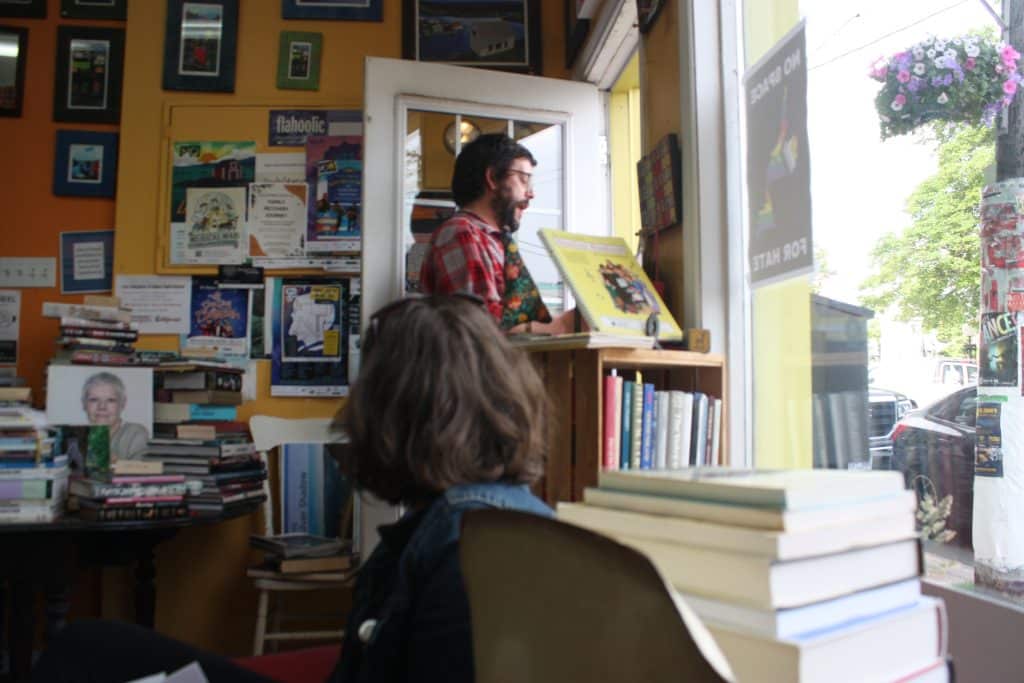
At Elaine’s Books on Duckworth Street in downtown St. John’s, Anthony Brenton bellows his well-wrought poems. He leans against shelves crammed with Newfoundland and Labrador fiction and poetry, taps out rhythms with his foot, sways to-and-fro, and summons his bardic spirit as he mesmerizes his Saturday evening audience.
There is a poem about a beggar, another about a fish immortalized by taxidermy, one about a spider succumbing to frost, and one about a widow who killed her husband. Poem after poem, Brenton’s command of his craft never wavers.
He inhabits the doorway at Elaine’s enticing pedestrians with his booming voice.
A young girl who left with her mother mid-reading returns to ask about books for sale. Brenton hands her The Lowlands Gulp (Batshit Publications, 2020), a horror tale inspired by Scotland’s most infamous cannibal, Sawney Bean. Illustrated by frequent collaborator Steven Abbott, it’s Brenton’s only book still in print and available for purchase. Copies are dwindling.
Will you stand with us?
Your support is essential to making journalism like this possible.
Born and raised in Glovertown, Brenton moved to St. John’s to attend university shortly after the turn of the millennium.
“It wasn’t really until I moved out here and came to university that I started to write anything that was worth anything,” Brenton says. “Before that, I read Stephen King, Edgar Allan Poe. Frost. Then I came here and started playing with some people in a band and immediately this guy gave me Burroughs and then I found a ton of stuff. Yeah, coming to university was a big eye opener.”
Poet and professor Mary Dalton offered some early encouragement.
“Mary Dalton was very interesting because where a lot of people were very dismissive of what I was trying to write, I think, there were some students who got it, some people that were repulsed,” Brenton says. “But, you know, she saw some value to it, saw some beauty amid the stuff. Some of these lines that people thought were very grotesque actually had something behind them. They looked at me and just saw drug-seeking behaviour and a fool and all these things, right? Missed that fact that there was something behind the gibberish.”
Brenton’s office is littered with notebooks and loose pages covered with handwritten scrawls and typed words. Two typewriters live here. One wall is lined with books. A quick scan reveals Charles Bukowski, Louis-Ferdinand Céline, Leonard Cohen, William Blake, and Gertrude Stein. A husband and father of two, Brenton sometimes struggles to explain the complicated relationship between art and the artist to his kids, especially when the artist or the art stand on questionable moral ground.
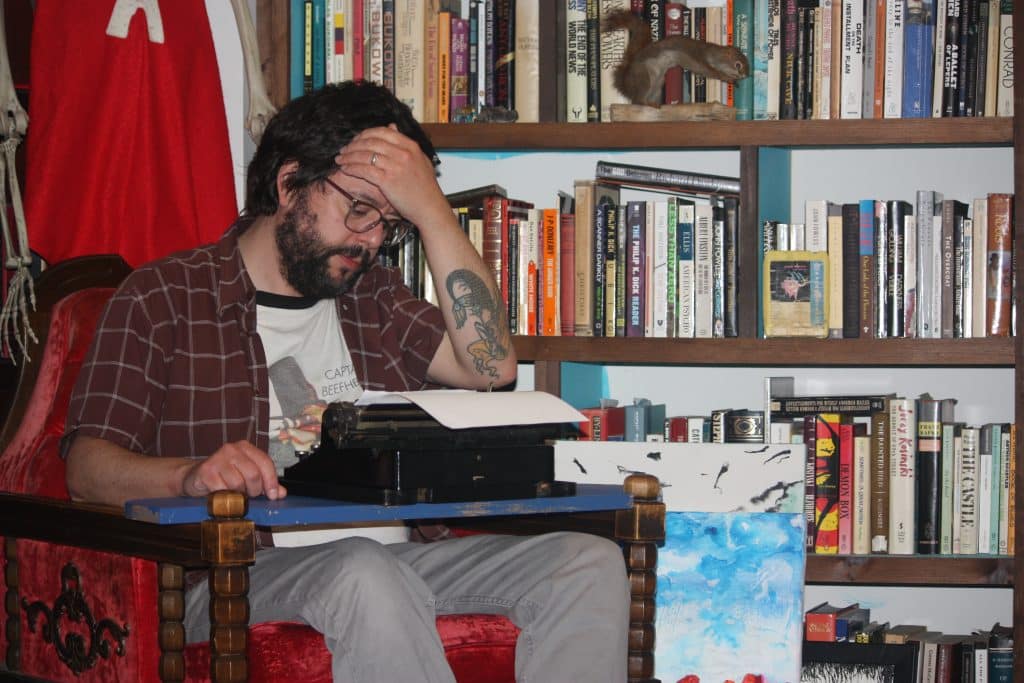
“I try to have this conversation with the kids,” Brenton says, “but it’s a tricky thing to think about how to separate someone like Céline from being sort of a Nazi sympathizer and all these things, but being a great writer, and me being able to excuse that somehow. It’s sometimes weird to justify a lot of these people. The shelves are full of them.”
Sitting at his desk under an Allen Ginsberg poster and a print of Salvador Dali’s The Temptation of St. Anthony, Brenton hands me a signed copy of Burroughs’ Port of Saints.
“The blatant revealing of self,” Brenton says in praise of Burroughs. “Just unapologetically himself. And that’s it. And just the way he approached language and storytelling really appealed to me. That fractured sense of reality. I got obsessed with it in A Book.”
A Book (Pink Eye, 2012) is Brenton’s first novel. He originally wrote it in 2005 while participating in the Community Youth Arts Program at the now deregistered Brother T.I. Murphy Centre on Water Street, and rewrote it for publication years later. It’s a semi-autobiographical story that tracks a young man’s move from the brutish realities of his rural hometown to the nightmare landscapes of the city and his own mind.

Bullies, poverty, drug use, religion, mental health issues, and psychiatric hospitalization all come into play in a scathing satire of society as a form of sport with rules and realities all run by highly organized intelligentsia. The book leaves you wondering who is sane and who isn’t. It’s reminiscent of Dr. Gabor Maté’s view of capitalist society as a sickness in The Myth of Normal.
“In university I got sick very quick, very fast, and had to drop out. A lot of what goes on in A Book is about that too. I was sort of hiding it from everybody. I was so paranoid that I sort of kept it from everybody that I was sick until I was literally snatched up and put in hospital, right? Against my will. It was something else. When I came out of it, I wrote A Book.”
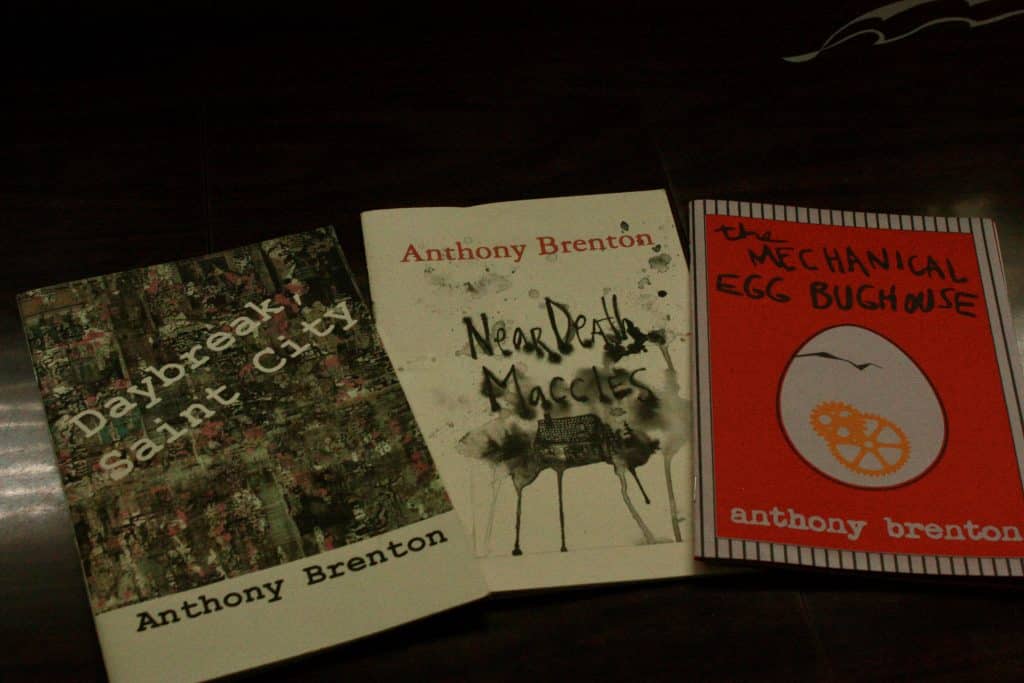
Brenton slips his only copies of other out-of-print books from various crevices and hands them over. There’s Daybreak, Saint City (Trainwreck Press, 2008), his first collection of poems. Near Death, Maccles (Trainwreck Press, 2008) explores a horrific childhood incident that left three inches of scar tissue on his arm. His second poetry collection, The Mechanical Egg Bughouse, was published by Jon Keefe’s now defunct Pink Eye in 2012. An of Rearing a Youngster (Pink Eye, 2013) is a surreal take on raising his first child.
A steel case at the foot of Brenton’s writing chair contains piles of notes related to For the Blinding Lights I Sniffed Upon, a book-length poem in progress about an artist’s journey to his deceased mentor’s wake and the reawakening of artistic vision.
On that note, we’re back to Maté’s The Myth of Normal and his definition of healing as “a natural movement toward wholeness,” a concept that strikes a chord with Brenton.
“Last April, on April’s Fools Day, the day of The Last Supper, I woke up and it was the first day I was without medication in about 20 years,” Brenton says. “And I’d taken a year to come off all my medication, and it was a very serious decision to make, but I found, ultimately, I was pretty blunted out by everything and in a serious way.
“So you can see this dry up in 2008 where there was a lot of stuff, paintings and all these things, and then it sort of dries up for about 14 years. And then over the course of a year I came off five medications and the last one was this really harsh medication, antipsychotic medication. Anyway, very bad detox. Once my head sort of cleared from that, I had this huge resurgence of insight and awareness of what was around me.
“And through art, I mean, that’s how I sort of got through a full year. I could have been in hospital for the whole year, and I know I got out of it because I wrote constantly. And then once I started feeling well again, then I started painting again. I go to a therapist every week, and it’s the first time I have, because before medication was just thrown at me.”
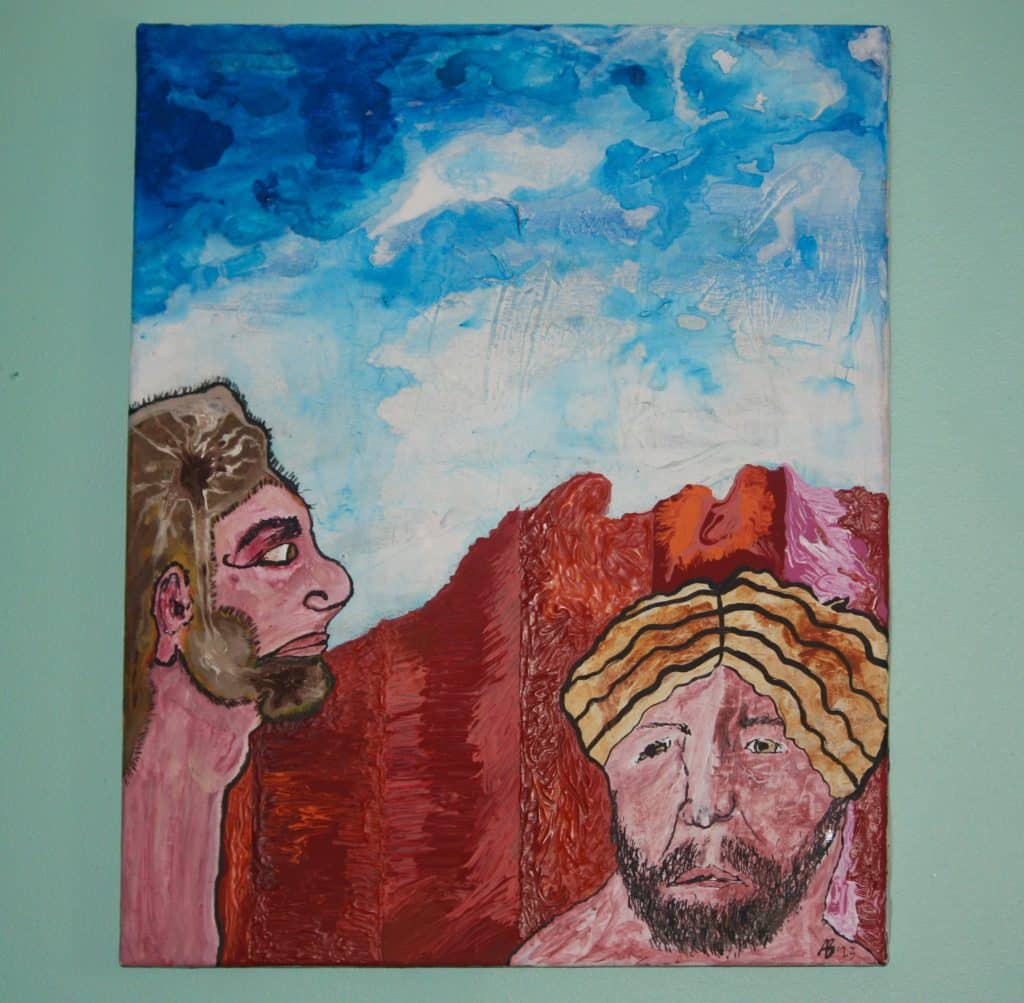
In addition to writing an album with his 14-year-old son and working on various paintings, Brenton also has two novels and three collections of poetry written for which he is seeking publication.
“I think the fact that I’m having trouble with publication is a pertinent point, right? I got all of this work, none of this is published, and I don’t see how I’m going to get it published. I can’t face the notion of sending something off and six months, a year later, I just get something back, a stamped, generic, nah, we can’t take it. I keep doing that, and you’ll get a project you’re super excited about and send it off and then it’s gone. You send it to a handful of people, but then I have to start something else and I lose interest in that project.
“Not that I lose interest in it, it goes to the background for a little bit and I can’t maintain sending it off. And then I’ll just get some rejection letters back and then it dies on the vine all the time, so I have this huge stock of stuff I’m trying to get published. So everything I have, basically, has been almost self-published, right? It’s not a matter of quality, I don’t think. It’s not a matter of what people would read, I don’t think. It’s a matter of I’m not able to put together that package to convince them that I’m somebody who’s going to sell books.
“There’s a psychological block. I find it insurmountable to do up a package and send it off to promote. A book like A Coughing Fit of Psalms, to thematically lay out what it means, and to say who is going to buy it in a succinct package that someone is going to look at and say this is a reasonable person and I should take a chance on this, it’s not going to happen.”
Despite Brenton’s difficulties with consistent publication, there’s no doubt his voice is unique and ripe for a wider audience. The more people who support his local appearances and seek his work, the better.
On July 11 at 8:30 p.m., Brenton will be at Erin’s Pub in St. John’s for a reading and painting exhibition.
“I don’t know how many pieces I’ll have up. Not a ton. Most of them are going to be for sale. I hope people go because it’s just me and it seems very vulnerable. Very like, why in the world would anybody go? I got a ton of stuff to read.”

Author

Related Articles

‘Honest storytelling’: N.L. drag icon set to unveil new show
Barbra Bardot brings her personal journey to the public stage in new St. John’s production ‘Becoming Barbra’
Queerness, science, and the Mistaken Point fossils of Newfoundland
Art meets science in a unique Eastern Edge residency

‘Our strength is in community’: the creative life of Beverly and Elizabeth Glenn-Copeland enters a new era
Acclaimed musician/writer couple Beverly and Elizabeth Glenn-Copeland share reflections on their love story and history together, on visiting Newfoundland, and on fighting hatred with courage and song