

Water holds a special place in queer and trans art. In literature and poetry, its symbolic value lies in its refusal to stay in the box, to obey borders or binaries. Water seeps, it leaks, it finds ways to escape the material boundaries we set for it. It transforms, transitioning with a fluidity that mocks the idea of fixed states. It goes from liquid to solid ice back to liquid and then evaporates into thin air, floating along as clouds before raining down on the earth in some new place and form.
Water cleanses. It erodes away the old, it transforms matter and makes way for new forms to emerge, whether of landscape or life. “The ocean is a lesbian,” writes Julia Armfield, author of Our Wives Under the Sea. Her work, like that of other queer writers, hearkens to the water’s dual nature in our lives: both comfort and danger, safety and threat. “It is an image that speaks eloquently to the queer sensation of being known and not being known,” Armfield writes, “a visual reminder that two things can simultaneously be true.”
If this is true in a broad sense, it’s something Newfoundlanders are acutely aware of, our entire existence demarcated by the water which surrounds us. “In the face of an endless horizon, we live and think from the water’s edge,” writes Sonja Boon in Unsettled Islands: Autoethnography and Feminist Theory at the Water’s Edge. This edge, she writes, is “a liminal space of potential and possibility. Anything can happen at the island’s edge.”
“Bluest now / and yet-to-come / the fathomless entanglement,” reflects NL scholar and artist Daze Jefferies in her poetry collection Water/Wept, conjuring the sense of limitless potential and promise the waters evoke.
Will you stand with us?
Your support is essential to making journalism like this possible.
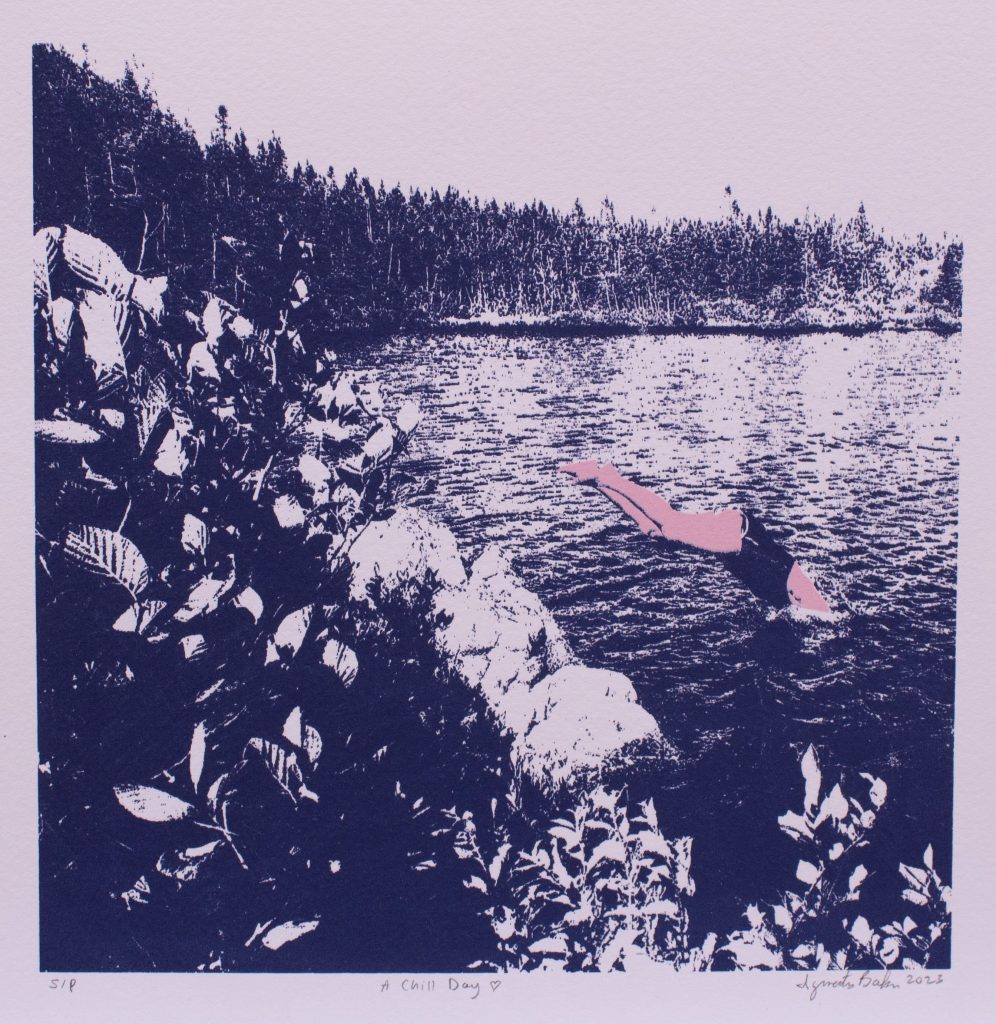
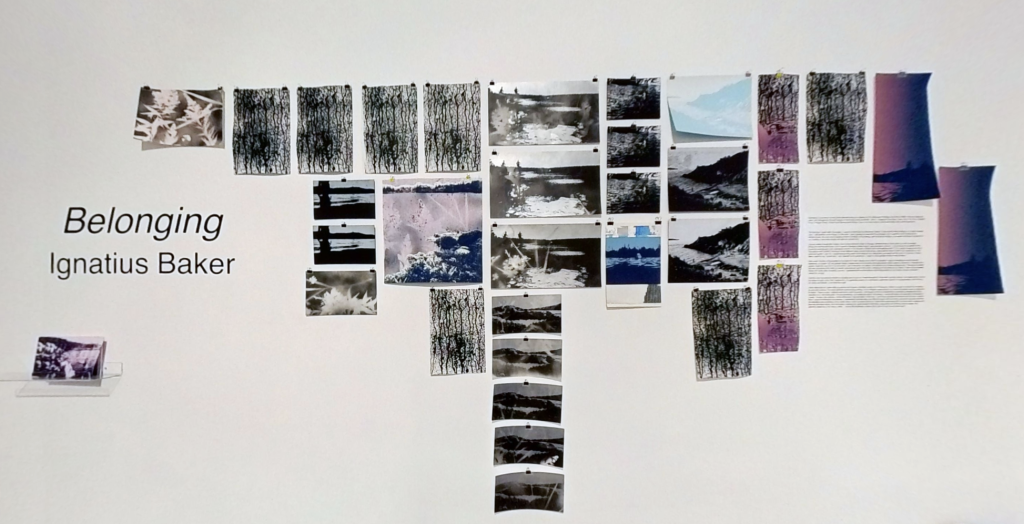
In Belonging, Ignatius Baker moves away from the ocean’s edge to explore our relationship with the island’s ponds. The exhibition is comprised of dozens of screen prints crafted from photographs of ponds and swimming holes around the Avalon Peninsula, and of queer and trans people swimming together in the waters. The show is “about finding a sense of belonging through swimming with other trans people and allies in nature,” Baker writes in the exhibition text. “It is where I started to find confidence in my body after transition, a time when I felt vulnerable and like I no longer belonged.”
The reckoning
Baker has been dedicated to art since childhood, but almost missed his true calling by getting sidetracked into a computer science career. Working in that field outside the province before the COVID-19 pandemic, he wrestled with a desire to turn to art full-time.
When the pandemic hit, it forced a reckoning and Baker resolved to give up computer science for art. Faced with a choice between a well-paying job teaching programming or a low-paying job as a screen printer, he opted for the screen-printing gig. He quickly mastered the basics. Eager to learn more, he approached St. Michael’s Printshop in downtown St. John’s. For over 50 years the venerable artist-run institution has facilitated printmaking, supporting hundreds of artists from across the province and beyond. Baker was deeply conscious of his lack of formal credentials and art degrees, fearing it would set him apart from others in the local art scene. But his experience with St. Michael’s was rewarding. He met other artists, participated in workshops, and in 2023 found himself the recipient of a Local Visiting Artists’ residency there. The work which came out of that residency is showcased in Belonging.
Approaching the project required Baker to think about his art in new ways, and about how to render what had previously been a deeply personal practice into one accessible to a broader audience.
“I wanted to bring in themes of queerness to my work, and one thing that really was important to me during transition was being outdoors: hiking with my friends, going swimming,” he explained. “The further I went into my transition the more I felt comfortable swimming, and realized how important that relationship to swimming has always been in my life. One of the biggest feelings of euphoria that I felt gender-wise after transition was going swimming and experiencing being embodied swimming.”
He describes this moment, at a pool on Vancouver Island, in a moving piece of prose included in the exhibition, juxtaposing the experience of swimming in pools with that of swimming in nature.
“At the pond, there is no sign to remind me of where I do and don’t belong,” he writes. “The pond glimmers announcing nothing. But it whispers reassurances as I mind the patterns and complexities of nature.”

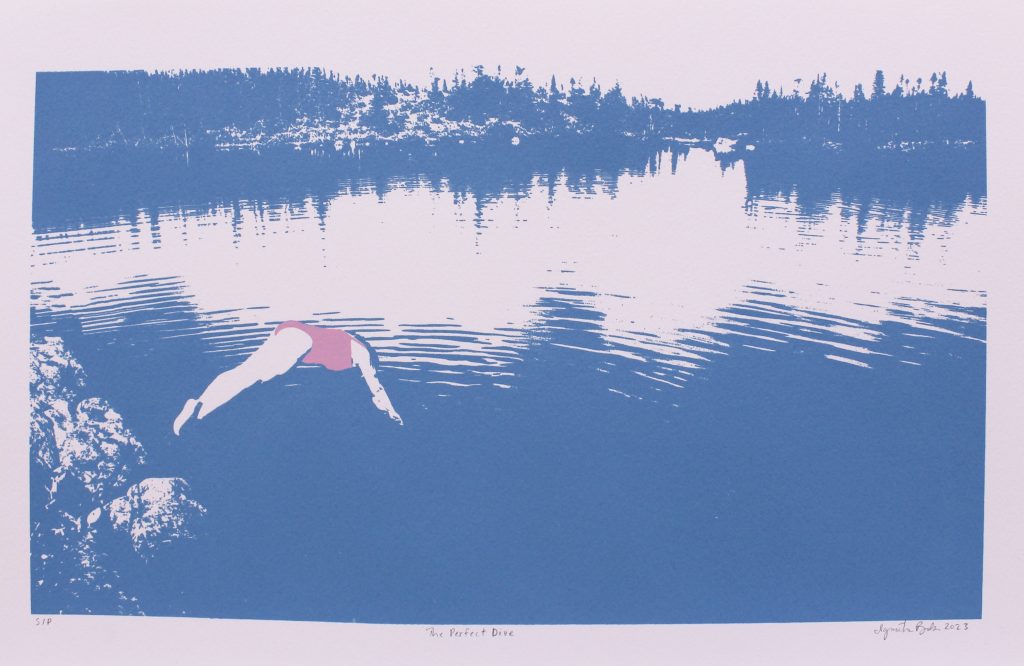
There is a vintage quality to the prints, shading and shadows endowing the images with a sense of timelessness. Amid the more subdued colour tones it’s the people who stand out, arms raised, bodies coiled, joy and vibrancy emanating from bodies in motion.
There’s another energy entirely to the floral prints, whose x-ray-like quality lends them an ethereal, enchanted presence. Ferns and seaweeds flow and writhe and merge, and the eye wonders what mysteries and magic lie obscured behind their leafy presence.
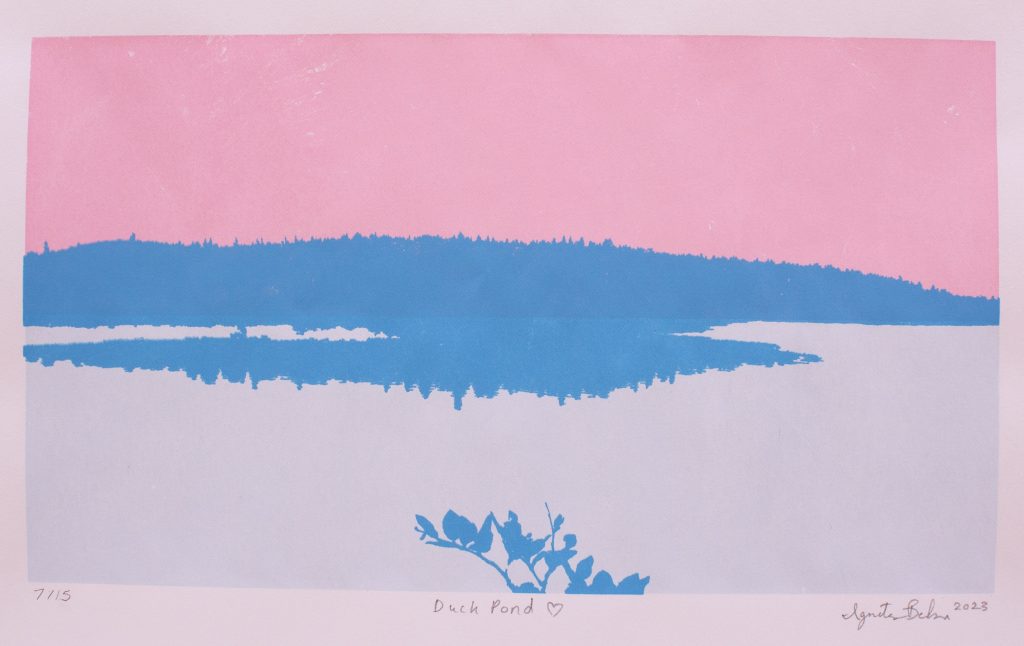
The stark juxtapositions of colour and the sheer vibrancy inherent to the prints underscores their snapshot-like quality: water and sky gleaming with brightness, framed by the shadowy merging of forest and field. The pinks are striking, evocative of the eye-capturing beauty of a Newfoundland sunset. The landscapes provide a calming, regulating backdrop but it’s always the bodies that stand out, their singular vitality underscoring our transient presence in this landscape. One set of images captures the rippling, concentric circles of water disturbed by a dive; the ripples convey an arresting sense of motion in an otherwise still landscape but the eye is held by a realization of absence: what disturbed the water? And where has it gone?
Identity and belonging
Speaking with Baker, I am struck by the parallels in our experiences. Hiking with friends has also been a pivotal part of my own transition, of aligning my changing body and presence with the calming rhythms of nature. But it’s our shared engagement with water that truly resonates.
When I was a child, swimming was important for me too – it was the one sport I enjoyed and excelled at. But I gave it up as I entered my teenage years, for reasons I only later realized were related to my own gender dysphoria. For decades I went to enormous, even ridiculous lengths to avoid swimming. It was only last summer, a few years into my own transition, that I entered the water again.
I couldn’t have done it without the support of my closest friends. I doubt they fully understood the terror with which I approached that day. Transition had finally given me a body I felt comfortable with, but every new experience that body has is one accompanied by fear, doubt, uncertainty; not only over my own navigating of an unfamiliar—yet at the same time, oh-so-natural—path, but also over how the world will respond. As we approached the water, strolling past other groups of swimmers along a rocky beach, my friends were both shield and strength. There is a vulnerability in being seen for the first time, and I, in a bathing suit more revealing than anything I’d worn before, was visible to the public for the first time since I began my transition. But my friends smiled and laughed and pointed out ducks, and when I slipped into the water, I finally felt myself home. The liquid surrounding my body, the sun warming the water above, and the laughter of those I loved most in the world beside me, was a euphoria well worth all the terror that preceded it. I doubt my friends understood how much this rebirth meant to me, or why I begged them to go back again and again all summer.
Being in the presence of the people you love and trust matters in situations like this, but in the water we are ultimately all alone, enveloped in our solitudes. There is a vacuum there that resonates with many of us who are trans; a recognition that our experience of embodiment, and the way it interfaces with the social, is so unique as to be difficult to convey even to those who are closest to us. There is a profound loneliness in recognizing this gulf dividing our experiences.
“There is such a terrifying element about it, especially when you don’t feel like everybody can fully understand what your experience is,” reflected Baker. “I grew up quite lonely and I think as I’ve gotten older I’ve realized that that loneliness has come from ideas about how I’m supposed to be in the world and how my friendships are supposed to be, that kind of thing. When I let go of the expectation of people needing to understand everything about me or needing to see me deeply, it was like: if I can see myself deeply and hold that, it doesn’t matter any more. Everybody’s going through their own experience in their own way and it’s not just gender, it’s so many different things that people feel lonely about. So being able to come into your own embodiment and getting to know yourself more [gives you] a stronger identity from which you can hold your values and your morals, and that’s what’s given me so much relief from loneliness — knowing that I am alone even around people, but that’s okay. We’re all alone together, but we can all support each other, and be caring, and we don’t need to understand everything to care for each other.”
I’ve wrestled with these same ideas, and I find Baker’s calm reflections reassuring. This tone of serenity, a calm and euphoric joy tinged with hints of melancholy, echoes in the prints. The bright colours reflect the sharp highs and lows of euphoria and its opposite; the glare of the screen print eliding easy deconstruction. We feel in shades, not in specificities; each of our emotional responses, the result of a hundred different thoughts and experiences all merging into the dark shade of an evening forest or the gleaming sparkle of sun on water. And as we slip into the water, enveloped by its fractal matrix of blues and other rainbow hues, we are simultaneously enwrapped and enraptured by the solitude of our experience of life.
“I am the only true witness to both my anxiety and my joy as I move through life,” Baker writes in Belonging. “Even with my trans friends, our experiences can be so unique to each other that I cannot rely on a particular person to understand a particular aspect of my experience. And with my cis family and friends, it can feel like a gulf.
“I would talk about my transition endlessly if I could […] Now, I hold my reality inside as I spend time swimming with my loved ones, enjoying the blue sky and blue waves, the fresh water, knowing the quiet miracle of the thing, being alive and offering love to myself, that attentive presence to the beauty within…”
A tribute to water
While queerness figures centrally in Belonging, it’s also a tribute to pond-swimming more broadly. People have a different relationship with nature in this province than Baker’s witnessed in other places he’s lived, he says. There’s a more relaxed relationship here, he feels, where people see nothing wrong in simply taking an entire day off just to hike into the woods, relax and spend time with each other and nature.
“I think that’s what they really cherish in swimming, it’s that feeling of community-building,” he says.
The names of the ponds depicted in Belonging reflect people’s whimsical relationships with them: Duck Pond, Tea Cup, Punch Bowl, and others. Everyone has their favourite pond, Baker notes, and sometimes even their own names for them. In a way, it’s as though the ponds themselves have their own personalities.
Baker originally planned to work with a limited colour palette of pink, white and blue, which represent the trans flag, but also, he admits, to keep himself from going overboard with colour. But he wound up varying the three colours, and by the end found himself experimenting with silver ink and black and blue spray paint as well. Queering his own palette brought surprising results, and at the urging of other artists he included these pieces in the exhibition too.
While Baker considers himself a painter, he enjoys working within the limitations of screen printing, especially where it allows him to explore colour. The vibrancy of his work reflects a desire to push the limits of traditional screen-printing techniques.
“A lot of traditional printing is very regimented; everything’s in these perfect editions, and although I have [that], I also have lots of images that are off or they wouldn’t make the cut. I wanted to include those in the show, on one hand to explore divergence of the images and then on the other hand to show people the process of screen printing. A lot of people will go into spaces where they only see one print and they’re not really getting a sense of what the process is behind it.
“This show is also in a way a love letter to screen printing, and to my time in St. Michael’s.”
Bedazzled by the gleaming colours and inviting fractal waters, the viewer is reminded why queer art is so important. It gives, not only in substance and content, but in its studied disdain for convention, its desire to push disciplines forward by exploring the very discomforts that threaten to rigidify them, whether that means upsetting your own colour palette or incorporating imperfect outtakes.
With Belonging completed, Baker plans to return to work on a similar project, this time on hiking along the East Coast Trail. He hopes his work will help people see and appreciate the beauty of this place, but also that it will help people see the beauty of themselves as well.
“Growing up in St. John’s I didn’t know about a lot of queer people until I was older,” he shares. “So my hope would be that through anything that I’m doing, that our visibility will help people who are younger see themselves in us, and see that we can live fulfilling lives that contribute our gifts to society.”
Belonging is showing at the Eastern Edge Gallery from Jan. 31-March 15, 2025.

Author
Related Articles
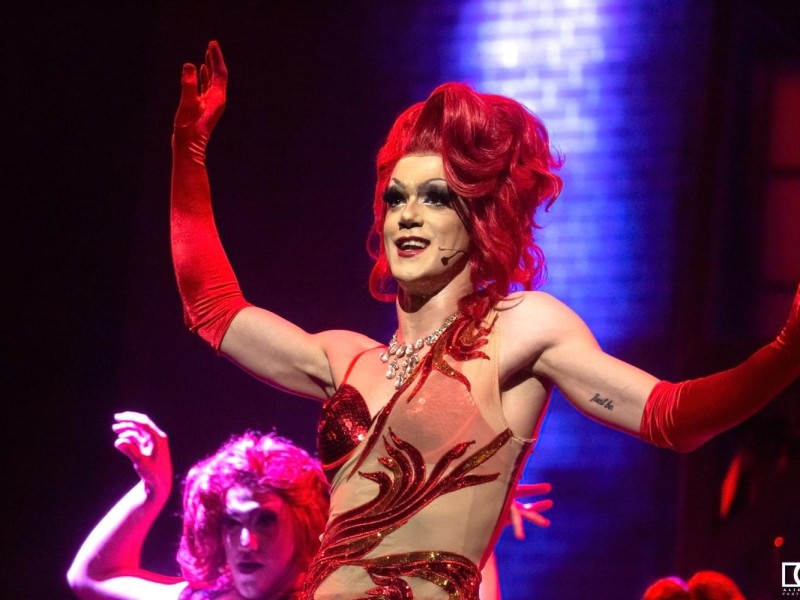
‘Honest storytelling’: N.L. drag icon set to unveil new show
Barbra Bardot brings her personal journey to the public stage in new St. John’s production ‘Becoming Barbra’
Queerness, science, and the Mistaken Point fossils of Newfoundland
Art meets science in a unique Eastern Edge residency

‘Our strength is in community’: the creative life of Beverly and Elizabeth Glenn-Copeland enters a new era
Acclaimed musician/writer couple Beverly and Elizabeth Glenn-Copeland share reflections on their love story and history together, on visiting Newfoundland, and on fighting hatred with courage and song