

In a decision that could reverberate across the country, St. John’s Pride and Fredericton Pride have given corporate sponsors like TD Bank the boot, and endorsed Palestinian solidarity boycott lists for this year’s Pride festivals.
The two Atlantic festivals have also named Palestine solidarity groups as grand marshals of their pride parades. Endorsing the Boycott, Divestment and Sanctions (BDS) lists means the two festivals are likely the first Pride festivals in the country to formally divest from TD Bank — a key funder of Pride festivals across the country.
TD has come under criticism from Palestinian solidarity activists for ties to companies connected to weapons manufacturing and the Israeli military.
In St. John’s, the decision came about following two weeks of discussions and negotiations, after St. John’s Pride (SJP) reached out to Palestine Action YYT — a grassroots coalition formed in October 2023 in the wake of Israel’s most recent wave of attacks on Gaza — and invited them to be grand marshals of the 2024 Pride parade.
According to St. John’s Pride External Co-Chair Eddy St. Coeur, the organization had been trying to figure out ways to better involve marginalized communities in the Pride festival and was impressed by Palestine Action YYT’s activism. The grassroots group has held weekly rallies and other events since October.
Will you stand with us?
Your support is essential to making journalism like this possible.
“It came about from our board seeing all the work that Palestine Action YYT was putting into these rallies and marches and trying to draw attention to the issue here at home,” St. Coeur said. “We could see the overlap and the intersectionalities of it all.”
When Pride reached out to the Palestine solidarity group, it provoked an internal debate among pro-Palestine activists. Past controversies surrounding the role of police in Pride and concerns about the influence of corporate sponsorship caused apprehension among Palestine Action members.
“There was trepidation on the part of organizers, but we were also interested to see if things had changed and if Pride was trying to take a new approach to the festival here,” said Carmella Gray-Cosgrove, a Palestine Action organizer.
“I think both sides went into it very open-minded, in good faith, and I think the process of starting the dialogue was the biggest hurdle to overcome,” said Zayd Khraishi, another Palestine organizer. “Once that was started I think there was a good faith effort to meet us where we were.”
Prior to meeting with St. John’s Pride, Palestine Action organizers developed a list of three key demands, including commitments to boycott and divest from 33 companies, to bar police and security agency uniforms, symbols, logos and insignias from the festival, and to engage in a process of reconciliation with Indigenous and racialized community members.

On June 19, the St. John’s Pride board voted to endorse all three demands. The list of demands has also been endorsed by other local queer community-serving organizations in the province. St. Coeur attended the June 29 Palestine Solidarity rally in downtown St. John’s to announce the decision.
“It’s because of all of you that we were able to make these moves happen,” he told a crowd of roughly 100 cheering marchers, waving Palestinian flags and beating drums. “So if you’re wondering if these marches every Saturday are making a difference, and if you’re wondering if being at Yazan’s Yard [the student encampment] up at the university is making a difference, I’m here to tell you that you folks are the reason why this is happening this year. It’s the only reason why we were able to do it.”
Gray-Cosgrove emphasized that the decision to divest was the product of years of activism.
“The groundwork was laid for this to happen over the past four years, since Black Lives Matter in particular,” she told The Independent. “Since 2020, through the really diligent work of Black activists in the city, racialised activists in the city, trans activists in the city, and Indigenous activists in the city who have all been really pushing for many of the same demands, it just so happened that we were here at this time when we reached this critical mass. It just had become unavoidable I think.”

TD Bank gets the boot
The BDS list presented to St. John’s Pride was tailored to the local community, targeting corporations that were involved with Pride in the past and had “egregious” connections to Israel or to weapons manufacturers, explained Palestine Action organizer Nikita Stapleton.
“It’s not a perfect list, it’s a working list, and the point of BDS is to be a commitment to put pressure on these entities to change their behaviour,” they said. “We’ve seen that that was an effective tool used against apartheid South Africa, and we feel like it can be a successful tool here in the fight against apartheid and other crimes and violence being committed by Israel.”
TD Bank has aggressively branded itself as a sponsor of Pride festivals around the country, to the point where many festivals have become heavily reliant on the company’s money. This has generated a backlash against the prominent role of corporate sponsorship in Pride, which has its roots in grassroots protests against homophobic and transphobic repression in the 1960s and ‘70s.
TD has also been targeted by Palestinian solidarity organizers for its investments in Elbit Systems — an Israeli military company — and General Dynamics, a major American weapons manufacturer. Divesting from TD Bank was a red line in the discussions between the two groups, said Khraishi.
St. John’s Pride’s decision to divest means the group will be returning a $5,000 donation it received from TD. The organization anticipates an overall loss of $10,000 to $15,000 in sponsorships and other revenue from companies identified on the BDS list. But activists emphasize that rejecting TD Bank has implications beyond the company’s complicity in genocide.
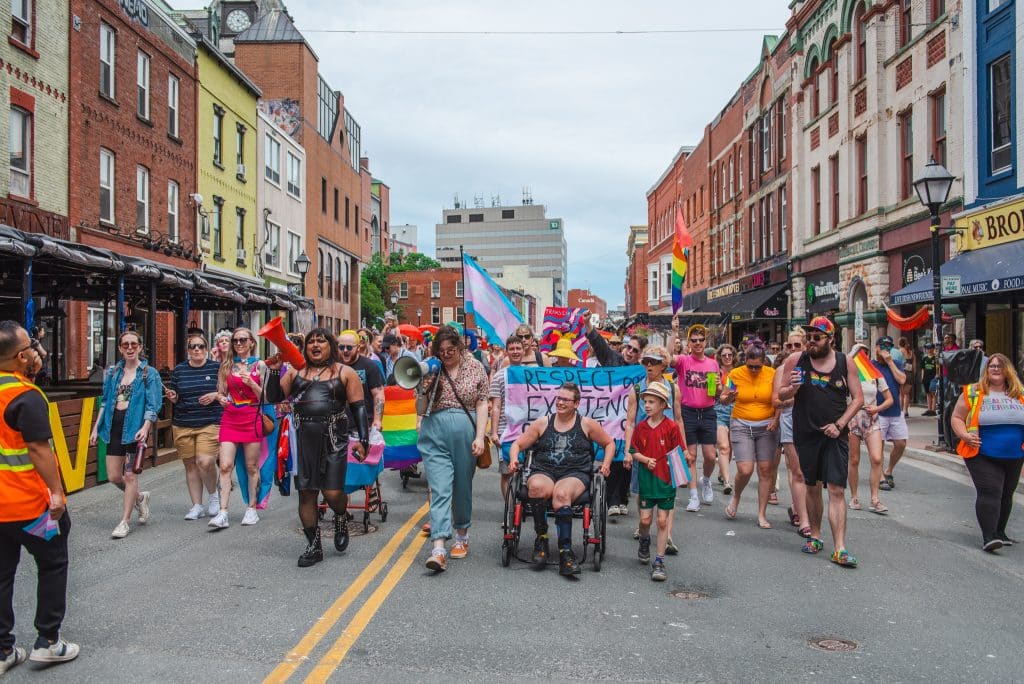
“It’s not just about BDS, it’s not just about the policing issue, but to us it really represents a shift in the priorities of St. John’s Pride,” said Stapleton. “It’s hopefully a shift in bringing Pride back to its roots as protest, and focusing and centring the most oppressed rather than what we have seen in recent years, which is prioritizing the comfort of allies or the comfort of sponsors.
“We think it represents a really positive shift toward the foundation of what Pride is meant to be. And that is a protest and a fight for liberation for all people. We’re excited that this is a really good first step in that direction, but we’re also aware that it is just a first step and that there is lots more work to be done.”
“Queer liberation was never handed down by a bank. It was never doled out by the generosity of a government,” said Khraishi. “Queer liberation was something that was hard fought for and hard won through serious, strenuous, concerted, consistent activism. It was a price that the queer movement historically paid for, in many cases, with their lives. And so I think now to turn around and say that we have to embrace these large financial institutions — I think that’s really kind of divorcing Pride from its historical roots, and it’s separating Pride and the promise of Pride from what it really historically has been about, which is a liberatory and liberationist theme.”
Pride festivals and Palestine solidarity
Pride festivals have become a touchstone issue for queer and anti-genocide activists across the country, largely because of Pride’s corporate sponsorship and the involvement of many of those same corporations in Israel’s genocide in Palestine. The refusal of several larger Pride festivals to divest, or to meet with Palestine solidarity activists, has prompted protests in several cities.
The June 2 Winnipeg Pride Parade was disrupted and delayed by Palestine solidarity activists, and the June 30 Toronto Pride Parade was disrupted by activists and canceled as a result. Similar disruptions have taken place in Chicago, Philadelphia, New York, and other cities. The divisive struggles in other cities underscore the significance of the partnerships being forged in places like St. John’s and Fredericton.
“I think we see this as a really big win and a really big moment,” said Khraishi. “So much of what we’ve seen coming out of Israel’s propaganda machine has been pink-washing and using LGBT identities as a sort of cover for their past atrocities and I think that by bringing Pride into a more radical and more protest-based movement, that’s a really big win.”
Organizers were quick to point out that part of Israel’s ‘pink-washing’ has been to depict Muslim majority countries as inherently anti-queer, something that is no more accurate than labeling countries like the United States — where violent forms of white Christian nationalism have also taken root and persecuted queer and trans people — anti-queer.
“It’s so important for us to realize that queer and trans Palestinians exist and that there already is this connection that exists between queer liberation and Palestinian liberation, inasmuch as all of our liberation is connected, but also specifically because of the need to acknowledge the folks that live at the intersection of that,” said Stapleton.
“It’s an Islamophobic dog-whistle,” said Khraishi. “We’ve seen that sort of rhetoric emerging all across the far right in northern countries — this idea that the far right, by cracking down on Muslim and racialized people, will be able to somehow act in service of gender-diverse and queer people and women. Really, it’s not rooted in reality; it’s an expedient intended to justify Islamophobic and racist policy.”
Gary Kinsman is one of Canada’s leading sociologists and a member of the No Pride in Policing Coalition in Toronto.
“I think that if people don’t grasp that our Pride is about ‘no pride in genocide,’ they really don’t understand where our movement came from,” he said.
“I would simply say that if you have real problems with this, look at the history of our movements. Look at our history, see where we came from, where Pride came from; it came from revolts against the police,” Kinsman added. “The other thing is that the Palestine situation is an emergency. It’s genocide. Thousands of Palestinians including many many Palestinian queer trans and gender diverse people are being killed or injured. Their lives are being destroyed and for the global Pride movement to not speak out globally about that is a complete denial of the history of where Pride actually came from.”
Will Atlantic efforts reverberate across Canada?
St. Coeur hopes St. John’s Pride’s divestment decision will encourage other Pride festivals to take similar steps.
“If the worry is that organizations are going to pull out or people are going to turn their backs on the organization or whatever, what we have been saying is, ‘Well, were those people involved for the right reasons? What were their motivations for getting involved?’ he said.
“And if what you’re telling me is that, when the rubber hits the road and we really do need to try and advance this global issue that’s impacting everybody across the world right now — if when we start to do that the response is, ‘Well, what are we going to do if that money never comes back?’ then maybe that money should never have been there in the first place.”
In Fredericton, Fierte Fredericton Pride Chair Jenna Albert was delighted to hear St. John’s Pride had taken steps to boycott and divest. Albert said their group made a similar announcement the day before.
“We’re happy the east coast is kind of presenting a united front,” they said, while acknowledging that some Atlantic festivals like Halifax Pride have resisted cutting ties with TD Bank.
“We strongly believe that queer liberation is tied to liberation for all marginalized groups, and what’s currently going on in Palestine with the genocide was something that was really concerning for us as a board but also for the broader queer community and the Fredericton community,” they said.
Making the commitment to divest was about making sure the group wasn’t just talking the talk, Albert said, but also walking the walk. They said their board, which also announced Fredericton Palestine Solidarity as grand marshals of the Pride parade, was very much united on the decision.
“Often we’re kind of viewed as a party committee, and really Pride organizations are so much more than that. They’re about advocacy, they’re about representing what the movement has been about from its inception, which was a form of protest, which was a form of fighting for our rights,” they said. “So I think the experiences Palestinians are going through now are really aligned with our own. And when you’re seeing those kinds of protests — either protests disrupting the parades, or alternative types of events that groups are putting on — it’s showing that the community has these expectations of us. And for Fredericton Pride, we wanted to make sure that we were representing our community in terms of what they want us to be doing for advocacy for them.”
Kinsman was a founding member of Toronto’s Lesbian and Gay Pride Day Committee in 1981, which eventually evolved into Pride Toronto. He’s spoken at Pride marches as far back as 1972 and has been a member of several successive queer and Pride organizations across the country. He was a member of Gays And Lesbians Together in St. John’s and participated in the successful effort to get the City of St. John’s to acknowledge Pride Week for the first time in 1991.
Earlier this year he formally resigned from Pride Toronto over its refusal to discuss the issue of divestment and to show solidarity for Palestine. He’s been a key organizer with the No Pride in Policing Coalition, formed in 2018 in the wake of Black Lives Matter protests against Toronto Pride’s connections with police. That group puts off Abolitionist Pride Day, an alternative pride festival in Toronto which drew thousands of participants this year.
Kinsman was elated to hear the news from St. John’s and Fredericton, and said it’s been vital to efforts elsewhere in the country.
“I felt like this is a direct means of support for what we’re trying to do here in Tkaronto,” he said. “It’s just an incredible move forward for the struggles to support the boycott, divestment and sanctions campaign across the so-called Canadian state, and it’s really of major use to us that this is happening. It helps to create the context in which more people are understanding that if St. John’s Pride can do this, if Fredericton Pride can do this, why the hell can’t Pride Toronto do it?”
Knowing their work is having this sort of impact has reframed the significance of local activism for St. John’s organisers. Gray-Cosgrave says she’s been astonished at the responses and grateful for the support they’ve received from across the country since the news was announced.
She says it has highlighted the movements’ interconnectedness nationally.
“There have been times in the past nine months where I’ve really felt like it’s so irrelevant that we’re doing this — we’re such a small place, we’re so far from the mainland, we’re so far from the centre,” she explains. “There’s so many times where I’ve felt like, ‘Oh, I would love to be at that march with 10,000 people in that huge city!’
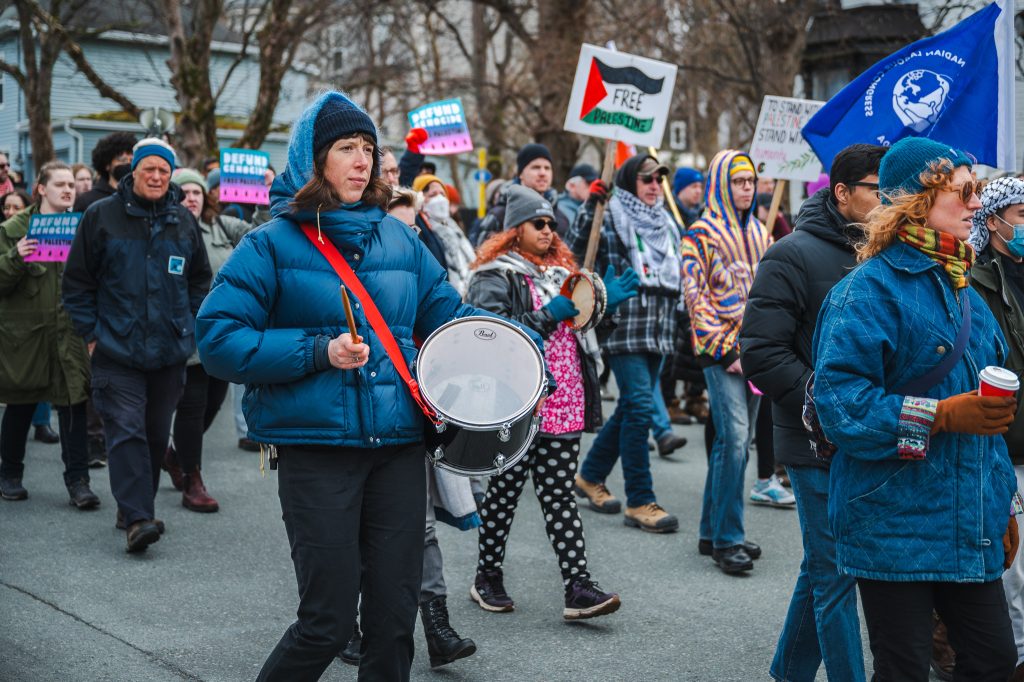
“But the past month or so has been a real awakening for me in understanding how connected the struggle is, even in a place that’s small like this and the impact that even our action can have here. This wouldn’t have happened without the past nine months of really consistent community-building that we’ve poured our hearts and souls into. For all of the organizers this has been like an unpaid full-time second job for us, and we’ve worked so hard — so it does feel really important, really significant, to see our work moving into the mainstream and being accepted in this way that nine months ago would have felt kind of impossible.”
Khraishi agrees.
“I think it’s quite historic that St. John’s Pride can be on the vanguard as opposed to following behind. It’s a really historic moment and shows just how far the narrative around Palestinian human rights has come in the past months that we’re now in a place where organizations like St. John’s Pride can feel comfortable incorporating Palestinian voices and Palestinian solidarity activism.”
Author
Related Articles
Muslim youth donate 600 pounds of food to Avalon food bank
As the province continues to see high rates of food insecurity, communities are coming together this holiday season to make sure households have food on the table
Head of Memorial University’s EDI office leaving role
In an interview with The Independent, Delores Mullings spoke candidly about challenges with the equity, diversity and anti-racism position
Labrador woman calls for nursing reform following husband’s death
Susanna Rumbolt says her husband Tim, who was battling cancer, should not have died following appointments with an oncology nurse in St. Anthony