
Basic income the answer to food insecurity
Budget 2024 doesn’t go far enough, says food security advocate

Newfoundland and Labrador has the highest rate of household food insecurity among all Canadian provinces, and advocates say things might not get better soon if the government doesn’t heed the advice of the province’s own Health Accord.
Josh Smee, CEO of provincial food security advocacy group Food First NL, was happy to see the Liberals allocate $3 million in last month’s provincial budget to expand school food programming, triple the provincial component of the child benefit, and introduce a new prenatal-early childhood nutrition supplement — all of which are part of the Liberals’ new poverty reduction plan.
Smee also says the government “is not doing enough,” and that it needs to implement a universal basic income program. It’s something the province’s 2022 Health Accord also calls for.
Basic Income NL, a coalition of organizations in the province, is also calling for a broad basic income program, saying it “would be a powerful intervention to reduce the rates of food insecurity.”
Will you stand with us?
Your support is essential to making journalism like this possible.
In 2021, Premier Andrew Furey acknowledged food security as “an important issue in Newfoundland and Labrador,” but since that time household food insecurity rates haven’t improved. Nearly one quarter of all households in the province experience food insecurity.
Food insecurity in NL
The United Nations defines food insecurity as having “a lack of regular access to enough safe and nutritious food for normal growth and development and an active and healthy life.”
In 2021, the year after Furey became premier, 17.9 per cent of households in the province were food insecure, with 4.5 per cent of those categorized as “severely insecure.” Severe food insecurity is defined by researchers as household members who “miss meals, reduce food intake and at the most extreme go day(s) without food.” The same research, based on Statistics Canada data, also found that more than one in four children in Newfoundland and Labrador live in food-insecure households — again, the highest rate of any province in Canada.
According to a 2022 report from the University of Toronto, 22.9 per cent of households in Newfoundland and Labrador were food insecure — still the highest rate among the 10 provinces — and 6.2 per cent of households were severely food insecure. Those figures amounted to approximately 116,000 people living in food-insecure households.
“The experience of food insecurity can range from concerns about running out of food before there is money to buy more, to the inability to afford a balanced diet, to going hungry, missing meals, and in extreme cases, not eating for whole days because of a lack of food and money for food,” the report says.
According to the 2022 “NL Nutritious Food Basket,” a Newfoundland and Labrador Statistics Agency survey tool, the weekly cost of food for a family of four in Newfoundland and Labrador was $309 — an increase from the 2021 cost of $282. Food prices have only risen since then.
In 2023, Food Banks Canada gave Newfoundland and Labrador a D-minus on its “report card,” stating the province had a 22.5 per cent rate of food insecurity. The organization cited a struggling economy, skyrocketing costs of living, and “a failing social assistance system” as key factors in the province’s food insecurity rate.
It also found poverty rates in rural areas and Indigenous communities are “particularly concerning.”
According to Memorial University researchers, Nunatsiavut, the Inuit territory in northern Labrador, “has the highest average prices of food, particularly in Nain.”
The Liberals’ track record and Budget 2024
Food insecurity factored into the Liberals’ 2021 election platform, which cited “improving food security” as part of the pathway to a healthy province. They promised to tackle food insecurity by improving their poverty reduction strategy, and by supporting community gardens and local agriculture.
In November 2023, the province announced a new three-year phased poverty reduction plan that “focuses on addressing important social determinants of health, income and food security.”
Last month, the Furey government unveiled its annual budget and touted “record high investment” in health care, seniors’ well-being, housing and poverty reduction, with 40 per cent of the provincial budget allocated to health care.
The Liberals expanded school food programs, “with the goal that all children up to grade nine will be able to access healthy food in school,” Finance Minister Siobhan Coady said in her budget speech.

Food First is part of the National Coalition for Healthy School Food and has been advocating for a national school food program.
On April 1, the federal government announced a new National School Food Program that will invest $1 billion over five years and help provinces expand their programs. The new national program is aimed at K-12 students and has a target “of providing meals to 400,00 more kids every year, beyond those served by existing school food programs,” according to the Prime Minister’s Office.
The Liberals have long touted growth in local agriculture as a means to lower food insecurity in the province.
In 2021, the party’s platform included an “Agricultural Sector Work Plan” they said would support growth in the province’s agricultural sector to “meet the goal of increasing provincial food security to 20 percent by 2022.”
In 2022, they announced they had more than doubled the province’s “self-sufficiency” of produce production in the province by increasing the amount of agricultural Crown land “that has been developed and enhanced for fruit and vegetable production.”
The Liberals appear to have conflated local food production with household food security. The Department of Fisheries, Forestry and Agriculture did not answer questions from The Independent about how growth in local agriculture translates to reducing household food insecurity, or how they are measuring progress.
In her budget speech, Coady said the government will invest $20 million in local agriculture to support more than 500 farmers. “The investment will help improve capacity through innovative applications to increase their yields, explore new markets, secondary processing, and reducing our reliance on imports,” she said.
Smee believes investment in agriculture is necessary, and that local agriculture is critical for local food security, especially given the existing and projected impacts of climate change. But he says the province needs more community-based retail options for buying locally-sourced food.
“Looking at how the province is approaching agriculture, the focus is very much on increasing our food self-sufficiency — the share of what’s eaten that’s produced here in the province — rather than on household-level food security,” he says. “That’s not to say there isn’t a connection between those two things; for fresh foods in particular, eating local is a good way to stretch a limited food budget since things don’t rot a day after you bring them home.
“That said, it’s clear that reducing household food insecurity is more tangential than it is a clear policy objective within the agriculture space; you tend to see food insecurity policy show up within the social development policy world.”
Improving access to food
Another barrier to healthy food is transportation, says Smee. “Every conversation we have about access to food, transportation features really prominently. I think sometimes we have a provincial policy environment that forgets that people without cars exist.”
Between 2020 and 2022, Food First and the St. John’s Food Policy Council surveyed more than 1,000 people in the St. John’s region, concluding that the key to reducing food insecurity is to “eliminate poverty, by addressing income, housing, transportation, and childcare.”
In their St. John’s Food Assessment, the groups heard many people felt “grocery stores were challenging to get to, too expensive, unwelcoming, or didn’t carry options they were excited about.”
So Food First launched a “Food on the Move” pop-up shop that brings affordable grocery options to different neighbourhoods around the capital city. On March 21, they set up shop on Memorial University’s campus.
“We know that this was a barrier in this neghbourhood,” explained Sarah Crocker, a program coordinator with Food First NL. “We want to help address the issue of student food insecurity as well.”
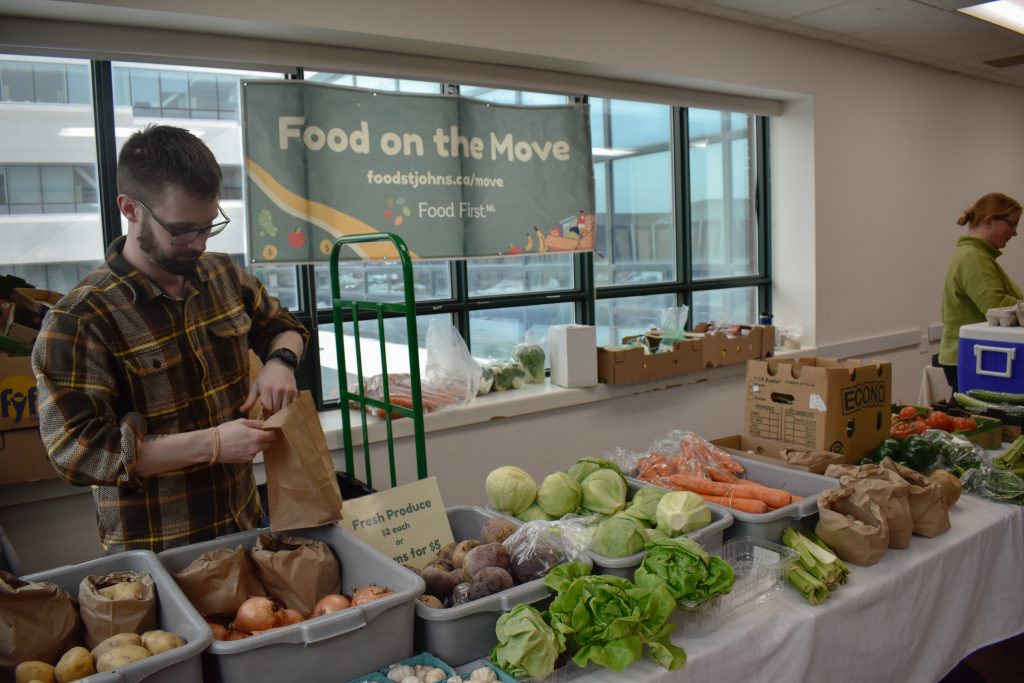
Food First says the initiative makes grocery shopping a more welcoming and social experience. “People are pumped to grocery-shop,” said Les Perry of Food First, “which is not always the experience we’re seeing in the grocery store.”
First-year psychology student Anna White said she earns minimum wage, which often makes fresh produce and transportation to the grocery store unaffordable for her. “I usually rely on frozen dinners,” she explained, adding the pop-up market “makes it so that I can actually cook a meal.
“This is a good opportunity for me to eat healthy and not go broke.”
On the west coast of Newfoundland, Food First NL launched its Western NL Food Hub last year, an online store that connects customers to local producers, including seafood producers. Once customers make their purchase online, they can pick up the Food Hub’s storefront in Corner Brook.
Basic income is best
The province’s 2022 Health Accord identifies food security as a social determinant of health and suggests economic security as a way to achieve it. The report also recommends implementing a basic income to achieve greater food security through economic security.
Food First NL and Basic Income NL say a basic income is the best way to reduce household food insecurity, while also improving health outcomes.
“A basic income is the single most impactful policy intervention we can imagine to reduce food insecurity,” Smee explains. “The evidence is incredibly clear that cash transfers are the only intervention that measurably reduces food insecurity rates.”
The provincial budget includes an improvement to the income support program, which will mean people will receive four times their previous benefits. And as part of the province’s poverty reduction plan, the government has implemented a basic income pilot for seniors that will give eligible residents an increase in payments to match federal senior benefits.
While the programs are a step in the right direction, Smee says the best thing that can be done for food insecurity is to give people money with no strings attached. This means providing people with unconditional funds, such as a basic income.
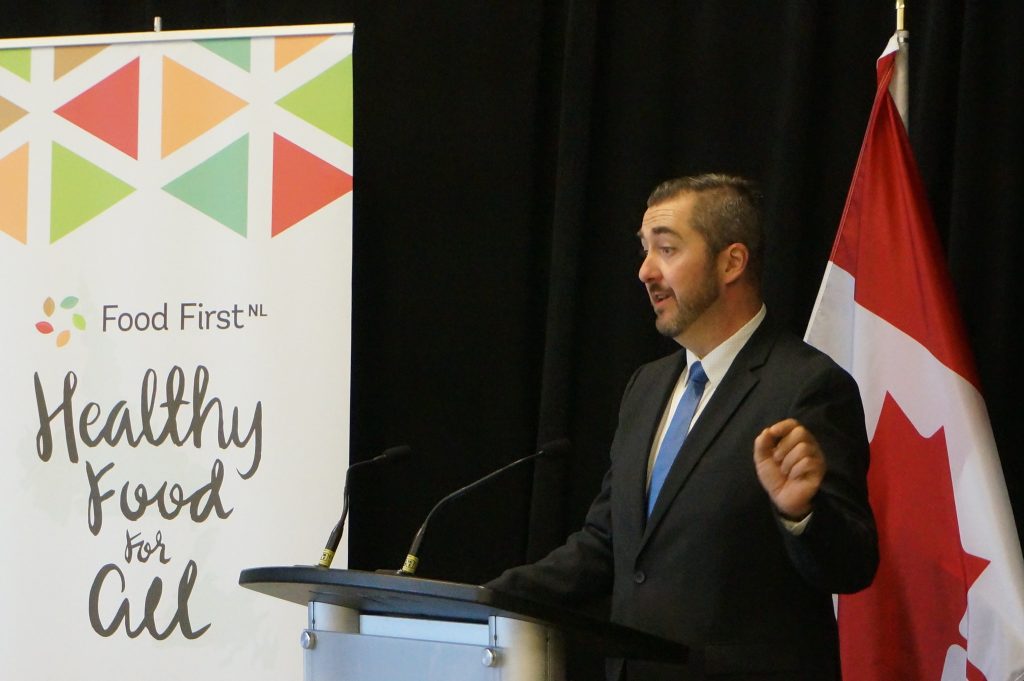
Smee also believes the basic income program for seniors, while being quite small, will still make a big difference. “It’s not for all 60-to-64-year-olds, it’s for those who are on income support and accessing the community support program. It’s a small, very vulnerable population.”
Basic Income NL suggests a broader basic income program is possible in the province and would effectively reduce poverty. “Food insecurity is overwhelmingly an issue of insufficient income, rather than supply chain constraints, and income-based interventions are by far the most efficient interventions to mitigate it,” reads its policy paper.
Furey has been supportive of a basic income program, including through the “poverty reduction plan,” which in the most recent budget is providing “incremental investment totalling $41 million” towards social programming and support for those with low incomes.
Smee thinks that the pilot programs are stepping stones to a broader basic income solution. “I think the pilots themselves make some impact, but they’re also pretty limited. And we won’t see the same kind of broad transformation that you would get if you had a basic income in the general population,” he says.
“We see how much shame people endure to access support with food, something an unconditional basic income floor would eliminate while providing people with real choice around what foods work for them.
“A basic income would be the most transformative possible policy change,” he adds.
“That said, a basic income isn’t enough by itself — we still need a robust set of social programs around it, and we still need a real living wage, something that would also make a basic income program more affordable.”
Editor’s note: We recognize food insecurity is greater in Labrador. The Independent will be reporting on food security issues in northern communities in the near future.

Author

Related Articles

Meaningful response to homelessness requires more than new builds, says NDP leader
Jim Dinn’s comments come in response to PC’s announcement of 10 new ‘micro homes’ in St. John’s

Muslim community commemorates 9th anniversary of Quebec City Mosque shooting
Anti-hate advocates say there’s still work to be done to combat Islamophobia in the province

PCs invite public input ahead of Budget 2026
The coming provincial budget will be the Progressive Conservatives’ first in more than a decade