
Canada, Inuit take step toward new marine-protected area off Labrador coast
Nunatsiavut, Makivvik sign memorandum of understanding with federal government

A new agreement between the federal government and Inuit in Labrador and Quebec marks the next stage of a process to create a new Inuit Protected Area and national marine conservation area off the coast of Labrador.
On Nov. 28 federal and Inuit representatives from Nunatsiavut Government and Makivvik—the legal corporate entity for Inuit in Quebec—signed a memorandum of understanding (MOU) that could lead to the official designation of up to 17,000 square kilometres of Nunatsiavut’s coastal and marine waters.
The area in question, in the Labrador Sea adjacent to Torngat Mountains National Park, “is a transition between Arctic and Atlantic habitats and is home to polar bears, whales, dolphins, seals, breeding and migrating seabirds, waterfowl, and a variety of fish species,” according to a Nov. 28 government news release.
The MOU, which follows a feasibility study completed in March 2024, will cover the creation of the protected area.
Will you stand with us?
Your support is essential to making journalism like this possible.
“The signing of this Memorandum of Understanding with the Nunatsiavut Government, Makivvik, and the Government of Canada is an important milestone and one that we have worked hard to reach,” Nunatsaivut President Johannes Lampe said in a media release.
If established, the proposed protected area will contribute up to 0.29 per cent—an area nearly three times the size of Prince Edward Island—to Canada’s target of protecting biodiversity and conserving 30 per cent of marine and coastal areas by 2030.
“We are glad to see this achievement that will see the establishment of this Inuit Protected Area become a reality. Labrador Inuit culture, knowledge, livelihood, and health is directly connected to the ocean. We look forward to continued progress toward managing the waters off the coast and in safeguarding Labrador Inuit culture and identity, as well as the fish and animals that we rely on for food. We are proud to take this next step forward in ensuring our true Labrador Inuit way of life is maintained for future generations.”
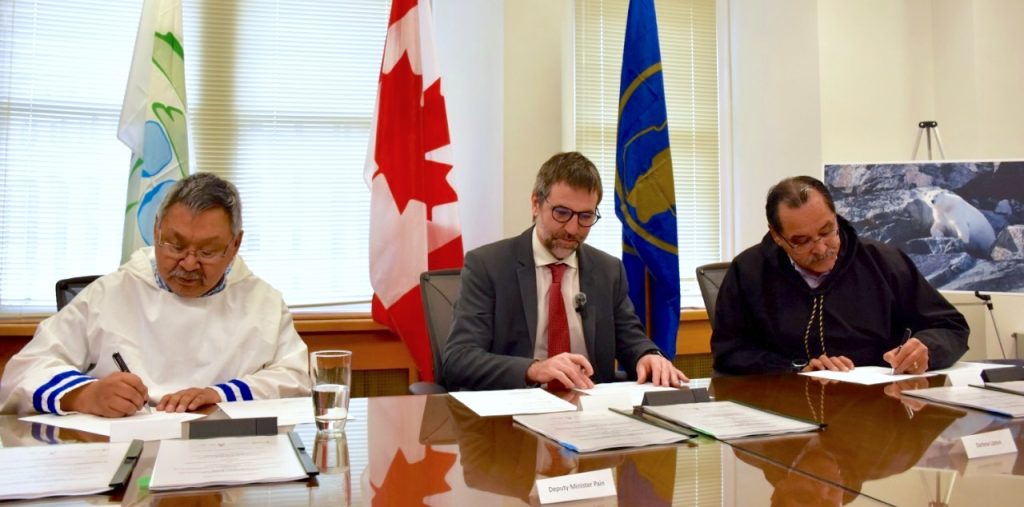
Lampe was one of three signatories to the agreement, which was also signed by Pita Aatami, president of Makivvik, and Steven Guilbeault, Minister of Environment and Climate Change and Minister responsible for Parks Canada.
Aatami echoed some of Lampe’s comments in the release, saying Makivvik and Inuit of Nunavik are “pleased and honoured” to partner in the process to protect the area.
“This land bares a particular significance to Inuit, and this project will help preserve our way of life, rights, and interests,” Aatami said. “It will also reinforce our important partnership with Labrador Inuit in a unique environment.’
The MOU, Aatami continued, “marks a meaningful advancement toward Inuit self-determination and the importance of Inuit governance principles. We look forward to pursuing this work and bringing it to fruition with both our Inuit and federal partners.”
According to the release, the proposed initiative recognizes and respects Inuit stewardship, emphasizes the importance of Inuit knowledge in conservation planning and implementation, and supports the Nunatsiavut Marine Plan.
With the MOU signed, negotiations will begin on an establishment agreement and Impact and Benefit Agreements with the Inuit governments. Nunatsiavut and Makivvik will work together to refine the final boundary and co-management structure, according to the release, and to continue consultations with rights-holders, partners, stakeholders, industry and the Government of Newfoundland and Labrador.

Author

Related Articles
The RCMP vs. the media: Bracken trial approaches its endgame
This court case could decide the future of press freedom — and police oversight — in Canada

Accounting watchdog to investigate Deloitte over fake citations in $1.6M healthcare report
Chartered Professional Accountants N.L. is leading the investigation after Deloitte admitted AI was involved
St. John’s teen says community, activism helped her find her voice
13-year-old Nyala Adam was inspired by a local summer camp focused on social justice and cultural inclusion