
Changes to temporary foreign worker program will hurt workers and province, experts say
Migrant workers don’t need to be shown the door, they need better protections

A local migrant workers’ rights advocate says Canada’s scaled back temporary foreign worker program dehumanizes migrant workers and will further harm those in Newfoundland and Labrador already facing precarity and exploitation.
Instead of telling migrant workers in this province to go home, the government should focus on protecting their fundamental rights, says Adi Khaitan, an organizer with Newfoundland and Labrador-based Migrant Action Centre.
“[The government is] essentially telling you we don’t need you anymore. So, you now have to uproot your lives and leave. And you do not get to contest it, and you no longer get to live here.”
On Aug. 26, Prime Minister Justin Trudeau announced changes to Canada’s temporary foreign worker program amid growing anti-immigrant sentiment from those blaming newcomers for rising unemployment rates and the lack of affordable housing.
Will you stand with us?
Your support is essential to making journalism like this possible.
The Liberals are shortening employment permits for migrant workers, restricting permits in regions with unemployment rates greater than six per cent, and reducing the number of temporary foreign workers that employers can hire.
Ottawa says there will be exceptions for seasonal food and agriculture, construction, and healthcare workers.
Trudeau says the changes will curb national unemployment, which jumped to 6.4 per cent in August. The unemployment rate among newcomers, according to the Bank of Canada, is 11.6 per cent.
Federal Housing Minister Sean Fraser, meanwhile, has said he’s banking on the changes to “potentially reduce the pressure on tens of thousands of housing units across the country.”
Changes won’t benefit province, says prof
Tony Fang, an economics professor and labour economics researcher at Memorial University, says that while the changes might have positive economic benefits for more populated provinces like Ontario, they will restrain population growth in Newfoundland and Labrador. “We don’t have [the] same worries and concerns compared to large urban centres.”
According to Statistics Canada, more than half of immigrants who land in Newfoundland and Labrador choose to leave the province within five years.
“Even despite healthy population growth in the last couple years, largely driven by immigration,” Fang said, Newfoundland has one of the lowest immigration rates in the country.
From 2016 to 2021, among Atlantic provinces, Newfoundland and Labrador experienced the least amount of growth through immigration. During that period, just 0.3 per cent of all landed immigrants in Canada moved to Newfoundland and Labrador.
Fang says the province must focus on retaining migrant workers. “We have a vast amount of land and natural resources in this province, but we have a relatively very small population.
“Atlantic Canadians not only appreciate the economic contribution but also [the] social and cultural contribution of immigrants,” he adds.

Populations are declining across the province, even in some of the province’s larger communities. In its 2021 census Statistics Canada found fewer inhabitants in 266 of the 372 communities than five years earlier.
Mount Pearl saw a 2.8 per cent decline, Corner Brook’s population fell by 2.4 per cent, and Happy Valley-Goose Bay experienced a 0.9 per cent decline between 2016 and 2021.
Newfoundland and Labrador’s average age, 45.5, is also higher than Canada’s national average of 41.7 years.
By 2033, the average age of seniors in the province is projected to increase from 24.4 per cent in 2023 to 29.7 per cent. Meanwhile, the population of youth aged 15 to 29 is projected to drop from 16 per cent in 2023 to 15.3 per cent.
Fang says it’s essential that the province continue to hire temporary foreign workers in areas where workers are limited and the population is declining.
The province’s unemployment rate sits at 9.6 per cent, above Ottawa’s new six per cent ceiling for the temporary foreign worker program. But Fang says the government is failing to consider the reasons behind high unemployment rates in certain sectors.
Newfoundland and Labrador’s higher unemployment rate “is a little bit inflated,” he explains, “because of the seasonal employment in many of our industries such as tourism and hospitality, agriculture, and fishery.
“The unique setup of the employment insurance (EI) program allows people to work for three to four months and then receive EI benefits for the remaining period of the year, [when] they would be categorized as unemployed. Given these benefits, there is little incentive or interest for them to pick up low-wage employment even though those jobs are available to them.”
That, says Fang, in part “explains the co-existence of the high unemployment rate and high vacancies [at] the same time. For example, 62 per cent of employers in NL reported hiring difficulties in 2021 according to our employer survey, when the unemployment rate ran high at 13.1 per cent.”
The problem is even more serious in rural and remote regions of the province, where aging populations are more prevalent, Fang explains.
Another major factor in the province’s higher unemployment rate and its need for outside workers is the “skill mismatch,” he adds, explaining “we have many jobs that local workers cannot do or are unwilling to do.” In information technology and skilled trades, he says, 65 per cent of employers reported worker shortages. While in low-wage production or service jobs, 43 per cent reported shortages.
Employment and housing issues are policy failures, not the fault of newcomers
During his announcement, Trudeau said the high unemployment rates are “not fair to Canadians struggling to find a good job, and it’s not fair to those temporary foreign workers, some of whom are being mistreated and exploited.”
But Khaitan says the government’s constant focus on the economic relationship between Canada and migrant workers fuels anti-migrant rhetoric and takes the conversation away from the human rights violations perpetrated by employers.

Anti-migrant sentiment is further exacerbated when politicians associate migrants with problems that Canadians are facing, including rising unemployment and housing, they add.
“I think a lot of it is still based on that colonial, xenophobic ideology that allows the state to essentially penalize migrants for systemic problems that migrants aren’t really causing.”
Responding to the Liberals’ announcement, Migrant Workers Alliance for Change Executive Director Syed Hussan said that “high unemployment, low wages, and unaffordable housing [are] not being caused by immigrants and migrants – these are caused by employer exploitation and policy failures.
“Migrants build communities, and they deserve equal rights and respect, not scapegoating,” he continued. “Canada must focus on increasing rights and permanent resident status for migrants, not decreasing the numbers of migrants.”
The Migrant Workers Alliance says Canada’s new temporary foreign worker program rules will force migrant workers to leave the country “and pay vast sums of money to return.”
They also argue that higher unemployment rates among migrant workers and newcomers are outcomes of racism and discrimination. “Immigrants are always the last hired, first fired,” the organization says. “Most immigrants are in low-wage jobs that are no longer entry-level positions because of lack of opportunities for re-training, accreditation and skills matching.
On accusations of immigrants being responsible for lack of affordable housing, the Alliance points out that “rent is set by speculators and landlords, not by demand, and has been allowed to skyrocket because provinces have waived rent controls.” Coupled with the low wages migrant workers are paid, the rising cost of housing rentals “mean migrants are barely able to afford housing, [they’re] not competing to buy single-family homes.
“Linking immigration and unemployment and affordability will increase xenophobia and racism.”
Canada’s program a ‘breeding ground for modern-day slavery’: UN
In July, the United Nations called Canada’s temporary foreign worker program “a breeding ground for contemporary forms of slavery.”
Khaitan says the report’s findings aren’t surprising and echo what “migrants have been saying for a very long time.”
Canada provides migrant workers with closed permits that tie them to the employer listed on their license. Typically, workers cannot quit or search for other jobs after they arrive in Canada.
The UN’s Special Rapporteur on contemporary forms of slavery, including its causes and consequences, Tomoya Obokata, visited Canada in 2023 and notes that workers fearing deportation choose to stay with exploitative employers and work under unsafe conditions.
Obokata also received reports of employer “underpayment and wage theft, physical, emotional, and verbal abuse, excessive work hours, limited breaks, extracontractual work, uncompensated managerial duties, lack of personal protective equipment, confiscation of documents, and reduced working hours.”
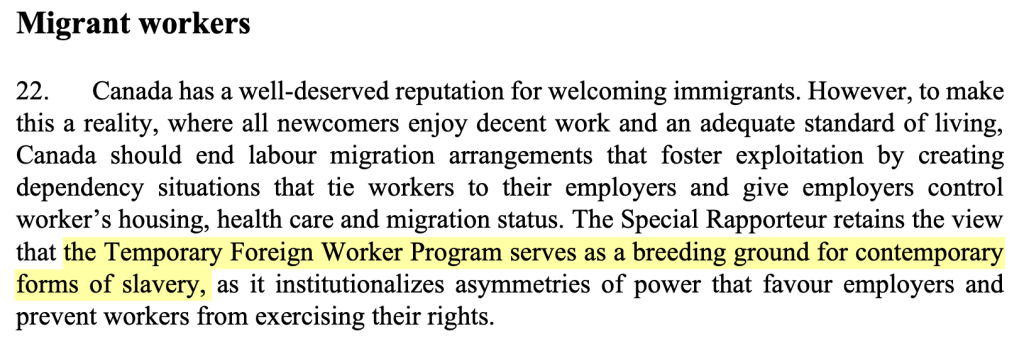
He notes that the federal government does not “proactively and effectively inform workers about their rights,” but instead defers “a significant portion of responsibility for informing temporary foreign workers of their rights to employers, despite the obvious conflict of interest.”
The report finds the two options available to migrant workers fleeing exploitative employers insufficient. Workers can attempt to change employers or apply for an open work permit for vulnerable workers. But the report notes that, in either case, workers may not have the information, time, means or language skills to apply.
Meghan Felt, an immigration lawyer with McInnes Cooper in St. John’s, says the province has other programs to attract workers, including the Newfoundland and Labrador Provincial Nominee Program.
The federal program is more well-known because there is more information about it online, but the provincial program’s application process is easier, Felt explains, and employers don’t have to pay an application fee. It is also easier to reach a representative for the nominee program, Felt says. “There is someone there to answer your questions for the most part, and they’re helpful.”
Crucially, the provincial nominee program is also a pathway to residency.
In an email to The Independent, a spokesperson for the Department of Immigration, Population Growth and Skills said that while employers in the St. John’s Census Metropolitan Area will be most impacted by the federal announcement, employers can still apply through the Provincial Nominee Program or the Atlantic Immigration Program.
“We encourage employers to contact the Office of Immigration and Multiculturalism for support. Our staff are ready to assist employers navigate these programs,” spokesperson Allison King wrote.
In 2023 and 2024, the combined limit for the two programs was 3,050 applications each year. The immigration department said the province had exhausted its allocation in 2022 and came close to reaching the cap in 2023.
Although the province nominates applicants for both programs, the final decision on the permits is made by the federal Department of Immigration, Refugees and Citizenship Canada.
Khaitan says many migrants call Newfoundland and Labrador home and deserve to be treated like they are part of the community, province and country. Instead of focusing on the economic relationship between migrant workers and Canada, they say, leaders should focus on making sure migrant workers have basic human rights and feel safe.
Khaitan says the first step to ensure migrant workers are safe is to end closed-work permits and allow workers to switch jobs.

Author

Related Articles

PCs invite public input ahead of Budget 2026
The coming provincial budget will be the Progressive Conservatives’ first in more than a decade

‘Goodnight Moon’ and the child in all of us
Artist Matthew-Robin Nye is in pursuit of wonder, and thinks we should be too

CEO pay at record highs as workers struggle to make ends meet: report
Business leaders from Tim Horton’s, Dominion, Shoppers and Suncor and Fortis among highest paid in Canada