
From snowbanks to finding community: Newcomers confront winter struggles
Winter blues can be especially hard on newcomers who are adjusting to a new country, new culture, new language and new weather. But a warm community can help the integration process feel less overwhelming.

Mohamad Al Maidani arrived in Corner Brook on a cold and snowy February day in 2016. When he looked to the left, he saw a snowbank; when he turned to the right, he saw another snowbank. He worried he would have to share his neighbourhood with polar bears, he laughs, thinking about the day. “It was funny. I opened the door and looked around,” he says. “I was looking right and left: ‘Is there any bear?’”
Newfoundland and Labrador’s winters are typically defined by shorter days, heavy snowfall, and sub-zero temperatures — a stark difference for the 41-year-old who came to Newfoundland from the Syrian capital of Damascus, home to 2.5 million people.
Around 15 per cent of Canada’s population has reported feeling the winter blues, which the Canadian Mental Health Association describes as “a wave of low emotions that come with these cold, dark days” — not to be confused with seasonal affective disorder, the medical condition of “regularly occurring depression in the winter season that can impair one’s daily life.”
Stephanie Ryan, clinical lead for NL Health Services’ Mental Health Promotion and Addictions Prevention Team, says Canadian winters can be especially hard on newcomers. “It exacerbates the feelings of isolation and other mental health problems that new Canadians often struggle with,” she explains. “Many have lost friends, family, careers, and homes, and that change is, for many, very unexpected and hard to deal with.”
Will you stand with us?
Your support is essential to making journalism like this possible.
Beyond that, feelings of depression or “low emotions” during the winter months can affect eating habits and daily routines, increase feelings of hopelessness and anxiety, and lead to further isolation from friends and family. Compounded by the common obstacles newcomers face, like language barriers and financial instability, refugees and other newcomers from warmer countries like Syria, the Philippines, and Nigeria often have a difficult time dealing with Newfoundland and Labrador winters on their own.
Michael Mak, a psychiatrist with the Centre for Addiction and Mental Health, says newcomers who come from warmer regions may not know what winter blues are, often making it harder for them to cope when symptoms become more severe.
Newcomers are also less likely to have access to a family doctor. When they are able to access a doctor, language can often be an impediment to diagnosis, Mak explains, because newcomers can struggle to explain their symptoms.
Goodness Anthony, who moved to St. John’s in 2019 says newcomers only realize how challenging Newfoundland and Labrador winters can be once they experience it firsthand. Originally from Nigeria, Anthony was used to warmer temperatures.
She recalls going to the mall with her son one warm morning in late summer, only to greet the cold winds as she left a few hours later. “We were not [wearing] our jackets, and we came out — oh my, the wind,” she recalls. “We missed our bus and had to walk back home.”

Anthony says she was “lucky” she attended a presentation on “how to dress during the winter” soon after moving to Canada. She is also involved with the provincial branch of the Canadian Mental Health Association.
She says governments, settlement agencies, and other organizations which work with newcomers should conduct awareness campaigns during the immigration and settlement process. Information packages with a focus on transportation and on dressing for the winter months should also be readily available to newcomers.
Refugees have a harder time adjusting
Al Maidani came to Corner Brook as a Syrian refugee. He and his family fled to Jordan after the civil war erupted in Syria; they stayed there for three years before moving to Corner Brook. When Al Maidani arrived with his wife and two sons, he struggled to integrate into the community. He says the first five years were particularly hard. “There was no Arab community. There was no one to speak my language,” he recalls.
He says adjusting to living in Newfoundland was even more difficult for him than it would be for someone who migrated for school or work. His English was limited and he didn’t have a job or connections to anyone in the province. “If you already have [English] language, or already have skills, I think that’s fine, [there is] no problem,” he says.
Ryan says strong community connections are important for newcomers to integrate into a region and help negate winter blues symptoms. In 2016, there were around 30 Syrians living in Corner Brook, but the two Syrian families Al Maidani arrived with that year moved out of the province soon after. Figures from 2021 suggest Corner Brook’s Syrian population had increased to 50.
Al Maidani says the move from a large city to a much smaller one in a different country where the language, culture, and traditions are different was daunting. “I was crying,” he says. “I was thinking to move back [to Jordan].”
From the tropics to the Labrador
Erwin Ponce arrived in Happy Valley-Goose Bay as a temporary foreign worker in 2011 — one of the first in a years-long wave of newcomers from the Philippines.
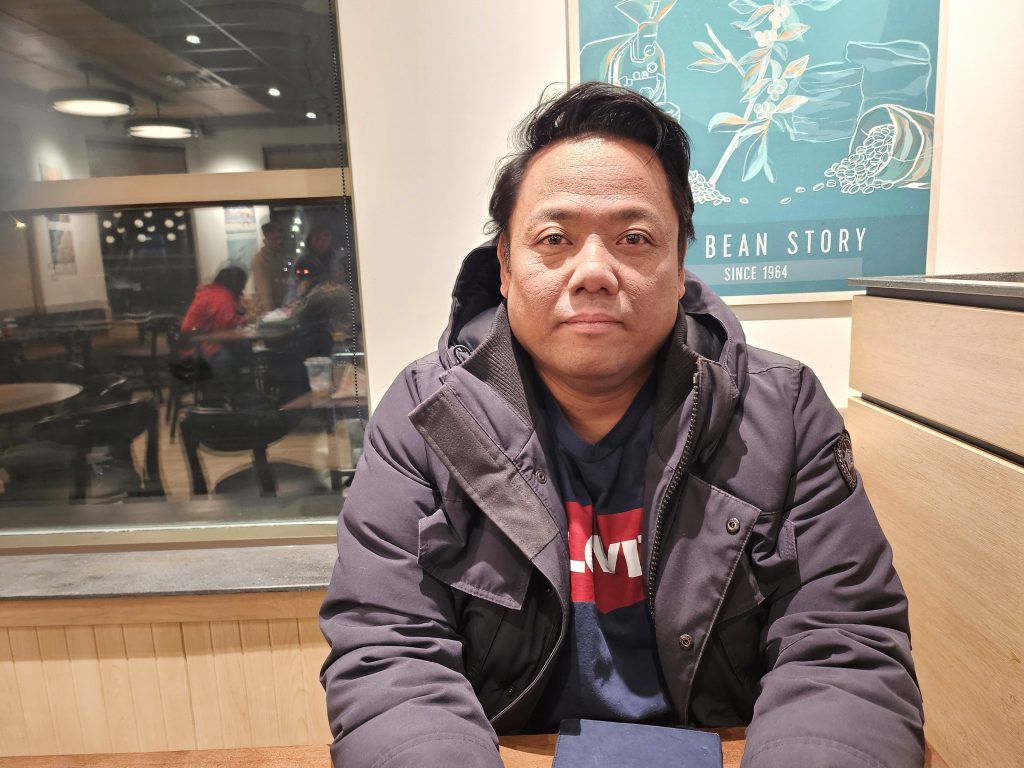
Sitting in a Tim Horton’s in the central Labrador town a decade and a half later, Ponce recalls the disparity between what he expected and what he found. He had seen pictures of Toronto and Montreal online and imagined working in a city with skyscrapers and many more people.
But it was his first snow that made him long for home. Ponce says homesickness crept in as he witnessed the snowfall in Goose Bay. “I opened the back door, and it started to snow, a little bit like flurries. I decided to stare at it, and it hit home.”
Ponce says travelling to and from work during his first winter in Labrador was hard. He couldn’t afford a car, or daily taxi rides, so he and his co-workers often walked back and forth. “We were walking in four feet of snow—and I wasn’t aware that it was filled with snow, like four feet of it—and suddenly I slipped into it. Like half of my body was into the snow,” he recalls.
Finding warmth in community
Ponce says the community support he received in Happy Valley-Goose Bay helped him feel more at home. To break the cycle of depression and feelings of homesickness he was experiencing, he says he had to involve himself within the community. So, he helped start a local Filipino association, volunteered at community events, and participated in local sports.
“In the winter, I had to do activities where I could interact with other people, local people here, and also with my countrymen,” he says.
Eight years later, Al Maidani is the proud owner of the beloved Mo’s Corner Barber Shop in Corner Brook. He says opening and running his own business would not have been possible without the support of Corner Brook’s residents. When he moved to Western Newfoundland’s largest community, there were no settlement agencies to help him and his family establish themselves there. Instead, he relied on the kindness of strangers.
Al Maidani began working as a hairdresser at a local salon, quickly realizing he had skills most of his peers didn’t. He had been a barber in Syria and had mastered shaving, threading, and faded haircuts, skills which made him popular in the community—so popular that the owner used a video of Al Maidani to promote the business. “She made a little video clip on Facebook and YouTube, and it became trendy,” he recalls.
When he opened his barbershop in 2018, Al Maidani received a lot of support from his clients and the community. He says he never would have learned to appreciate winter if it wasn’t for the residents of Corner Brook.
If you are a newcomer and want to share your experiences settling in Newfoundland and Labrador, please email editor@theindependent.ca.
This article is part of The Independent’s Coming to Newfoundland & Labrador series. Click here to read the other stories. The series was made possible through the financial support of Carleton University’s Emerging Reporter Fund on Resettlement in Canada.

Author

Related Articles
N.L. education system struggling to meet the needs of newcomer students
Families and organizations are working to create safe spaces for refugee youth to thrive, stay connected with their roots and build strong community connections
Musicians use creative approaches to help newcomers feel at home
In Newfoundland and Labrador, music plays a key role in preserving history and expressing the province’s identity and cultural heritage. Through their work, these musicians are helping newcomers connect with and become part of that cultural fabric.

Newcomers love N.L. and power economic growth, but lack of supports drive them away
The provincial government and settlement agencies must eliminate barriers that newcomers face when they arrive, say observers, or else the trend will continue